
Time Delay Relays: When to Use Them in Control Panels
DETAILS
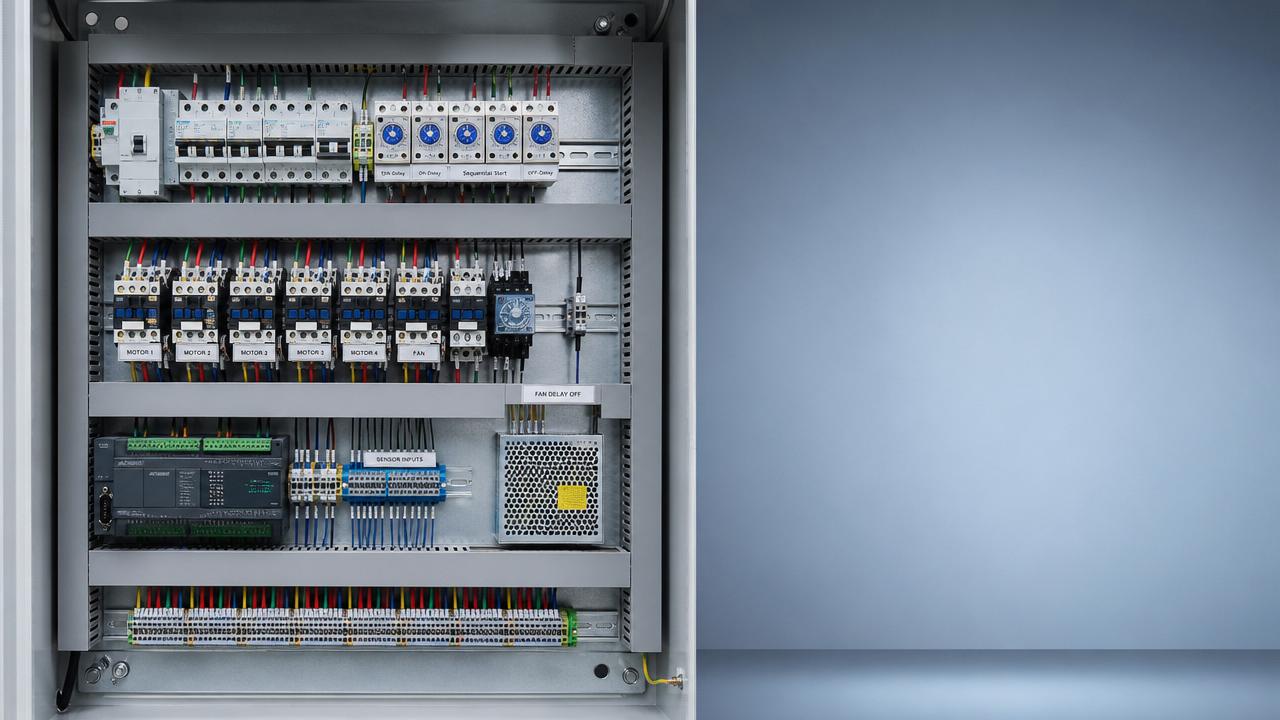
In control panels, time delay relays play a critical role in protecting equipment, stabilizing sequences, and preventing costly start-up or shut-down errors. For operators and users working with complex electrical systems, knowing when to apply these relays can improve safety, reduce downtime, and support more reliable performance. This article explains where time delay relays are most effective and how they help streamline panel operation in real-world industrial settings.
What do time delay relays actually do in control panels?
Time delay relays are switching devices that intentionally postpone an electrical action. Instead of opening or closing contacts the moment a signal appears, they wait for a preset time. That delay can be a fraction of a second or several minutes, depending on the control objective.
For operators, the practical value is simple. A well-chosen delay prevents motors from starting together, stops pumps from short cycling, allows sensors to stabilize, and gives contactors time to sequence safely. In crowded control panels, those functions reduce nuisance trips and help systems recover more predictably after power loss.
In industrial environments linked to semiconductor tools, EMS production lines, thermal packaging equipment, and precision assembly systems, timing errors are not minor issues. A mistimed fan, valve, conveyor, or heater can create scrap, thermal drift, component stress, or false fault conditions.
- Delay on make: waits before energizing the output after input power is applied.
- Delay on break: keeps output active for a set time after input power is removed.
- Interval timing: energizes output immediately, then changes state after the preset period.
- Repeat cycle timing: alternates ON and OFF periods for flashing, pulsing, or staged process control.
The best use of time delay relays is not just adding time for the sake of it. It is adding controlled timing where equipment behavior, electrical load, and process stability require separation between one event and the next.
When should operators use time delay relays?
Many users first encounter time delay relays after a problem appears: repeated breaker trips, relay chatter, premature motor wear, or unstable machine startup. In practice, these relays are most valuable before those issues become chronic.
Common application scenarios
The following table shows where time delay relays are commonly used in control panels and what problem each timing strategy helps solve.
These scenarios show why time delay relays are often more about system coordination than simple switching. Operators benefit when timing is tuned to machine behavior, not guessed from habit.
Situations where timing is especially important
- When a panel controls multiple inductive loads that should not energize at once.
- When process equipment contains heaters, blowers, or thermal modules that need controlled cool-down.
- When sensors or power supplies need a short settling time before interlocks become active.
- When restart after a power interruption could create unsafe or unstable machine behavior.
- When maintenance teams need clearer fault isolation by separating events in time.
In high-precision manufacturing chains, including PCB fabrication, SMT assembly, and thermal management processes, sequencing discipline matters. SCM frequently emphasizes this point in technical benchmarking because electrical timing affects not only uptime, but also downstream quality consistency.
Which type of time delay relay fits your control task?
Not every control problem needs the same timing logic. Choosing the wrong relay type can create delayed faults, incomplete shutdown, or unnecessary complexity. Users should start with the process event that needs to happen first, then map the timing response around it.
This comparison table helps operators and panel users understand how different time delay relays behave under typical control conditions.
The relay type should support the machine sequence, not force the sequence to adapt to the relay. If multiple actions need coordination, it may be better to combine time delay relays with PLC logic rather than overloading one timer with too many duties.
What parameters matter most before selecting time delay relays?
Users often focus only on the time range. That is important, but not enough. A relay that matches the timing window but fails on voltage compatibility, contact rating, or environmental tolerance can create hidden reliability problems inside the panel.
Selection checklist for operators and buyers
- Confirm control voltage. Check whether the relay coil or input accepts AC, DC, or universal voltage used in the panel.
- Verify contact configuration. SPDT, DPDT, normally open, or normally closed arrangements affect wiring and logic behavior.
- Review load type. Resistive, inductive, and motor loads stress contacts differently and may require derating.
- Check timing range and adjustment resolution. Fine tuning matters when startup windows are narrow.
- Assess mounting style and panel space. DIN rail format, terminal style, and service access influence maintenance speed.
- Consider ambient conditions. Heat, vibration, dust, and electrical noise can shorten life or affect repeatability.
For users in electronics manufacturing and supply-chain-critical operations, repeatability is not a secondary feature. Timing drift can alter thermal cycles, equipment readiness, and process synchronization. SCM’s engineering perspective is especially useful here because component behavior should be reviewed in relation to actual operating stress, not brochure claims alone.
If a relay is placed near heat-generating drives, transformers, or power conversion stages, thermal exposure should be reviewed carefully. In many control panels, nominal relay settings are accurate enough at room temperature but become less stable under elevated cabinet conditions.
How do time delay relays compare with PLC timers and solid-state timing?
Operators often ask whether time delay relays are still necessary when a PLC is available. The answer depends on the control objective, maintenance strategy, and failure risk. Time delay relays remain useful when a dedicated, easy-to-troubleshoot timing function is preferred at the hardware level.
The comparison below helps frame that decision in practical terms rather than theory.
In many facilities, the best answer is hybrid design. Use PLC logic for complex sequence control and keep independent time delay relays for fail-safe delays, post-run cooling, or simple hardware interlocks. That approach can improve maintainability without sacrificing control flexibility.
What mistakes cause poor performance or nuisance failures?
Time delay relays are often blamed when the real problem is system mismatch. For operators, recognizing the common failure patterns makes maintenance faster and helps avoid repeated parts replacement.
Frequent mistakes in panel applications
- Using a relay contact directly on a load that exceeds its switching category, especially with motors or solenoids.
- Selecting an off-delay relay when the process actually needs delayed energizing at startup.
- Ignoring cabinet temperature rise, which can alter timing stability and shorten component life.
- Placing timing devices in noisy electrical environments without reviewing interference from drives or switching power equipment.
- Choosing broad timing ranges that make fine adjustment difficult during commissioning.
In precision manufacturing contexts, these mistakes can show up as intermittent jams, unstable thermal states, unexplained fault resets, or process timing scatter that is difficult to trace. This is where independent technical review has value. SCM helps engineering and procurement teams compare component claims against application risk, environmental stress, and supply consistency.
How should procurement teams and users evaluate suppliers?
Selecting time delay relays is not only a technical decision. It is also a sourcing decision. Users and procurement teams need confidence that the specified timing behavior can be delivered consistently across batches, environments, and installation regions.
The table below outlines a practical supplier review framework for time delay relays used in control panels.
For organizations buying into the semiconductor and EMS ecosystem, supplier transparency matters as much as relay function. SCM’s role as an independent technical repository becomes relevant when teams need benchmark-driven insight rather than marketing language, especially for components tied to uptime, thermal control, and quality assurance.
What standards and reliability factors should users keep in mind?
Time delay relays in control panels should be reviewed within the broader framework of panel safety, component quality, and process reliability. The relay itself is only one element, but its behavior interacts with wiring methods, overload protection, contact suppression, and system documentation.
- Check whether the panel design aligns with applicable regional electrical practices and internal plant standards.
- Review whether connected components support the reliability class required by the application, especially in critical production tools.
- Verify that supporting components such as terminal blocks, contactors, and protection devices are matched to the switching duty.
- Document timer settings clearly so replacement or maintenance does not alter approved machine behavior.
Where high-reliability electronics production is involved, users may also want component data connected to broader quality systems such as ISO 9001 environments or product expectations aligned with IPC-Class 3 assemblies. Even when a relay is a small part of the bill of materials, timing failures can cascade into process instability.
FAQ: practical questions about time delay relays
How do I know if a time delay relay is better than a standard relay?
Use a standard relay when immediate switching is acceptable. Use time delay relays when the sequence itself affects safety, current peaks, process stability, or equipment wear. If the order and spacing of events matter, timing control usually adds value.
Are time delay relays suitable for motors and fans?
Yes, often they are ideal for motor and fan control, especially for staggered startup and cooling overrun. The key point is contact rating. The relay should not be asked to switch a load beyond its intended category. In some designs, the timer controls a contactor rather than the motor directly.
What timing range should I choose?
Choose the narrowest practical range that still covers your process. A relay set near the middle of its range is usually easier to adjust accurately than one operating at the extreme low end of a very broad range. Commissioning tests should confirm actual machine response, not just nominal timer settings.
Why do some time delay relays seem inconsistent in the field?
The relay may not be the only cause. Voltage fluctuation, panel heat, electrical noise, contact loading, and poor grounding can all affect apparent behavior. Independent data review is useful when timing inconsistency appears across multiple installations or supply lots.
Why consult SCM when evaluating time delay relays and panel components?
For users and operators, the challenge is not just finding a relay that works once. It is finding a component strategy that remains reliable across production shifts, environmental stress, and supply chain changes. That is where SCM adds practical value.
SCM supports engineering and procurement decisions through independent technical insight across the semiconductor and EMS supply chain. Our work connects component-level behavior with broader issues such as thermal management, manufacturing precision, compliance documentation, and long-term reliability under demanding conditions.
- Parameter confirmation for relay timing, electrical interface, and operating environment
- Selection support for panel applications involving motors, heaters, fans, sensors, and staged sequences
- Guidance on supply chain risk, alternate sourcing, and consistency across manufacturing regions
- Discussion of documentation expectations, quality workflows, and component benchmarking needs
If your team is reviewing time delay relays for a new control panel or troubleshooting unstable timing in an existing installation, contact SCM to discuss application parameters, selection options, delivery considerations, documentation requirements, sample evaluation paths, and benchmark-driven sourcing decisions.
Recommended News
- RelaysHow to vet an industrial automation distributor for genuine relaysVet an industrial automation distributor with confidence. Learn how to verify relay authenticity, traceability, and quality controls to reduce downtime and sourcing risks.
- RelaysWhat Standard Tests Measure Relay Contact Resistance Degradation?Are there standard test methods for relay contact resistance degradation? Explore IEC standards, endurance testing, Kelvin measurement, and environmental validation for reliable relay sourcing.
- RelaysVietnam Tariff Shift Favors China-Origin Relays Until 2027Vietnam tariff shift favors China-origin relays until 2027. Learn how the 3% tax on non-ASEAN relay imports impacts sourcing, costs, and procurement strategy in Vietnam.
- RelaysJapan Enforces JIS C 5012:2026 Relay EMI Test RuleJapan Enforces JIS C 5012:2026 Relay EMI Test Rule: learn how the new 1.8-2.4 GHz radiated immunity and IEC 61000-4-3:2024 report requirements may impact relay compliance, cost, and Japan market access.
- RelaysWhen a Relay Switches Factory Becomes a Risk to Product QualityRelay switches factory risks can quietly damage product quality, safety, and reliability. Learn the warning signs, audit points, and how to choose a stable supplier.
- RelaysHow to Compare Relay Switches Factory Capabilities for Stable SupplyRelay switches factory comparison starts with capacity, quality control, traceability, and lead time stability. Learn how to identify reliable suppliers and reduce sourcing risk.