
Thermal Relays vs Breakers: Which Fits Motor Protection?
DETAILS
Choosing the right motor protection device can impact reliability, uptime, and project cost. This guide compares thermal relays and breakers from an engineering and procurement perspective, helping project managers and engineering leads decide which option best fits different motor protection scenarios. We will look at performance, trip behavior, installation factors, and risk control to clarify where thermal relays deliver the most value.
Why does the thermal relays vs breakers decision matter in real projects?
For project managers, motor protection is rarely an isolated component choice. It affects commissioning speed, panel layout, maintenance planning, spare part strategy, and the downstream cost of unexpected stoppages.
In electronics manufacturing, semiconductor utilities, thermal packaging lines, SMT conveyors, cleanroom handling systems, and facility support equipment, motors often run under variable load, frequent starts, and temperature-sensitive conditions. That makes protection accuracy more important than simply choosing the cheapest device.
The common confusion is simple: both thermal relays and breakers can interrupt risk, but they do not protect in the same way. A thermal relay is primarily designed to detect overload conditions over time. A breaker is mainly focused on fault interruption, especially short circuits and higher fault currents, though some motor protection breakers combine multiple functions.
- If the main concern is overload caused by sustained overcurrent, phase imbalance, or stalled operation, thermal relays often deserve closer attention.
- If the main concern is branch circuit isolation and high fault interruption, breakers usually play the leading role.
- In many practical motor control panels, both are used together because they address different failure modes.
What project teams usually get wrong
A frequent mistake is assuming one device replaces the other in every case. Another is selecting based only on rated current, without considering motor start profile, ambient temperature, duty cycle, coordination requirements, and reset behavior.
SCM regularly sees this issue in supply-chain benchmarking for EMS and industrial electronics projects: specification sheets may look acceptable, yet field performance diverges because testing conditions, tolerance control, or protection coordination were not compared in a standardized way.
What are thermal relays and breakers actually designed to do?
Before comparing thermal relays and breakers, it helps to separate overload protection from fault interruption. That distinction drives selection logic, especially for engineering leaders managing uptime-sensitive equipment.
Thermal relays
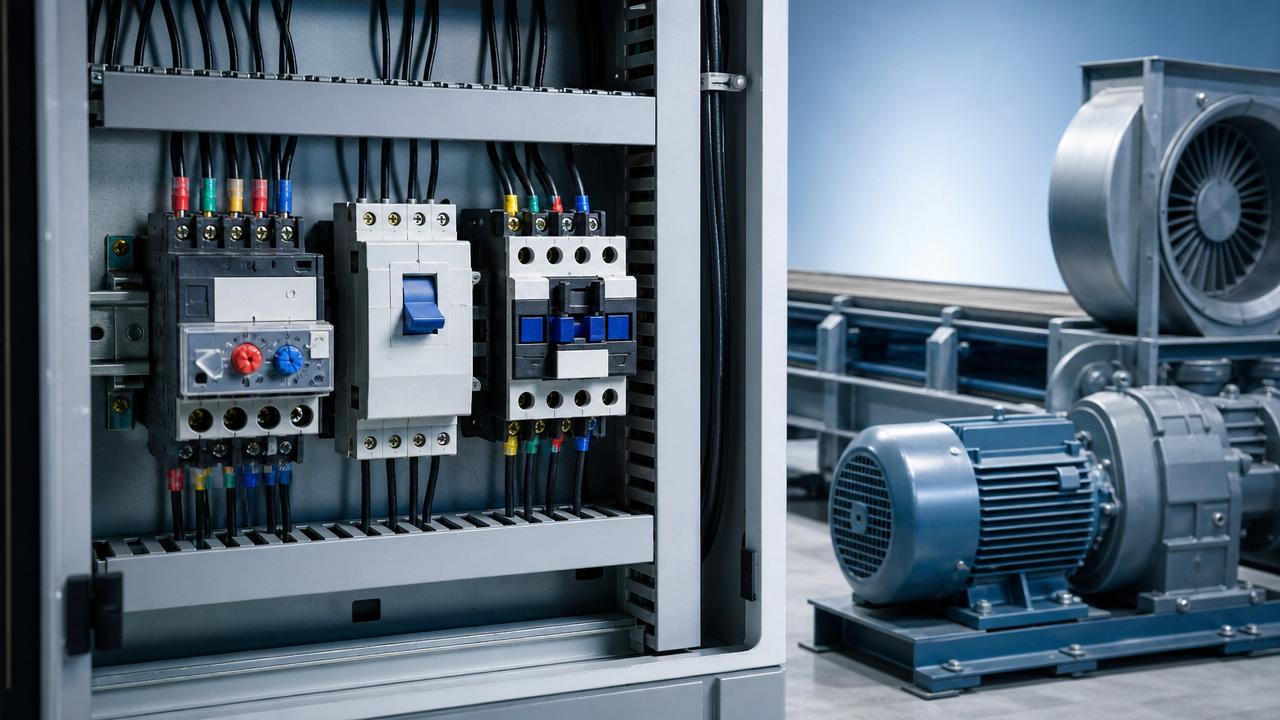
Thermal relays are generally used with contactors to protect motors from overload. They operate on a thermal principle, often using bimetal elements that respond to current-induced heating. When overload persists, the relay trips and opens the control circuit, stopping the motor before insulation damage escalates.
This makes thermal relays valuable where motor windings face gradual heat buildup rather than instantaneous catastrophic current spikes.
Breakers
Breakers are switching and protective devices that open the circuit during abnormal current conditions. Standard circuit breakers are strong at short-circuit protection and branch isolation. Some motor circuit protectors or motor protection circuit breakers also include adjustable overload features.
However, not every breaker offers the same thermal behavior or motor-specific sensitivity as dedicated thermal relays. The device category matters.
The table below helps project teams compare thermal relays and breakers across the functions most relevant to motor protection planning.
The key takeaway is that thermal relays and breakers are not direct equivalents in many designs. Project teams usually get better outcomes when they define the protection objective first, then choose the device combination that matches the motor risk profile.
Which motor protection scenarios are better for thermal relays?
Thermal relays are especially relevant when the motor spends long periods near full load, starts frequently, or operates in process lines where mechanical drag can slowly rise before a visible failure occurs.
High-value scenarios for thermal relays
- Conveyor and feeder motors in SMT or assembly lines, where overload can build gradually as bearings age or material flow changes.
- Cooling and ventilation motors in thermal management systems, where prolonged overload directly threatens process stability and temperature control.
- Pump and fan applications with moderate starting current but long operating cycles, where winding temperature matters more than instant fault clearing.
- Compact control panels where contactor-relay integration simplifies maintenance and replacement planning.
Why project managers often prefer thermal relays in these cases
A well-matched thermal relay can lower nuisance trips during normal motor inrush while still responding to sustained overload. That balance is useful when downtime penalties are high and false trips disrupt production scheduling.
Thermal relays also support clearer overload adjustment around the motor full-load current. For engineering teams, that can make field tuning easier than relying on a general-purpose breaker selected mainly for branch protection.
Where do breakers fit better in motor protection architecture?
Breakers become more critical when the design priority shifts toward fault interruption capacity, coordinated protection across feeders, and fast circuit isolation under severe fault conditions.
Common breaker-led applications
- Main distribution and branch circuits feeding multiple motor loads.
- Installations with higher prospective fault current, where interrupting rating is a major compliance and safety concern.
- Projects requiring convenient manual isolation for service access and lockout procedures.
- Applications using motor protection circuit breakers that combine switching, short-circuit protection, and adjustable overload in one coordinated package.
For many project leads, the most practical question is not whether breakers are better than thermal relays, but whether a breaker-only arrangement provides enough overload sensitivity for the actual motor duty.
Thermal relays vs breakers: what technical differences should procurement teams compare?
When procurement supports engineering on motor protection, the decision should not stop at list price. Device behavior, coordination, and lifecycle fit matter more than small upfront savings.
The next comparison table highlights the factors that typically shape a thermal relays purchasing decision versus a breaker-based alternative.
This comparison is where independent technical review becomes valuable. SCM helps engineering and sourcing teams verify whether protection devices are being compared on equivalent data, not just on distributor descriptions or incomplete datasheets.
How should project managers choose between thermal relays and breakers?
A practical selection path
- Define the motor failure you are mainly trying to prevent: overload heating, locked rotor stress, short circuit, or all three.
- Confirm motor full-load current, starting method, duty cycle, ambient temperature, and restart frequency.
- Review whether upstream protection already covers short-circuit interruption.
- Check whether the control architecture uses a contactor, direct-on-line starter, or integrated motor starter assembly.
- Compare documentation quality, supply continuity, and serviceability, not just nominal ratings.
Quick guidance by situation
Choose thermal relays when overload sensitivity, motor winding protection, and process continuity are the main priorities. Choose breakers when fault interruption, feeder protection, and isolation functions dominate. Choose a coordinated combination when the motor is operationally critical and both overload and fault risks must be controlled with low ambiguity.
What cost and lifecycle factors are easy to overlook?
The cheapest initial hardware choice may create higher lifetime cost if trips are poorly matched to process behavior. For project owners, the real cost includes commissioning delays, technician callouts, spare inventory, line stoppage, and replacement lead-time exposure.
Cost drivers beyond purchase price
- Nuisance trip frequency during motor starting or transient loading.
- Misalignment between protection settings and real operating current.
- Additional accessories needed for breaker coordination or relay mounting.
- Downtime cost if replacement units are not standardized across sites.
- Documentation gaps that slow compliance review or customer acceptance.
In global supply chains, SCM often finds that data transparency matters as much as unit price. Comparable lifecycle evaluation requires verified ranges, trip characteristics, material consistency, and realistic sourcing lead-time assumptions.
What standards and compliance checkpoints should be reviewed?
Motor protection decisions should be checked against the applicable installation code, control panel standard, and end-market requirements. The exact standard set depends on region and equipment category, but teams should at least verify that device ratings, coordination data, and intended use align with the target installation environment.
Typical compliance review points
- Rated current range and whether it matches the motor nameplate and design margin.
- Short-circuit protective coordination and interrupting capability at the point of installation.
- Ambient temperature assumptions used for trip performance.
- Compatibility with IEC-oriented or UL-oriented project requirements, if relevant to the export market.
- Control panel documentation needed for customer validation and maintenance records.
This is an area where SCM adds practical value. Our benchmarking approach helps teams compare device documentation and reliability evidence across suppliers, which is especially important when procurement is sourcing from multiple manufacturing regions.
FAQ: common questions about thermal relays and breakers
Can thermal relays replace breakers completely?
Usually no. Thermal relays are mainly for overload protection and generally require upstream short-circuit protection. If your project needs branch circuit interruption and isolation, a breaker or coordinated protective device is still required.
Are thermal relays better for motor overload than standard breakers?
In many motor-specific overload cases, yes. Thermal relays are designed around thermal behavior and can provide more suitable overload response for motor windings than a standard breaker selected primarily for circuit protection. The exact answer depends on the breaker type and trip settings.
What should procurement ask suppliers before buying thermal relays?
Ask for adjustment range, trip class or trip behavior, contactor compatibility, ambient derating information, reset mode, documentation quality, and lead-time stability. Also confirm whether the relay is being offered as part of a coordinated starter solution or as a standalone device.
When is a motor protection circuit breaker a better choice?
It can be a strong choice when you need a compact, integrated protective device with switching and short-circuit capability, especially in panels where space, wiring simplicity, and service isolation are important. Even then, review whether its overload performance fits the actual motor duty cycle.
Why choose us for motor protection evaluation and sourcing intelligence?
SCM supports project managers and engineering leads who need more than catalog-level comparison. We help teams interpret technical data in the context of real manufacturing and facility operations, especially where thermal management, reliability, and supply-chain consistency directly affect project outcomes.
Because SCM operates as an independent technical think tank focused on the semiconductor and EMS supply chain, our value is in structured benchmarking, documentation review, and risk visibility. That is particularly useful when evaluating thermal relays, breakers, contactor assemblies, or related control hardware sourced across different regions.
- Parameter confirmation for motor current range, trip behavior, and coordination logic.
- Selection support for thermal relays versus breaker-based protection architecture.
- Supply-chain review covering documentation completeness, manufacturing consistency, and lead-time risk.
- Compliance-oriented guidance for export projects, customer acceptance packages, and standardized reporting needs.
- Discussion on sample evaluation, quotation comparison, and application-specific protection tradeoffs.
If your team is comparing thermal relays for a new motor control panel, replacing an underperforming breaker arrangement, or validating a supplier before procurement, contact SCM with your operating current, motor duty, panel constraints, target standards, and delivery schedule. We can help you narrow the option set, identify risk points, and structure a more defensible protection decision.
Recommended News
- RelaysHow to vet an industrial automation distributor for genuine relaysVet an industrial automation distributor with confidence. Learn how to verify relay authenticity, traceability, and quality controls to reduce downtime and sourcing risks.
- RelaysWhat Standard Tests Measure Relay Contact Resistance Degradation?Are there standard test methods for relay contact resistance degradation? Explore IEC standards, endurance testing, Kelvin measurement, and environmental validation for reliable relay sourcing.
- RelaysVietnam Tariff Shift Favors China-Origin Relays Until 2027Vietnam tariff shift favors China-origin relays until 2027. Learn how the 3% tax on non-ASEAN relay imports impacts sourcing, costs, and procurement strategy in Vietnam.
- RelaysJapan Enforces JIS C 5012:2026 Relay EMI Test RuleJapan Enforces JIS C 5012:2026 Relay EMI Test Rule: learn how the new 1.8-2.4 GHz radiated immunity and IEC 61000-4-3:2024 report requirements may impact relay compliance, cost, and Japan market access.
- RelaysWhen a Relay Switches Factory Becomes a Risk to Product QualityRelay switches factory risks can quietly damage product quality, safety, and reliability. Learn the warning signs, audit points, and how to choose a stable supplier.
- RelaysHow to Compare Relay Switches Factory Capabilities for Stable SupplyRelay switches factory comparison starts with capacity, quality control, traceability, and lead time stability. Learn how to identify reliable suppliers and reduce sourcing risk.