
Fast Switching Relays: Speed Limits and EMI Tradeoffs
DETAILS
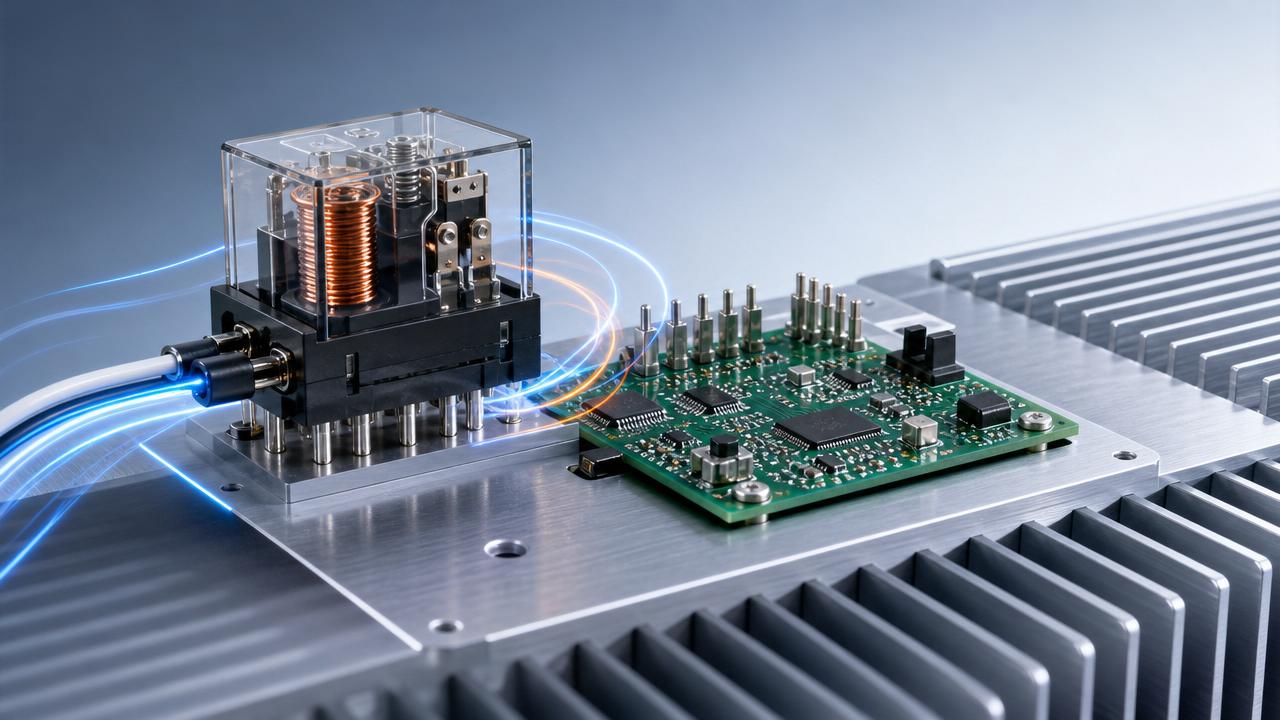
Fast switching relays are often chosen when timing, signal integrity, and system reliability must be balanced within tight electrical and thermal limits. For technical evaluation teams, the real challenge is not only how fast a relay can switch, but how its speed affects contact bounce, EMI generation, and long-term performance under demanding conditions. This article examines the practical speed limits and EMI tradeoffs that determine whether fast switching relays are truly fit for high-performance electronic applications.
Why fast switching relays need a checklist
A relay that switches faster is not automatically a better relay. In mixed-signal systems, speed can improve throughput, but it can also increase arcing, overshoot, and radiated noise. Fast switching relays therefore need a structured review, especially when they sit near sensitive ICs, precision sensors, or high-frequency lines.
A checklist makes the tradeoff visible. It helps separate datasheet headline numbers from real operating behavior, including coil drive, contact mechanics, PCB layout, and enclosure shielding. That is the difference between a relay that looks fast on paper and one that stays stable in production.
Core checks for fast switching relays
- Check operate and release times together, because a fast pull-in can still hide a slow, noisy release that affects timing accuracy.
- Review contact bounce duration, since short bounce windows can still create false transitions in control and measurement circuits.
- Confirm coil power and drive waveform, as excessive drive current can speed switching but raise heat and stress nearby components.
- Measure EMI in the target assembly, not only at component level, because PCB return paths and cable length reshape noise behavior.
- Verify contact rating under real load types, since resistive, inductive, and capacitive loads create very different switching stress.
- Assess insulation and creepage margins, especially when fast operation occurs in compact layouts with limited spacing.
- Test thermal rise during repeated cycling, because higher speed often means higher duty stress and less cooling time.
- Inspect suppression strategy, including diodes, RC snubbers, or TVS parts, to control EMI without slowing response too much.
- Compare life expectancy under expected cycle count, since accelerated switching can shorten contact life faster than expected.
- Validate lot-to-lot consistency, because timing spread can matter as much as nominal speed in precision systems.
Application scenarios and what to watch
In test and measurement systems, fast switching relays are valued for quick channel selection and lower dead time. Here, the key risk is not only EMI, but also microsecond-level bounce that can corrupt readings. Layout symmetry, short trace paths, and local decoupling are often as important as the relay itself.
In industrial control, the focus shifts toward endurance and load interruption. Fast switching relays may reduce response delay, but inductive loads can create stronger voltage spikes. A careful suppression network and verified contact material selection usually matter more than raw speed claims.
In communication or data-related subsystems, EMI tradeoffs become critical. Even small contact transients can couple into clocks, ADC front ends, or analog paths. A relay that switches slightly slower, yet cleaner, may outperform a faster part that injects broad-spectrum noise.
Commonly overlooked risks
One frequent mistake is judging fast switching relays only by operate time. Release time, bounce recovery, and contact stability after switching are equally important. A balanced timing profile is often more reliable than an aggressive speed peak.
Another overlooked issue is EMI coupling through the PCB itself. Fast coil energizing and de-energizing can create current edges that travel through ground planes and shared power rails. If the board stack-up is weak, the relay may become a system-wide noise source.
A third risk is thermal accumulation in dense assemblies. Repeated fast switching can increase coil heating and raise surrounding component temperature. That can shift timing, weaken margins, and reduce long-term reliability in enclosed equipment.
Practical execution steps
- Define the real switching target first, including load type, cycle rate, and acceptable noise level.
- Measure timing and EMI on the final board, not in isolation, so layout effects are captured early.
- Use suppression only as much as needed, because over-damping can slow response and hide timing issues.
- Run thermal and endurance tests together, since speed, heat, and life are tightly linked in fast switching relays.
For high-density electronics, keep the relay loop small, separate noisy return paths, and reserve margin for worst-case load switching. For systems with mixed analog and digital content, verify that fast switching relays do not shift noise into the measurement band.
Final decision points
Fast switching relays are best treated as timing devices with electrical side effects, not simply as faster contact parts. The right choice depends on whether the application can tolerate bounce, EMI, heat, and timing spread at the same time.
Before approval, compare several relay candidates under identical load and board conditions. If a slightly slower part delivers cleaner switching, better thermal behavior, and longer life, that is usually the stronger engineering result.
For organizations benchmarking components across semiconductor and EMS supply chains, disciplined testing is the safest path. Start with timing data, confirm EMI behavior, and finish with reliability validation. That sequence turns fast switching relays from a risk into a controlled design choice.
Recommended News
- RelaysHow to vet an industrial automation distributor for genuine relaysVet an industrial automation distributor with confidence. Learn how to verify relay authenticity, traceability, and quality controls to reduce downtime and sourcing risks.
- RelaysWhat Standard Tests Measure Relay Contact Resistance Degradation?Are there standard test methods for relay contact resistance degradation? Explore IEC standards, endurance testing, Kelvin measurement, and environmental validation for reliable relay sourcing.
- RelaysVietnam Tariff Shift Favors China-Origin Relays Until 2027Vietnam tariff shift favors China-origin relays until 2027. Learn how the 3% tax on non-ASEAN relay imports impacts sourcing, costs, and procurement strategy in Vietnam.
- RelaysJapan Enforces JIS C 5012:2026 Relay EMI Test RuleJapan Enforces JIS C 5012:2026 Relay EMI Test Rule: learn how the new 1.8-2.4 GHz radiated immunity and IEC 61000-4-3:2024 report requirements may impact relay compliance, cost, and Japan market access.
- RelaysWhen a Relay Switches Factory Becomes a Risk to Product QualityRelay switches factory risks can quietly damage product quality, safety, and reliability. Learn the warning signs, audit points, and how to choose a stable supplier.
- RelaysHow to Compare Relay Switches Factory Capabilities for Stable SupplyRelay switches factory comparison starts with capacity, quality control, traceability, and lead time stability. Learn how to identify reliable suppliers and reduce sourcing risk.