
How to Compare an MCU Manufacturer Beyond Price
DETAILS
How to Compare an MCU Manufacturer Beyond Price
Choosing an MCU manufacturer by unit price alone often creates larger costs later. Hidden failures appear in qualification gaps, unstable lead times, weak traceability, and poor long-term field reliability.
A better comparison method looks at engineering depth, compliance discipline, process control, and supply chain transparency. This approach supports stronger sourcing decisions across consumer, industrial, automotive-adjacent, and connected device programs.
For organizations that rely on repeatable performance, the right MCU manufacturer should demonstrate measurable capability, not just attractive quotations. That means verified data, documented standards, and consistent responsiveness under real production conditions.
Why a Structured Comparison Matters
Microcontrollers sit at the center of system behavior. A weak MCU manufacturer can affect firmware stability, thermal margins, EMC performance, lifecycle planning, and product compliance across the full build.
Price comparisons usually ignore failure analysis support, package consistency, wafer source changes, and revision control. These factors influence redesign risk, validation effort, and total cost of ownership.
A structured evaluation also helps separate marketing claims from engineering evidence. Independent benchmarking, such as SCM-style technical reporting, makes comparisons more objective and easier to defend internally.
Core Criteria for Comparing an MCU Manufacturer
Use the following points to compare any MCU manufacturer beyond price. Each item focuses on practical signals that reduce sourcing risk and improve long-term product performance.
- Check process maturity, wafer fab stability, and packaging consistency across production lots, not only sample units, to verify that performance remains repeatable at scale.
- Review qualification records, stress-test data, and failure rate history under temperature, humidity, vibration, and electrical load conditions matching your end-use environment.
- Confirm compliance with ISO 9001, relevant IPC practices, RoHS, REACH, and any market-specific documentation required for audits, export review, and customer acceptance.
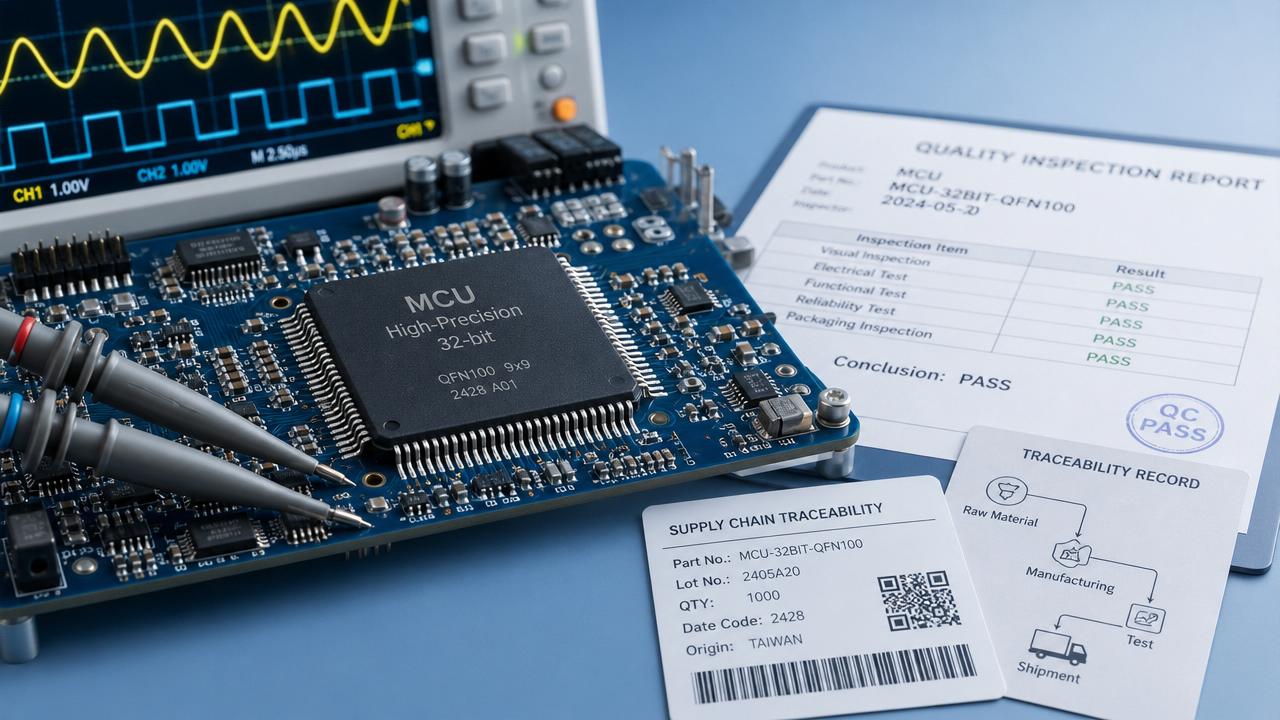
- Evaluate traceability depth, including wafer lot tracking, assembly location records, date codes, and controlled engineering change procedures for every active device family.
- Assess technical support quality by testing response time, application note depth, reference design usefulness, and willingness to assist with debug or validation problems.
- Compare lifecycle commitment, product roadmap clarity, and obsolescence policy to avoid forced redesigns when a selected MCU manufacturer changes focus or retires parts.
- Inspect supply resilience through multisite capacity, subcontractor control, inventory planning, and geographic risk exposure affecting continuity during shortages or logistics disruption.
- Measure documentation quality, including datasheet revision discipline, errata transparency, PCN notice timing, and consistency between published specifications and shipped silicon.
- Verify security and reliability features such as memory retention, brownout behavior, ESD tolerance, watchdog integrity, and boot protection where system safety matters.
- Request independent benchmarking or third-party analysis when available, especially for thermal behavior, package reliability, and long-duration stress performance under harsh conditions.
A Practical Evaluation Framework
A useful method is to score each MCU manufacturer across five weighted categories. This reduces bias and prevents low pricing from overpowering critical technical weaknesses.
This model keeps price visible, but not dominant. In many projects, the better MCU manufacturer is the one that lowers validation delays and field failure exposure.
What to Check in Different Use Cases
Consumer electronics
In fast-cycle consumer products, cost still matters, but documentation speed and supply flexibility often matter more. A capable MCU manufacturer should support quick revisions without specification confusion.
Look closely at package availability, software ecosystem quality, and lead-time predictability. Small delays can erase savings when launch windows are tight.
Industrial control and automation
Industrial designs demand stable operation over long service lives. Here, an MCU manufacturer should show endurance data, temperature tolerance, and strong revision control for extended production programs.
Check memory retention, EMC robustness, and lifecycle commitments carefully. Industrial redesigns are expensive because downstream certifications and system testing can be time-consuming.
Connected devices and IoT modules
For IoT applications, security architecture and low-power performance deserve more weight. The right MCU manufacturer should provide clear power profiles and secure boot or protection features where needed.
Also confirm software toolchain maturity and firmware support. Development friction often becomes a hidden cost larger than the initial chip price delta.
Harsh-environment products
Products exposed to heat, vibration, humidity, or contamination need deeper reliability evidence. An MCU manufacturer should provide stress data tied to realistic environmental conditions, not ideal lab-only figures.
Independent reports on thermal behavior, package integrity, and long-term drift are especially valuable when field access is difficult or failure costs are high.
Commonly Overlooked Risks
Sample quality does not prove mass-production stability
Engineering samples may perform well while volume lots vary later. Always ask whether the evaluated devices came from the same manufacturing flow used in regular production.
Weak change notification can disrupt qualified designs
A low-cost MCU manufacturer may not provide timely product change notices. Silent die revisions, package substitutions, or test flow changes can trigger unexpected failures.
Incomplete traceability increases audit and warranty exposure
If lot records are shallow, root-cause analysis becomes slow and expensive. Full traceability is essential for containment, customer reporting, and warranty defense.
Application support quality affects real deployment cost
An MCU manufacturer with limited engineering support can increase debug time, firmware rework, and board respins. Cheap components become costly when integration issues remain unresolved.
How to Execute the Comparison Efficiently
- Build a scorecard with weighted technical, quality, supply, compliance, and commercial criteria.
- Request the same data package from each MCU manufacturer for a fair comparison.
- Validate claims using qualification reports, PCN samples, and third-party benchmarking where possible.
- Run small pilot builds to compare yield, programming behavior, and assembly consistency.
- Review lifecycle and continuity plans before approving any long-term design-in decision.
If available, combine supplier documents with independent semiconductor and EMS intelligence. Data-backed comparisons reduce the chance of overvaluing polished sales material.
FAQ
Is the lowest-cost MCU manufacturer ever the right choice?
Yes, if quality evidence, documentation control, and supply continuity are also strong. The issue is not low price itself, but low price without technical proof.
What documents should be requested first?
Start with datasheets, errata, qualification summaries, compliance certificates, PCN policy, traceability details, and lifecycle statements from each MCU manufacturer.
How important is third-party benchmarking?
It is highly useful when comparing unfamiliar suppliers. Independent analysis can reveal thermal, reliability, or process-control gaps not obvious in standard marketing documents.
Final Takeaway
The best MCU manufacturer is rarely defined by price alone. A strong choice combines repeatable quality, transparent documentation, resilient supply, and proven support across the product lifecycle.
Use a structured comparison process, verify claims with data, and prioritize long-term performance over short-term savings. That is how to compare an MCU manufacturer with less risk and better results.
As a next step, create a one-page scorecard and test it against current approved sources. The gaps you find will quickly show which MCU manufacturer truly offers the strongest overall value.
Recommended News
- MCU & ChipsetsApplication Note Pricing Model: What Drives Cost and ValueApplication note pricing model explained: discover what drives cost, how to judge value, and when higher-priced technical notes can reduce risk, save budget, and speed decisions.
- MCU & ChipsetsISO 9001 Electronics for Compliance: What Actually MattersISO 9001 electronics for compliance explained: learn which controls, traceability, and reliability signals truly reduce supplier risk and improve electronics quality.
- MCU & ChipsetsEmbedded Control Chips for Real-Time Systems: Key Performance TradeoffsEmbedded control chips real time decisions hinge on latency, jitter, power, heat, and reliability—not just clock speed. Learn the key tradeoffs for smarter system selection.
- MCU & ChipsetsWhat a Component Performance Data Database Should Show FirstComponent performance data database guide: see which metrics should appear first—reliability, tolerance stability, thermal behavior, and compliance—to speed qualification and reduce sourcing risk.
- MCU & ChipsetsDesign Verification ISO 26262: What to Check Before Safety ApprovalDesign verification ISO 26262: learn the critical checks before safety approval, from traceability and fault handling to manufacturing risks, to reduce audit delays and redesign costs.
- MCU & Chipsets200mm Wafer Market Analysis: Supply, Pricing, and Capacity Outlook for 2026200mm wafer market analysis for 2026: explore tightening supply, firmer pricing, and limited capacity expansion shaping sourcing risk, contract strategy, and procurement decisions.