
What should an LED thermal solution quotation include?
DETAILS
A useful LED thermal solution quotation is not a price sheet with a part number attached. It is a technical and commercial definition of what will be built, how its thermal performance will be assessed, and which assumptions support the quoted cost. If those details are missing, two quotations may appear comparable while representing very different levels of thermal capability, manufacturing control, and delivery risk.
For an LED assembly, heat management directly affects light output stability, color consistency, driver reliability, and service life. The quotation should therefore make it possible to answer a practical question: will this quoted solution keep the LED system within its intended operating temperature under the real installation conditions? A low unit price is useful only when that question has a clear, documented answer.
Start with the thermal objective, not the heatsink price
The first section of an LED thermal solution quotation should state the application and thermal target. “LED heatsink” is not enough. A compact indoor luminaire, an outdoor floodlight, a horticultural fixture, and an enclosed industrial indicator may use similar-looking metal parts but face very different thermal conditions.
The quotation should identify the LED power to be dissipated, the ambient temperature range assumed for the design, the allowable LED junction or board temperature, the expected mounting orientation, and whether cooling is natural convection, forced air, liquid cooling, or contact with a larger chassis. It should also identify important restrictions such as sealed enclosures, dust exposure, sun loading, nearby heat-generating electronics, or limited airflow.
A thermal resistance figure can be helpful, but it needs context. Thermal resistance measured on an open test bench may not represent performance after the part is placed inside a tight fixture. Likewise, a quoted temperature rise has little value unless the input power, ambient condition, airflow, interface material, and measurement location are stated. The thermal claim should be tied to a defined test condition rather than presented as a standalone promise.
When the design uses several LEDs, the quotation should also clarify whether the thermal analysis considers total system power, local hot spots, and uneven power distribution. A baseplate may have acceptable average temperature while one LED cluster operates substantially hotter than the rest.
What the LED thermal solution quotation should define
The most reliable quotations turn the technical scope into checkable line items. The following elements should be visible enough that engineering, quality, and sourcing can review the same document without filling gaps with assumptions.
Material and process details should be specific enough to reproduce the part
Most LED thermal parts are made from aluminum, copper, graphite-based materials, ceramic substrates, or combinations of these. The quotation does not need a materials-science essay, but it should specify the selected material rather than using vague wording such as “high thermal conductivity aluminum.” Material grade, temper where relevant, finish, and thickness should match the drawing and bill of materials.
Material choice is only one part of the cost equation. The manufacturing route often has a larger impact on the final price at a given volume. An extruded aluminum profile may suit a long, repeatable geometry and can be economical once the profile is established. A die-cast housing can integrate structural and thermal functions but may introduce tooling cost, wall-thickness limits, and different surface characteristics. CNC machining offers flexibility for prototypes or complex features, yet it can become expensive when the part requires extensive material removal or multiple setups.
The quotation should state which process is being used and what is included after the main forming step. Common omissions include drilling and tapping, flatness correction, deburring, cleaning, anodizing, powder coating, thermal pad application, captive hardware, labeling, and final assembly. These operations may look minor individually, but they affect both landed cost and schedule.
Dimensions alone are not sufficient. Tolerances should be listed for the surfaces that govern thermal contact and assembly fit. Flatness at the LED mounting face, hole location, threaded features, and interface height are usually more important than tight tolerances applied broadly across a noncritical profile. Over-specifying every dimension increases cost; under-specifying the LED contact surface can create inconsistent thermal results from lot to lot.
The thermal interface deserves its own line item
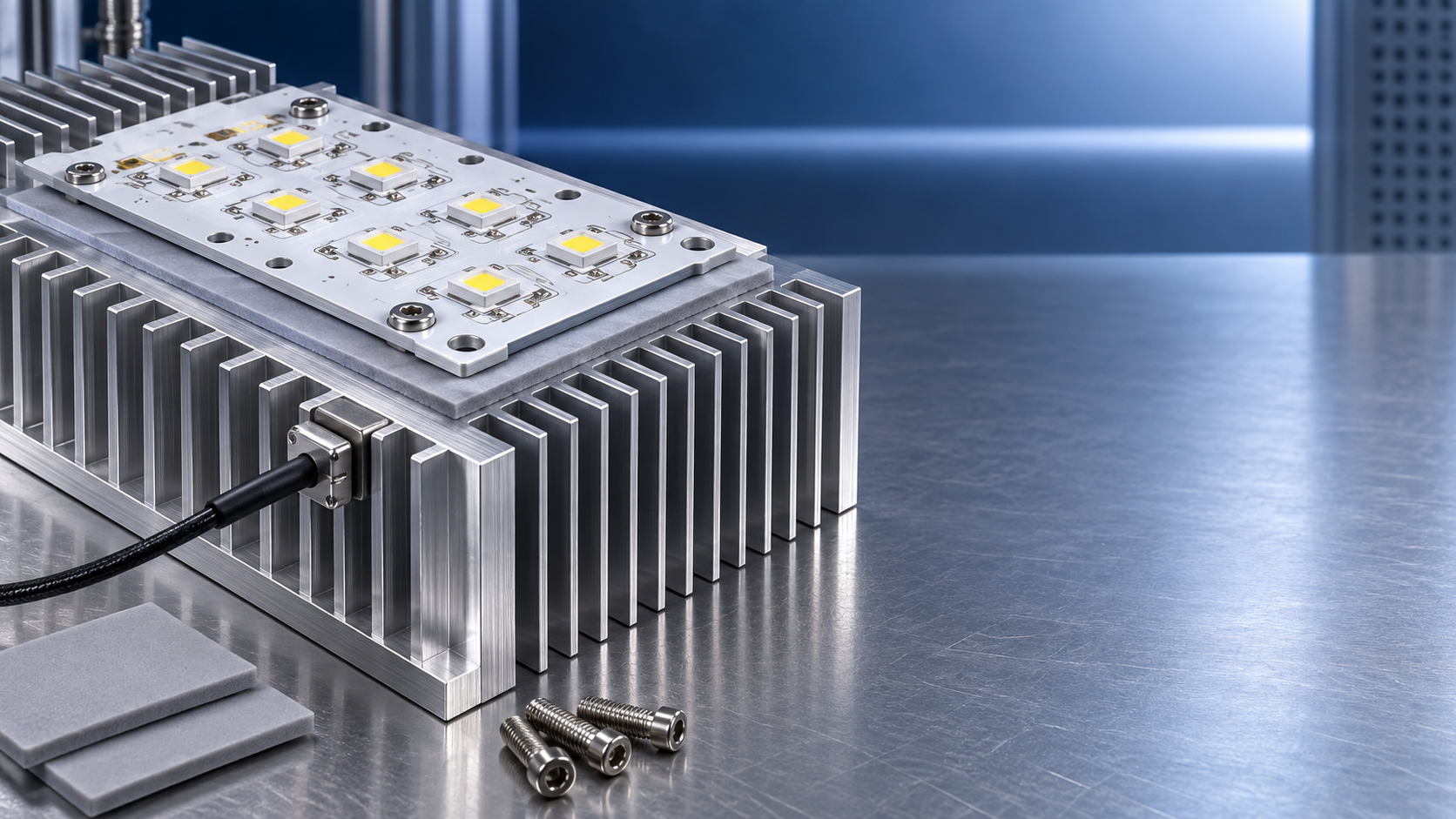
A well-designed heatsink cannot compensate for a poor interface between the LED board and the heat-spreading surface. Air gaps at that joint impede heat flow. The LED thermal solution quotation should identify the thermal interface material, nominal thickness, placement method, coverage area, and whether it is supplied as a separate component or applied during assembly.
It should also clarify the mechanical condition assumed by the thermal design. A screw-mounted metal-core PCB, a pressure plate, a spring clip, and a bonded assembly do not create the same contact pressure or long-term behavior. If torque-controlled screws are required, that should be part of the assembly instruction and quote scope. If adhesive is used, cure requirements and rework limitations matter because they affect production yield and field repair options.
A common comparison error is to select a heatsink quotation based on its material mass while treating the interface material as an accessory. In a thin, high-power LED module, the mounting interface may be as consequential as the fin geometry. The same heatsink can perform differently when the pad thickness, screw pattern, or board flatness changes.
Ask how performance will be verified
Thermal verification should be defined before a purchase order is released, especially where the LED module operates near its temperature limit or the final fixture has restricted airflow. A quotation can reference simulation, physical testing, or both, but it should distinguish between them. Simulation is valuable for comparing design options and identifying likely hot spots. Physical testing validates the manufactured assembly under stated conditions.
The useful information is not merely that a test will occur. The quotation should state what will be measured, where sensors or instruments will be placed, the operating power, stabilization approach, ambient environment, fixture orientation, airflow condition, and acceptance criteria. For an LED system, the relationship between the measured board or case temperature and the LED manufacturer’s permitted operating condition should be clear.
Where samples are part of the quotation, include the sample build configuration. A prototype made with hand-applied interface material, a different finish, or temporary fasteners may not represent volume production. If thermal validation depends on a particular board construction or LED package, the applicable revision should be identified as well.
Separate prototype economics from volume-production economics
An LED thermal solution quotation should show cost by meaningful quantity ranges, but quantity breaks alone are not enough. Prototype and production pricing often differ because the manufacturing approach changes. A machined prototype may validate heat dissipation and mechanical fit, yet it may not reflect the final die-cast or extruded part’s cost, surface texture, tolerances, or assembly method.
Tooling, engineering work, fixtures, gauges, and first-article inspection should be visible as separate charges where applicable. Combining everything into one prototype price makes it difficult to understand whether a later production price is realistic. It can also conceal a commercial gap: a low prototype price may exclude the development work needed to make the part repeatable in volume.
For production, request clarity on minimum order quantity, manufacturing lead time, material procurement lead time, capacity assumptions, packaging format, and whether pricing includes standard quality documentation. Packaging matters more than it appears. Unprotected anodized surfaces, bent fins, damaged threads, or contamination on thermal-contact faces can convert an apparently low-cost component into a production problem.
Compare quotations on total installed cost
The cheapest thermal component is not automatically the lowest-cost solution after installation. A part with a lower piece price may require more manual assembly, a thicker thermal pad, additional brackets, or a redesigned enclosure. It may also force tighter process control at the LED board assembly stage. Those costs can exceed the visible saving on the heatsink itself.
Use a comparison sheet that separates one-time charges, unit price, interface material, fasteners, assembly labor, test cost, packaging, logistics, expected rejects, and any changes required to the LED board or enclosure. The goal is not to create a theoretical model with false precision. It is to prevent a price comparison from ignoring costs that will inevitably appear after the part arrives.
Serviceability should also be considered. A bonded thermal assembly may reduce part count and speed initial assembly, but replacing a failed LED board can become difficult. A mechanically clamped design may cost more upfront while making repair and inspection easier. Neither arrangement is universally better; the correct choice depends on the expected product life, repair policy, production method, and environmental exposure.
Watch for scope gaps that look harmless at quotation stage
Several omissions repeatedly create disputes or redesign work. The first is the definition of the LED board itself. The thermal supplier needs the board outline, mounting-hole pattern, keep-out areas, local copper arrangement where relevant, and component clearance information. A generic thermal drawing cannot confirm compatibility with an unspecified PCB.
The second is the final mounting environment. A heatsink mounted vertically in open air behaves differently from the same part mounted horizontally inside a sealed plastic enclosure. If the production product uses a lens, gasket, fan, chassis, or external housing, the thermal interaction should be considered in the quoted design scope.
The third is finish selection. Decorative or protective finishes can alter surface behavior, dimensional fit, grounding arrangements, and contact surfaces. The quotation should identify masked areas or uncoated thermal contact zones where needed. It should also define cosmetic expectations separately from functional acceptance criteria, so surface appearance does not become an unplanned rejection issue.
Finally, distinguish design responsibility from build-to-print responsibility. A supplier quoting to an existing drawing may be responsible for manufacturing the specified part but not for confirming that it meets the system thermal target. If design validation is expected, the quotation should explicitly include the analysis, testing, and deliverables needed to support that responsibility.
A practical quotation request sequence
Before requesting prices, prepare a concise technical package. It should include the current mechanical drawing, LED board drawing or data, expected power dissipation, installation description, ambient conditions, cooling assumptions, target temperature limits, estimated volumes, and required prototype timing. Mark items that are fixed requirements and items that can be optimized for cost.
Then ask each supplier to return the quotation in the same structure: proposed design or drawing revision, material and process, thermal interface, tooling and non-recurring charges, unit price by volume, lead time, test scope, quality documentation, exclusions, and validity conditions. This makes comparisons more meaningful than collecting several unrelated price sheets.
Independent manufacturing benchmarks can be useful when quotations differ sharply in material selection, tolerance claims, process capability, or test depth. Resources such as SiliconCore Metrics focus on translating thermal packaging and electronics manufacturing parameters into comparable technical evidence, which can help separate a genuine scope difference from a vague commercial claim.
A complete quotation does not eliminate all thermal risk. It does make the remaining risk visible, assignable, and manageable before the design reaches volume production. That is the standard worth using when evaluating an LED thermal solution: not whether the supplier has quoted a metal part, but whether the quotation defines a repeatable thermal result at a cost structure the finished product can support.
Recommended News
- Heat DissipationHow to prevent overheating in automotive PCB power distributionPrevent overheating in automotive PCB power distribution with practical tips on copper layout, thermal paths, and testing. Discover how to reduce hotspots and improve reliability.
- Heat DissipationCan heat spreading intelligence identify hot spots in PCB designs?Discover how heat spreading intelligence identifies PCB hot spots before fabrication. Learn to assess thermal models, validate predictions, and choose design changes that improve reliability.
- Heat DissipationWhich heat sink materials suit high-power electronics made in Germany?Heat sink materials Germany: compare aluminum, copper, graphite, and hybrid designs for high-power electronics. Find the right balance of thermal performance, weight, cost, and manufacturability.
- Heat DissipationHow to assess a graphite materials supplier's capability for thermal partsGraphite materials supplier assessment starts with more than machining. Discover how to evaluate thermal performance, purity, precision, cleanliness, traceability, and testing for reliable thermal parts.
- Heat DissipationHow to assess a heat dissipation supplier before placing an orderHeat dissipation supplier assessment guide: verify thermal performance, materials, process control, samples, capacity, and total risk before placing an order.
- Heat DissipationHow automotive PCB material selection affects thermal reliabilityAutomotive PCB material selection shapes thermal reliability. Explore CTE, Tg, moisture resistance, stack-up design, and proven qualification strategies for demanding vehicle electronics.