
Thermal Management Compliance for Power Boards
DETAILS
Thermal management compliance for power boards is no longer just a design checkbox. It directly affects product safety, field reliability, SMT process stability, regulatory readiness, and total lifecycle cost. For engineering teams, procurement managers, quality leaders, and project stakeholders, the real question is not simply whether a power board runs hot, but whether its thermal behavior remains controlled, documented, and compliant under real operating conditions. From PCB stack-up and copper balance to component placement, reflow soldering quality, relay heat rise, capacitor endurance, and enclosure-level airflow, thermal compliance must be evaluated as a system, not as an isolated test result.
For organizations sourcing or validating power boards across the global semiconductor and EMS supply chain, the most useful approach is practical: identify the thermal failure risks early, verify which standards and acceptance criteria apply, and use measurable engineering evidence to judge whether a board is suitable for the intended duty cycle. This guide explains what thermal management compliance actually means, what readers in engineering, quality, purchasing, and program roles should inspect first, and how to make better technical and commercial decisions with less uncertainty.
What buyers, engineers, and quality teams really need to know first
The core search intent behind thermal management compliance for power boards is usually transactional and evaluative rather than purely educational. Readers want to know whether a board design, supplier, or assembled product can safely dissipate heat, pass compliance checks, maintain performance over time, and avoid failures that create warranty, safety, or procurement risk.
In practical terms, the first questions are usually these:
- What thermal limits must this power board meet in actual use?
- Which compliance criteria matter most: internal specifications, IPC requirements, safety standards, or customer qualification rules?
- How do PCB design, SMT assembly, and component selection affect heat rise and long-term reliability?
- What test data should a supplier provide before approval?
- How can a buyer or technical evaluator identify hidden thermal risk before mass production?
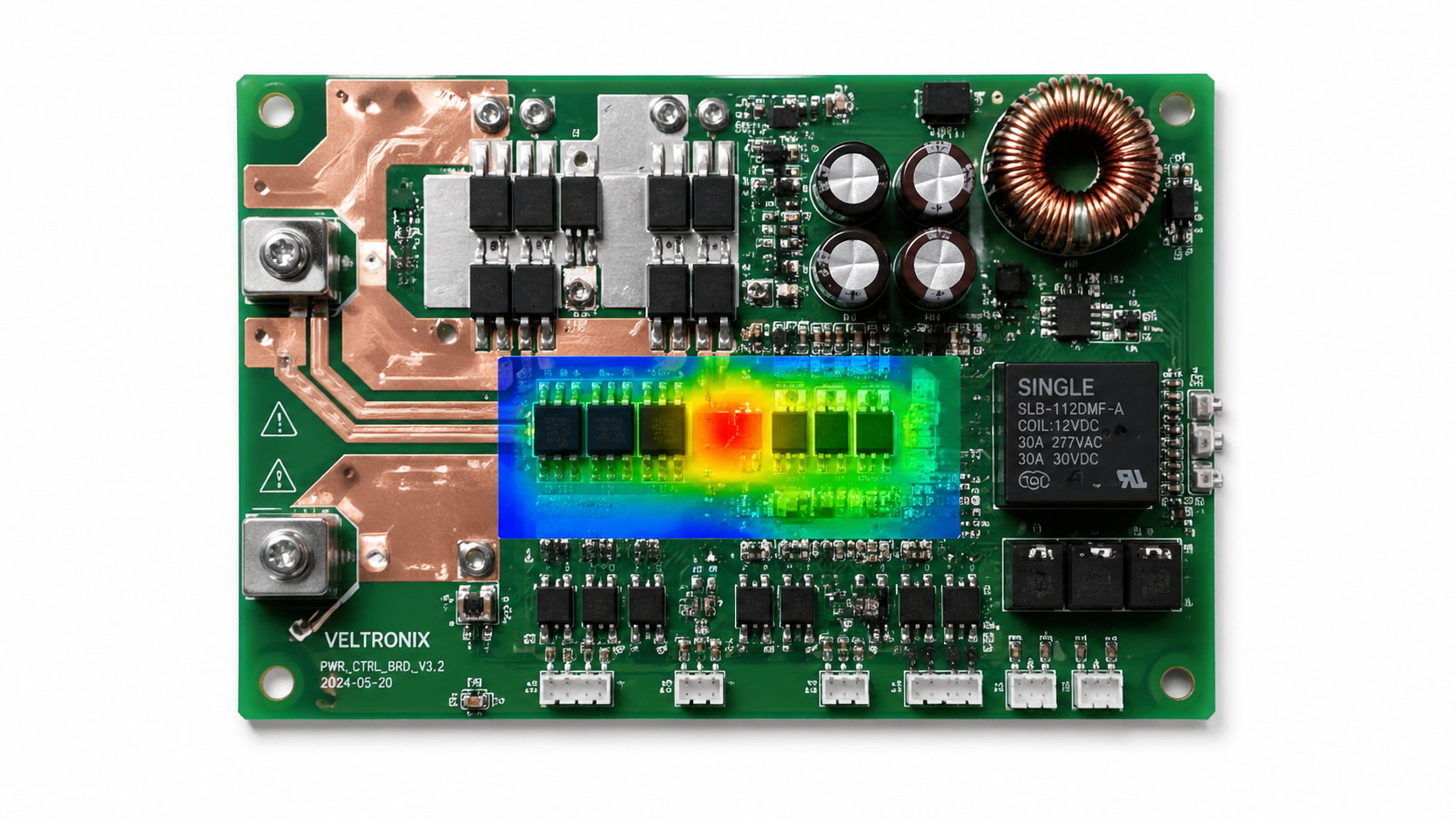
The short answer is that compliance is not proven by a single thermal image or a single passing prototype. It requires alignment between design intent, material selection, assembly quality, thermal test evidence, and expected service environment.
What thermal management compliance means for a power board in real-world terms
For a power board, thermal management compliance means the assembly can operate within acceptable temperature limits during normal and abnormal conditions without causing electrical instability, accelerated material degradation, solder fatigue, component derating violations, or safety hazards. This applies across the full chain of PCB compliance, SMT compliance, and semiconductor compliance.
In real products, this includes several layers:
- Board-level compliance: copper thickness, trace width, thermal vias, dielectric properties, and laminate temperature capability must support the expected power density.
- Assembly-level compliance: SMT soldering quality, reflow soldering profile control, voiding behavior, and pick and place accuracy influence thermal resistance and mechanical reliability.
- Component-level compliance: MOSFETs, regulators, capacitors, inductors, relays, connectors, and other circuit components must remain within rated junction, case, and ambient limits.
- System-level compliance: the board must function reliably inside the target enclosure, airflow condition, mounting orientation, and ambient temperature range.
This is why thermal compliance cannot be reduced to one phrase such as “the board passes at 25°C ambient.” A compliant board is one that remains thermally controlled in the actual operating envelope that matters to the customer.
Which risks matter most if thermal compliance is weak
Weak thermal management rarely causes just one isolated issue. It tends to create a chain of technical and business consequences that affect multiple departments.
For engineers and operators, poor heat control can lead to:
- Drift in electrical performance
- Premature capacitor aging
- Semiconductor junction overstress
- Solder joint cracking under thermal cycling
- Relay contact degradation or coil overheating
- Hot spots near high-current traces or connectors
- Intermittent failures that are difficult to reproduce
For procurement, quality, and finance teams, the risks are equally serious:
- Higher field return rates
- Supplier disputes over root cause
- Unexpected redesign costs
- Delayed customer approvals
- Compliance failures in audits or qualification reviews
- Brand damage if safety or reliability incidents reach the market
Thermal compliance, therefore, is not only an engineering topic. It is a supply chain risk control issue and a lifecycle cost issue.
What should be checked in the PCB design before approving a power board
If the board itself is not thermally capable, no amount of late-stage testing will fully compensate. Technical evaluators should inspect the design structure early, especially when comparing suppliers or reviewing prototypes.
Key PCB design factors include:
- Copper weight and distribution: insufficient copper thickness or poor copper balance can trap heat and increase resistive loss.
- Trace and plane sizing: high-current paths need width and continuity matched to current load and temperature rise targets.
- Thermal via strategy: vias under power semiconductors or thermal pads must be correctly sized, tented or untented as required, and manufacturable at scale.
- Layer stack-up: multi-layer PCB design affects heat spreading, dielectric performance, and reliability under thermal stress.
- Material selection: Tg, Td, CTE, and thermal conductivity of the laminate matter when the board faces repeated heating cycles.
- Creepage and clearance: thermal optimization must not compromise electrical safety distances.
For higher-power applications, it is also important to verify whether the design uses heat spreaders, insulated metal substrates, heavy copper construction, or dedicated thermal interface materials. A low-cost board that appears electrically acceptable may still fail long-term thermal reliability if these design controls are absent.
How SMT assembly quality affects thermal performance more than many teams expect
Many organizations focus on board layout but underestimate the influence of assembly execution. In reality, SMT compliance has a direct impact on thermal resistance, local hot spots, and long-term durability.
Areas that deserve close attention include:
- Solder voiding under thermal pads: excessive voiding can impair heat transfer from power packages to the PCB.
- Reflow soldering profile: poor thermal profiling can cause weak wetting, warped packages, head-in-pillow effects, or stress on sensitive electronic parts.
- Pick and place accuracy: placement deviation can reduce thermal pad contact quality or create inconsistent solder joints.
- Component coplanarity and alignment: especially critical for bottom-terminated components and power packages.
- Solder paste printing control: stencil design and paste volume influence pad coverage, voiding, and thermal conduction.
When reviewing a manufacturing source, ask for process capability evidence rather than generic quality claims. Useful data may include X-ray inspection criteria for thermal pads, reflow profile windows, Cp/Cpk data for placement accuracy, and defect escape records for power assemblies.
Which components most often determine thermal compliance outcomes
Not all circuit components contribute equally to thermal risk. On power boards, a small number of high-stress parts often dominate heat generation and reliability outcomes.
Priority components to review include:
- Power semiconductors: MOSFETs, IGBTs, rectifiers, regulators, and driver ICs must be checked for junction temperature margin, package dissipation capability, and derating.
- Capacitors: both electrolytic and ceramic capacitors are sensitive to temperature, ripple current, and nearby heat sources. Capacitor endurance can fall sharply as temperature rises.
- Magnetics: inductors and transformers need verification for winding temperature rise, core losses, and insulation life.
- Electrical relays and connectors: contact resistance, coil temperature, and terminal heating can become hidden failure points under repeated load.
- Resistors and shunts: localized surface heating may affect neighboring components and board discoloration.
- Electromechanical parts: housings, terminals, and plastic materials must tolerate the thermal environment without creep or degradation.
For procurement and business evaluators, this means the bill of materials should not be judged only on unit price or brand reputation. Thermal derating data, lifetime curves, and application margin are often more important than nominal datasheet ratings.
What evidence should a supplier provide to prove thermal compliance
A capable supplier should be able to support compliance claims with structured, reviewable data. If the evidence is vague, fragmented, or limited to marketing summaries, that is a warning sign.
The most useful evidence usually includes:
- Thermal simulation reports with assumptions clearly stated
- Measured temperature rise data at defined ambient conditions and load profiles
- Thermal imaging with identified hot spots and component references
- Junction or case temperature calculations for key semiconductors
- Derating analysis for capacitors, relays, connectors, and magnetic components
- Reflow and SMT process validation records
- Reliability test data such as thermal cycling, power cycling, burn-in, or highly accelerated stress screening where relevant
- Conformance to applicable IPC, ISO, customer, or product safety requirements
The best reports do not only say a board “passed.” They explain under what conditions it passed, what the thermal margin was, and where the design remains sensitive to application changes.
How to evaluate thermal compliance during technical sourcing or supplier comparison
When teams compare multiple EMS providers, PCB fabricators, or component options, thermal compliance should be part of a structured evaluation model rather than an afterthought.
A practical review framework can include the following questions:
- What is the maximum continuous and peak power load?
- What ambient and enclosure conditions define the real use case?
- What are the hottest components, and what thermal margin do they have?
- Is the PCB material and copper structure adequate for the load?
- Does the SMT process support consistent heat transfer at scale?
- What reliability evidence supports long-term operation?
- What changes in BOM, layout, or enclosure would invalidate the result?
This approach is especially useful for project managers, procurement specialists, and approval stakeholders who may not need to perform thermal analysis themselves but still need a defensible basis for supplier selection.
Common mistakes that create false confidence in compliance reviews
Many power boards appear acceptable during early evaluation but later fail in production or field use because the review criteria were too narrow.
Common mistakes include:
- Testing only at room temperature instead of worst-case ambient
- Ignoring enclosure effects and validating on an open bench
- Using nominal load instead of real peak or transient load
- Assuming datasheet maximum temperature equals safe operating practice
- Reviewing component ratings without considering board-level heat coupling
- Accepting prototype thermal results without verifying manufacturing repeatability
- Overlooking the impact of SMT soldering defects on thermal resistance
- Failing to account for aging, dust, fan degradation, or field contamination
These mistakes are costly because they create apparent compliance without true thermal robustness. For quality and safety teams, this is one of the most important takeaways: thermal compliance must be repeatable, contextual, and evidence-based.
How thermal compliance supports better business decisions, not just better engineering
For management, procurement, and finance stakeholders, thermal management compliance should be viewed as a decision-enabling metric. It helps answer whether a lower-cost board is actually economical, whether a new supplier is truly qualified, and whether a product launch carries avoidable reliability risk.
Strong thermal compliance usually delivers business value in several ways:
- Lower field failure and warranty exposure
- Fewer engineering change orders after launch
- Better predictability in qualification and audit processes
- Reduced supply chain disruption from inconsistent assembly quality
- Improved confidence in sourcing high-performance electronic parts globally
- Clearer communication between engineering, quality, purchasing, and executive teams
For organizations operating across international manufacturing hubs, independent benchmarking and standardized compliance reporting add even more value. They reduce reliance on subjective supplier claims and create a shared technical basis for commercial decisions.
A practical checklist for reviewing a power board’s thermal compliance
Before approving a power board for sourcing, qualification, or deployment, use this simplified checklist:
- Define real ambient temperature, airflow, and enclosure conditions
- Identify highest-loss semiconductors and hottest passive components
- Confirm copper weight, stack-up, thermal vias, and laminate suitability
- Review component derating, especially for capacitors, relays, connectors, and magnetics
- Verify SMT soldering quality, voiding control, and reflow process capability
- Request measured thermal test data, not only simulations
- Check reliability evidence under thermal cycling or extended operation
- Document thermal margin and assumptions for future engineering changes
- Confirm alignment with applicable IPC-Class 3, ISO 9001, customer, or product-specific compliance requirements
If several of these items are missing, the board may still be usable, but it should not be treated as thermally low-risk.
Conclusion: thermal compliance should be treated as a system-level qualification decision
Thermal management compliance for power boards is best understood as a system-level qualification issue that connects PCB design, SMT assembly, component quality, reliability testing, and supplier transparency. The readers most interested in this topic are not looking for abstract theory. They need to know how to judge whether a power board will remain safe, stable, and economically viable in the real world.
The most reliable path is to evaluate thermal behavior using measurable evidence, realistic operating conditions, and cross-functional review. When thermal compliance is handled well, organizations gain more than a cooler board. They gain stronger reliability, cleaner supplier decisions, lower lifecycle cost, and greater confidence across engineering, procurement, quality, and program execution.
For teams navigating global semiconductor and EMS sourcing, that level of clarity is no longer optional. It is a competitive requirement.
- PCB
- substrates
- SMT assembly
- passive components
- IPC-Class 3
- EMS
- thermal management
- multi-layer PCB
- ISO 9001
- thermal interface materials
- PCB design
- SMT process
- thermal management compliance
- PCB compliance
- SMT compliance
- semiconductor compliance
- component placement
- reflow soldering
- SMT soldering
- electronic parts
- circuit components
- semiconductor
- Power Semi
- high-performance
- electromechanical parts
- relays
- electrical relays
- connectors
- thermal conductivity
Recommended News
- Heat DissipationHow to prevent overheating in automotive PCB power distributionPrevent overheating in automotive PCB power distribution with practical tips on copper layout, thermal paths, and testing. Discover how to reduce hotspots and improve reliability.
- Heat DissipationCan heat spreading intelligence identify hot spots in PCB designs?Discover how heat spreading intelligence identifies PCB hot spots before fabrication. Learn to assess thermal models, validate predictions, and choose design changes that improve reliability.
- Heat DissipationWhich heat sink materials suit high-power electronics made in Germany?Heat sink materials Germany: compare aluminum, copper, graphite, and hybrid designs for high-power electronics. Find the right balance of thermal performance, weight, cost, and manufacturability.
- Heat DissipationHow to assess a graphite materials supplier's capability for thermal partsGraphite materials supplier assessment starts with more than machining. Discover how to evaluate thermal performance, purity, precision, cleanliness, traceability, and testing for reliable thermal parts.
- Heat DissipationHow to assess a heat dissipation supplier before placing an orderHeat dissipation supplier assessment guide: verify thermal performance, materials, process control, samples, capacity, and total risk before placing an order.
- Heat DissipationHow automotive PCB material selection affects thermal reliabilityAutomotive PCB material selection shapes thermal reliability. Explore CTE, Tg, moisture resistance, stack-up design, and proven qualification strategies for demanding vehicle electronics.