
PCB Compliance Risks Hidden in Material Changes
DETAILS
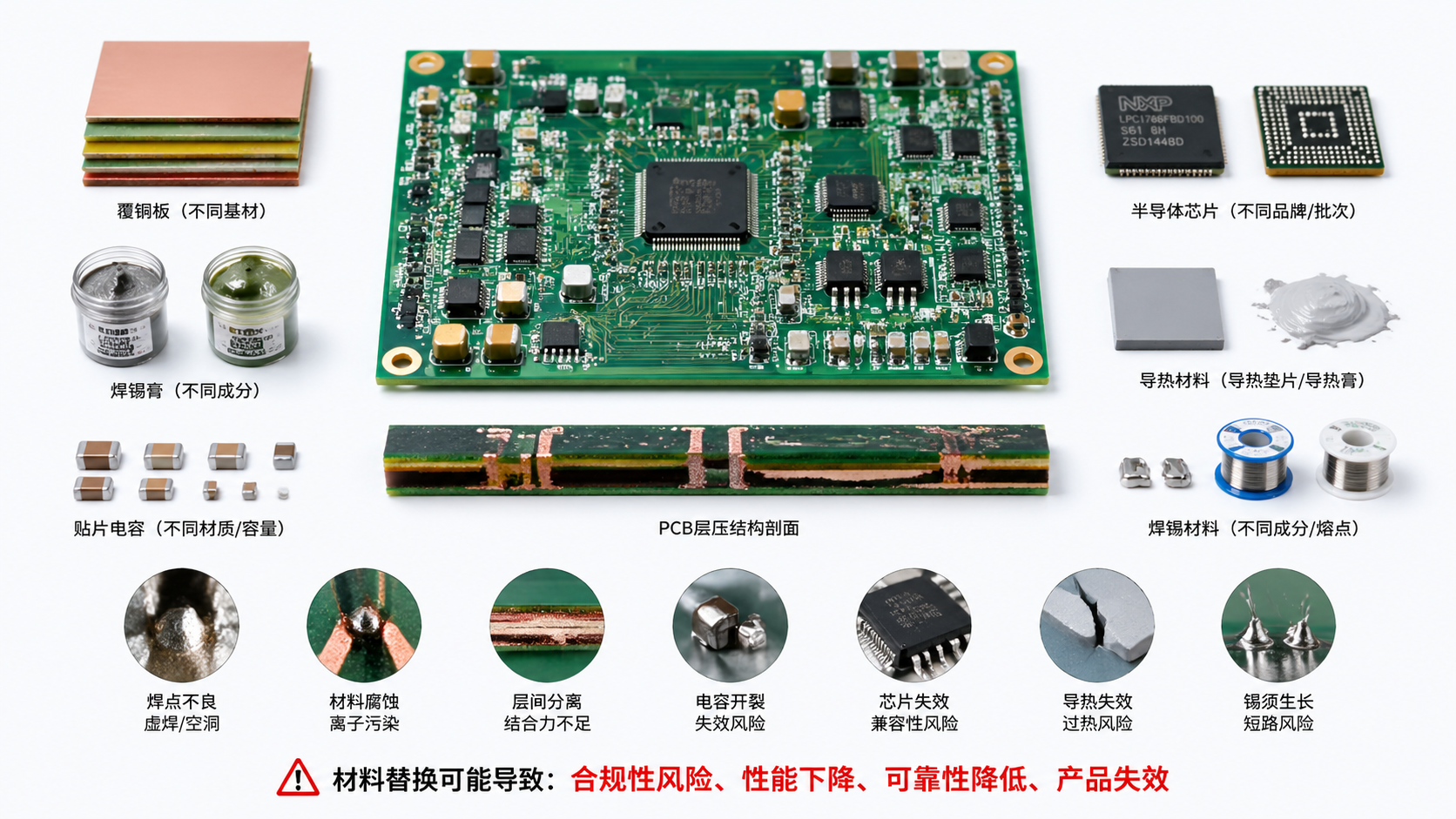
Material substitutions in PCB and circuit board assembly often look harmless on paper, but they are one of the fastest ways to create hidden compliance failures, reliability drift, and unexpected approval delays. A resin swap, laminate grade change, alternate capacitor source, modified solder paste, or different thermal interface material can alter electrical behavior, thermal performance, outgassing, flammability status, and process stability. For engineers, procurement teams, and quality managers, the real risk is not the change itself—it is the gap between what was changed and what was requalified. In practice, PCB compliance risks hidden in material changes usually emerge when documentation, validation scope, and supplier declarations lag behind actual production reality.
The most practical conclusion is simple: any material change that affects dielectric performance, solderability, mechanical stress, chemical composition, thermal dissipation, or traceability should be treated as a compliance event, not just a sourcing adjustment. Organizations that manage this well reduce scrap, avoid customer escalations, shorten approval cycles, and protect both product reliability and commercial continuity.
Why small material changes create disproportionate compliance risk
In electronics manufacturing, compliance is rarely tied to a single finished-board test. It is built on the full stack of materials, processes, certificates, and controlled assumptions behind the product. That is why minor substitutions can trigger major consequences.
A PCB laminate with a slightly different dielectric constant may affect controlled impedance. A replacement solder mask may change adhesion or chemical resistance. An alternate solder alloy or solder paste flux system may shift reflow behavior, voiding, residue profile, or long-term corrosion risk. A new capacitor or electromechanical component may still match form, fit, and function on a datasheet, yet fail derating, endurance, or environmental requirements under actual operating conditions.
From a compliance perspective, these changes can impact:
- IPC conformance and customer-specific build requirements
- RoHS, REACH, halogen-free, and material declaration status
- UL recognition and flammability assumptions
- SMT process stability and solder joint reliability
- Thermal management compliance in dense or high-power assemblies
- Semiconductor and passive component approval traceability
- Product qualification records used in audits, claims, or field investigations
The hidden issue is that many organizations review cost and lead time first, while compliance impact is checked later or only partially. That sequence creates avoidable exposure.
Which material changes are most likely to trigger PCB compliance, SMT compliance, and semiconductor compliance issues
Not every change carries equal risk. The highest-risk substitutions are the ones that alter the physical behavior of the assembly or break the documented basis of prior approval.
1. PCB base materials and laminates
Changes in resin system, glass weave, copper foil type, Tg, Td, Dk, Df, CAF resistance, or moisture absorption can affect signal integrity, thermal cycling durability, and high-layer-count reliability. This matters especially in telecom, automotive-adjacent, industrial control, and high-speed computing applications.
2. Solder mask, surface finish, and chemistry
A different solder mask formulation or surface finish can influence solderability, pad definition, ionic cleanliness, corrosion resistance, and rework performance. ENIG, OSP, immersion silver, and HASL are not interchangeable from a compliance and process-control standpoint.
3. Soldering materials and SMT soldering consumables
Replaced solder paste, flux, preforms, or wave solder materials can alter wetting, slump, voiding, tombstoning, residue behavior, and reflow window robustness. A material approved in one profile may fail in another. Reflow soldering validation should not be assumed transferable without evidence.
4. Capacitors and circuit capacitors
Capacitors are often dual-sourced under commercial pressure, but equivalent capacitance and voltage ratings do not guarantee equivalent reliability. ESR, ripple current tolerance, temperature stability, humidity resistance, piezoelectric behavior, and failure mode can vary widely. High-performance capacitors in power and filtering sections deserve special scrutiny.
5. Active semiconductors and passive components
PCN-driven package changes, die shrinks, plating changes, mold compound updates, and alternate fabs can affect solder joint behavior, thermal resistance, moisture sensitivity, and long-term field reliability. Semiconductor compliance risk is often underestimated because the part number appears unchanged.
6. Thermal interface and thermal packaging materials
Pads, adhesives, encapsulants, potting compounds, and heat spreader interface materials directly affect junction temperature control, aging, and safety margin. In compact assemblies, a seemingly minor thermal material change can undermine the whole reliability model.
7. Electromechanical parts
Connectors, relays, switches, and sockets may pass dimensional checks while failing insertion life, plating durability, vibration tolerance, or current-carrying stability. These are frequent sources of field failures after “equivalent” substitutions.
What your teams should verify before approving any substitute material
For most target readers—engineers, buyers, quality staff, project leaders, and approvers—the key question is not “Is the substitute available?” but “What exactly must be revalidated before we accept it?” A practical review framework should include the following.
Material identity and declaration control
- Manufacturer name, plant, and exact part or formulation revision
- Latest material declaration for RoHS, REACH, SVHC, halogen status, and customer-specific restricted substance requirements
- UL file references or safety-related listing status where relevant
- Certificate validity dates and traceable version control
Technical equivalence, not just commercial equivalence
- Electrical parameters across operating temperature and frequency
- Mechanical properties such as CTE, adhesion, flex endurance, and warpage response
- Thermal properties including conductivity, Tg, decomposition resistance, and interface performance
- Chemical compatibility with cleaning agents, coatings, flux residues, and environmental exposure
Process compatibility
- Stencil, placement, and profile compatibility in SMT assembly
- Reflow soldering window and peak temperature tolerance
- Wave/selective solder response if applicable
- MSL handling, bake requirements, and storage limitations
Reliability impact
- Thermal cycling, humidity bias, mechanical shock, and vibration sensitivity
- Electrochemical migration, CAF, dendrite, or corrosion risk
- Aging drift in capacitors, adhesives, and thermal materials
- Field-service implications and replacement interchangeability
Documentation completeness
- Engineering change notice or deviation approval
- Risk assessment and sign-off matrix
- Updated BOM, AVL, process instructions, and control plans
- Evidence package for customer audits or internal quality review
Common hidden compliance gaps that are missed in real production
Most compliance failures do not happen because teams ignore quality on purpose. They happen because each function sees only part of the change.
Datasheet matching replaces real qualification
A buyer finds a part with matching top-line specifications. Engineering assumes it is close enough. Quality assumes engineering reviewed it. Production uses it. No one verifies process behavior or lifetime performance.
Certificates are collected but not mapped to the exact build
A supplier provides RoHS or REACH statements, but they may apply to a family, a previous revision, or a different manufacturing site. Documentation exists, yet traceability to the actual shipped lot is weak.
Customer and regulatory requirements are treated as the same thing
A material may be legally compliant but still fail an OEM requirement, internal standard, IPC-Class 3 expectation, or approved vendor restriction.
PCN notices are not connected to risk classification
Semiconductor and passive suppliers frequently issue process or material change notifications. If these are logged administratively but not technically assessed, hidden drift enters production under the same internal part number.
Thermal effects are checked too late
Teams validate assembly yield but not thermal margin. The product passes initial test, then degrades faster in the field because the substituted material altered heat flow, hotspot behavior, or mechanical stress under temperature cycling.
SMT profile assumptions are reused without evidence
A new solder paste, finish, or component termination may require a different profile window. Keeping the old reflow profile can increase head-in-pillow, voiding, insufficient wetting, or brittle joint risk.
How to assess whether a material change needs full requalification or limited review
A good decision process balances speed with risk. Not every change needs a complete restart, but every change needs a structured classification.
Low-risk changes may include administrative updates, packaging changes, or equivalent materials with proven same-site, same-process, same-formulation continuity and strong supporting evidence.
Medium-risk changes often involve alternate approved sources, revised chemistry with similar declared performance, or process consumable changes that require targeted validation such as solderability, profile confirmation, cleanliness, or limited environmental testing.
High-risk changes include laminate system changes, solder alloy or flux system substitutions, thermal interface material changes, semiconductor package or fab changes, and any capacitor replacement in critical circuits. These usually justify engineering review, documented risk assessment, and reliability-focused requalification.
A practical trigger model is to ask five questions:
- Does the substitution affect electrical, thermal, chemical, or mechanical behavior?
- Does it change any basis of prior certification or customer approval?
- Does it alter SMT soldering, reflow soldering, or assembly process settings?
- Does it affect lifetime, safety margin, or field serviceability?
- Can we prove equivalence with lot-specific, traceable evidence?
If the answer to any of these is yes—or uncertain—the change should move into formal technical review rather than simple procurement substitution.
What evidence decision-makers need before approving a change
Different stakeholders approve for different reasons, so the evidence package must be useful across functions.
For technical evaluation personnel and engineers
They need comparative specifications, validation data, process capability evidence, and clear statements on what has and has not been tested. They also need to understand whether the change affects impedance, solder joint integrity, thermal resistance, EMI performance, or environmental robustness.
For procurement and commercial reviewers
They need risk-adjusted sourcing value, not just lower unit cost. That includes lead time resilience, second-source continuity, approval cycle impact, nonconformance cost exposure, and the chance of line stoppage or customer return.
For quality, safety, and compliance personnel
They need declaration validity, audit-ready traceability, standards mapping, and a documented rationale for acceptance. Missing paperwork alone can become a failure point during customer review.
For project managers and financial approvers
They need a clear picture of decision trade-offs: whether the change reduces shortage risk, what validation effort is required, how it may affect schedule, and what the downside cost is if the assumption is wrong.
The strongest approval files typically include a concise change summary, risk ranking, test plan, evidence matrix, and final sign-off trail tied to BOM and lot records.
How independent benchmarking reduces hidden supply chain and compliance exposure
One reason hidden compliance risk persists is that many companies rely too heavily on supplier-provided equivalence claims. Those claims are useful, but they are not always sufficient for high-reliability or audit-sensitive programs. Independent benchmarking adds an external technical baseline.
For organizations working across the global semiconductor and EMS supply chain, independent data can help compare laminate behavior, SMT placement precision, solder joint process windows, component endurance, and thermal management performance under standardized conditions. This is especially valuable when sourcing spans multiple Asian manufacturing hubs and international customer compliance frameworks.
Independent engineering repositories and compliance-oriented test reporting can support:
- Faster screening of substitute materials before production disruption
- More objective comparison of high-performance capacitors, PCB materials, and semiconductor variants
- Better alignment with IPC-Class 3 and ISO 9001 quality expectations
- Stronger evidence for procurement, quality, and technical sign-off
- Reduced dependence on incomplete or marketing-oriented supplier claims
For firms managing high-mix, high-reliability, or cost-sensitive electronics programs, this kind of transparency is not just a quality benefit. It is a business control mechanism.
A practical checklist to prevent compliance surprises from material substitutions
If your team needs a working approach, use this checklist before releasing any material change into live production:
- Identify whether the change affects PCB materials, SMT consumables, semiconductors, passives, thermal materials, or electromechanical parts
- Confirm exact manufacturer, site, revision, and lot traceability
- Collect updated compliance declarations and verify applicability to the real shipped item
- Compare technical parameters that matter in actual operating conditions, not only headline specs
- Review process compatibility for soldering, SMT soldering, and reflow soldering
- Classify risk level and define whether limited validation or full requalification is required
- Update BOM, AVL, work instructions, and control documents before implementation
- Capture cross-functional approval from engineering, quality, procurement, and project ownership
- Monitor first lots closely for yield, thermal behavior, and early reliability indicators
- Archive evidence in an audit-ready format
This process does not need to be slow. It needs to be disciplined. In most cases, the cost of structured review is far lower than the cost of a field issue, customer complaint, or emergency requalification.
Conclusion
PCB compliance risks hidden in material changes are rarely caused by a single bad decision. They are usually the result of incomplete visibility across engineering, procurement, quality, and project management. The most dangerous substitutions are the ones that look equivalent commercially but are not equivalent electrically, thermally, chemically, or procedurally.
For teams responsible for PCB compliance, SMT compliance, semiconductor compliance, and thermal management compliance, the right mindset is clear: treat every material change as a controlled technical event. Verify the real impact, validate what matters, document the decision path, and use independent data where supplier claims are not enough.
When that discipline is in place, companies not only reduce compliance risk—they build a more resilient, faster, and more defensible electronics supply chain.
- PCB
- SMT assembly
- active semiconductors
- passive components
- thermal packaging
- signal integrity
- IPC-Class 3
- EMS
- thermal management
- SMT placement
- ISO 9001
- PCB materials
- SMT process
- thermal management compliance
- PCB compliance
- SMT compliance
- semiconductor compliance
- circuit board assembly
- reflow soldering
- SMT soldering
- semiconductor
- high-performance
- electromechanical parts
- high-performance capacitors
- circuit capacitors
- relays
- connectors
- potting compounds
Recommended News
- HDI TechnologyHow to vet PCB suppliers in a directory before requesting quotesPCB suppliers directory guide: learn how to verify capabilities, certifications, traceability, and quote assumptions before selecting a reliable PCB partner.
- HDI TechnologyHow UAE engineering data repositories improve design traceabilityEngineering data repository UAE solutions strengthen design traceability by linking requirements, revisions, supplier evidence, and manufacturing data. Explore practical ways to reduce risk and accelerate releases.
- HDI TechnologyHow to verify UL recognition for printed circuit boardsPrinted circuit boards UL verification made clear: learn how to check UL marks, file numbers, factory scope, stack-ups, and traceability for audit-ready compliance.
- HDI TechnologyMulti layer PCB design guide for controlling signal crosstalkMulti layer PCB design guide for controlling signal crosstalk with stackup, spacing, return-path, and validation strategies for reliable high-density boards.
- HDI TechnologyHow tighter manufacturing tolerances change HDI PCB pricesMicro tolerance manufacturing price explained: see how tighter HDI PCB tolerances affect yield, inspection, supplier options, and sourcing costs.
- HDI TechnologyHow automotive PCB impedance control prevents signal failuresAutomotive PCB impedance control prevents reflections, noise, and timing errors in ADAS, EV, and infotainment systems. Learn how to build reliable signal paths.