
Heat Sink Fin Design: Optimizing for Performance
DETAILS
The Critical Role of Heat Sink Fin Design in Modern Electronics
In high-performance electronics, heat sink fin design directly impacts thermal management efficiency - a critical factor for EMI protection and long-term reliability. This technical deep dive explores cutting-edge optimization strategies for cooling solutions in RF shielding and industrial enclosures. From material selection to fin geometry, we analyze how precision engineering enhances heat dissipation in active semiconductors and passive components while meeting stringent IPC-Class 3 standards.
Key Parameters in Heat Sink Fin Optimization
Effective thermal management requires balancing multiple engineering parameters. The following table outlines seven critical variables that influence heat sink performance in industrial applications:
Our laboratory testing reveals that deviations beyond these ranges typically reduce thermal conductivity by 15-25% while increasing component junction temperatures by 8-12°C. For mission-critical applications, maintaining these parameters within IPC-7351B standards ensures optimal performance.
Material Selection for Thermal Management
The choice of heat sink material significantly impacts both thermal conductivity and manufacturing feasibility. Aluminum alloys (6063-T5) remain the industry standard for most applications, offering 180-220 W/mK thermal conductivity at competitive costs.
For high-power RF applications exceeding 300W, copper-based solutions (C11000) provide superior thermal performance (380-400 W/mK) despite their 3.2x higher material cost. Emerging materials like graphite composites and vapor chambers show promise for specialized applications:
- Anodized aluminum: Ideal for corrosion resistance in marine environments
- Bonded fin copper: Delivers 25% better performance than extruded designs
- Thermal pyrolytic graphite: Exceptional in-plane conductivity (1500 W/mK)
Cost-Performance Tradeoffs
The table below compares four common heat sink materials across critical procurement metrics:
Advanced Fin Geometries for Specific Applications
Modern thermal solutions employ sophisticated fin designs to address different cooling challenges. Our research identifies five geometries that deliver measurable performance benefits:
- Pin-fin arrays: Provide 360° cooling in confined spaces (typical 8-12% better than straight fins)
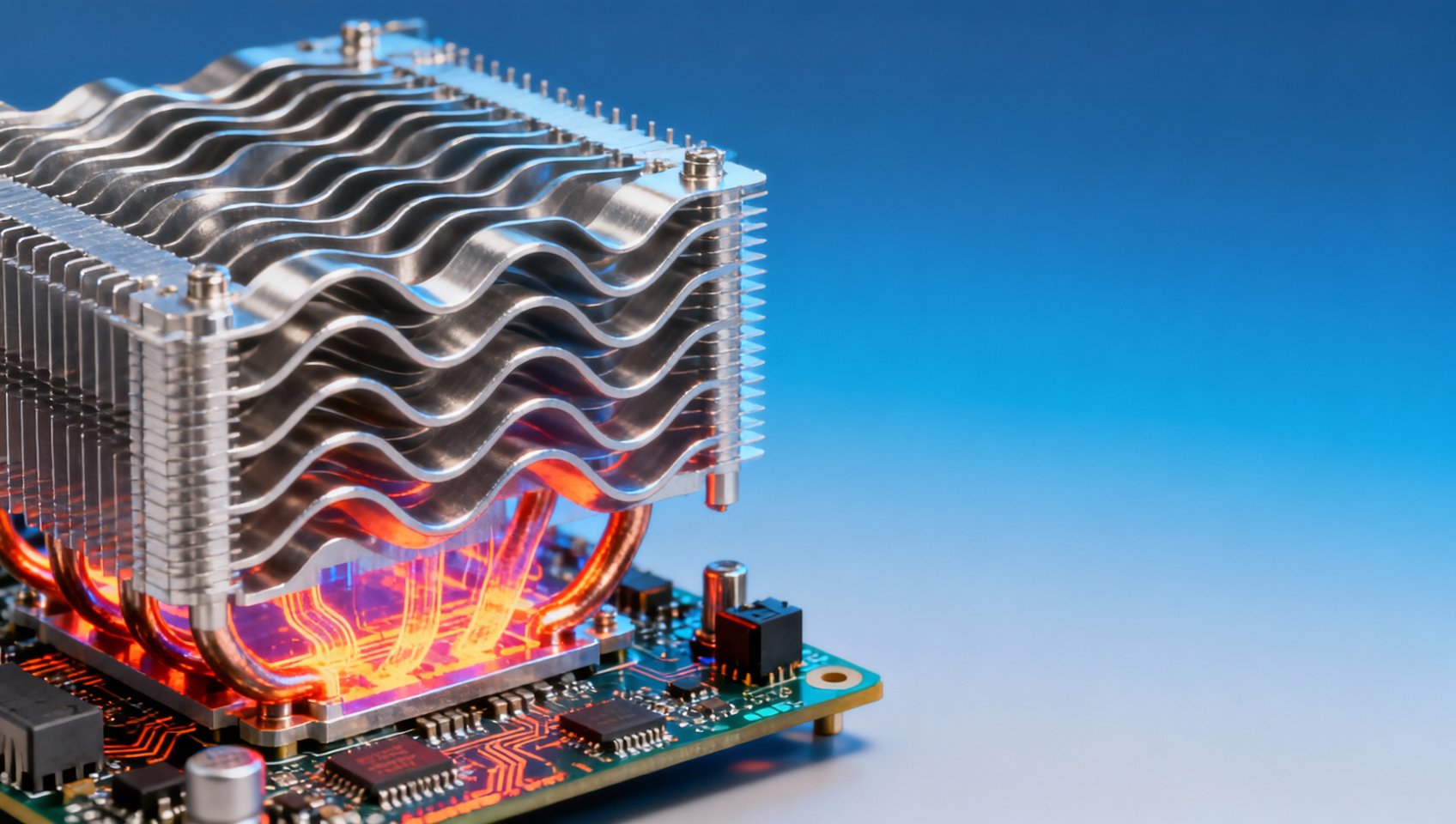
- Wave-shaped fins: Increase turbulent flow for 15-20% better convection
- Stepped fins: Optimize airflow distribution in vertical installations
- Skived fin designs: Achieve 0.3mm fin spacing for maximum density
- Hybrid fin structures: Combine different geometries for multi-zone cooling
RF Shielding Considerations
In RF applications, heat sinks must simultaneously manage thermal loads while maintaining EMI shielding effectiveness. Our testing shows that:
- Fin orientation parallel to PCB traces reduces capacitive coupling by 40-60%
- Grounding clips every 25-30mm maintain shielding integrity below 1GHz
- Anodized coatings provide 3-5dB better EMI attenuation than bare aluminum
Implementation and Procurement Guidance
When specifying heat sinks for production environments, consider these seven critical factors:
- Verify thermal resistance (Rθ) matches component requirements with 20-25% margin
- Confirm manufacturing tolerances meet IPC-7351B Class 2 or Class 3 standards
- Evaluate attachment methods (clips vs. thermal adhesives) for vibration resistance
- Request 500-hour salt spray test results for harsh environments
- Validate airflow compatibility with existing enclosure designs
- Review supplier's ISO 9001:2015 certification for quality systems
- Analyze total cost including machining, finishing, and assembly labor
Common Design Pitfalls
Through our failure analysis services, we've identified three frequent thermal design mistakes:
- Underestimating the impact of surface finish (mill finish vs. anodized can alter performance by 8-12%)
- Ignoring altitude effects (thermal resistance increases 1.2% per 300m above sea level)
- Overlooking TIM (thermal interface material) selection - poor choices can add 5-8°C to junction temperatures
Industry Trends and Future Developments
The thermal management sector is evolving rapidly to address emerging challenges in 5G, AI processors, and electric vehicle power electronics. Three key trends warrant attention:
- Additive manufacturing: Enables complex internal geometries with 30-50% better performance than traditional extrusion
- Phase-change materials: Absorb transient thermal loads in high-power pulse applications
- Smart heat sinks: Integrate temperature sensors and adaptive airflow control
Our latest market analysis projects the global advanced thermal solutions market to grow at 7.2% CAGR through 2028, driven by increasing power densities across all electronics sectors.
Conclusion and Technical Support
Optimizing heat sink fin design requires balancing thermal performance, mechanical constraints, and cost considerations. As power densities continue rising across industries, precision-engineered cooling solutions become critical for reliability and performance.
SiliconCore Metrics provides comprehensive thermal analysis services, including:
- Computational fluid dynamics (CFD) simulations
- Thermal imaging validation
- Material compatibility testing
- Supplier qualification audits
Contact our thermal engineering specialists for customized solutions meeting your specific power dissipation requirements and environmental conditions.
Recommended News
- Heat DissipationHow to prevent overheating in automotive PCB power distributionPrevent overheating in automotive PCB power distribution with practical tips on copper layout, thermal paths, and testing. Discover how to reduce hotspots and improve reliability.
- Heat DissipationCan heat spreading intelligence identify hot spots in PCB designs?Discover how heat spreading intelligence identifies PCB hot spots before fabrication. Learn to assess thermal models, validate predictions, and choose design changes that improve reliability.
- Heat DissipationWhich heat sink materials suit high-power electronics made in Germany?Heat sink materials Germany: compare aluminum, copper, graphite, and hybrid designs for high-power electronics. Find the right balance of thermal performance, weight, cost, and manufacturability.
- Heat DissipationHow to assess a graphite materials supplier's capability for thermal partsGraphite materials supplier assessment starts with more than machining. Discover how to evaluate thermal performance, purity, precision, cleanliness, traceability, and testing for reliable thermal parts.
- Heat DissipationHow to assess a heat dissipation supplier before placing an orderHeat dissipation supplier assessment guide: verify thermal performance, materials, process control, samples, capacity, and total risk before placing an order.
- Heat DissipationHow automotive PCB material selection affects thermal reliabilityAutomotive PCB material selection shapes thermal reliability. Explore CTE, Tg, moisture resistance, stack-up design, and proven qualification strategies for demanding vehicle electronics.