
Industrial Thermal Enclosure OEM: Key Risks Before Approval
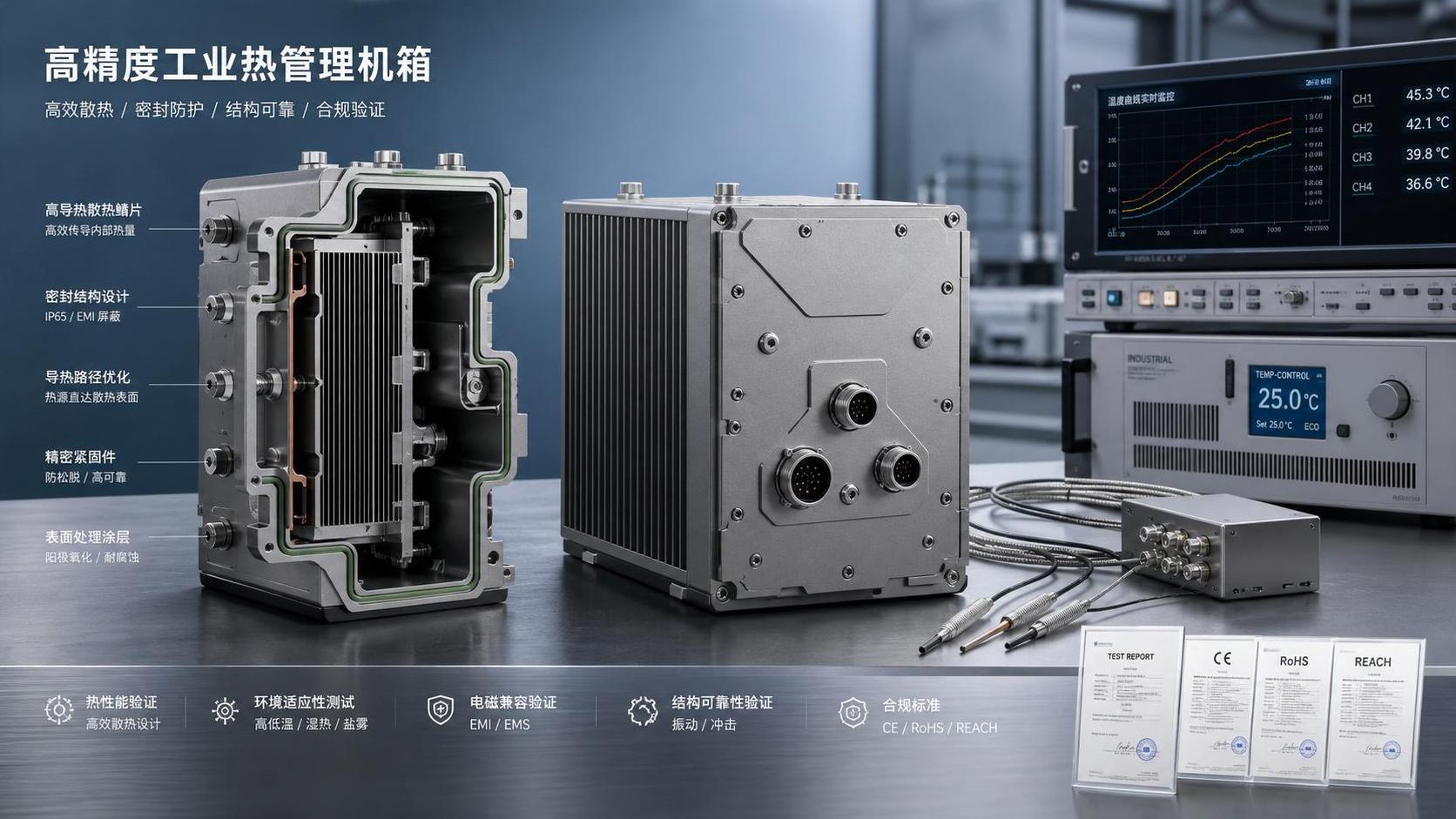
DETAILS
Industrial Thermal Enclosure OEM: Key Risks Before Approval
Approving an industrial thermal enclosure OEM sounds straightforward until the first field issue appears.
At that point, thermal drift, sealing failure, compliance gaps, and delayed corrective action quickly become commercial problems.
That is why industrial buyers should treat industrial thermal enclosure OEM selection as a structured risk decision, not a price comparison exercise.
The strongest suppliers usually prove capability through engineering data, process discipline, and repeatable production control.
From SCM’s perspective, the best approval process starts with one question: can this manufacturer protect performance at scale, under real operating stress?
Why Industrial Thermal Enclosure OEM Approval Carries More Risk Than It Seems
A thermal enclosure is rarely a simple metal box.
It affects heat dissipation, internal component life, ingress protection, EMI behavior, structural rigidity, and service access.
In industrial environments, those variables become harder to manage because ambient conditions are unstable.
Dust, vibration, temperature cycling, and fluctuating duty loads expose weak design assumptions very quickly.
A capable industrial thermal enclosure OEM should therefore validate more than dimensional accuracy.
It should demonstrate thermal modeling quality, production consistency, and post-build verification methods.
More importantly, the supplier should explain where performance margins come from and where they may collapse.
Risk 1: Thermal Performance Claims Without Measured Evidence
The first approval risk is trusting thermal claims that are based on assumptions instead of measured results.
Many enclosure vendors can discuss airflow, heatsinks, and materials in broad terms.
Far fewer can present chamber data, hotspot mapping, derating curves, and load-case comparisons.
This matters because nominal cooling capacity often fails under stacked tolerances.
A gasket change, fan variance, coating thickness, or assembly gap can alter actual heat transfer performance.
Before approving an industrial thermal enclosure OEM, ask for evidence in these areas:
- Thermal simulation assumptions and boundary conditions
- Measured temperature rise at worst-case power loads
- Validation under high ambient and cycling conditions
- Correlation between prototype and production units
- Clear pass or fail thresholds for mission-critical components
If the supplier cannot show this clearly, the thermal design may still be immature.
Risk 2: Material and Surface Choices That Undermine Reliability
Material selection is often treated as a sourcing detail, yet it strongly affects thermal and mechanical stability.
An industrial thermal enclosure OEM may offer aluminum, stainless steel, plated steel, or hybrid builds.
Each option changes conductivity, weight, corrosion behavior, manufacturability, and total lifecycle cost.
Surface treatments add another layer of risk.
Powder coating, anodizing, passivation, and EMI coatings can influence both dissipation and durability.
In real projects, failures often come from the interaction between materials rather than one obvious defect.
For example, galvanic corrosion, warpage, thread wear, or coating adhesion loss may appear after deployment.
A qualified industrial thermal enclosure OEM should document material traceability and environmental test results.
Risk 3: Compliance Coverage That Looks Complete but Is Not
Compliance risk is easy to underestimate because many suppliers present certificates early in the sales process.
The issue is not whether certificates exist.
The issue is whether they match your enclosure configuration, production site, and intended operating conditions.
That distinction becomes critical for sectors with strict uptime, safety, or export requirements.
A serious industrial thermal enclosure OEM should be able to map compliance evidence to product variants.
Review these checkpoints during approval:
- IP rating validation for the exact sealing design
- Material compliance linked to the current bill of materials
- EMI or EMC considerations when coatings and fasteners change
- Manufacturing site certifications, including ISO 9001 scope
- Document control for engineering changes after qualification
If a supplier cannot tie certifications to real production control, approval should pause there.
Risk 4: Process Capability That Breaks Down at Production Scale
A prototype can pass while mass production still fails.
That pattern is common when enclosure tolerances, assembly fit, and thermal interfaces are sensitive.
The underlying problem is process capability, not design intent.
An industrial thermal enclosure OEM should show how it controls flatness, hole position, weld distortion, interface pressure, and final inspection repeatability.
This is where supplier audits become practical rather than procedural.
Ask to see process control plans, gauge methods, and nonconformance handling.
More importantly, ask what defects increase when output ramps.
Suppliers with mature systems usually answer directly because they track those failure modes already.
A Practical Scale-Up Review Table
Risk 5: Weak Supply Continuity and Change Management
Even a technically strong industrial thermal enclosure OEM can create business risk through unstable supply management.
This becomes more visible during material shortages, demand spikes, or tooling transfers.
The key question is whether engineering changes are controlled with the same discipline as production.
A material substitution that seems minor can change thermal conductivity, corrosion resistance, or assembly behavior.
That also means procurement and engineering should review supplier resilience together.
Useful approval questions include lead-time buffers, second-source planning, tooling ownership, and revision notification rules.
In practice, strong OEM partners usually provide structured ECO workflows and documented deviation approvals.
How to Evaluate an Industrial Thermal Enclosure OEM More Effectively
A better approval process combines technical proof, operational evidence, and commercial transparency.
That sounds obvious, but many sourcing teams still overweight unit cost and underweight validation depth.
A practical review sequence usually works better:
- Define worst-case thermal and environmental loads before RFQ release.
- Require the industrial thermal enclosure OEM to submit validation data, not summary claims.
- Audit process capability on critical dimensions and thermal interfaces.
- Review compliance documents against the exact configuration under approval.
- Check change control, supply continuity, and field response procedures.
- Approve only after prototype results match scalable manufacturing conditions.
This approach shortens the distance between sourcing decisions and real operational outcomes.
What Stronger OEM Approval Looks Like
A reliable industrial thermal enclosure OEM does not rely on broad capability statements.
It shows data, explains limits, and connects engineering decisions to manufacturing discipline.
That is especially important when enclosure performance supports electronics with narrow thermal margins.
From a procurement decision standpoint, the real objective is not simply supplier approval.
It is reducing the chance of hidden failure after launch, scale-up, or site deployment.
SCM’s view is consistent across the semiconductor and EMS supply chain: hardware performance should be validated like a system, not purchased like a line item.
When reviewing an industrial thermal enclosure OEM, the best next step is a disciplined gap analysis against thermal data, compliance fit, process capability, and supply resilience.
That is usually where better decisions start, and where expensive surprises begin to disappear.
Recommended News
- Heat DissipationHow to prevent overheating in automotive PCB power distributionPrevent overheating in automotive PCB power distribution with practical tips on copper layout, thermal paths, and testing. Discover how to reduce hotspots and improve reliability.
- Heat DissipationCan heat spreading intelligence identify hot spots in PCB designs?Discover how heat spreading intelligence identifies PCB hot spots before fabrication. Learn to assess thermal models, validate predictions, and choose design changes that improve reliability.
- Heat DissipationWhich heat sink materials suit high-power electronics made in Germany?Heat sink materials Germany: compare aluminum, copper, graphite, and hybrid designs for high-power electronics. Find the right balance of thermal performance, weight, cost, and manufacturability.
- Heat DissipationHow to assess a graphite materials supplier's capability for thermal partsGraphite materials supplier assessment starts with more than machining. Discover how to evaluate thermal performance, purity, precision, cleanliness, traceability, and testing for reliable thermal parts.
- Heat DissipationHow to assess a heat dissipation supplier before placing an orderHeat dissipation supplier assessment guide: verify thermal performance, materials, process control, samples, capacity, and total risk before placing an order.
- Heat DissipationHow automotive PCB material selection affects thermal reliabilityAutomotive PCB material selection shapes thermal reliability. Explore CTE, Tg, moisture resistance, stack-up design, and proven qualification strategies for demanding vehicle electronics.