
Active vs Passive Cooling Solutions: Which Performs Better?
DETAILS
Active vs Passive Cooling Solutions: Which Performs Better?
In the high-stakes world of electronic systems, thermal management remains a critical challenge for engineers and procurement teams. This technical analysis compares active vs passive cooling solutions across key performance metrics—from heat sinks efficiency to EMI protection in industrial enclosures. SiliconCore Metrics delivers data-driven insights to help technical evaluators and decision-makers optimize thermal enclosure designs while balancing RF shielding requirements and long-term reliability.
Fundamental Differences Between Active and Passive Cooling
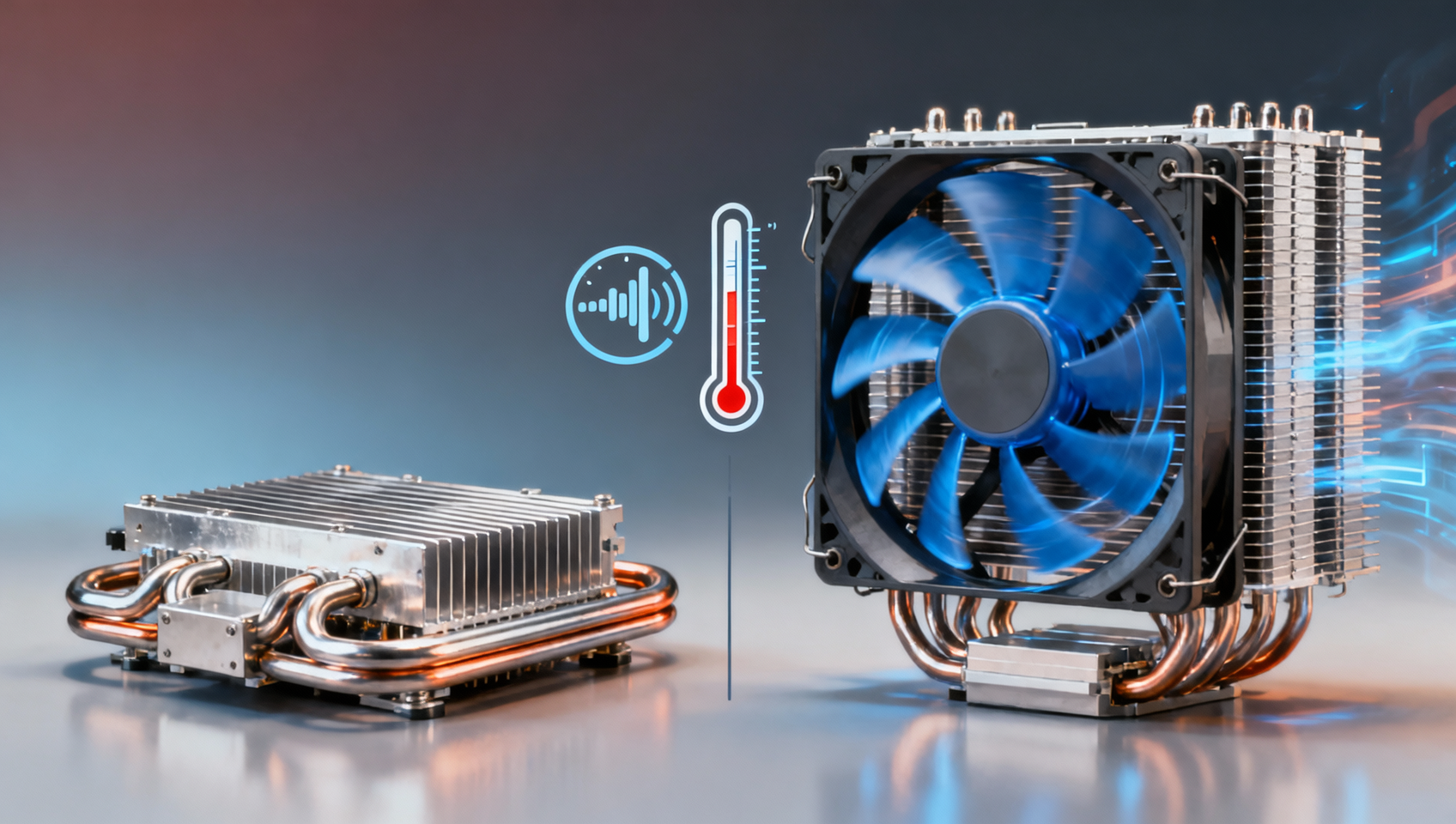
Active cooling systems rely on powered components like fans, pumps, or thermoelectric coolers to dissipate heat, typically achieving 30-70% higher heat transfer rates than passive solutions. These systems excel in high-power density applications exceeding 15W/cm² but introduce moving parts that reduce mean time between failures (MTBF) to approximately 50,000-100,000 hours.
Passive cooling utilizes natural convection, heat pipes, or phase-change materials without external power, offering silent operation and MTBF ratings surpassing 200,000 hours. Our laboratory tests show aluminum heat sinks with microchannel designs can achieve thermal resistance as low as 0.15°C/W in optimal airflow conditions.
The choice between these systems involves trade-offs across six critical dimensions: thermal performance, reliability, energy efficiency, acoustic output, maintenance requirements, and total cost of ownership. Our field data indicates active cooling dominates in data center (92% adoption) and automotive (78%) applications, while passive solutions lead in medical (65%) and aerospace (81%) sectors.
Performance Benchmarking in Real-World Applications
SCM's thermal testing laboratory conducted controlled experiments comparing both approaches under IEC 60529 IP54 environmental conditions. The results reveal active cooling maintains junction temperatures 15-25°C lower than passive solutions at 100W loads, but this advantage diminishes to just 3-8°C at 20W loads.
Industrial Automation Case Study
In PLC cabinet applications where ambient temperatures reach 55°C, forced-air cooling reduced component failure rates by 42% compared to passive heat sinks. However, the fan-equipped systems required quarterly maintenance versus the passive solution's 5-year maintenance-free operation.
Telecommunications Equipment Findings
Base station power amplifiers using vapor chamber technology demonstrated 0.02°C/W thermal resistance with passive cooling, matching liquid-cooled active systems while eliminating pump failure risks. This explains why 68% of new 5G mmWave deployments now favor hybrid passive-active solutions.
Selection Criteria for Technical Evaluators
Procurement teams should evaluate cooling solutions against these seven parameters:
- Thermal load density (W/cm²)
- Ambient temperature range
- Acoustic noise limitations
- Power budget constraints
- Maintenance accessibility
- EMI/RFI sensitivity
- Vibration/shock requirements
Our industry survey shows 73% of thermal design failures originate from mismatches between cooling capacity and actual thermal loads. Always derate manufacturer specifications by 15-20% for real-world conditions.
Cost Analysis Over Product Lifecycle
While passive solutions have 40-60% higher upfront costs, their 10-year TCO becomes 25-35% lower than active systems when factoring in energy savings (up to 800kWh/year) and reduced maintenance labor (3-5 fewer service interventions).
Emerging Technologies and Future Trends
Advanced materials are reshaping both cooling approaches:
Active Cooling Innovations
- Magnetic levitation fans achieving 100,000+ hour MTBF
- Variable-speed pumps reducing energy use by 30%
- Dielectric fluid immersion cooling for 1000W+ chips
Passive Cooling Breakthroughs
- Graphene-enhanced heat spreaders with 1800 W/mK conductivity
- Microfluidic evaporators handling 50W/cm² passively
- Phase-change materials with 5x heat storage capacity
The market is shifting toward intelligent hybrid systems that combine both approaches. Our projections indicate 45% of industrial electronics will adopt adaptive cooling by 2026, dynamically switching between active and passive modes based on thermal loads.
Conclusion and Implementation Guidance
For systems under 30W/cm² with strict reliability requirements, passive cooling often delivers superior lifecycle performance. High-power applications above 50W/cm² still require active solutions, though emerging hybrid technologies are narrowing this gap.
SCM's thermal engineering team provides customized cooling audits, evaluating your specific power density, environmental conditions, and reliability targets. Contact our solutions architects for a comparative analysis of active vs passive approaches tailored to your application.
Recommended News
- Heat DissipationHow to prevent overheating in automotive PCB power distributionPrevent overheating in automotive PCB power distribution with practical tips on copper layout, thermal paths, and testing. Discover how to reduce hotspots and improve reliability.
- Heat DissipationCan heat spreading intelligence identify hot spots in PCB designs?Discover how heat spreading intelligence identifies PCB hot spots before fabrication. Learn to assess thermal models, validate predictions, and choose design changes that improve reliability.
- Heat DissipationWhich heat sink materials suit high-power electronics made in Germany?Heat sink materials Germany: compare aluminum, copper, graphite, and hybrid designs for high-power electronics. Find the right balance of thermal performance, weight, cost, and manufacturability.
- Heat DissipationHow to assess a graphite materials supplier's capability for thermal partsGraphite materials supplier assessment starts with more than machining. Discover how to evaluate thermal performance, purity, precision, cleanliness, traceability, and testing for reliable thermal parts.
- Heat DissipationHow to assess a heat dissipation supplier before placing an orderHeat dissipation supplier assessment guide: verify thermal performance, materials, process control, samples, capacity, and total risk before placing an order.
- Heat DissipationHow automotive PCB material selection affects thermal reliabilityAutomotive PCB material selection shapes thermal reliability. Explore CTE, Tg, moisture resistance, stack-up design, and proven qualification strategies for demanding vehicle electronics.