
Reed Relays or Solid State: Which Fits Test Gear
DETAILS
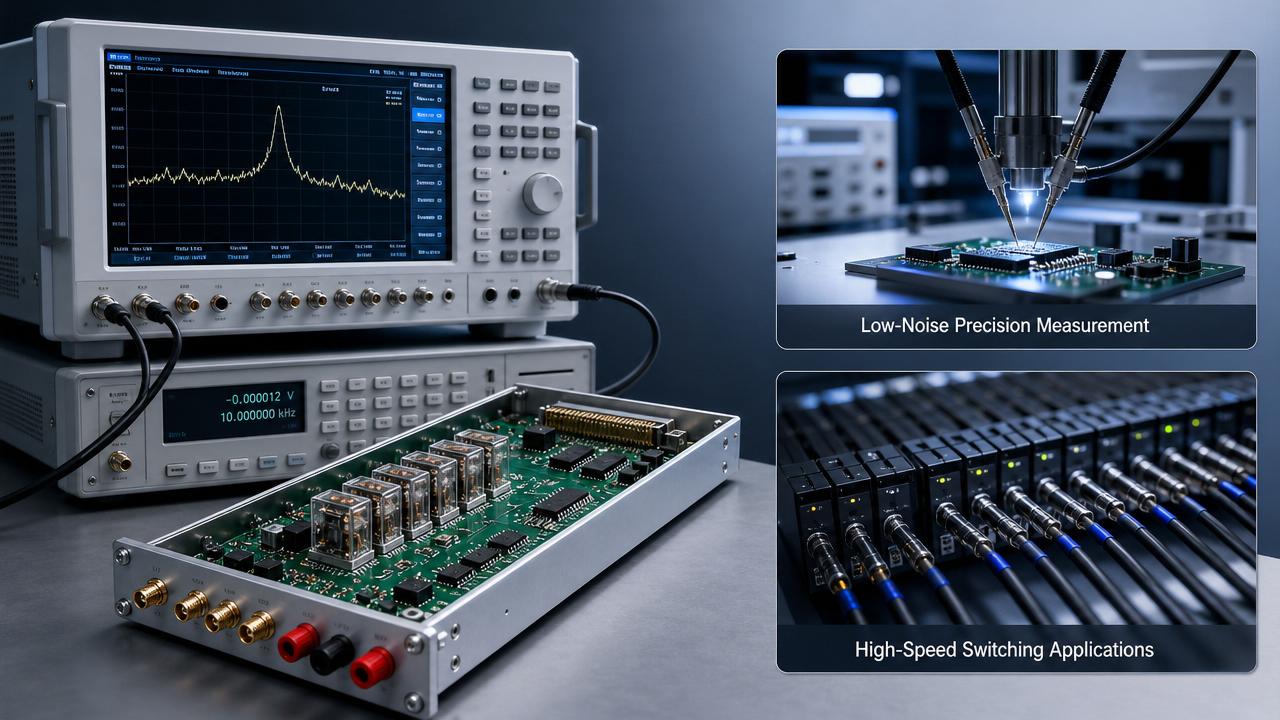
When choosing switching technology for precision test systems, the decision often narrows to reed relays or solid-state devices. In many modern benches, reed relays remain highly relevant because they balance signal fidelity, isolation, and practical lifecycle value.
For test gear used across electronics, semiconductor validation, EMS inspection, and mixed-signal measurement, the right switch depends on the scenario. A fast answer rarely works. What matters is matching switching behavior to measurement risk.
From SCM’s benchmarking perspective, data-driven selection reduces retest rates, protects instrument accuracy, and limits hidden maintenance cost. That is why understanding where reed relays fit better than solid-state options is still important.
Why the test scenario matters more than the technology label
A switch inside test gear does more than open and close a path. It influences leakage, contact resistance, capacitance, crosstalk, settling time, and long-term repeatability.
That means a switching choice should start with application context. Low-level analog measurement, RF routing, high-density multiplexing, and high-speed production screening all impose different constraints.
In many precision systems, reed relays are preferred when the signal must stay clean. Solid-state switching often wins when speed, silent operation, or massive cycle counts matter most.
A poor fit creates subtle errors. Offset drift, unstable readings, false failures, and calibration burden often come from the wrong switch architecture, not from the instrument itself.
Scenario 1: Low-level measurement paths usually favor reed relays
When test gear measures microvolts, low currents, or high insulation resistance, parasitics become critical. This is where reed relays often outperform solid-state alternatives.
Their mechanical contacts provide very low leakage and strong isolation. That helps preserve signal integrity in parametric testing, sensor simulation, and precision data acquisition.
For semiconductor characterization and board-level validation, low thermal EMF can also matter. In those setups, the clean metal contact behavior of reed relays can reduce measurement uncertainty.
Key judgment points in this scenario
- Leakage current must stay extremely low.
- Off-isolation is more important than switching speed.
- Signal distortion cannot be tolerated.
- Measurement repeatability matters more than throughput.
Scenario 2: High-speed automated screening often favors solid-state switching
Production environments with rapid channel scanning usually prioritize speed and endurance. Solid-state switches excel here because they switch quickly and tolerate very high cycle counts.
In burn-in racks, digital functional tests, and repetitive pass/fail screening, mechanical wear may become a constraint. Solid-state devices reduce bounce and allow faster sequencing.
Still, that advantage comes with trade-offs. Higher leakage, on-resistance variation, and charge injection can complicate sensitive analog paths.
If speed dominates and signals are tolerant, solid-state is often the better fit. If accuracy dominates, reed relays usually deserve a closer look.
Scenario 3: Mixed-signal test gear needs selective switching, not one universal answer
Many current systems test analog, digital, and power domains together. In those cases, hybrid architecture often performs better than choosing only one switching type.
A common approach uses reed relays on precision measurement nodes and solid-state switches on fast control or routing branches. This reduces compromise across the whole instrument.
That design logic is increasingly useful in semiconductor labs, automotive electronics validation, and EMS functional fixtures where test coverage keeps expanding.
Where hybrid switching makes sense
- One path handles precision analog sensing.
- Another path handles fast digital selection.
- Maintenance windows are limited.
- Test coverage changes frequently.
Scenario 4: Harsh environments shift the balance toward reliability details
Temperature swings, vibration, humidity, and contamination all affect switch behavior. Neither option is automatically superior without reviewing the operating environment.
Sealed reed relays can perform well in controlled but demanding measurement environments. Their hermetic construction helps protect contacts from external contamination.
Solid-state devices avoid mechanical contact wear, but thermal drift and electrical stress still require close attention. In dense systems, heat management can become the real reliability limiter.
This is especially relevant in compact ATE modules, thermal packaging validation, and continuous-duty racks where thermal accumulation changes electrical behavior over time.
How reed relays and solid-state options differ across test scenarios
Practical selection advice for different test gear requirements
A useful decision process starts with the measurement risk, not the component catalog. The following guidance helps narrow the choice quickly.
- Choose reed relays for electrometer paths, insulation tests, and low-level analog routing.
- Choose solid-state for very fast scanning, repetitive digital switching, and silent operation needs.
- Use hybrid switching when one instrument serves both precision and throughput targets.
- Review thermal load, leakage limits, and isolation before comparing purchase price.
- Validate with actual signal conditions, not only data sheet best-case numbers.
Questions worth asking during evaluation
- What is the smallest signal the path must preserve?
- How many cycles will the switch see per day?
- Is leakage or speed the larger system risk?
- Will thermal drift affect calibration intervals?
Common misjudgments when comparing reed relays and solid-state switches
One common mistake is assuming newer technology always replaces older designs. In precision instrumentation, reed relays still solve problems that solid-state devices may not handle as cleanly.
Another error is focusing only on rated life. Lifecycle cost also includes drift-related troubleshooting, failed retests, board redesigns, and calibration disruption.
A third oversight is ignoring off-state behavior. Leakage and parasitic coupling often matter more than headline switching speed in sensitive test gear.
Finally, some teams compare devices without system-level loading. Cable capacitance, fixture design, and thermal packaging can change real performance significantly.
What to do next when specifying switching for modern test systems
Start by mapping every signal path by sensitivity, switching frequency, voltage, and environmental stress. That simple matrix often shows where reed relays belong immediately.
Next, run a short benchmark using realistic loads. Compare leakage, settling, repeatability, and thermal drift under actual fixture conditions, not ideal lab assumptions.
For organizations managing semiconductor or EMS supply chains, independent engineering data adds confidence. Objective benchmarking supports better sourcing, lower failure risk, and more stable test coverage.
In the end, the best answer is not reed relays versus solid-state in general. It is which switching method fits each test scenario with the lowest measurement risk and strongest long-term value.
Recommended News
- RelaysHow to vet an industrial automation distributor for genuine relaysVet an industrial automation distributor with confidence. Learn how to verify relay authenticity, traceability, and quality controls to reduce downtime and sourcing risks.
- RelaysWhat Standard Tests Measure Relay Contact Resistance Degradation?Are there standard test methods for relay contact resistance degradation? Explore IEC standards, endurance testing, Kelvin measurement, and environmental validation for reliable relay sourcing.
- RelaysVietnam Tariff Shift Favors China-Origin Relays Until 2027Vietnam tariff shift favors China-origin relays until 2027. Learn how the 3% tax on non-ASEAN relay imports impacts sourcing, costs, and procurement strategy in Vietnam.
- RelaysJapan Enforces JIS C 5012:2026 Relay EMI Test RuleJapan Enforces JIS C 5012:2026 Relay EMI Test Rule: learn how the new 1.8-2.4 GHz radiated immunity and IEC 61000-4-3:2024 report requirements may impact relay compliance, cost, and Japan market access.
- RelaysWhen a Relay Switches Factory Becomes a Risk to Product QualityRelay switches factory risks can quietly damage product quality, safety, and reliability. Learn the warning signs, audit points, and how to choose a stable supplier.
- RelaysHow to Compare Relay Switches Factory Capabilities for Stable SupplyRelay switches factory comparison starts with capacity, quality control, traceability, and lead time stability. Learn how to identify reliable suppliers and reduce sourcing risk.