
Fast Switching Relays for ATE: Speed vs Signal Integrity
DETAILS
In ATE design, fast switching relays directly influence throughput, repeatability, and measurement trust. Higher switching speed shortens handler idle time and test sequence duration.
Yet speed alone does not define performance. Fast switching relays can also introduce bounce, parasitic capacitance, crosstalk, and impedance discontinuities that reduce signal integrity.
For semiconductor validation, board-level test, and EMS verification, that tradeoff matters. A relay that saves milliseconds may also distort low-level analog signals or high-frequency edges.
SiliconCore Metrics tracks these interactions through data-driven benchmarking. In practice, relay selection must balance cycle time, contact stability, bandwidth, thermal drift, and long-term reliability.
This article explains how fast switching relays affect ATE architecture, what signal risks appear first, and which selection methods improve both speed and measurement confidence.
Fundamentals of fast switching relays in ATE
Fast switching relays are electromechanical or solid-state devices that route signals quickly between instruments, fixtures, loads, and device pins inside automated test equipment.
Their main purpose is path control. They connect different resources without manual intervention and support dense test matrices across analog, digital, RF, and mixed-signal channels.
In ATE, switching time is often measured from control command to stable conduction. However, usable time also includes settling, bounce decay, and instrument synchronization.
That distinction is important. A nominally fast relay may not improve total test time if the signal needs extra settling before accurate sampling.
Common relay categories include:
- Electromechanical relays for low leakage and broad signal compatibility.
- Reed relays for fast operation, compact size, and strong repeatability.
- Solid-state relays for high speed and long cycle life.
- Hybrid architectures for mixed precision and throughput goals.
The best fast switching relays depend on signal type. DC parametric tests, RF paths, and power switching each stress different relay characteristics.
Why speed and signal integrity conflict
Fast switching relays improve index time, but every relay adds electrical and mechanical variables. As switching becomes faster, those variables become harder to ignore.
Mechanical contacts may bounce. Solid-state paths may add on-resistance, charge injection, or nonlinear capacitance. Either case can distort measurement windows.
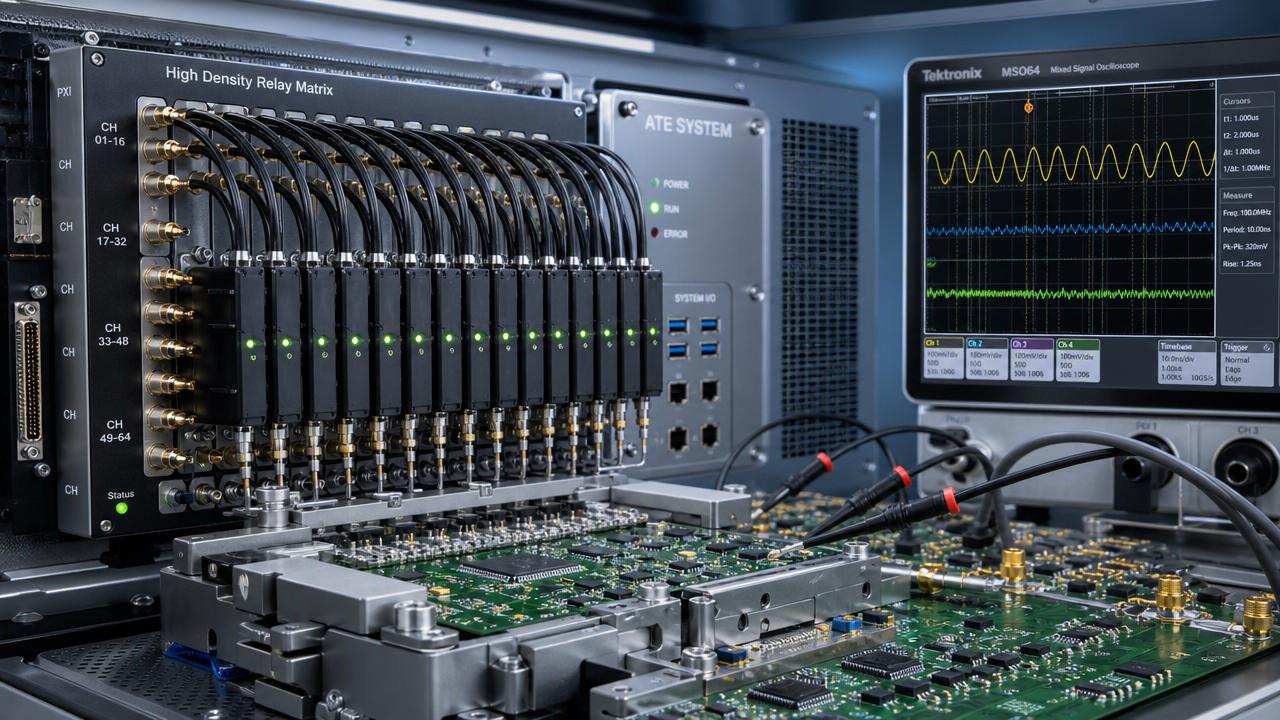
In high-speed ATE, the relay is not isolated from the channel. It becomes part of the signal path and changes the effective network seen by the instrument.
Several mechanisms drive the tradeoff:
- Contact bounce creates transient opens and short spikes.
- Parasitic capacitance limits bandwidth and slows edges.
- Parasitic inductance causes ringing and overshoot.
- Leakage current corrupts low-level measurements.
- Crosstalk couples activity between adjacent channels.
- Thermal drift shifts resistance and repeatability over time.
When test limits are tight, even small relay artifacts can alter pass-fail outcomes. That is why fast switching relays must be evaluated beyond datasheet switching speed.
Key performance metrics that matter most
A practical ATE review should compare fast switching relays across electrical, timing, and durability metrics rather than focusing on one headline number.
For fast switching relays, settling time often deserves more attention than operate time. It reflects actual readiness for measurement, not just motion completion.
Industry context across semiconductor and EMS environments
The pressure for faster test is rising across wafer sort, package test, board-level validation, and contract assembly verification. Device complexity keeps expanding channel counts and test vectors.
At the same time, tolerances are shrinking. Fine-pitch interconnects, higher data rates, and stricter compliance requirements increase sensitivity to relay-induced errors.
SCM sees three recurring market concerns in relay benchmarking:
- Test throughput targets are becoming aggressive in multi-site platforms.
- Signal integrity budgets are tightening in mixed-signal and RF paths.
- Reliability expectations now extend to harsher thermal and duty conditions.
These pressures affect the broader electronics supply chain. Relay behavior impacts fixture design, calibration frequency, retest rates, and final confidence in reported compliance data.
That makes fast switching relays a cross-functional engineering decision, not merely a catalog sourcing choice.
Operational value of selecting the right fast switching relays
The right relay strategy can improve more than speed. It can reduce false failures, extend maintenance intervals, and stabilize measurements across shifting environmental conditions.
When fast switching relays are properly matched to signal class, ATE systems gain measurable operational advantages:
- Shorter total test cycles without unstable data capture.
- Lower retest volume caused by switching artifacts.
- Better consistency across sites, lots, and fixtures.
- Reduced downtime linked to relay wear or drift.
- Higher trust in compliance reports and benchmark datasets.
This is especially relevant where IPC-Class 3 expectations, traceable test records, and ISO 9001 quality systems require repeatable, auditable signal behavior.
Typical ATE scenarios and relay selection priorities
Different test scenarios require different compromises. No single fast switching relays architecture fits every path in a modern ATE platform.
These examples show why fast switching relays should be mapped to channel intent, not chosen solely by advertised switching speed.
Practical engineering guidance for balancing speed and integrity
A disciplined selection process reduces compromise. The goal is to quantify relay impact inside the real signal chain, including fixture, cable, load, and instrument behavior.
1. Define the true measurement window
Measure stable acquisition time after switching. Do not rely only on operate time. Include bounce, settling, and software trigger delays.
2. Model parasitics at channel level
Use S-parameters, lumped models, or time-domain captures. Fast switching relays should be assessed as part of the interconnect network.
3. Separate precision paths from utility paths
Reserve premium low-leakage relays for critical measurements. Use faster or lower-cost switching where the signal budget is less sensitive.
4. Validate under thermal and duty stress
Relay behavior can shift with temperature, switching density, and load history. Life data matters as much as initial performance.
5. Control PCB layout around relay channels
Even excellent fast switching relays can underperform on poor layouts. Minimize stubs, manage return paths, and reduce channel coupling.
6. Track drift through periodic benchmarks
Benchmark insertion loss, leakage, resistance, and repeatability over time. Independent datasets help identify wear before field failures emerge.
Implementation next steps for data-driven relay decisions
Fast switching relays deliver real value when selection is tied to measured signal requirements, not broad assumptions about speed.
Start by ranking each ATE channel by sensitivity, bandwidth, leakage tolerance, cycle count, and thermal exposure. Then compare relay options against those quantified limits.
Next, build a verification plan that captures both throughput and signal integrity. Include settling data, eye quality, isolation, contact resistance drift, and life-cycle behavior.
For organizations needing independent benchmarking, SCM provides technical intelligence across semiconductors, PCB fabrication, SMT assembly, passive components, and thermal packaging.
That approach turns relay selection into an evidence-based engineering decision. In demanding ATE systems, the best fast switching relays are those that preserve speed without sacrificing trusted measurement outcomes.
Recommended News
- RelaysHow to vet an industrial automation distributor for genuine relaysVet an industrial automation distributor with confidence. Learn how to verify relay authenticity, traceability, and quality controls to reduce downtime and sourcing risks.
- RelaysWhat Standard Tests Measure Relay Contact Resistance Degradation?Are there standard test methods for relay contact resistance degradation? Explore IEC standards, endurance testing, Kelvin measurement, and environmental validation for reliable relay sourcing.
- RelaysVietnam Tariff Shift Favors China-Origin Relays Until 2027Vietnam tariff shift favors China-origin relays until 2027. Learn how the 3% tax on non-ASEAN relay imports impacts sourcing, costs, and procurement strategy in Vietnam.
- RelaysJapan Enforces JIS C 5012:2026 Relay EMI Test RuleJapan Enforces JIS C 5012:2026 Relay EMI Test Rule: learn how the new 1.8-2.4 GHz radiated immunity and IEC 61000-4-3:2024 report requirements may impact relay compliance, cost, and Japan market access.
- RelaysWhen a Relay Switches Factory Becomes a Risk to Product QualityRelay switches factory risks can quietly damage product quality, safety, and reliability. Learn the warning signs, audit points, and how to choose a stable supplier.
- RelaysHow to Compare Relay Switches Factory Capabilities for Stable SupplyRelay switches factory comparison starts with capacity, quality control, traceability, and lead time stability. Learn how to identify reliable suppliers and reduce sourcing risk.