
What Thermal Management Certification Covers in 2026
DETAILS
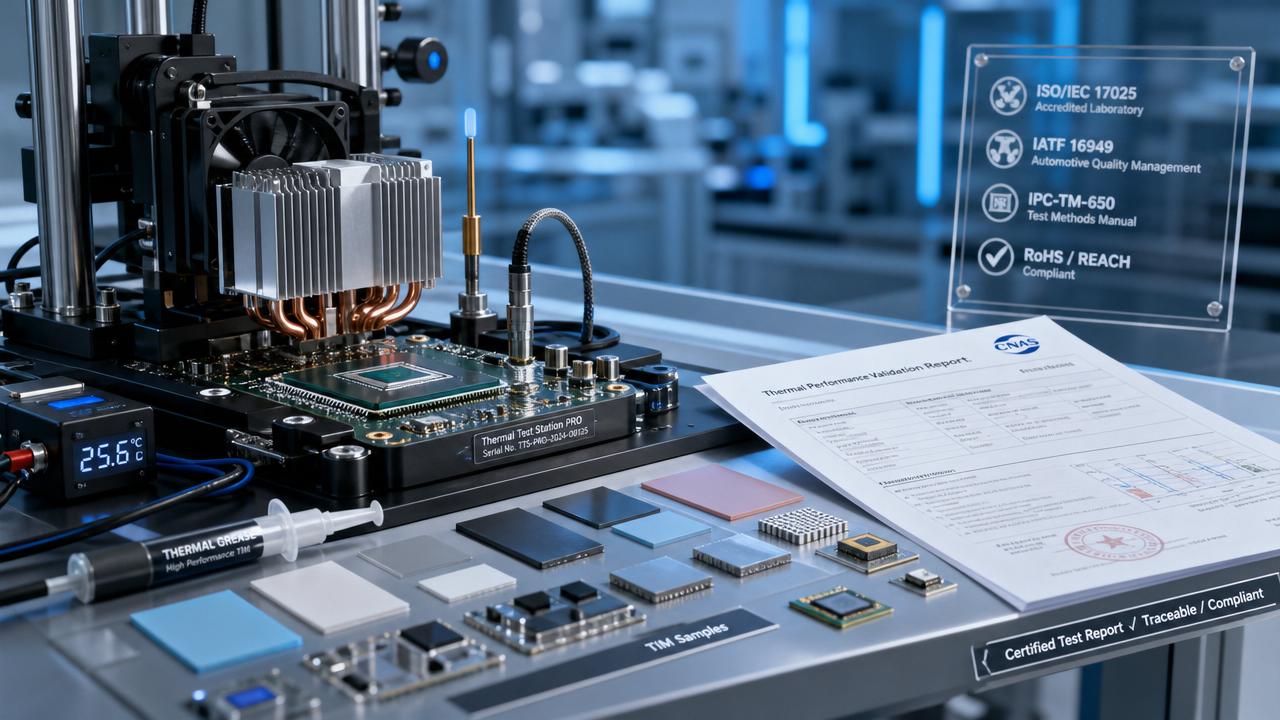
As heat density rises across semiconductors, PCB assemblies, and advanced electronic systems, thermal management certification is becoming a critical benchmark for reliability, compliance, and sourcing confidence in 2026.
For engineers, buyers, and technical researchers, the key question is simple: what does thermal management certification actually verify, and how useful is it for comparing products, materials, and suppliers?
In 2026, the answer is broader than many expect. Thermal management certification no longer refers only to a single thermal test or a generic safety review.
It increasingly covers material performance, thermal interface behavior, environmental durability, manufacturing consistency, compliance documentation, and traceable test conditions relevant to real electronic operating environments.
For information researchers, this matters because certification has become a shortcut for judging whether a component or manufacturing partner can support reliability goals without relying only on marketing claims.
At the same time, not all certifications mean the same thing. Some validate test methods, some validate factory systems, and others validate product-level thermal performance.
What searchers usually want to know about thermal management certification
Most users searching for thermal management certification are not looking for theory first. They want to understand coverage, practical meaning, and decision value.
Their real intent is usually to answer several business and technical questions quickly: what is being certified, who issues it, what tests are involved, and whether it reduces sourcing risk.
They also want to know if a certified thermal material, module, or supplier is actually more reliable in demanding applications such as power electronics, dense PCBs, EV systems, or advanced packaging.
That means the most useful explanation is not a broad definition of thermal management. It is a structured view of what certification covers in practice in 2026.
In 2026, thermal management certification usually covers five core areas
Across the electronics and semiconductor supply chain, thermal management certification commonly falls into five major coverage areas: thermal performance, material integrity, environmental reliability, process consistency, and compliance traceability.
These areas apply differently depending on whether the subject is a thermal interface material, heat spreader, substrate, enclosure design, PCB stack-up, power module, or full manufacturing process.
For procurement teams, the value lies in separating laboratory performance claims from independently verified performance under controlled standards and repeatable conditions.
For engineers, the value lies in understanding the exact test boundary conditions, because thermal performance numbers are only meaningful when test setup and operating assumptions are clear.
1. Verified thermal performance under defined test conditions
The first and most visible part of thermal management certification is measured thermal performance. This often includes thermal conductivity, thermal resistance, heat dissipation behavior, or junction temperature control capability.
In 2026, stronger certification frameworks place greater emphasis on the full test context, not just the headline number printed on a datasheet.
That means reporting sample thickness, clamping pressure, interface roughness, power load, ambient conditions, airflow assumptions, mounting geometry, and measurement method.
For example, a thermal interface material may show strong conductivity in one setup but weaker system-level performance when bond line thickness or contact pressure changes.
A useful certification therefore does more than confirm a number. It defines how that number was produced and whether the result is repeatable across comparable production lots.
This is especially important in semiconductor packaging, insulated metal substrates, vapor chambers, and high-density PCB assemblies where thermal bottlenecks often occur at interfaces rather than in bulk material.
2. Material composition, stability, and suitability for application
The second area covered by thermal management certification is material validation. In 2026, buyers increasingly expect proof that thermal materials remain stable under real use conditions.
This applies to thermal pads, gap fillers, phase-change materials, potting compounds, adhesives, greases, ceramic substrates, graphite sheets, and encapsulation materials.
Certification may assess composition consistency, filler dispersion, outgassing behavior, dielectric compatibility, mechanical integrity, and resistance to pump-out, dry-out, cracking, or delamination.
In practice, this helps users judge whether a thermal material is suitable for long-life systems rather than only for short-term lab demonstrations.
For electronics manufacturing services and OEM sourcing teams, this coverage is valuable because thermal failure often begins with material drift, not with immediate catastrophic breakdown.
A certified material should therefore show not only initial thermal efficiency but also stable behavior over time, especially under thermal cycling and humidity exposure.
3. Environmental and reliability testing for long-term operation
A major shift in 2026 is the stronger link between thermal management certification and reliability testing. Thermal performance is now expected to hold up under stress, not just at time zero.
As a result, certification increasingly includes thermal cycling, thermal shock, high-temperature storage, humidity bias exposure, mechanical vibration, and continuous load testing.
These tests matter because many electronics failures come from repeated expansion and contraction across dissimilar materials, solder interfaces, laminates, and package structures.
For example, a certified heat spreader assembly may need to demonstrate stable interface contact after repeated thermal excursions, while a PCB thermal material may need to resist delamination under moisture stress.
In power electronics and automotive-adjacent applications, long-term thermal reliability often matters more than peak thermal performance. A slightly lower initial value may still be better if durability is stronger.
That is why smart researchers look for certifications that include aging and stress data rather than relying only on room-temperature test results.
4. Manufacturing process control and repeatability
Another important part of thermal management certification in 2026 is process consistency. A material or product can test well once and still fail in volume production.
For this reason, many certification schemes now examine whether the manufacturer can reproduce thermal performance across batches, lines, and operating windows.
This may include process audits, statistical quality records, incoming material control, calibration records, curing or lamination controls, thickness tolerance checks, and traceability systems.
For EMS providers and semiconductor supply chain buyers, this area is often more important than a single thermal benchmark because repeatability determines field reliability and warranty risk.
Independent technical assessment is especially valuable here. It can reveal whether strong thermal claims depend on unusually narrow process conditions that may not hold at production scale.
In other words, certification should help answer not just “Can this work?” but “Can this be manufactured consistently without hidden thermal variance?”
5. Compliance documentation and audit-ready traceability
The fifth area is documentation. In 2026, thermal management certification increasingly supports compliance workflows, supplier qualification, and technical due diligence.
This means the certification package may include test reports, standard references, sample identification, revision control, lot traceability, laboratory methods, uncertainty statements, and audit records.
For multinational sourcing teams, this documentation reduces friction during qualification because it provides a common evidence base across engineering, quality, and procurement functions.
It also helps organizations compare suppliers more fairly. Without standardized reporting, two vendors may present similar thermal claims that are based on completely different assumptions.
Good certification does not eliminate the need for internal validation, but it improves transparency and shortens the path to informed decision-making.
What thermal management certification does not automatically guarantee
One common misunderstanding is that certification guarantees superior real-world performance in every use case. It does not.
A certified thermal product may still underperform if the application environment differs from the tested configuration, if assembly quality is poor, or if system airflow assumptions are unrealistic.
Likewise, a factory with quality certification does not automatically mean every thermal product from that site is independently performance-certified.
This distinction matters because the phrase thermal management certification can refer to different layers of assurance: product testing, material testing, manufacturing system approval, or standards compliance.
Searchers should therefore ask a simple follow-up question every time: certification of what, against which standard, under what conditions, and by whom?
How to evaluate whether a certification is meaningful
For information researchers comparing suppliers or technologies, the best approach is to evaluate certification quality, not just certification presence.
Start with the issuing body. Independent, technically credible organizations generally provide stronger decision value than self-declared internal reports.
Next, review the test method. Look for named standards, defined conditions, repeatability data, and application relevance rather than isolated performance numbers.
Then check the scope. Does the certification cover raw material, finished product, assembled subsystem, or factory process? The answer changes how much confidence it should provide.
Also review aging and environmental data. In 2026, any serious thermal management certification should show how performance changes over time, not only at initial measurement.
Finally, examine traceability. If samples, revisions, and lot identity are unclear, certification value drops because results may not map reliably to current production.
Why certification matters more in high-density electronics in 2026
The importance of thermal management certification is rising because electronic systems are becoming more thermally constrained at nearly every level of integration.
Higher power densities, thinner form factors, tighter packaging, AI hardware demand, electrification trends, and faster switching devices all increase thermal stress.
As a result, even small differences in interface resistance, substrate behavior, or assembly variation can have outsized effects on reliability, performance throttling, and lifecycle cost.
This is especially relevant in semiconductors, advanced PCB fabrication, SMT assemblies, and thermal packaging, where heat paths cross multiple materials and manufacturing steps.
In these environments, certification is not just a compliance checkbox. It becomes part of technical risk management and supplier intelligence.
What engineers and procurement teams should ask suppliers next
If a vendor claims thermal management certification, the next questions should be specific and evidence-based.
Ask which standard or framework was used, whether the testing was independent, what the sample configuration was, and whether results reflect current production conditions.
Ask how thermal performance changes after cycling, humidity exposure, vibration, and long-term storage. Ask whether process capability data is available for volume manufacturing.
For PCB, semiconductor, and EMS sourcing, also ask how the certified thermal behavior interacts with adjacent materials such as laminates, solders, underfills, housings, and mounting hardware.
These follow-up questions often reveal whether certification is a strong technical qualification tool or only a marketing label.
Conclusion: what thermal management certification really covers in 2026
In 2026, thermal management certification covers far more than a simple heat rating. At its best, it validates thermal performance, material stability, environmental durability, manufacturing consistency, and compliance traceability.
For information researchers, its real value lies in making thermal claims comparable, auditable, and more trustworthy across the global electronics supply chain.
Still, certification should be read carefully. Its usefulness depends on scope, test relevance, independence, and production traceability.
If you treat thermal management certification as a structured evidence set rather than a generic badge, it becomes a practical tool for evaluating suppliers, materials, and long-term reliability risk.
That mindset is increasingly essential in semiconductor and EMS markets where thermal margins are shrinking and data transparency matters more than ever.
Recommended News
- Heat DissipationHow to prevent overheating in automotive PCB power distributionPrevent overheating in automotive PCB power distribution with practical tips on copper layout, thermal paths, and testing. Discover how to reduce hotspots and improve reliability.
- Heat DissipationCan heat spreading intelligence identify hot spots in PCB designs?Discover how heat spreading intelligence identifies PCB hot spots before fabrication. Learn to assess thermal models, validate predictions, and choose design changes that improve reliability.
- Heat DissipationWhich heat sink materials suit high-power electronics made in Germany?Heat sink materials Germany: compare aluminum, copper, graphite, and hybrid designs for high-power electronics. Find the right balance of thermal performance, weight, cost, and manufacturability.
- Heat DissipationHow to assess a graphite materials supplier's capability for thermal partsGraphite materials supplier assessment starts with more than machining. Discover how to evaluate thermal performance, purity, precision, cleanliness, traceability, and testing for reliable thermal parts.
- Heat DissipationHow to assess a heat dissipation supplier before placing an orderHeat dissipation supplier assessment guide: verify thermal performance, materials, process control, samples, capacity, and total risk before placing an order.
- Heat DissipationHow automotive PCB material selection affects thermal reliabilityAutomotive PCB material selection shapes thermal reliability. Explore CTE, Tg, moisture resistance, stack-up design, and proven qualification strategies for demanding vehicle electronics.