
Thermal Management Certification: Key Tests That Matter
DETAILS
Thermal Management Certification Is Becoming a Strategic Reliability Signal
For technical evaluators, thermal management certification now signals far more than basic compliance.
It reflects whether a device, module, board, or package can survive rising power density and tighter performance margins.
Across semiconductor, EMS, PCB, and thermal packaging applications, heat is no longer a secondary design concern.
It directly affects electrical stability, lifetime, safety, and field failure rates.
That is why thermal management certification has become a key comparison factor in qualification and sourcing decisions.
The most useful certifications are built on test methods that reproduce real stress, not ideal lab conditions.
Independent technical benchmarking also matters because thermal claims often vary across materials, test fixtures, and reporting standards.
In this environment, data transparency helps teams compare thermal paths, interface quality, and long-term reliability with greater confidence.
Why the Importance of Thermal Management Certification Is Rising
Several market signals are pushing thermal management certification into earlier design and approval stages.
Chiplet architectures, compact enclosures, AI workloads, power electronics, and automotive electrification all increase heat concentration.
At the same time, product lifecycles demand longer service intervals and fewer unexpected shutdowns.
Thermal underperformance now creates cascading issues across solder joints, dielectric materials, active devices, and passive components.
This makes thermal management certification valuable not only for validation, but also for supply chain risk reduction.
The trend is strongest where thermal budgets are narrow and failure costs are high.
Current signals shaping evaluation priorities
- Higher watt density in smaller footprints
- More frequent use of advanced TIMs and vapor chambers
- Tighter reliability demands in IPC-Class 3 environments
- Broader use of extreme environmental stress validation
- Greater scrutiny of supplier test methods and reporting consistency
The Key Drivers Behind Stronger Thermal Test Expectations
The rise of thermal management certification is driven by measurable engineering and business factors.
The table below summarizes the most important forces behind stricter thermal qualification demands.
Which Tests Matter Most in Thermal Management Certification
Not every thermal test carries equal decision value.
The strongest thermal management certification programs combine steady-state, transient, interface, and durability measurements.
1. Thermal resistance testing
Thermal resistance remains a foundation metric in thermal management certification.
It measures how effectively heat moves from junction to case, board, sink, or ambient.
Useful reports clearly define fixture conditions, airflow, mounting pressure, and power load.
Without those details, comparisons are often misleading.
2. Thermal conductivity verification
Material suppliers frequently advertise conductivity values under selective conditions.
Certification-grade testing verifies bulk and effective conductivity in practical assemblies.
This matters for gap fillers, pads, adhesives, ceramic substrates, and metal-core structures.
3. Thermal interface resistance measurement
A strong material can still fail in use because contact surfaces behave differently under pressure and aging.
Interface resistance testing reveals how much performance is lost between mating surfaces.
It is especially important in heatsinks, lids, power modules, and high-density packages.
4. Thermal cycling and shock testing
Thermal management certification should include reliability under repeated expansion and contraction.
Thermal cycling exposes solder fatigue, delamination, cracking, and pump-out in interface materials.
Thermal shock adds faster transitions and often reveals weak package-to-board interactions.
5. Power cycling validation
Power cycling simulates internal heating and cooling during actual switching or processing behavior.
It is highly relevant for semiconductors, power devices, and assemblies facing intermittent peak loads.
This test often exposes failures missed by passive ambient cycling.
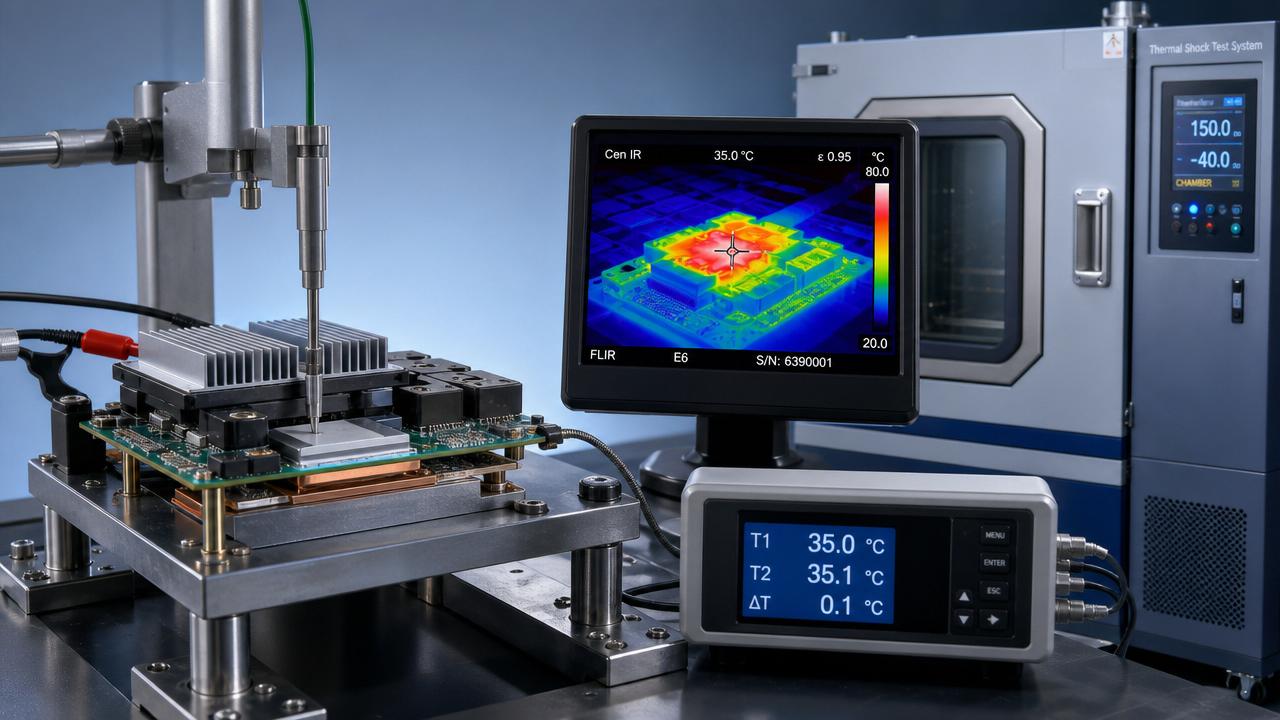
6. Infrared thermography and hot-spot mapping
Surface temperature mapping gives visual evidence of heat concentration and spread.
When paired with calibrated sensors, it helps validate model assumptions and identify local risk zones.
This strengthens thermal management certification by connecting numbers to physical behavior.
7. Environmental stress and humidity exposure
Heat rarely acts alone in field conditions.
Moisture, contaminants, and bias conditions can change thermal paths and accelerate degradation.
Combined stress testing better reflects long-term reliability expectations.
How These Certification Tests Influence Broader Business Decisions
The influence of thermal management certification extends across design review, component approval, and supplier qualification.
Reliable thermal data reduces uncertainty when comparing packages, substrates, TIMs, and assembled modules.
It also shortens rework loops caused by thermal surprises discovered late in validation.
In cross-border manufacturing environments, standardized certification improves communication around performance expectations.
That aligns well with SCM’s role in translating complex thermal and manufacturing metrics into comparable reports.
Areas most affected by stronger thermal evidence
- Package selection and board stack-up decisions
- TIM choice, compression window, and assembly control
- Warranty risk and field reliability forecasting
- Second-source qualification and regional supplier comparison
- Compliance reporting tied to IPC-Class 3 and ISO 9001 processes
What to Check Before Accepting Any Thermal Management Certification
A certificate alone is not enough.
Its technical value depends on the quality, transparency, and relevance of the supporting evidence.
- Confirm the exact standard, method, and pass criteria used
- Review test fixture geometry and mounting conditions
- Check whether airflow, pressure, and power levels reflect real use
- Look for pre- and post-aging performance comparisons
- Compare sample size, repeatability, and statistical spread
- Assess whether independent labs validated supplier claims
- Verify that thermal management certification covers the full assembly path
A Practical Framework for Smarter Next-Step Evaluation
A structured review process improves the usefulness of thermal management certification.
The goal is to connect thermal test results with actual operating risk.
The Direction Ahead for Thermal Qualification and Benchmarking
Thermal qualification is moving toward more integrated, data-rich, and application-specific certification models.
Static pass or fail reporting will not be enough for high-density electronics.
Future thermal management certification will increasingly combine physical testing, simulation correlation, and long-horizon reliability evidence.
That shift favors organizations able to interpret thermal data across PCB fabrication, SMT assembly, semiconductors, passive components, and thermal packaging.
Independent repositories such as SCM are well positioned to support this need through standardized benchmarking and technical intelligence.
If thermal management certification is part of an upcoming evaluation, start by mapping the highest-risk thermal interfaces.
Then compare supplier data against independent test criteria, aging behavior, and real operating conditions.
A disciplined approach turns certification from a document into a practical reliability advantage.
Recommended News
- Heat DissipationHow to prevent overheating in automotive PCB power distributionPrevent overheating in automotive PCB power distribution with practical tips on copper layout, thermal paths, and testing. Discover how to reduce hotspots and improve reliability.
- Heat DissipationCan heat spreading intelligence identify hot spots in PCB designs?Discover how heat spreading intelligence identifies PCB hot spots before fabrication. Learn to assess thermal models, validate predictions, and choose design changes that improve reliability.
- Heat DissipationWhich heat sink materials suit high-power electronics made in Germany?Heat sink materials Germany: compare aluminum, copper, graphite, and hybrid designs for high-power electronics. Find the right balance of thermal performance, weight, cost, and manufacturability.
- Heat DissipationHow to assess a graphite materials supplier's capability for thermal partsGraphite materials supplier assessment starts with more than machining. Discover how to evaluate thermal performance, purity, precision, cleanliness, traceability, and testing for reliable thermal parts.
- Heat DissipationHow to assess a heat dissipation supplier before placing an orderHeat dissipation supplier assessment guide: verify thermal performance, materials, process control, samples, capacity, and total risk before placing an order.
- Heat DissipationHow automotive PCB material selection affects thermal reliabilityAutomotive PCB material selection shapes thermal reliability. Explore CTE, Tg, moisture resistance, stack-up design, and proven qualification strategies for demanding vehicle electronics.