
How R&D Engineers Reduce EMI in RF Module Layouts
DETAILS
For R&D engineers working on RF modules, EMI is not just a layout issue—it directly affects signal stability, compliance, and product reliability. From grounding strategy to component placement and trace routing, every design choice matters. This article explores practical layout methods that help reduce electromagnetic interference while supporting high-performance, manufacturable RF designs.
Why EMI Control Matters in RF Module Layouts
For R&D engineers, EMI control begins long before final testing. It starts at schematic partitioning and continues through stack-up, placement, routing, shielding, and validation.
In RF modules, unwanted coupling can raise the noise floor, detune matching networks, and degrade receiver sensitivity. Small layout errors often create large performance shifts at high frequencies.
This concern extends across the semiconductor and EMS supply chain. Layout quality influences regulatory success, yield stability, field reliability, and the repeatability of assembled hardware.
Independent technical review is valuable here. SiliconCore Metrics (SCM) supports data-driven engineering decisions by analyzing PCB materials, assembly precision, component behavior, and compliance risk factors.
Core EMI Sources That R&D Engineers Must Identify
Before solving EMI, R&D engineers need a clear model of where interference originates. In RF modules, the most common sources are both intentional and parasitic.
- High-speed digital clocks leaking into RF paths
- Poor return-current paths under controlled-impedance traces
- Power supply ripple coupling into amplifiers and mixers
- Long stubs and vias creating resonant structures
- Inadequate shielding between transmit and receive sections
- Ground discontinuities around antennas, filters, and baluns
These issues rarely appear alone. A noisy converter, weak grounding, and poor placement can combine into broad EMI failures that are difficult to isolate late in development.
Industry Focus Areas in Modern RF Design
Current RF products demand tighter integration, smaller footprints, and faster release cycles. As a result, R&D engineers face higher EMI risk in less board area.
Several industry trends are shaping layout priorities:
In this environment, R&D engineers benefit from benchmark data on dielectric constants, placement accuracy, and component drift under temperature and vibration stress.
Layout Methods That Reduce EMI at the Board Level
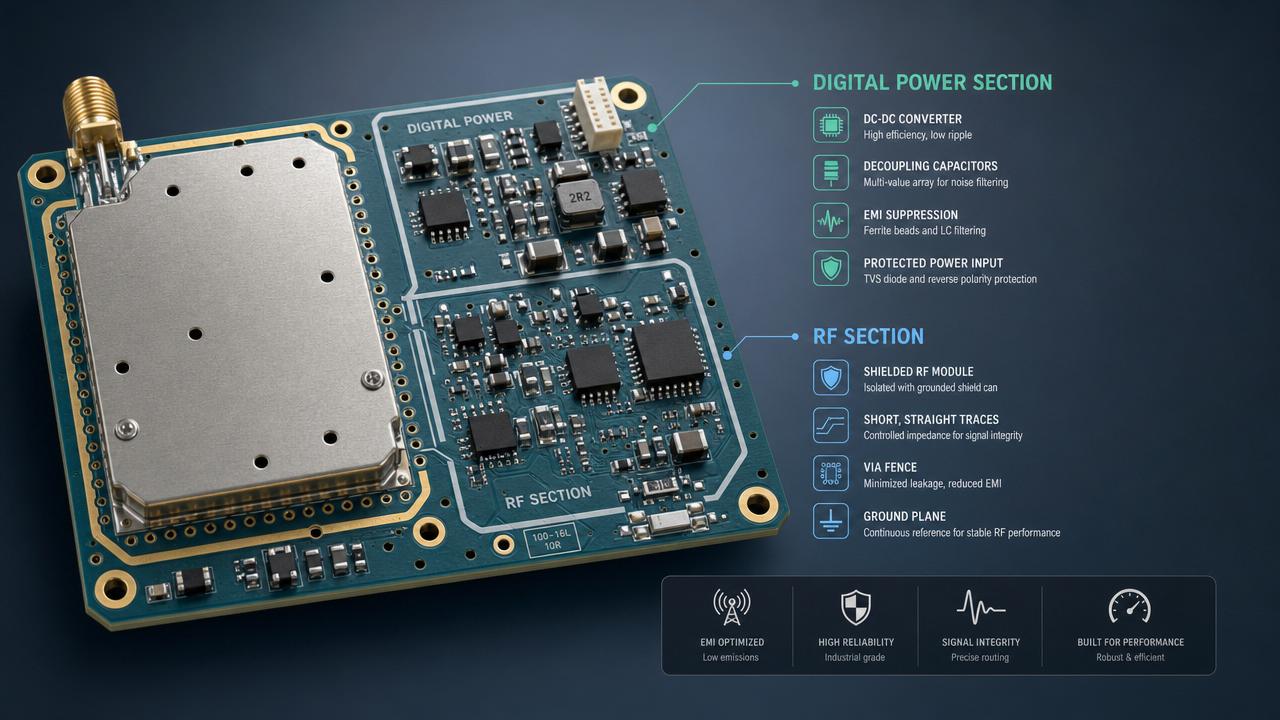
Partition RF, digital, and power zones
R&D engineers should divide the board into functional regions before placement begins. Keep RF front ends away from switching regulators, clocks, memory buses, and high-current drivers.
Signal flow should remain linear. Avoid layouts that force RF traces to cross noisy regions or pass near power inductors and crystal circuits.
Build a continuous ground reference
A solid ground plane is one of the most effective EMI controls. It lowers return-path impedance and reduces loop area for high-frequency currents.
R&D engineers should avoid splits beneath critical RF traces. If layer transitions are necessary, place stitching vias near the signal via to maintain return continuity.
Control trace geometry and routing length
Shorter RF paths generally reduce radiation and insertion loss. Maintain controlled impedance, minimize bends, and avoid unnecessary test pads or stubs on sensitive nets.
When bends are unavoidable, use gentle curves or two 45-degree segments. This helps R&D engineers reduce discontinuities that can reflect energy and promote coupling.
Use decoupling as a placement discipline
Decoupling capacitors work best when placed very close to device power pins. The loop from capacitor to pin to ground should be as small as possible.
For RF modules, R&D engineers often combine bulk, mid-frequency, and high-frequency capacitors. This supports wideband suppression of supply noise entering active devices.
Add via fences and localized shielding
Via stitching around RF traces, module edges, and noisy blocks can improve field containment. It also strengthens the ground boundary near sensitive transmission paths.
Where board density allows, shield cans may isolate low-noise amplifiers, oscillators, or mixers. However, shielding should support the layout, not compensate for weak routing decisions.
Business and Engineering Value of Better EMI Layouts
Effective EMI layout does more than improve lab performance. It creates measurable value across development, qualification, and manufacturing.
- Fewer board spins caused by emission or sensitivity problems
- Faster pre-compliance and certification progress
- Higher repeatability across PCB and SMT production lots
- Lower risk from supplier variation in laminates and components
- Stronger long-term reliability under thermal and mechanical stress
For R&D engineers, this means layout quality is not only a technical task. It is also a risk-control method tied to cost, schedule, and field stability.
SCM’s focus on independent benchmarking supports this process. Reliable data on materials, assembly precision, and component endurance helps teams predict EMI behavior more accurately.
Typical RF Module Scenarios and Layout Priorities
Different module types expose R&D engineers to different EMI risks. The layout response should match the signal environment and operating conditions.
This scenario-based approach helps R&D engineers prioritize the most influential changes instead of applying generic rules without frequency or product context.
Practical Review Checklist for R&D Engineers
A structured review before prototype release can catch many EMI problems early. The checklist below is useful during layout audits and design signoff.
- Confirm functional zoning between RF, digital, and power blocks.
- Check that every critical RF trace has a continuous reference plane.
- Review matching networks for shortest possible placement.
- Verify decoupling capacitor distance and via count.
- Inspect return-current paths at each layer transition.
- Measure spacing between antennas, clocks, and converters.
- Evaluate shielding, via fences, and ground stitching density.
- Align PCB design choices with IPC-Class 3 and ISO 9001 requirements where relevant.
R&D engineers should also compare simulation assumptions with actual PCB materials and SMT tolerances. Real manufacturing variation can shift impedance and EMI behavior significantly.
Next-Step Approach for More Reliable RF Layout Decisions
The best EMI outcomes come from combining layout discipline with measured data. R&D engineers should integrate stack-up validation, placement review, and pre-scan planning into one workflow.
A practical next step is to benchmark current designs against independent material, assembly, and reliability data. This makes hidden risk factors easier to identify before compliance failure appears.
SiliconCore Metrics provides technical intelligence that supports this effort, especially where PCB dielectric behavior, SMT precision, and component reliability affect EMI performance.
For R&D engineers, better RF layout is not a single fix. It is a repeatable engineering method that turns cleaner signals, stronger compliance, and more dependable products into standard practice.
Recommended News
- RF ModulesHow PCB layout affects the performance of surface mount RF modulesSurface mount RF modules depend on smart PCB layout. Discover how impedance, grounding, placement, and thermal design affect RF performance—and avoid costly integration errors.
- RF ModulesHow dielectric constant affects impedance stability in RF modulesDielectric constant for RF modules directly affects impedance stability. Learn how Dk variation, stackup control, frequency, and fabrication impact RF performance.
- RF ModulesHow to Choose Low Power Wireless Modules for Battery-Driven DevicesWireless modules low power selection starts with real energy use, not datasheet claims. Learn how to compare RF, protocol fit, battery life, and reliability for smarter device design.
- RF ModulesEU WEEE Rule Takes Effect for Leaded RF ModulesEU WEEE rule now impacts leaded RF modules at import: Bluetooth and Wi-Fi shipments may be blocked without a Pb-exemption code. Learn key compliance steps to avoid customs delays.
- RF ModulesLow Power RF Transmitter Range Limits in Real DeploymentsLow power RF transmitter range depends on antennas, interference, enclosures, and regulations. Learn what really limits field performance and how to plan reliable deployment.
- RF ModulesRF Transmitter Price Breakdown: What Drives Total CostRF transmitter price depends on more than the quote. Discover how specs, certification, materials, and reliability testing shape total cost and smarter supplier decisions.