
How to Improve Heat Dissipation Without Redesign
DETAILS
Improving heat dissipation without a full redesign is usually possible if the thermal bottleneck is not architectural. In practice, many overheating issues come from assembly quality, interface resistance, airflow inefficiency, component derating gaps, or material choices that can be corrected faster and at far lower cost than a board or enclosure redesign. For engineering teams, buyers, quality managers, and project owners, the key is to identify which thermal fixes deliver measurable temperature reduction without introducing new reliability, compliance, or sourcing risk.
For semiconductor and EMS decision-makers, this is not only a thermal question. It is also a question of manufacturability, component compliance, field reliability, cost control, and procurement timing. A practical thermal improvement plan should therefore focus on verifiable changes such as thermal interface upgrades, assembly process optimization, copper utilization, component replacement within footprint limits, airflow path correction, and better validation methods.
Start with the real question: is the heat problem caused by design limits or by implementation losses?
Before changing materials or suppliers, teams should determine whether the temperature issue comes from the fundamental power density of the product or from avoidable thermal resistance in the current build. This distinction matters because many products appear to need a redesign when the real cause is poor heat transfer at one or two interfaces.
Typical non-redesign thermal losses include:
- Uneven or excessive thermal interface material (TIM)
- Low clamp force between heat source and heatsink
- Void formation in SMT soldering or thermal pads
- Localized hot spots created by component clustering
- Blocked airflow near tall components or cable bundles
- Underperforming capacitors, regulators, or power semiconductors with higher loss than expected
- PCB stackup or copper distribution that is acceptable electrically but weak thermally
If the temperature rise is driven mainly by these losses, heat dissipation can often be improved without changing the main product architecture. That is good news for project managers, procurement teams, and finance approvers because corrective action can stay within existing qualification boundaries.
What changes usually work without a redesign?
The most effective non-redesign improvements tend to fall into five practical categories.
1. Improve thermal interfaces
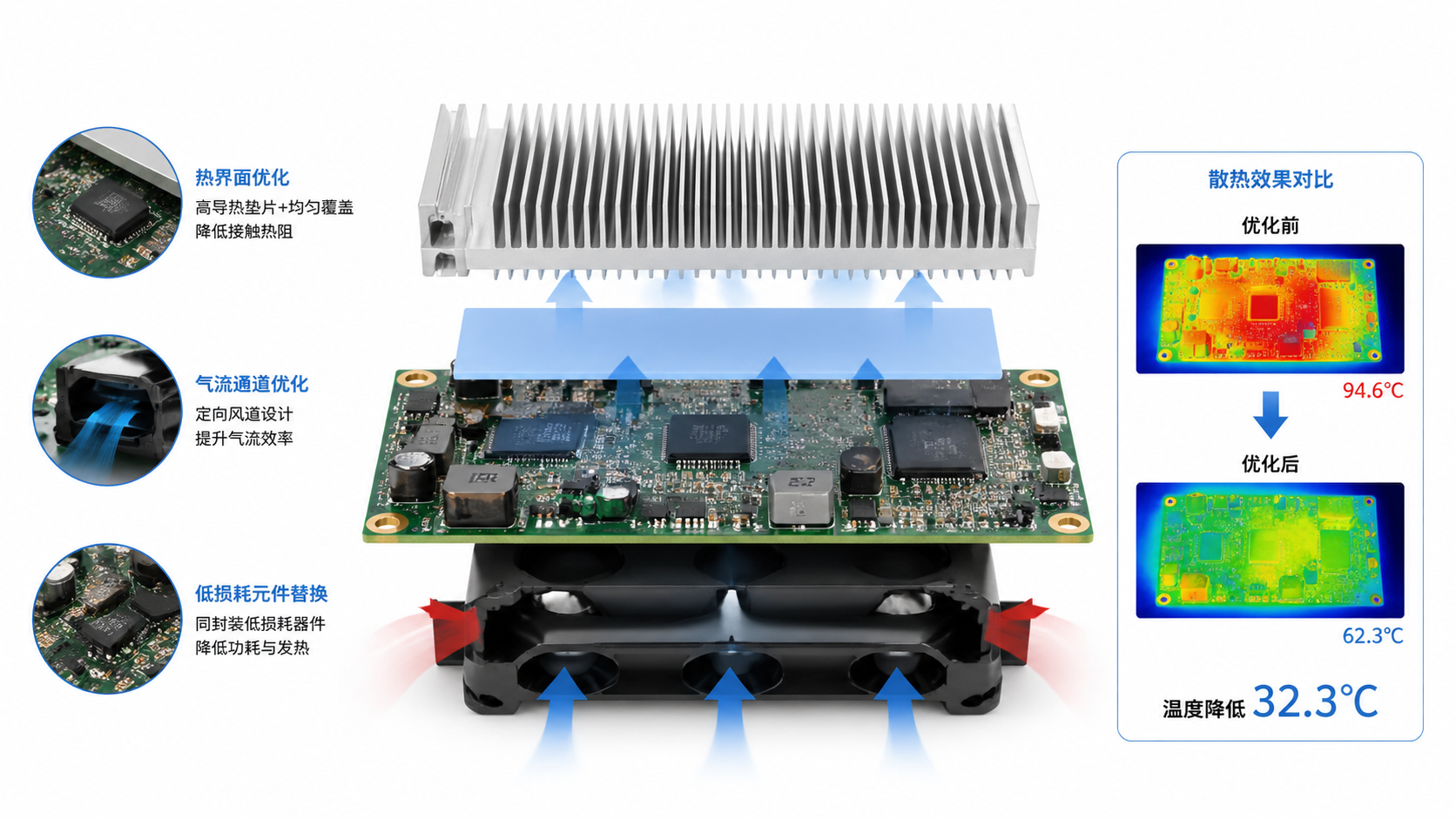
Thermal interface resistance is frequently underestimated. A better TIM, correct thickness control, improved flatness, or more consistent mounting pressure can reduce junction or case temperature significantly. In many assemblies, replacing a generic pad with a better-characterized interface material produces more benefit than changing the heatsink itself.
What to check:
- TIM thermal conductivity and compression behavior
- Surface flatness and roughness at contact points
- Application consistency in high-volume circuit board assembly
- Pump-out or dry-out risk under thermal cycling
2. Optimize airflow instead of adding more hardware
Many systems already have enough airflow volume, but not enough airflow efficiency. Repositioning a fan, clearing intake obstruction, improving vent path continuity, or adding low-cost ducting can lower hot-spot temperature without changing the enclosure structure. For after-sales and maintenance teams, even cleaning dust loading and restoring fan performance can recover lost thermal margin.
3. Upgrade components within the same footprint
If redesign is off the table, component substitution may still be available. Higher-efficiency MOSFETs, lower-ESR capacitors, lower-loss magnetics, or industrial capacitors with better ripple current handling can reduce self-heating while preserving PCB layout. This approach is often attractive to procurement and technical evaluation teams because it links thermal improvement directly to sourcing choices.
Examples include:
- Replacing a regulator with a pin-compatible higher-efficiency version
- Selecting active semiconductors with lower Rds(on) or switching loss
- Using high-performance capacitors with lower ESR to reduce heat under ripple load
- Choosing passive components with better temperature derating curves
4. Improve heat spreading through the PCB
Even without changing the board outline, some thermal gains may come from process or fabrication adjustments in future builds: heavier copper in limited zones, better via fill quality, improved solder wetting on thermal pads, or better attachment over exposed pads. In electronics manufacturing services, process discipline around pick and place, stencil design, SMT soldering, and reflow soldering often affects real thermal performance more than expected.
5. Reduce avoidable power loss at the process level
Sometimes the best thermal fix is simply lowering heat generation. Small firmware or operating-condition adjustments, better gate drive tuning, tighter voltage regulation, or load balancing can reduce thermal stress with almost no mechanical impact.
Where engineering teams usually miss thermal improvement opportunities
Thermal issues are often treated as a heatsink problem when they are actually cross-functional problems. The biggest missed opportunities usually sit between design intent and manufacturing reality.
Assembly-induced thermal resistance
In high-density assemblies, poor coplanarity, solder voids, misalignment from pick and place tolerances, and reflow profile variation can create measurable thermal penalties. A package may meet electrical test but still run hotter because heat is not transferring properly into the board or attached thermal structure.
Component compliance does not equal thermal suitability
A part may satisfy basic semiconductor compliance or sourcing requirements and still perform poorly in a high-temperature application. Technical evaluation teams should go beyond datasheet minimums and review:
- Thermal derating behavior
- Long-term drift at elevated temperature
- Power cycling endurance
- Moisture and environmental stress reliability
- Lot-to-lot consistency from the supply chain
PCB material and stackup assumptions
For some products, the dielectric system and copper distribution influence not just signal integrity but also local thermal spreading. Teams focused only on electrical compliance may miss the thermal consequences of material selection, especially in multi-layer boards where heat must move laterally before it can dissipate.
How to evaluate fixes without creating new reliability or sourcing risk
A good thermal improvement is not just a lower temperature reading. It must also remain manufacturable, available, compliant, and stable over product life.
Use a practical decision screen:
- Thermal benefit: How many degrees of reduction are realistically achievable?
- Implementation speed: Can this be deployed in current production, next lot, or only after requalification?
- Supply chain stability: Is the upgraded material or component available from approved or benchmarked sources?
- Process sensitivity: Will tighter assembly control be required?
- Reliability impact: Does the change improve long-term stress tolerance or only short-term cooling?
- Cost justification: Is the cost per degree reduced acceptable relative to product value and failure risk?
This framework is especially useful for procurement personnel, business evaluators, and financial approvers who need a defensible basis for approving thermal countermeasures without authorizing a full redesign project.
What evidence should be collected before making a decision?
To avoid subjective debates, teams should compare options with standardized evidence. The most useful data sets include:
- Junction, case, ambient, and board-level temperature measurements
- Thermal imaging under steady-state and transient load
- Power loss breakdown by component group
- Solder void and attachment quality inspection results
- Reflow profile records and SMT process capability data
- Supplier thermal specifications validated against actual operating conditions
- Derating analysis for capacitors, semiconductors, and passive parts
For quality control and safety managers, the priority is not just proving a lower temperature today but proving that the margin remains valid across production variation, environmental stress, and field aging.
Best options by stakeholder: engineering, procurement, quality, and management
For engineers and operators
- Check TIM condition, mounting pressure, and airflow path first
- Review hot-spot components for drop-in efficiency upgrades
- Audit solder quality on thermal pads and power packages
- Validate thermal performance after reflow soldering and final assembly, not only at prototype stage
For procurement teams
- Benchmark replacement parts on thermal performance, not just unit price
- Assess second-source availability for upgraded semiconductors and capacitors
- Request consistency data for high-stress applications
For quality and compliance teams
- Confirm that thermal fixes do not reduce IPC-Class 3 or ISO-oriented process compliance
- Require validation under actual environmental stress conditions
- Review long-term reliability effects of new interface materials or substituted components
For project and business decision-makers
- Prioritize changes with low qualification burden and measurable thermal gain
- Compare field failure risk against the cost of minor process or component upgrades
- Avoid waiting for a redesign if a controlled correction can recover sufficient margin now
When a non-redesign approach is enough, and when it is not
A non-redesign approach is usually sufficient when the product is only moderately above its thermal target, when hot spots are localized, when process variability is high, or when component losses can be reduced through substitution. It is also appropriate when the business case demands fast correction with minimal disruption to qualification and supply chain continuity.
However, a full redesign is more likely necessary when:
- Power density exceeds the enclosure’s fundamental thermal capacity
- Airflow path is structurally constrained by the product architecture
- PCB area, copper, or component spacing is intrinsically insufficient
- Safety margin cannot be restored under worst-case ambient conditions
- Reliability targets still fail after process and component optimizations
The key is to avoid jumping too early to either extreme. Some teams waste time forcing minor fixes onto a fundamentally overloaded design, while others authorize expensive redesigns for problems that better thermal management and manufacturing control could have solved.
Conclusion
Improving heat dissipation without redesign is often realistic, but only when the problem is approached with disciplined thermal analysis and cross-functional decision-making. The fastest gains usually come from reducing interface resistance, improving airflow efficiency, tightening circuit board assembly quality, and selecting lower-loss electronic parts that fit existing mechanical and sourcing constraints.
For organizations operating across the semiconductor and EMS supply chain, the best results come from data-backed evaluation rather than assumptions. When engineers, procurement leads, quality teams, and project managers work from the same thermal evidence, they can lower operating temperature, protect compliance, reduce field risk, and avoid unnecessary redesign cost.
In short, if the product’s architecture is still fundamentally sound, smarter thermal management can deliver meaningful heat dissipation improvements through targeted changes in materials, process control, component selection, and validation discipline.
- PCB
- active semiconductors
- passive components
- signal integrity
- IPC-Class 3
- EMS
- thermal management
- environmental stress
- SMT process
- semiconductor compliance
- circuit board assembly
- reflow soldering
- SMT soldering
- electronic parts
- semiconductor
- Power Semi
- high-performance
- high-performance capacitors
- industrial capacitors
- heat dissipation
- thermal conductivity
Recommended News
- Heat DissipationHow to prevent overheating in automotive PCB power distributionPrevent overheating in automotive PCB power distribution with practical tips on copper layout, thermal paths, and testing. Discover how to reduce hotspots and improve reliability.
- Heat DissipationCan heat spreading intelligence identify hot spots in PCB designs?Discover how heat spreading intelligence identifies PCB hot spots before fabrication. Learn to assess thermal models, validate predictions, and choose design changes that improve reliability.
- Heat DissipationWhich heat sink materials suit high-power electronics made in Germany?Heat sink materials Germany: compare aluminum, copper, graphite, and hybrid designs for high-power electronics. Find the right balance of thermal performance, weight, cost, and manufacturability.
- Heat DissipationHow to assess a graphite materials supplier's capability for thermal partsGraphite materials supplier assessment starts with more than machining. Discover how to evaluate thermal performance, purity, precision, cleanliness, traceability, and testing for reliable thermal parts.
- Heat DissipationHow to assess a heat dissipation supplier before placing an orderHeat dissipation supplier assessment guide: verify thermal performance, materials, process control, samples, capacity, and total risk before placing an order.
- Heat DissipationHow automotive PCB material selection affects thermal reliabilityAutomotive PCB material selection shapes thermal reliability. Explore CTE, Tg, moisture resistance, stack-up design, and proven qualification strategies for demanding vehicle electronics.