
How integrated automotive thermal management improves winter EV range
DETAILS
A cold-soaked EV starting a short winter journey must warm its occupants, manage a chilled battery, and provide traction power from the same energy reserve. Cabin heating can consume substantial energy before the vehicle travels far, while low battery temperature can restrict available power and regenerative braking. The resulting range loss is not simply a heater-efficiency problem.
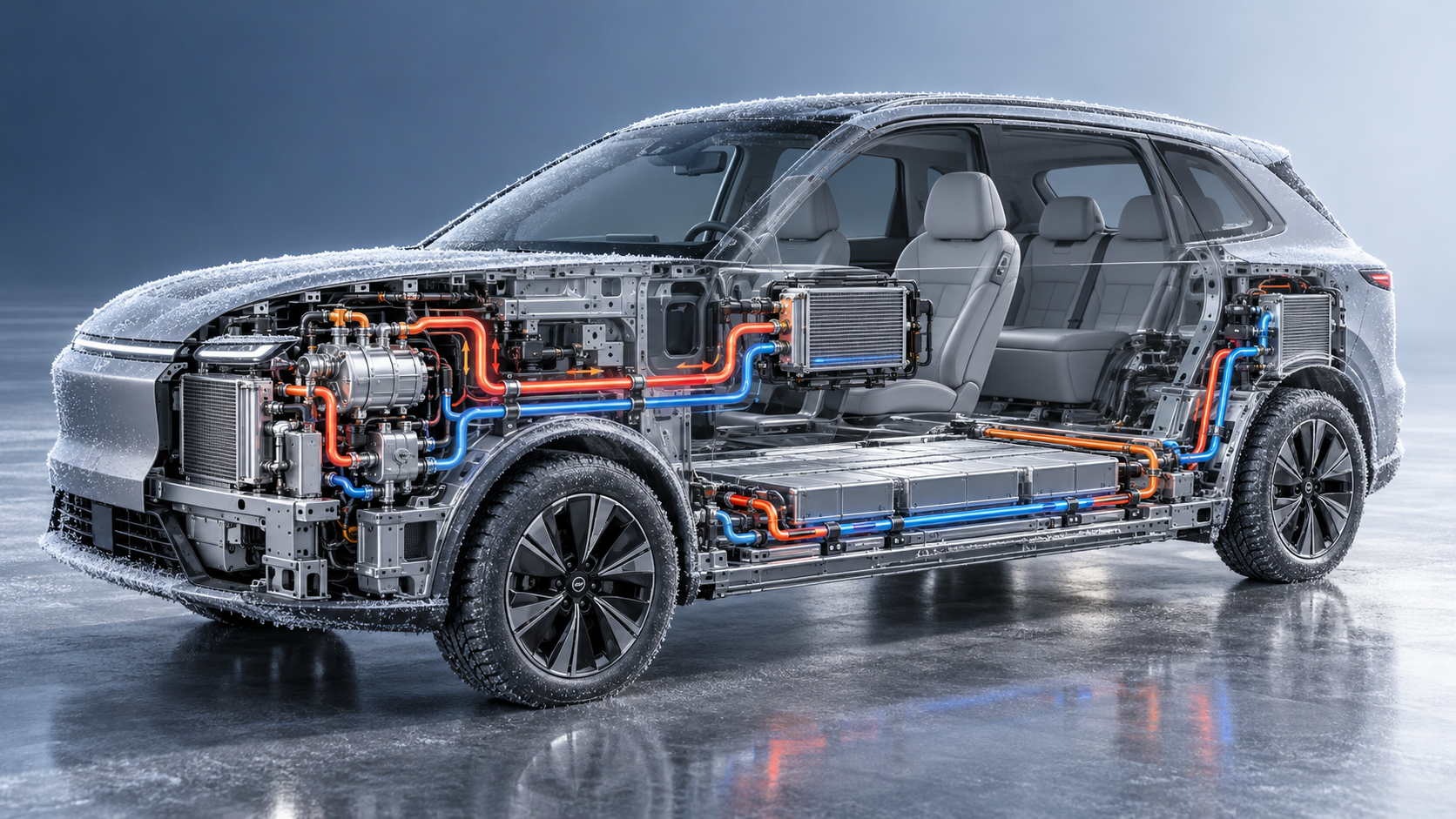
Integrated automotive thermal management preserves winter range by coordinating heat production, recovery, storage, and distribution across the cabin, battery, and powertrain. A heat pump can reduce electrical heating demand, but its benefit depends on available heat sources, coolant routing, and control decisions. The meaningful evaluation is therefore total vehicle energy consumption at equivalent comfort and battery operating conditions—not compressor efficiency alone.
Separate the winter losses before assessing the solution
Winter range reflects several mechanisms that thermal integration affects differently. Cabin heating adds an auxiliary load. Battery warming consumes energy but can improve power availability and charge acceptance. Cold cells have greater internal resistance and may reach operating limits sooner under load. Denser air, winter tires, wet roads, and snow can increase traction demand independently of the thermal system.
A useful first-order relationship is:
Range ≈ usable battery energy under the test conditions ÷ total battery energy consumption per unit distance.
Both terms can change in winter. Thermal management can lower heating consumption and influence accessible battery energy, but it cannot eliminate road-load penalties. An improvement measured on a dry dynamometer should not be presented as an equivalent benefit on snow-covered roads.
Trip length also changes the result. Initial cabin and battery warm-up impose a transient energy cost that weighs heavily on short journeys. A longer drive spreads that cost over more distance and may provide more recoverable powertrain heat. Compare short-trip and sustained-driving performance separately rather than relying on one combined average.
Where integration actually saves energy
Recovering heat without treating it as free
Motors, inverters, onboard chargers, and batteries release heat during operation. An integrated system can direct suitable heat toward cabin heating or use it as a heat-pump source instead of rejecting it to ambient air. Depending on component temperatures, heat may transfer through a heat exchanger directly or require the refrigerant circuit to raise its temperature.
Availability matters. An efficient powertrain operating at light load may produce little useful waste heat, particularly just after a cold start. Charger heat is relevant only while charging and only where the architecture supports recovery. Deliberately generating motor or inverter losses is active heating, not free heat recovery; its electrical cost belongs in the vehicle energy balance.
Moving heat with less electrical input
A heat pump transfers energy from a lower-temperature source to a warmer sink. Its heating coefficient of performance, or COP, compares delivered heat with electrical input. Evaluators must establish whether a quoted COP covers only the compressor or includes pumps, fans, controls, and supplemental heaters.
Colder source conditions and higher required delivery temperatures generally make heat pumping more demanding. Ambient heat-exchanger frosting can introduce defrost cycles, interrupt heat delivery, and increase average consumption. Refrigerant selection and compressor capability shape the operating envelope, but neither proves a whole-vehicle range benefit without cold-condition testing.
Sharing hardware while preserving temperature control
The cabin, battery, and power electronics do not need the same temperature. Successful integration connects them selectively rather than circulating one common coolant stream through every component. Multiport valves, bypasses, refrigerant-to-coolant heat exchangers, and independently controlled pumps allow heat sharing while maintaining appropriate temperature boundaries.
A poorly chosen connection can send cabin-heating energy into unnecessary thermal mass or cool a battery that should remain warm. Conversely, isolating every loop can discard useful heat. Assess the operating-mode map: which circuits connect during initial warm-up, cruising, charging, and defrost, and what conditions trigger each transition?
The difficult control decision: heat now or save energy?
Consider departure after an overnight outdoor soak. The cabin needs immediate heating and windshield clearing, while the battery may require conditioning. Powertrain waste heat is initially scarce. The controller must decide how much energy to allocate to each load and when to introduce supplemental resistance heating.
Maximum battery warming is not automatically the most range-efficient choice. On a short, low-power trip, the energy spent heating the pack may exceed the driving-energy reduction it enables. A longer route, high power demand, or an approaching fast-charge stop can justify a different strategy. Battery protection limits remain mandatory regardless of the energy optimum.
Useful control inputs include pack temperature distribution, state of charge, ambient conditions, requested cabin comfort, predicted trip duration, and charging plans. Route prediction can improve scheduling, but the vehicle also needs a robust fallback when navigation is unavailable or the driver changes destination.
- At departure: meet visibility requirements and manage battery power limits while avoiding unnecessary heating of inactive circuits.
- During driving: use recoverable heat where its temperature and availability reduce total electrical demand.
- Before fast charging: condition the battery against the expected charging requirement, accounting for the energy spent reaching that condition.
- During defrost: maintain visibility and acceptable heat delivery without unstable switching between heat-pump and backup-heater modes.
Preconditioning while plugged in can preserve onboard energy at departure, provided the external supply can support the loads. It shifts some consumption to the grid rather than eliminating it. Report trip battery consumption and total charging energy separately so that better departure range is not mistaken for lower total energy use.
Architecture details that can erase the expected gain
Integration adds hydraulic and refrigerant interactions. Long coolant paths, restrictive valves, or highly resistive heat exchangers can increase pump consumption. Excessive coolant volume and component thermal mass delay useful heat delivery. Insulation and pipe routing affect how much recovered heat reaches its intended destination.
Cold-temperature coolant viscosity deserves particular attention. Flow measured under warm laboratory conditions may not represent cold-start operation. Pump speed commands alone do not establish adequate circulation; flow, pressure drop, fluid properties, and heat-exchanger temperature differences must be checked together.
Heat-exchanger approach temperatures also matter. A nominally available heat source may be too cool to deliver the required heating output through the installed exchanger. Raising compressor effort or coolant flow can compensate only within equipment limits and with an energy penalty.
Electrical implementation affects both efficiency and repeatability. Compressor inverters, pump drives, connectors, and temperature sensors must operate reliably through cold starts, thermal cycling, moisture exposure, and vibration. Sensor bias or lag can trigger premature valve transitions, excessive heating, or repeated mode hunting. Validate sensor placement and control hysteresis alongside component ratings.
Integration also changes failure behavior. A sticking valve or erroneous sensor can affect several thermal functions rather than one isolated loop. Fault handling should preserve battery protection and required windshield clearing, even if energy-saving operation must be abandoned.
A winter test matrix that exposes system-level performance
Start with an explicit baseline: a previous architecture, a non-integrated operating mode, or another vehicle configuration. Document differences in tires, mass, software, usable battery capacity, and cabin equipment. Without these controls, a consumption difference cannot confidently be attributed to thermal integration.
A cold-soak definition should specify more than time in a chamber. Record whether relevant battery, coolant, and cabin temperatures have reached the intended starting condition. Residual heat from charging or a previous drive can materially change the apparent benefit.
Maintain equivalent comfort, not merely identical dashboard setpoints. Different air distribution, blower behavior, and radiant surface temperatures can produce different occupant conditions at the same setting. Record cabin temperature development, windshield-clearing performance, and any use of seat or steering-wheel heating.
Measurements that distinguish savings from shifted loads
Net battery energy per distance is the primary driving metric, supported by time-resolved measurements of compressor, supplemental heater, pumps, blowers, and battery-conditioning demand. Include relevant low-voltage consumption and conversion losses in the accounting boundary. Subsystem traces explain whether a gain came from heat recovery, reduced heating service, or a different initial condition.
Use matched start and end conditions where practical. A test that finishes with a colder battery may appear efficient because it deferred thermal demand. Record final pack temperature and state of charge, and disclose thermal-state differences rather than attributing all energy variation to architecture.
Additional decision-useful measurements include:
- Warm-up energy and time: energy required to reach defined cabin comfort and battery operating conditions.
- Whole-system heating performance: delivered useful heat relative to the electrical inputs included in a clearly stated boundary.
- Temperature uniformity: battery sensor spread and local limits, not just average pack temperature.
- Transient behavior: heater spikes, compressor cycling, valve transitions, and defrost interruptions.
- Repeatability: variation across repeated tests, with measurement uncertainty stated alongside small claimed gains.
Official range procedures and supplemental engineering tests answer different questions. Applicable homologation procedures must be followed for regulated declarations, but they may not cover the cold-soak, humidity, route, and charging scenarios needed for design evaluation. Record the procedure version and deviations. Component qualification or a quality-management certificate does not demonstrate winter-range improvement.
Turning the evidence into an engineering decision
When gains disappear at low ambient temperature, inspect heat-source availability, compressor limits, supplemental-heater duty, and defrost behavior before changing the battery-heating strategy. When short-trip performance is weak but sustained driving improves, investigate thermal mass, unnecessary loop circulation, and warm-up priorities. High pump demand points toward hydraulic losses or control settings rather than inadequate heat-pump COP.
Acceptance criteria should pair an energy target with service constraints: comparable cabin comfort, required visibility, permissible battery temperatures, acceptable power availability, and stable fault response. Reject a claimed saving that depends on leaving occupants colder or operating the battery outside its intended limits.
The strongest evidence for integrated thermal management is a repeatable reduction in total vehicle energy consumption across relevant winter duty cycles, with starting conditions, delivered services, and final thermal states made explicit. Where benefits occur only after prolonged driving or plugged-in preconditioning, state that boundary clearly; it determines whether the architecture addresses the vehicle’s actual winter use.
Recommended News
- Heat DissipationHow integrated automotive thermal management improves winter EV rangeDiscover how integrated automotive thermal management improves winter EV range through heat recovery, smarter battery conditioning, and efficient cabin heating—and what proves real energy savings.
- Heat DissipationWhich thermal interface quality metrics matter after thermal cycling?Explore thermal interface quality metrics after thermal cycling, from retained resistance to contact integrity. Learn how to set acceptance criteria and qualify materials with confidence.
- Heat DissipationHow to prevent overheating in automotive PCB power distributionPrevent overheating in automotive PCB power distribution with practical tips on copper layout, thermal paths, and testing. Discover how to reduce hotspots and improve reliability.
- Heat DissipationWhat Thermal Conductivity Is Enough for Heat Sink Paste?What thermal conductivity threshold matters most for heat sink paste? Explore the 3–8 W/m·K screening range and learn how thickness, contact resistance, and aging guide smarter selection.
- Heat DissipationCan heat spreading intelligence identify hot spots in PCB designs?Discover how heat spreading intelligence identifies PCB hot spots before fabrication. Learn to assess thermal models, validate predictions, and choose design changes that improve reliability.
- Heat DissipationWhich heat sink materials suit high-power electronics made in Germany?Heat sink materials Germany: compare aluminum, copper, graphite, and hybrid designs for high-power electronics. Find the right balance of thermal performance, weight, cost, and manufacturability.