
Manual vs SMT Soldering: What Works Better
DETAILS
Manual vs SMT soldering affects quality, speed, cost, and semiconductor compliance across modern circuit board assembly. From soldering techniques and SMT soldering to reflow soldering, pick and place machine accuracy, and thermal management compliance, engineers, buyers, and quality teams need clear benchmarks. This guide compares both methods to help evaluate electronic parts, circuit components, and high-performance production decisions.
How do manual soldering and SMT soldering differ in real production?
For many EMS projects, the choice between manual soldering and SMT soldering is not simply a process preference. It influences assembly repeatability, defect risk, throughput, labor planning, and post-assembly inspection. Information researchers may look for a broad comparison, but technical evaluators and procurement teams usually need a decision framework tied to board density, package size, volume range, and compliance expectations.
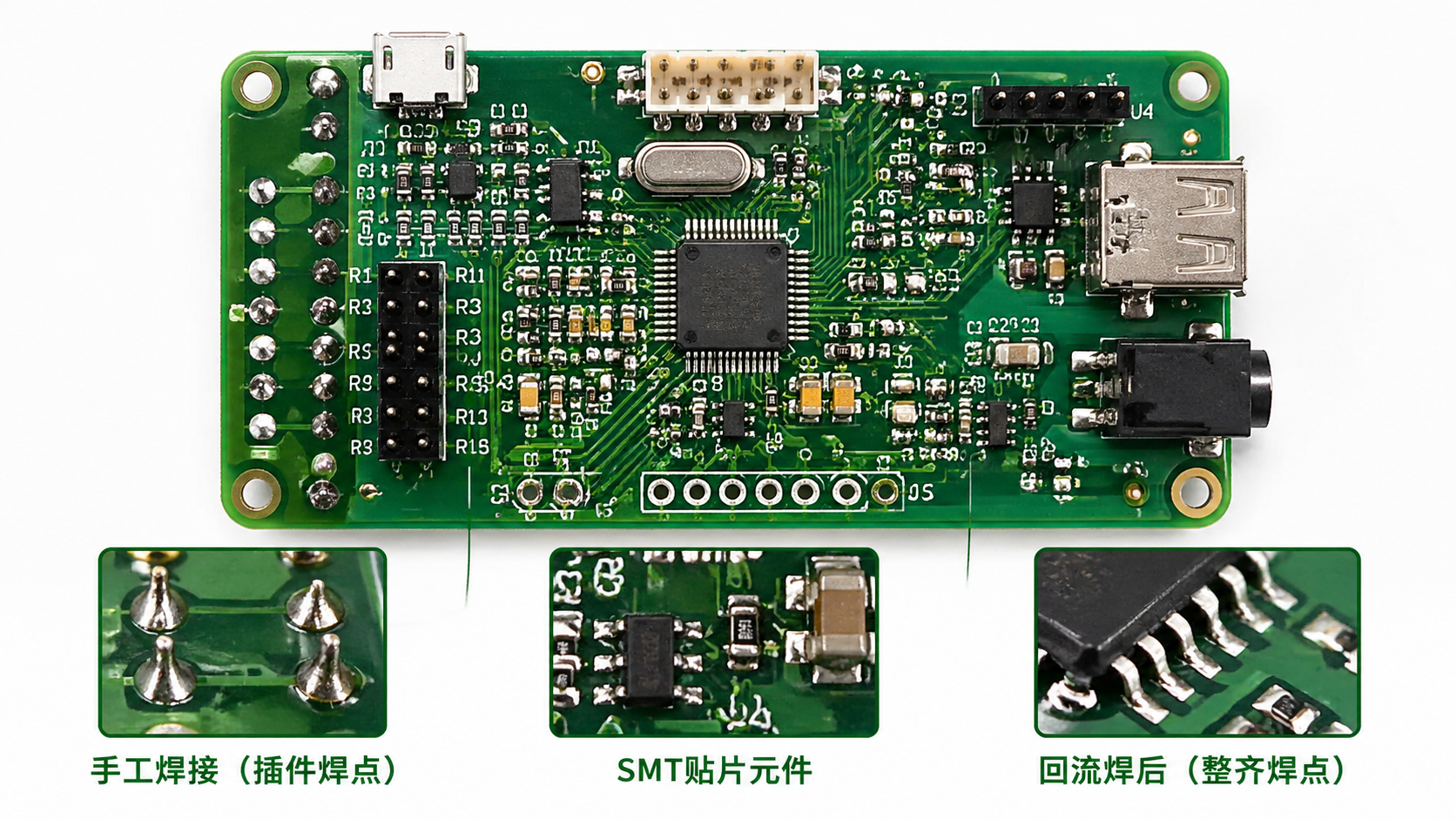
Manual soldering is typically performed with hand tools such as temperature-controlled soldering irons, hot air stations, and localized rework equipment. It is commonly used for prototypes, low-volume builds, selective repairs, through-hole components, and special assemblies that cannot move through a standard SMT line. In practical terms, it supports flexibility in the 1–50 board range and often remains necessary during engineering validation or service maintenance.
SMT soldering, by contrast, is a line-based process built around solder paste printing, pick and place machine loading, reflow soldering, and automated inspection. It is the standard choice for fine-pitch packages, multi-layer PCB assemblies, and medium-to-high volume production, often beginning to show strong economic advantage from small recurring batches upward. It also fits better when placement consistency and traceable process windows matter across 100, 1,000, or 10,000 units.
At SCM, we analyze SMT placement precision metrics, thermal behavior, component reliability, and PCB-related manufacturing variables as measurable engineering factors. That matters because the real question is not whether one method is universally better. The better method depends on assembly complexity, tolerance stack-up, thermal limits, inspection strategy, and whether your target is a prototype in 3–7 days or a qualified recurring production lot over several quarters.
A practical definition for buyers and engineers
Manual soldering offers adaptability at the workstation level. Operators can adjust dwell time, angle, and solder volume in response to visible conditions, which is useful for mixed technologies and repair tasks. However, process output depends heavily on operator skill, training consistency, and workstation controls such as iron tip condition, temperature calibration, and ESD discipline.
SMT soldering offers process scalability. Paste deposition, placement, and reflow are standardized into repeatable steps that can be monitored by SPI, AOI, X-ray, and profile verification. That makes SMT especially attractive to project managers and quality teams who need stable Cp/Cpk-oriented process behavior, reduced variation between shifts, and easier root-cause tracing when defects appear.
Core comparison at a glance
The table below compares manual soldering and SMT soldering across production, quality, cost, and procurement dimensions. It is designed for teams deciding between low-volume flexibility and repeatable mass assembly.
This comparison shows why the selection rarely rests on labor cost alone. Manual soldering is valuable where flexibility and localized control matter. SMT soldering becomes stronger when board density rises, package geometry tightens, and consistency must be demonstrated across many lots, suppliers, or compliance reviews.
Which method works better for quality, thermal control, and reliability?
Quality teams and safety managers usually judge soldering methods through three lenses: joint integrity, thermal exposure, and long-term reliability. A solder joint that passes initial inspection but fails after thermal cycling, vibration, or humidity exposure can create expensive field returns. This is why soldering method selection must align with package sensitivity, board material behavior, and expected service environment.
Manual soldering can deliver excellent results in skilled hands, especially for connectors, leaded parts, and repair work. Yet it carries more variability in tip temperature, contact time, solder volume, and flux handling. Even a small deviation over repeated operations can increase the risk of insufficient wetting, lifted pads, or thermal stress on neighboring components. These risks become more visible when boards use tighter spacing or heat-sensitive semiconductor devices.
SMT soldering, especially with controlled reflow soldering, gives a defined thermal profile with stages such as preheat, soak, peak, and cooling. While profile values depend on solder chemistry and component limits, the process advantage lies in repeatability. Engineering teams can validate a profile over multiple runs, compare zones, and align line settings with component recommendations. This is particularly useful for assemblies that must support IPC-oriented workmanship targets and documented quality records.
SCM’s role is relevant here because thermal management and micro-tolerance behavior should be benchmarked, not assumed. For example, placement precision, PCB dielectric behavior, and component endurance under stress all influence assembly reliability. Procurement teams that compare suppliers only by unit price often miss the hidden cost of inconsistent solder joints, especially in products intended for industrial control, telecom, automotive-adjacent electronics, or high-uptime embedded systems.
Where each process is likely to create risk
- Manual soldering risk rises when operators handle fine-pitch ICs, dense pad arrays, or repetitive high-count joints over long shifts. Fatigue and technique drift can affect consistency within a single 4–8 hour production window.
- SMT soldering risk rises when stencil design, paste storage, placement accuracy, or reflow profiling are poorly controlled. In these cases, defects may scale quickly across an entire lot instead of remaining localized.
- For both methods, quality depends on incoming component condition, PCB finish, operator training, and inspection discipline. Soldering method alone cannot compensate for weak materials or loose process control.
Typical technical checkpoints
In manual soldering reviews, engineers often check 4 key points: tip temperature stability, dwell time consistency, flux compatibility, and pad or lead cleanliness. In SMT reviews, the checklist usually expands to 6 points: stencil quality, paste deposition, pick and place alignment, reflow profile, inspection coverage, and moisture-sensitive device handling. That broader control framework is one reason SMT soldering is favored in higher-volume environments.
For maintenance teams, however, manual soldering still has an edge. When replacing a failed connector, touching up a shield can, or correcting a field-return board, a full SMT line is neither practical nor cost-efficient. In other words, reliability strategy should distinguish between initial production and post-sales service activities.
What should procurement and project teams compare before making a decision?
Purchasing decisions in electronics assembly often fail when teams compare only quoted assembly price. A lower visible cost can lead to higher total cost if rework rates, delayed qualification, or compliance failures are not included. Financial approvers, sourcing managers, and business evaluators need a structured comparison covering direct labor, setup burden, yield stability, and downstream risk.
Manual soldering often appears inexpensive at first because the equipment investment is lower. For a short prototype run, that can be true. But as board complexity and order frequency increase, labor hours can grow quickly. SMT soldering introduces setup costs such as stencil preparation, line programming, and profile validation, yet those fixed costs are spread more efficiently when the same assembly repeats over 2–4 production cycles or more.
Lead time is another factor. Manual soldering can be faster for urgent one-off jobs, rework, or engineering samples needed in 3–5 days. SMT soldering may require extra preparation during first article builds, but after process release, repeat lots are often more predictable. Project managers responsible for launches should compare not only first-run speed, but also schedule confidence over the next 30–90 days.
SCM supports this type of decision by translating technical variables into benchmark-driven evaluation criteria. Instead of asking whether a supplier “can do SMT,” buyers should ask for measurable evidence related to placement capability, thermal process discipline, material compatibility, inspection method, and standards alignment.
Procurement comparison table
The following table is useful when procurement, engineering, finance, and quality teams need a shared evaluation sheet for manual soldering versus SMT soldering.
The table highlights an important reality: procurement should treat soldering as a total-cost and risk-control decision. In many cases, the best path is hybrid. Teams may use SMT soldering for core board population, then apply manual soldering for odd-form devices, connector attachment, shield modifications, or engineering change orders.
A 5-point sourcing checklist
- Define board volume by phase: prototype, pilot, and recurring production. A method that works for 10 samples may fail economically at 2,000 units.
- Review component mix: through-hole, passive chips, fine-pitch ICs, thermal pads, and special connectors should be classified before quoting.
- Request process evidence: ask for inspection flow, handling controls, and how defects are isolated and corrected.
- Check compliance alignment: IPC-Class 3 expectations, ISO 9001 process discipline, ESD handling, and traceability records may affect supplier suitability.
- Compare not just quote price, but rework pathway, lead time stability, and engineering support for design changes within 7–15 days.
Which applications favor manual soldering, SMT soldering, or a hybrid approach?
Application context often settles the debate faster than abstract theory. Operators and project engineers usually ask a straightforward question: what works better for this board, this component mix, and this delivery schedule? In practice, the answer is often segmented by product maturity, package type, and service requirements.
Manual soldering is usually the better fit for cable terminations, mechanical reinforcements, hand-installed through-hole components, custom lab fixtures, and field service tasks. It is also useful during design iteration, where component substitutions or ECO changes occur rapidly and the board revision may change within 1–2 weeks. In these cases, flexibility outweighs line efficiency.
SMT soldering is the preferred route for compact consumer electronics, industrial controllers, telecom boards, sensor modules, and compute-related hardware using dense component placement. If the design includes small passive components, QFN or BGA packages, or multiple identical boards, SMT delivers stronger process control. It also supports automated inspection more naturally, which matters to quality and audit teams.
A hybrid process is common in real factories. Many assemblies run through paste printing, placement, and reflow for the majority of components, then move to manual stations for through-hole connectors, large mechanical parts, or final touch-up. This mixed method can balance cost, flexibility, and schedule, provided the transition points are clearly defined and documented.
Application mapping table
Use this table to match soldering method with board condition, output target, and support requirements across common electronics manufacturing scenarios.
For many organizations, the hybrid route is the most realistic. It avoids forcing all assemblies into a single process model and instead matches each operation to the technical and commercial value it creates. That is especially useful when one program must satisfy engineering agility, purchasing discipline, and quality accountability at the same time.
Common decision mistakes
- Choosing manual soldering for dense assemblies simply to avoid initial setup cost, then absorbing high rework effort later.
- Choosing SMT soldering for unstable early prototypes where the design changes every few days and feeder or stencil rework slows the project.
- Ignoring service life needs. A board that must survive thermal cycling, vibration, or continuous duty should be reviewed differently from a short-life lab assembly.
What standards, checks, and implementation steps should teams require?
Whether you choose manual soldering or SMT soldering, implementation should be tied to workmanship criteria, material controls, and documentation. In semiconductor and EMS supply chains, process claims have limited value without evidence. Quality leaders and technical buyers should therefore ask how the method is validated, what records are retained, and how deviations are handled when components, PCB finishes, or thermal loads change.
A practical baseline often includes IPC-oriented workmanship expectations, ISO 9001-aligned quality management practices, ESD control, incoming material verification, and inspection records. For high-reliability builds, teams may also review thermal profile records, moisture-sensitive device handling, and acceptance criteria for solder fillet appearance, voiding concerns, or rework authorization paths. The exact set depends on product class and customer requirements, but the control logic should be consistent.
SCM helps organizations interpret these factors through independent benchmarking and engineering repositories rather than vendor marketing claims. That is useful when teams compare suppliers across regions, especially between Asian manufacturing hubs and international buyers who require standardized technical transparency. The result is a more disciplined review of what the process can repeatedly achieve, not just what it achieved once in a sample build.
For implementation, most teams benefit from a staged approval path. Instead of moving directly from quote to full production, use 3 stages: design and material review, pilot assembly and inspection verification, then controlled production release. This reduces the risk of scaling a poor soldering choice across an entire procurement cycle.
A practical 4-step implementation flow
- Board and BOM assessment: classify package types, thermal sensitivity, PCB layer complexity, and expected volume over the next 1–3 quarters.
- Process selection: assign manual soldering, SMT soldering, or hybrid routing based on density, inspection needs, and serviceability.
- Pilot verification: confirm solder quality, functional behavior, rework pattern, and documentation completeness on a limited batch.
- Production control: lock approved settings, train operators, review defects by lot, and update controls when component or board changes occur.
FAQ for engineers, buyers, and quality teams
Is manual soldering always cheaper than SMT soldering?
Not always. Manual soldering can be cheaper for a very small build, urgent repair, or engineering sample because setup is minimal. But when assemblies are dense or repeated over multiple lots, labor hours and rework risk can outweigh the upfront savings. SMT soldering often becomes more cost-efficient once setup is amortized across recurring production.
Which method is better for fine-pitch semiconductors and compact boards?
SMT soldering is generally the better choice for fine-pitch packages, dense pad layouts, and small passive components. The combination of paste control, pick and place machine accuracy, and reflow soldering gives stronger repeatability than workstation-based manual assembly. Manual soldering still plays a role in localized touch-up or engineering changes.
Can one project use both methods?
Yes, and many do. A hybrid process is common when boards contain both standard SMT devices and components better suited to hand assembly, such as large connectors, odd-form parts, or post-reflow modifications. This approach is often practical for industrial electronics, custom systems, and pilot production.
What should quality teams verify before approving a soldering process?
At minimum, confirm material compatibility, thermal handling, inspection coverage, operator or line control, and acceptance criteria. For SMT soldering, profile verification and placement quality are central. For manual soldering, operator consistency, station control, and workmanship review are critical. A 5-point audit covering materials, method, equipment, inspection, and records is a practical starting point.
Why consult SCM before finalizing your soldering and sourcing strategy?
When teams debate manual vs SMT soldering, the real issue is often not the tool itself but the lack of comparable technical evidence. SCM helps bridge that gap by turning manufacturing variables into benchmarkable engineering data. Instead of relying on broad supplier claims, buyers and engineers can review factors such as SMT placement precision, PCB material behavior, thermal management impact, and component reliability under demanding conditions.
This matters across the full decision chain. Researchers need structured information. Operators need practical process guidance. Technical evaluators need measurable parameters. Procurement and finance teams need total-cost visibility. Quality and safety managers need compliance-oriented process clarity. Project leaders need a method that supports both launch timing and field reliability. SCM’s independent reporting model is designed to support exactly these cross-functional decisions.
If you are comparing manual soldering, SMT soldering, or a hybrid route, consult SCM for support on parameter confirmation, process benchmarking, component and PCB evaluation, compliance-oriented review, and sourcing risk analysis. We can help you assess which assembly path fits your volume range, thermal profile needs, inspection plan, and delivery window, whether your next step is sample support, supplier comparison, technical due diligence, or quotation alignment.
Contact SCM when you need a clearer basis for product selection, reflow soldering process review, pick and place capability assessment, IPC-Class 3-oriented quality expectations, or a practical roadmap from prototype to recurring production. The most effective soldering choice is the one supported by evidence, not assumption.
- PCB
- passive components
- IPC-Class 3
- EMS
- thermal management
- multi-layer PCB
- SMT placement
- precision metrics
- ISO 9001
- component reliability
- thermal management compliance
- semiconductor compliance
- circuit board assembly
- pick and place machine
- component placement
- reflow soldering
- SMT soldering
- soldering techniques
- electronic parts
- circuit components
- embedded systems
- semiconductor
- high-performance
- connectors
Recommended News
- Reflow SolderingHow to compare thermal profiles for reflow process benchmarkingImprove reflow process benchmarking by comparing thermal profiles, process windows, and repeatability. Discover how to evaluate ovens and suppliers with reliable, auditable data.
- Reflow SolderingHow thermal cycling reliability testing reveals solder joint fatigueThermal cycling reliability testing reveals solder joint fatigue through CTE mismatch, crack monitoring, and failure analysis—learn how to build more reliable electronics.
- Reflow SolderingHow automotive PCB assembly processes prevent solder joint failuresPCB assembly process automotive controls help prevent solder joint failures through DFM, paste inspection, precise reflow profiling, and risk-based validation. Learn proven reliability practices.
- Reflow SolderingWhat SMT process capability evidence is needed for AEC-Q100 projects?SMT process capability AEC Q100 evidence: learn the essential controls for reflow, MSL, solder-joint inspection, traceability, and automotive release.
- Reflow SolderingWhen does FR4 PCB assembly need tighter reflow temperature control?FR4 PCB assembly needs tighter reflow control when thermal mass, fine-pitch components, moisture, and reliability demands narrow the process window. Learn key profiling factors.
- Reflow SolderingWhat BGA defects reveal weak SMT process capabilitySMT process capability BGA insights: learn how BGA defects expose weak printing, placement, reflow, and inspection control—and what they mean for reliability, audits, and supplier risk.