
Marine Collagen Wholesale: How to Compare MOQ, Purity, and Price
DETAILS
Marine Collagen Wholesale: How to Compare MOQ, Purity, and Price
In marine collagen wholesale, smart procurement starts with clearer benchmarks, not cheaper quotes alone.
MOQ, purity, traceability, and landed cost shape supplier value far more than a single unit price.
That matters even more when shipment timing, batch consistency, and compliance affect downstream production plans.
This guide breaks down how to compare marine collagen wholesale offers with a practical, risk-aware purchasing lens.
The goal is simple: secure stable quality, reasonable pricing, and dependable supply without hidden cost surprises.
Why marine collagen wholesale decisions need a wider cost view
Many buying teams begin with a spreadsheet sorted by price per kilogram.
That is useful, but incomplete.
In marine collagen wholesale, the cheapest quote may carry higher testing costs, more rejects, or weaker delivery reliability.
A lower MOQ may look attractive too.
Yet smaller batch orders often come with higher freight cost, less favorable payment terms, or reduced customization.
From a procurement perspective, marine collagen wholesale should be assessed through total acquisition cost.
That includes raw material price, minimum order quantity, documentation quality, testing burden, lead time, and claim resolution speed.
When these factors are visible early, supplier comparison becomes much more objective.
Start with MOQ, but read what MOQ really signals
MOQ is not just a volume threshold.
In marine collagen wholesale, MOQ often reflects production scale, packaging efficiency, and supplier confidence in demand stability.
A very high MOQ can reduce the unit price.
However, it may increase inventory pressure and tie up working capital for too long.
A very low MOQ can support pilot orders.
Still, it may indicate the supplier is trading stock rather than controlling manufacturing quality.
When reviewing MOQ, compare these points:
- MOQ by standard grade versus customized specification
- Price breaks at different volume tiers
- Packaging format, such as drums, bags, or private label units
- Shelf life impact on batch size planning
- Whether sample fees are deductible from future bulk orders
In practice, the best marine collagen wholesale partner often offers flexible MOQ tiers instead of one rigid threshold.
That flexibility reduces demand risk while preserving room for future cost negotiation.
Purity is not one number, so ask for the full specification
Purity is one of the most misunderstood points in marine collagen wholesale.
Some suppliers promote a headline purity figure without explaining test methods or related composition data.
That creates comparison problems immediately.
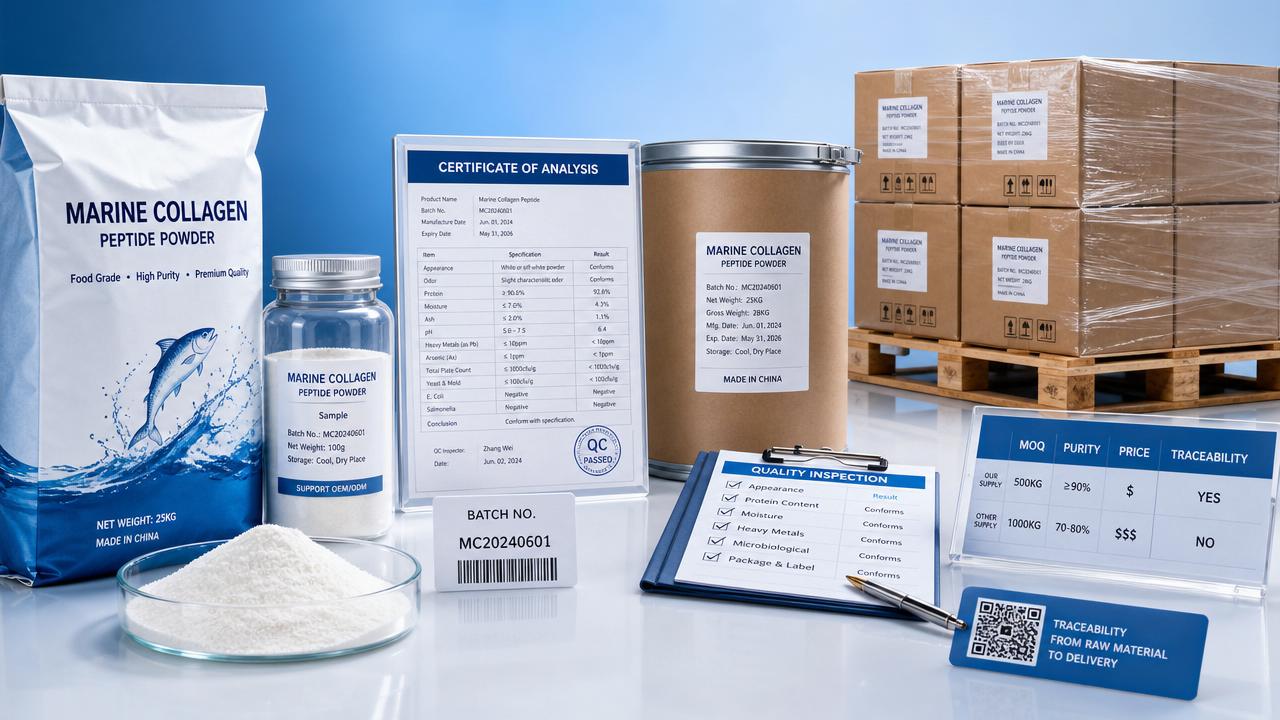
A stronger evaluation starts with the certificate of analysis and the exact parameters behind the purity claim.
Important specification points usually include:
- Protein content percentage
- Moisture and ash levels
- Molecular weight range or peptide distribution
- Heavy metal limits
- Microbiological results
- Solubility, odor, and appearance consistency
In marine collagen wholesale, purity should also be linked to intended application.
A formulation for beverages may prioritize solubility and taste neutrality.
A formulation for capsules may care more about concentration and flow characteristics.
This is where data discipline matters.
At SCM, the same logic applies across technical sourcing: standardized parameter review prevents misleading comparisons and lowers risk.
Price comparison should include landed cost and quality cost
A quote is only the starting point in marine collagen wholesale.
Real cost emerges after freight, customs, testing, storage, and possible nonconformance handling are added.
A practical comparison model includes:
- EXW, FOB, or CIF pricing basis
- Freight cost per kilogram at actual order volume
- Import duty and clearance charges
- Third-party lab verification cost
- Expected loss from rejects or off-spec batches
- Payment term impact on cash flow
This wider view often changes the ranking of suppliers.
For example, a supplier with a slightly higher base price may offer faster lead time and more stable batch data.
That can lower emergency buying and reduce safety stock requirements.
In marine collagen wholesale, the best price is often the most predictable total cost.
Traceability and compliance protect long-term purchasing performance
Traceability is no longer a secondary document issue.
In marine collagen wholesale, it directly affects recall exposure, claim handling, and brand protection.
Strong suppliers should provide clear source information, batch records, and test documentation with consistent formatting.
Before approving bulk orders, verify:
- Species and origin disclosure
- Lot-level traceability records
- GMP, HACCP, ISO, or related certifications
- Allergen and contaminant controls
- Change notification process for raw material or process adjustments
This step may seem administrative, but it saves time later.
When documentation is weak, every issue takes longer to investigate and settle.
That hidden delay becomes part of the real marine collagen wholesale cost structure.
A simple supplier scorecard makes marine collagen wholesale decisions clearer
A scorecard helps turn mixed supplier claims into a comparable decision set.
It also keeps internal discussions focused on evidence instead of impressions.
Assigning weighted scores makes marine collagen wholesale reviews more consistent across teams.
It also creates a record for future rebidding and performance tracking.
Questions worth asking before placing a bulk order
Good questions often reveal more than polished brochures.
Use these checks during marine collagen wholesale discussions:
- Can the supplier share recent batch-to-batch variation data?
- What is the standard lead time, and what causes delays?
- How are complaints handled, and what is the response window?
- Are there cost differences between standard and custom specifications?
- What happens if test results differ from the supplied COA?
These questions keep marine collagen wholesale negotiations grounded in operational reality.
More importantly, they help separate scalable partners from opportunistic traders.
Final takeaway for smarter marine collagen wholesale sourcing
Marine collagen wholesale works best when decisions are made through measurable standards.
MOQ shows flexibility, purity shows product fit, and price shows very little without context.
The strongest buying approach combines specification review, traceability checks, and total cost analysis.
That approach is consistent with SCM’s broader sourcing philosophy: better technical data leads to better supply decisions.
Before confirming your next marine collagen wholesale contract, build a scorecard, validate the COA, and compare landed cost line by line.
Recommended News
- HDI TechnologyHow to vet PCB suppliers in a directory before requesting quotesPCB suppliers directory guide: learn how to verify capabilities, certifications, traceability, and quote assumptions before selecting a reliable PCB partner.
- HDI TechnologyHow UAE engineering data repositories improve design traceabilityEngineering data repository UAE solutions strengthen design traceability by linking requirements, revisions, supplier evidence, and manufacturing data. Explore practical ways to reduce risk and accelerate releases.
- HDI TechnologyHow to verify UL recognition for printed circuit boardsPrinted circuit boards UL verification made clear: learn how to check UL marks, file numbers, factory scope, stack-ups, and traceability for audit-ready compliance.
- HDI TechnologyMulti layer PCB design guide for controlling signal crosstalkMulti layer PCB design guide for controlling signal crosstalk with stackup, spacing, return-path, and validation strategies for reliable high-density boards.
- HDI TechnologyHow tighter manufacturing tolerances change HDI PCB pricesMicro tolerance manufacturing price explained: see how tighter HDI PCB tolerances affect yield, inspection, supplier options, and sourcing costs.
- HDI TechnologyHow automotive PCB impedance control prevents signal failuresAutomotive PCB impedance control prevents reflections, noise, and timing errors in ADAS, EV, and infotainment systems. Learn how to build reliable signal paths.