
How tighter manufacturing tolerances change HDI PCB prices
DETAILS
Why a small tolerance change can produce a large price change
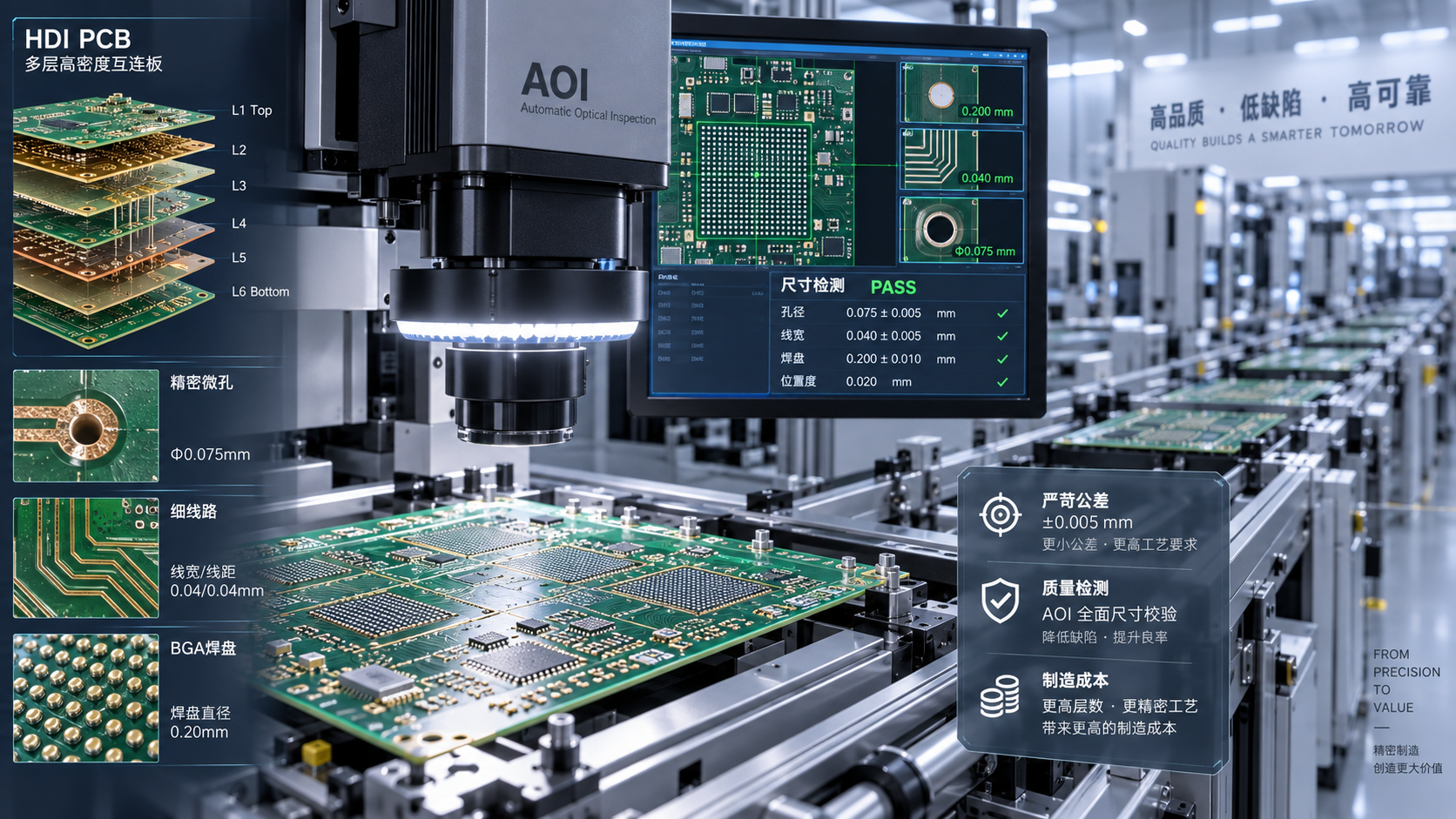
Tighter tolerances raise HDI PCB prices because they affect far more than one dimensional measurement on a fabrication drawing. A reduction in trace width, spacing, registration allowance, drill position, dielectric thickness variation, or finished-board flatness can lower manufacturing yield, require additional process controls, and limit the number of factories able to quote the job with confidence.
For procurement teams, the practical question is not whether tighter specifications cost more. They almost always do. The useful question is whether each tighter requirement protects electrical performance, assembly reliability, or field life enough to justify the added manufacturing cost and sourcing constraint.
An HDI board designed for dense BGA fan-out, high-speed interfaces, fine-pitch components, and tightly controlled impedance may need demanding tolerances in selected areas. Applying the same precision across the entire board, however, can turn a manageable design into a high-risk quote. The resulting micro tolerance manufacturing price is often driven less by raw material cost than by process capability, inspection effort, scrap exposure, and capacity availability.
Tolerance cost begins with process capability, not the drawing alone
A PCB drawing may state a target value and an allowed deviation, but the supplier has to determine whether that range can be held consistently through imaging, etching, lamination, drilling, plating, and final finishing. In HDI fabrication, these steps are tightly connected. A narrow conductor can be affected by copper distribution, resist definition, etch compensation, and surface treatment. A small buried-via pad can be affected by drilling accuracy, layer registration, plating coverage, and sequential-lamination movement.
When the tolerance window becomes narrower, the fabricator may need slower and more controlled processes. It may select higher-grade imaging materials, add measurement points, run more coupons, tighten incoming-material controls, or reduce the number of panels processed under one set of conditions. Each step adds direct cost or reduces productive output.
The difference is especially clear when a nominal requirement crosses a factory's normal operating range. A supplier can quote a common HDI stack-up efficiently when it fits established tooling, known material combinations, and proven registration allowances. A slightly tighter line width or microvia location can move the order into an engineering-controlled process. The price jump may appear disproportionate because the board has shifted from standard production capability to exceptional capability.
That distinction matters when comparing quotations. Two suppliers may both accept the stated requirements, yet one may regard them as routine while the other treats them as a best-effort build. A low initial quote can therefore be misleading if it relies on an optimistic interpretation of manufacturing tolerances or contains assumptions that later trigger engineering questions, delivery delays, or price adjustments.
The four cost mechanisms buyers should expect
Tighter HDI requirements typically affect price through four mechanisms. They may overlap, but separating them helps procurement teams ask more precise questions during quotation review.
1. Lower panel yield
Yield is often the largest hidden driver. HDI boards contain multiple opportunities for variation: fine-line imaging, laser-drilled microvias, sequential lamination, blind or buried structures, plated holes, and final electrical testing. A board can meet most requirements and still be rejected because one feature falls outside a narrow acceptance limit.
As allowable variation shrinks, more panels may be lost to nonconformance. The supplier must spread the cost of those losses across boards that pass. This is why a tolerance change can have a modest effect on material cost but a substantial effect on unit price.
Yield pressure is particularly important when several tight requirements appear together. Fine lines alone may be manageable. Fine lines combined with small annular rings, tight layer-to-layer registration, constrained dielectric thickness, and high-aspect-ratio plated features create a compounded risk. Buyers should avoid evaluating each callout as an isolated cost item.
2. More expensive materials and stack-up control
Some tolerance requirements can be addressed only by changing the material system or controlling it more closely. For example, impedance-sensitive HDI structures may require tighter copper weight control, dielectric selection with more predictable construction, or a stack-up designed around actual pressed thickness rather than nominal prepreg values.
Material choice does not automatically guarantee precision. A premium laminate cannot compensate for an unrealistic registration target or an aggressive via-to-pad geometry. Still, where signal integrity and impedance consistency are critical, a supplier may need to use materials and press cycles that produce more stable results. The added cost comes from both the material itself and the operational discipline needed to use it consistently.
Procurement should therefore ask whether an added material charge is tied to a defined electrical or mechanical requirement. A vague “high-performance material” label does not provide enough information for a cost decision. The quotation should connect the material choice to the relevant stack-up, impedance target, thermal requirement, or reliability exposure.
3. Additional inspection and verification
Precision requirements are only meaningful if they can be verified. Tighter tolerances may call for more automated optical inspection, X-ray checks for hidden structures, microsection analysis, impedance testing, dimensional measurement, solderability review, or more detailed inspection records.
Inspection cost is not simply a charge for a test report. It also reflects the time required to collect measurements, isolate nonconforming lots, review deviations, and maintain traceability. For low-volume prototype or qualification builds, this burden can represent a meaningful share of total cost because the setup work is distributed across fewer boards.
Buyers should distinguish between a requirement that must be controlled and a requirement that must be documented on every lot. Those are not always the same thing. A supplier may have robust internal controls for a feature while routine lot-by-lot reporting adds cost without improving the buyer's decision-making. When documentation is required, specify the measurements, sampling basis, and acceptance criteria rather than requesting broad reporting by default.
4. Reduced supplier and capacity options
The tighter the specification, the smaller the qualified supplier pool can become. This may raise prices even when the build itself is technically feasible. A capable factory may reserve its most controlled HDI lines for programs with established volumes, advanced engineering support, or longer planning horizons. Short lead-time demand then carries a capacity premium.
This is one reason price comparisons should include lead time, lot size, and capacity commitment. A supplier quoting a low unit price for a narrow tolerance range may be assuming a longer lead time, a larger production run, or access to a specific process window that cannot be guaranteed for every release. The price is useful only when those assumptions align with the purchasing plan.
Which tolerance calls are most likely to move an HDI quote
Not every tight specification has the same financial effect. Procurement teams do not need to challenge every engineering requirement, but they should recognize the callouts most likely to alter cost or delivery risk.
- Fine line width and spacing: These requirements influence imaging resolution, etch control, copper thickness selection, inspection sensitivity, and yield. Their cost effect becomes larger when the design has extensive fine-line routing rather than a few localized features.
- Microvia diameter, capture pad, and via-to-pad relationship: Small laser vias require reliable drilling, desmear, plating, and registration. Marginal geometries can lead to poor yield or reliability concerns even when the fabrication process can initially produce them.
- Layer-to-layer registration: Sequentially laminated HDI structures are sensitive to material movement and alignment. A demanding registration requirement across multiple build-up cycles may require special panel planning and additional verification.
- Finished dielectric thickness: This affects controlled impedance, coupling, and high-speed signal behavior. The tolerance must be evaluated after pressing, not only from nominal laminate and prepreg data.
- Drill position, annular ring, and breakout allowance: These dimensions interact with pad size, registration, and board density. Reducing allowance to reclaim routing space can create an expensive yield penalty.
- Flatness and warpage: A stringent flatness requirement may be justified for fine-pitch assembly or thermal interfaces, but it can add process constraints, especially on thin, large, asymmetric, or heavily copper-balanced designs.
Some of these requirements are essential for a specific design. Others may be inherited from an older drawing, copied from a generic standard, or applied globally when only a local region needs the control. That is where a buyer can help create a more cost-effective conversation between design engineering and the fabricator.
Do not treat IPC Class 3 as a universal answer to precision questions
IPC-Class 3 is often associated with high reliability, and it can be relevant for boards that face demanding service conditions or serious consequences of failure. It should not be used as a substitute for defining the actual manufacturing and functional requirements of an HDI design.
A Class 3-oriented build may carry more stringent workmanship expectations, verification requirements, and process documentation. Yet an HDI board can still need explicit specifications for impedance, microvia structures, layer registration, material performance, and acceptance criteria. Conversely, calling for Class 3 where the application does not require it may increase cost and narrow sourcing options without solving the electrical problem the design actually has.
The purchasing implication is straightforward: request the appropriate quality standard, but also make sure the drawing and fabrication notes identify the dimensions and performance characteristics that matter. A vague high-reliability instruction leaves suppliers to make different assumptions, which weakens quote comparability.
How to review a quote when tolerances are driving cost
The lowest quoted unit price is rarely enough to determine whether an HDI source is competitive. Procurement should ask suppliers to identify the assumptions behind their price, particularly where the drawing includes small features or unusual controls. The goal is not to force disclosure of proprietary processes. It is to determine whether the quoted product is built to the same interpretation of the requirement.
A useful quotation review can focus on a limited set of questions:
- Which tolerances are within normal production capability, and which require special process control?
- Are any dimensions quoted as targets with a broader manufacturing allowance than the drawing appears to permit?
- What stack-up, copper weights, and finished dielectric assumptions support the price?
- Which inspection, test, and reporting activities are included in the quote?
- What yield assumptions, minimum lot sizes, or panel utilization assumptions affect the unit price?
- Are there features that require engineering review before the supplier can make a firm commitment?
- Does the lead time include any first-article, coupon, or qualification activity required for the specified controls?
These questions make it easier to compare suppliers on a like-for-like basis. They also expose a common problem in PCB sourcing: a quotation may be technically responsive while leaving enough ambiguity that later manufacturing review changes the commercial terms.
For high-consequence programs, it is useful to compare quotations against a normalized fabrication requirement rather than only against the released artwork package. A short controlled document can state the approved stack-up, critical dimensions, impedance test approach, acceptable material substitutions, reporting needs, and revision-control rules. It reduces the chance that two suppliers price different builds under the same part number.
Where tolerance relaxation can reduce cost without creating avoidable risk
Reducing cost does not necessarily mean relaxing every precision requirement. The better approach is to identify where a tolerance protects a real function and where it reflects a conservative default.
For example, controlled impedance features may require strict dielectric and trace geometry control, while non-critical signal routing may tolerate a wider range. Microvia registration near a fine-pitch BGA may need tight control, whereas less dense areas of the board may not. A mechanical datum linked to a connector or thermal interface may deserve a tight positional tolerance; cosmetic or nonfunctional dimensions often do not need the same treatment.
Engineering and procurement can review the design with three questions in mind: Does this dimension affect electrical performance, assembly yield, reliability, or mechanical fit? Is the specified range based on a validated functional limit or simply a legacy drawing convention? Can the requirement be localized to the critical area rather than imposed across the entire board?
Localizing control is frequently more effective than applying a stringent global tolerance. It gives the fabricator room to optimize the rest of the panel while preserving the features that drive product performance. It can also broaden the qualified supplier base, which may matter more than a small per-board savings when supply continuity is at stake.
A practical purchasing position
Tighter HDI manufacturing tolerances should be purchased as performance controls, not as generic quality upgrades. They are justified when they protect signal integrity, assembly compatibility, thermal performance, mechanical alignment, or long-term reliability. They become expensive when they are over-applied, poorly defined, or specified without considering the interaction between fabrication steps.
A sound sourcing decision connects each costly tolerance to a functional need, tests whether the requirement is localized or global, and compares supplier quotations using the same stack-up and verification assumptions. That approach gives procurement a clearer view of micro tolerance manufacturing price: not as an arbitrary premium, but as the commercial effect of yield risk, process control, evidence requirements, and available manufacturing capacity.
Recommended News
- HDI TechnologyHow to vet PCB suppliers in a directory before requesting quotesPCB suppliers directory guide: learn how to verify capabilities, certifications, traceability, and quote assumptions before selecting a reliable PCB partner.
- HDI TechnologyHow UAE engineering data repositories improve design traceabilityEngineering data repository UAE solutions strengthen design traceability by linking requirements, revisions, supplier evidence, and manufacturing data. Explore practical ways to reduce risk and accelerate releases.
- HDI TechnologyHow to verify UL recognition for printed circuit boardsPrinted circuit boards UL verification made clear: learn how to check UL marks, file numbers, factory scope, stack-ups, and traceability for audit-ready compliance.
- HDI TechnologyMulti layer PCB design guide for controlling signal crosstalkMulti layer PCB design guide for controlling signal crosstalk with stackup, spacing, return-path, and validation strategies for reliable high-density boards.
- HDI TechnologyHow tighter manufacturing tolerances change HDI PCB pricesMicro tolerance manufacturing price explained: see how tighter HDI PCB tolerances affect yield, inspection, supplier options, and sourcing costs.
- HDI TechnologyHow automotive PCB impedance control prevents signal failuresAutomotive PCB impedance control prevents reflections, noise, and timing errors in ADAS, EV, and infotainment systems. Learn how to build reliable signal paths.