
Agri & Forestry Drone Applications That Reduce Survey Time
DETAILS
Why Agri & Forestry drone applications save time in very different ways
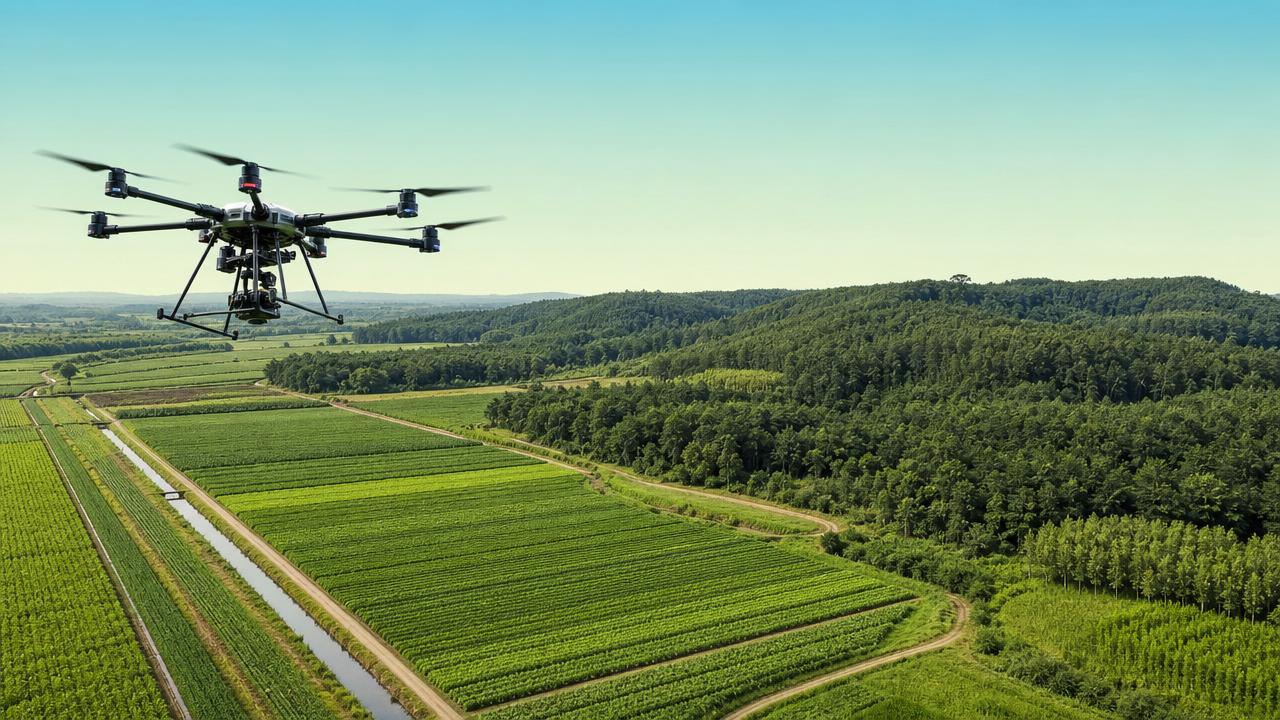
Agri & Forestry drone applications reduce survey time because they change how field data is collected, checked, and used in real decisions.
That time saving is not only about faster flights.
It comes from fewer repeat visits, better spatial consistency, and earlier detection of conditions that would otherwise stay hidden.
In practice, one survey brief can mean very different things.
A crop health review, a drainage inspection, and a timber stock estimate may all use drones, but the data priorities are not the same.
That is why Agri & Forestry drone applications work best when the workflow matches the field objective, not just the aircraft specification.
This is also where a data-driven mindset matters.
Organizations that already rely on technical benchmarking, like the discipline seen across SiliconCore Metrics research, often evaluate drones the same way.
They look past headline features and focus on measurement reliability, repeatability, and integration into broader reporting standards.
The first judgment is the survey purpose, not the platform
Before choosing sensors or flight patterns, it helps to define what must be proven after the flight.
Some Agri & Forestry drone applications support ongoing monitoring.
Others support one-time planning, insurance evidence, compliance documentation, or intervention targeting.
Those goals shape everything that follows.
For example, broad-acre crop scouting usually values speed, revisit frequency, and anomaly detection.
Forestry compartment mapping often puts more weight on canopy penetration limits, terrain variation, and geospatial accuracy over large boundaries.
A drainage or erosion review needs elevation confidence and edge clarity.
The common mistake is assuming all land surveys need the highest image resolution.
In many cases, faster turnaround and cleaner comparisons between survey dates bring more value than ultra-dense imagery.
Crop monitoring works when frequency matters more than perfect detail
One of the most practical Agri & Forestry drone applications is routine crop monitoring across large fields.
Here, the goal is rarely just to create a beautiful map.
The real value is spotting stress patterns early enough to guide irrigation checks, nutrient adjustments, or pest response.
In this setting, repeated flights under similar conditions often matter more than maximum payload complexity.
A consistent weekly dataset can reveal change direction clearly.
A single high-end survey without repeatability may be less useful operationally.
The better approach is to align altitude, time of day, overlap, and vegetation index selection with the crop stage.
That makes comparisons valid and cuts time spent rechecking ambiguous areas on foot.
What usually deserves closer attention in crop surveys
- Uneven vigor bands that follow irrigation lines or soil transitions
- Localized stress near access roads, turning zones, or shaded boundaries
- Repeat anomalies that remain visible across several flights
- Differences between spectral readings and visible canopy appearance
Forestry mapping becomes more complex once canopy and terrain interfere
Forestry work uses Agri & Forestry drone applications differently.
Survey speed still matters, but the bigger challenge is data reliability across uneven topography and dense canopy cover.
Stock estimation, road condition review, firebreak planning, and replanting analysis all ask for different outputs.
Visible imaging can support canopy health interpretation and boundary tracking.
However, it may not answer structure-related questions under closed cover.
That is where teams often overestimate what a standard imaging package can deliver.
If the objective includes understory visibility or more accurate terrain modeling, sensor selection and processing methods need stricter review.
The useful lesson is simple.
Agri & Forestry drone applications in forestry should be scoped around the layer being measured, not just the area being covered.
Drainage, erosion, and access planning often deliver the fastest return
Some of the most immediate time savings come from terrain-related surveys.
These include drainage bottlenecks, erosion scars, washout risk, culvert assessment, and seasonal access route planning.
The reason is practical.
Manual inspection of these features is slow, repetitive, and often incomplete when conditions are wet or remote.
Agri & Forestry drone applications help by turning fragmented observations into a continuous surface model.
That allows teams to identify flow direction, blocked channels, unstable slopes, and route interruptions before mobilizing heavy equipment.
In these cases, survey time drops not because every flight is short, but because fewer site revisits are needed after the first map is processed.
Different field conditions change what “good data” actually means
A recurring issue in Agri & Forestry drone applications is using one quality standard for every project.
That sounds efficient, but it often creates avoidable delays.
Flat, open farmland allows simpler planning and faster mosaics.
Mixed woodland, steep terrain, and variable light produce very different error risks.
Wind exposure, canopy shadow, moisture, and access limitations all affect data capture quality.
The better comparison is not only drone versus manual survey.
It is whether the captured dataset is reliable enough for the operational decision that follows.
This is similar to how technical labs assess manufacturing variation.
A result becomes useful when the measurement method is stable, documented, and comparable over time.
Practical checks before standardizing a workflow
- Confirm whether the decision depends on visible features, thermal differences, or elevation change
- Review how often the same area must be revisited during a season
- Check whether post-processing speed matters more than maximum spatial resolution
- Define acceptable error limits before the first flight, not after anomalies appear
Where teams misjudge Agri & Forestry drone applications
The most common misjudgment is treating drone adoption as a hardware upgrade only.
In reality, the time savings depend on the full workflow.
Flight planning, control points, weather timing, file processing, and report formatting can save or waste as much time as the aircraft itself.
Another mistake is copying a successful survey design from one field type to another.
A plantation block, a mixed forest edge, and a flood-prone agricultural parcel may look similar on a map.
Their risk profile is not similar in operation.
There is also a cost misconception.
Low entry equipment can appear efficient, yet repeated manual checking may erase the savings.
On the other side, overspecified systems can slow deployment and complicate maintenance without improving the final decision.
A better fit comes from matching survey logic to reporting needs
The strongest Agri & Forestry drone applications are designed backward from the report, map layer, or intervention plan that must be delivered.
That approach shortens the path between capture and action.
It also avoids collecting data that looks impressive but answers the wrong question.
A useful operating model is to define three things early: the field condition, the minimum decision-grade accuracy, and the review cycle.
Once those are clear, platform and sensor choices become easier to justify.
This method reflects the same evidence-based discipline used in high-precision technical sectors, where reliable benchmarking matters more than broad claims.
For that reason, organizations comparing Agri & Forestry drone applications should document repeatability, environmental limits, and data handoff quality with the same care used in any structured engineering review.
What to review before scaling drone use across sites
When Agri & Forestry drone applications expand from pilot use to regular operations, the next step is not simply buying more flight capacity.
It is building a clear fit standard for different site types.
Start by separating monitoring tasks from measurement tasks.
Then compare terrain, canopy conditions, revisit frequency, weather constraints, and output format requirements.
From there, review implementation difficulty, maintenance intervals, and processing effort, not only flight time.
That kind of structured comparison makes survey time reductions more durable.
It also helps establish a repeatable benchmark for future field programs, especially where data quality must support broader operational or compliance records.
Recommended News
- HDI TechnologyHow to vet PCB suppliers in a directory before requesting quotesPCB suppliers directory guide: learn how to verify capabilities, certifications, traceability, and quote assumptions before selecting a reliable PCB partner.
- HDI TechnologyHow UAE engineering data repositories improve design traceabilityEngineering data repository UAE solutions strengthen design traceability by linking requirements, revisions, supplier evidence, and manufacturing data. Explore practical ways to reduce risk and accelerate releases.
- HDI TechnologyHow to verify UL recognition for printed circuit boardsPrinted circuit boards UL verification made clear: learn how to check UL marks, file numbers, factory scope, stack-ups, and traceability for audit-ready compliance.
- HDI TechnologyMulti layer PCB design guide for controlling signal crosstalkMulti layer PCB design guide for controlling signal crosstalk with stackup, spacing, return-path, and validation strategies for reliable high-density boards.
- HDI TechnologyHow tighter manufacturing tolerances change HDI PCB pricesMicro tolerance manufacturing price explained: see how tighter HDI PCB tolerances affect yield, inspection, supplier options, and sourcing costs.
- HDI TechnologyHow automotive PCB impedance control prevents signal failuresAutomotive PCB impedance control prevents reflections, noise, and timing errors in ADAS, EV, and infotainment systems. Learn how to build reliable signal paths.