
Signal Relays vs Power Relays: Key Selection Points
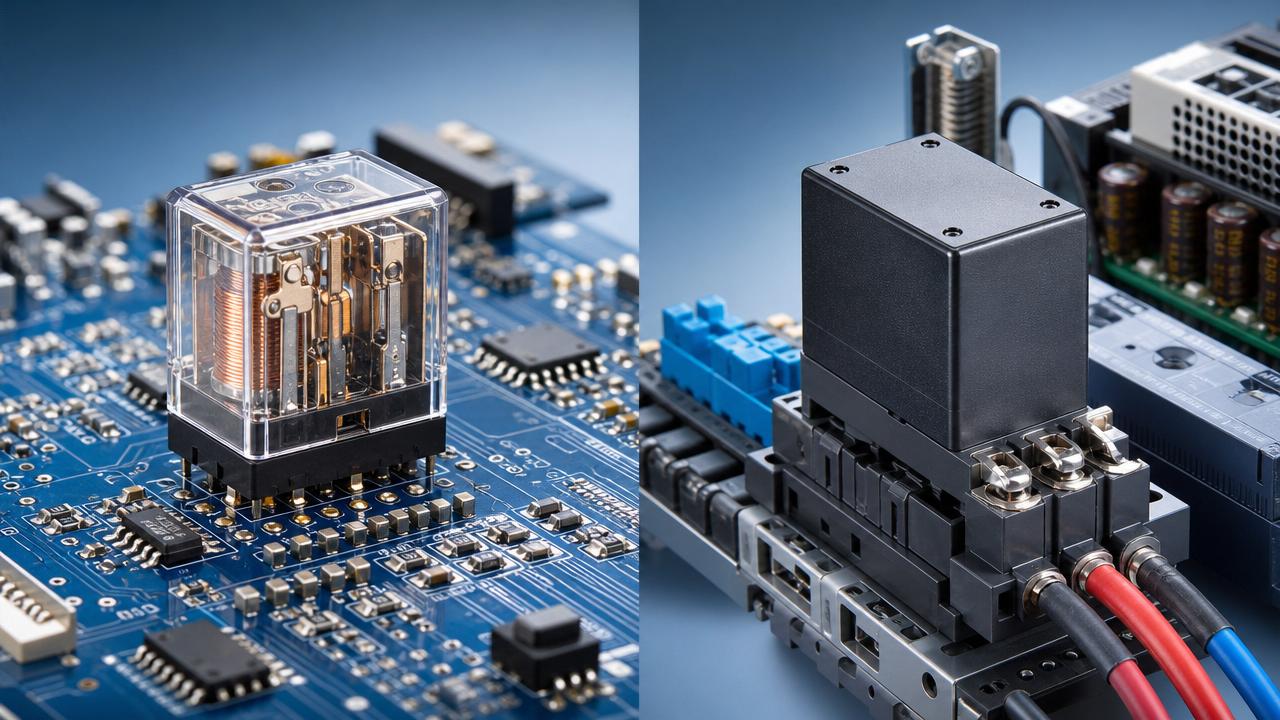
DETAILS
Choosing between signal relays and power relays affects switching precision, thermal stability, and service life across modern electronic systems.
For designs where low-level current, timing accuracy, and contact integrity matter, signal relays demand closer evaluation than their size suggests.
In contrast, power relays are built for heavier loads, wider contact gaps, and stronger arc control.
Understanding these differences helps reduce field failures, improve compliance confidence, and support better component selection across the semiconductor and EMS supply chain.
Definition and Core Difference Between Signal Relays and Power Relays
A relay is an electrically operated switch that opens or closes contacts through an energized coil or solid-state mechanism.
Signal relays are optimized for low-level electrical paths, often carrying milliamps or small voltages with minimal distortion.
Power relays handle larger current and voltage loads, usually in control cabinets, motor circuits, power distribution, and industrial equipment.
The main distinction is not only load capacity.
It also includes contact material, insulation distance, mechanical endurance, switching speed, and sensitivity to contamination.
Signal relays are typically smaller and more precise.
Power relays are generally stronger, bulkier, and more tolerant of switching stress.
Typical electrical focus
- Signal relays: low current, low voltage, high contact sensitivity.
- Power relays: high current, higher inrush, stronger isolation needs.
- Signal relays: cleaner switching paths for measurement or communication lines.
- Power relays: better arc resistance for energy transfer applications.
Why Relay Selection Matters in Today’s Electronics Supply Chain
Relay selection now carries more risk because electronic assemblies operate at tighter tolerances and higher integration density.
A mismatch between relay type and circuit behavior can create unstable signals, contact welding, thermal drift, or unexpected downtime.
This is especially relevant in sectors tracked by SiliconCore Metrics, where data-driven component validation supports reliable manufacturing outcomes.
Signal relays deserve particular attention in test equipment, telecom boards, instrumentation modules, and compact control electronics.
These environments often require repeatable switching under low-energy conditions, where poor contact physics can distort readings.
Current industry attention points
Key Selection Points for Signal Relays and Power Relays
The best selection method starts with actual load behavior, not only nominal ratings on a datasheet.
For signal relays, low-level switching performance often matters more than maximum current capability.
For power relays, transient load conditions can be more important than steady-state operation.
1. Load type and magnitude
Check whether the relay switches resistive, inductive, capacitive, or mixed loads.
Signal relays are usually chosen for dry circuits, sensor lines, audio paths, logic routing, and test matrices.
Power relays are better for heaters, motors, lamps, compressors, and battery-connected switching paths.
2. Contact material and contact resistance
Signal relays often use precious metal contacts to preserve stable performance at low currents.
Power relays may use more robust materials that tolerate arcing and higher thermal stress.
If contact resistance varies too much, signal relays can corrupt measurement accuracy or communication quality.
3. Coil power and response characteristics
Low coil power is valuable in portable devices, dense control boards, and energy-conscious systems.
Signal relays often offer faster response and lower actuation energy.
Power relays may need stronger drive conditions to maintain stable switching under heavy mechanical loads.
4. Isolation and physical spacing
Signal relays can still require strong isolation when used in mixed-voltage systems or test environments.
Power relays normally need larger clearance and creepage distances for safety compliance.
5. Environmental durability
Temperature, vibration, humidity, and airborne contamination all affect relay longevity.
Signal relays may suffer from oxidation or film buildup when switching very small loads.
Power relays may degrade through heat cycling, coil stress, and repeated arc exposure.
Application Value Across Common Electronic and Industrial Systems
Signal relays create value where switching must remain accurate, repeatable, and electrically clean.
They are common in automated test systems, medical electronics, telecom infrastructure, and precision instrumentation.
Power relays create value where higher energy must be controlled safely and reliably over long duty cycles.
They support HVAC controls, charging systems, industrial automation panels, and power conversion assemblies.
In mixed assemblies, both relay types may appear on the same board or within the same enclosure.
The wrong substitution can upset EMC behavior, service intervals, or thermal margins.
Typical usage comparison
Practical Classification of Relay Selection Scenarios
A practical relay decision often becomes easier when grouped by circuit objective.
- Routing or isolating weak signals: choose signal relays.
- Switching moderate to heavy loads: choose power relays.
- Compact PCB with strict timing: evaluate miniature signal relays.
- High inrush startup loads: favor power relays with surge margin.
- Harsh environmental exposure: compare sealed versions and endurance data.
- Safety-critical systems: review agency approvals and spacing requirements.
If a circuit carries both control logic and switched power, split the functions instead of forcing one relay type to cover both roles.
Implementation Notes and Common Mistakes to Avoid
One common mistake is selecting by physical size alone.
A compact relay is not automatically suitable for delicate signals, and a large relay is not automatically safer.
Another mistake is ignoring minimum load specifications.
Some signal relays are designed specifically for dry switching and may outperform general-purpose devices significantly.
It is also risky to overlook inrush current, contact bounce, and derating curves.
These factors influence failure rate more than headline ratings in many real assemblies.
Recommended review checklist
- Verify actual current, voltage, and load profile.
- Check minimum and maximum switching ratings.
- Review contact resistance stability over life.
- Confirm coil power, drive logic, and thermal limits.
- Assess sealing, contamination risk, and vibration exposure.
- Align with IPC-Class 3, ISO 9001, and product safety expectations where required.
Next-Step Evaluation for Better Relay Decisions
The choice between signal relays and power relays should come from measured circuit behavior, environmental stress, and reliability targets.
When signal accuracy, low contact resistance, and repeatable low-energy switching are essential, signal relays are usually the right path.
When current, surge handling, and physical isolation dominate, power relays remain the better fit.
A disciplined comparison using benchmark data, endurance testing, and application-specific derating will deliver stronger long-term results.
For deeper component evaluation, build a short validation matrix covering electrical load, contact behavior, thermal margin, and compliance criteria before final release.
Recommended News
- RelaysHow to vet an industrial automation distributor for genuine relaysVet an industrial automation distributor with confidence. Learn how to verify relay authenticity, traceability, and quality controls to reduce downtime and sourcing risks.
- RelaysWhat Standard Tests Measure Relay Contact Resistance Degradation?Are there standard test methods for relay contact resistance degradation? Explore IEC standards, endurance testing, Kelvin measurement, and environmental validation for reliable relay sourcing.
- RelaysVietnam Tariff Shift Favors China-Origin Relays Until 2027Vietnam tariff shift favors China-origin relays until 2027. Learn how the 3% tax on non-ASEAN relay imports impacts sourcing, costs, and procurement strategy in Vietnam.
- RelaysJapan Enforces JIS C 5012:2026 Relay EMI Test RuleJapan Enforces JIS C 5012:2026 Relay EMI Test Rule: learn how the new 1.8-2.4 GHz radiated immunity and IEC 61000-4-3:2024 report requirements may impact relay compliance, cost, and Japan market access.
- RelaysWhen a Relay Switches Factory Becomes a Risk to Product QualityRelay switches factory risks can quietly damage product quality, safety, and reliability. Learn the warning signs, audit points, and how to choose a stable supplier.
- RelaysHow to Compare Relay Switches Factory Capabilities for Stable SupplyRelay switches factory comparison starts with capacity, quality control, traceability, and lead time stability. Learn how to identify reliable suppliers and reduce sourcing risk.