
Electrical Relays vs Solid State: Which Fits Better
DETAILS
When comparing electrical relays with solid state alternatives, engineers, buyers, and project teams must weigh reliability, thermal management compliance, switching speed, and long-term cost. From circuit components and electromechanical parts to circuit board assembly, SMT compliance, and semiconductor compliance, the right choice affects performance, maintenance, and risk. This guide helps you evaluate which solution fits better across modern electronic parts and high-precision applications.
For B2B teams operating across semiconductor manufacturing, EMS sourcing, industrial controls, and high-precision electronics, relay selection is rarely a simple component decision. It affects PCB layout density, thermal packaging, signal integrity, maintenance planning, and even supplier qualification. A relay that performs well in a low-duty commercial device may become a weak link in a 24/7 industrial assembly, a Class 3 electronics program, or an environmentally stressed field deployment.
That is why technical evaluators, procurement leaders, quality managers, and project owners need more than a basic feature comparison. They need a structured view of operating cycles, load type, leakage behavior, contact wear, heat dissipation, compliance expectations, and total lifecycle cost. In many programs, the better choice is not universally electromechanical or solid state; it depends on the electrical profile, environmental stress, service model, and business risk tolerance.
Understanding the Core Difference Between Electrical Relays and Solid State Switching
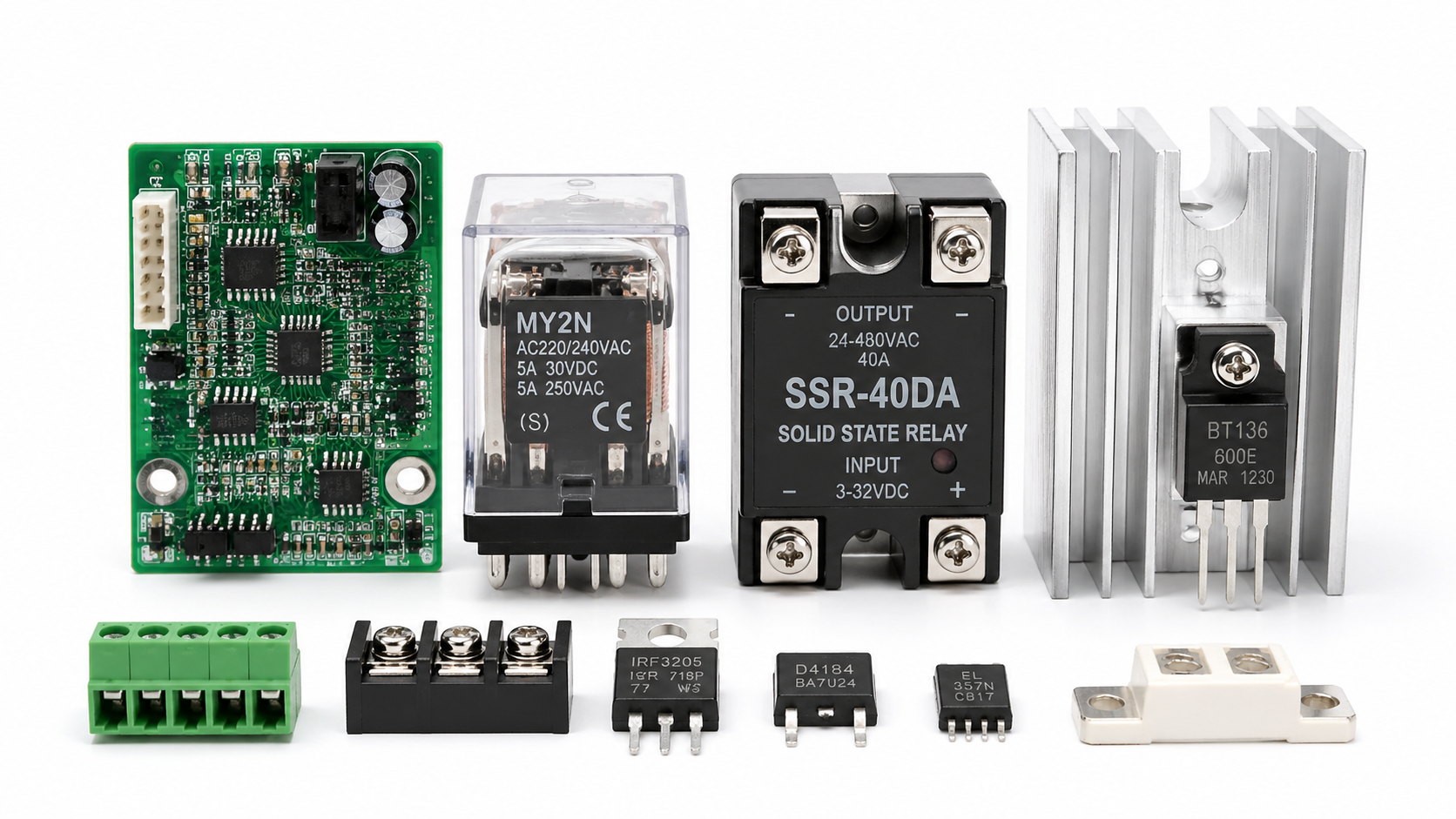
An electrical relay is an electromechanical device that uses a coil and moving contacts to open or close a circuit. A solid state relay, often called an SSR, performs the same control function through semiconductor devices such as thyristors, triacs, MOSFETs, or opto-isolated switching elements. Both are used in power control, automation, test systems, thermal equipment, and board-level designs, but their operating behavior differs in ways that directly affect system design.
Mechanical relays are valued for physical isolation, low on-state resistance in many use cases, and the ability to handle inrush or mixed loads with clear off-state separation. In contrast, solid state devices switch faster, often in the microsecond to millisecond range, generate no contact bounce, and avoid arc-driven wear because they contain no moving contacts. That makes them attractive in applications with frequent switching cycles, vibration, or restricted maintenance access.
However, the trade-off is important. Mechanical relays can provide near-zero leakage when open, while solid state relays typically exhibit off-state leakage current. For a low-current sensing circuit or safety interlock, that small leakage may still matter. On the other hand, in a heater control loop switching hundreds of times per hour, the limited contact life of an electromechanical relay can become a predictable maintenance burden within 12 to 36 months.
From an engineering repository perspective, the distinction should be examined at four levels: electrical behavior, thermal behavior, assembly impact, and lifecycle reliability. These four levels often reveal whether the relay decision belongs to component engineering alone or must be escalated to procurement, quality, and project management teams.
High-level functional comparison
The table below summarizes the practical differences most relevant to electronic manufacturing services, semiconductor-adjacent systems, and industrial electronics programs.
The key conclusion is that neither solution is automatically superior. Electromechanical relays often fit applications that need clear isolation, low leakage, and cost-effective control of moderate switching duty. Solid state relays fit better when cycle count, silent operation, and switching speed matter more than leakage current or additional thermal design effort.
Where misunderstanding usually starts
- Assuming a higher cycle rating always means lower system cost, without considering heat sinks, enclosure temperature, or power derating.
- Comparing current rating on paper but ignoring inrush current, inductive load behavior, or repetitive surge exposure.
- Treating relay selection as a standalone BOM choice instead of a cross-functional design, quality, and sourcing decision.
Performance, Reliability, and Thermal Management in Real Operating Conditions
In real production systems, relay performance is shaped by operating environment more than by catalog descriptions. A relay rated for 10 A resistive load may behave very differently under motor startup, heater cycling, capacitive charging, or ambient temperatures above 40°C. This is especially relevant in electronics manufacturing, thermal packaging equipment, reflow-adjacent systems, and precision instrumentation where even small switching losses can influence thermal drift and enclosure design.
Mechanical relays usually fail progressively through contact wear, welding, or inconsistent actuation after a defined number of operations. Depending on load type, practical life may range from 100,000 electrical cycles to several million operations. Solid state relays avoid mechanical wear, but their reliability is highly tied to junction temperature. If heat is not controlled, a relay that appears robust in laboratory conditions may derate sharply in the field, particularly in sealed cabinets or high-density assemblies.
Thermal management is therefore not optional for solid state switching. Designers often need to evaluate on-state voltage drop, expected load current, enclosure airflow, and heat sink resistance. For example, a 1.6 V drop at 8 A results in 12.8 W of dissipation. In a compact control box, that heat can push internal temperature above acceptable limits within a short duty cycle unless thermal paths are engineered correctly.
By contrast, mechanical relays generally dissipate less heat in the load path but create other reliability concerns: contact bounce, audible clicking, and sensitivity to shock or contamination. In dusty or chemically aggressive environments, contact surfaces and housings can age faster than expected, which is a quality-control issue in long-life equipment and remote service installations.
Typical operating risk profile
The next table maps common performance risks that engineering and quality teams should evaluate during design review, sourcing approval, or incoming inspection planning.
The practical takeaway is that reliability depends on matching the failure mode to the application. Mechanical relays tend to show wear-out through moving parts. Solid state relays tend to show stress through temperature and overcurrent events. Both can be reliable if derating, transient protection, and realistic duty-cycle analysis are handled early in the program.
What technical teams should validate
- Confirm load type: resistive, inductive, capacitive, lamp, motor, or mixed.
- Measure actual switching frequency over a 24-hour duty profile rather than relying on nominal assumptions.
- Review ambient and enclosure temperature at peak production conditions, not only room-temperature test data.
- Check whether off-state leakage, zero-cross behavior, or turn-on delay affects system safety or process precision.
Application Fit: Which Technology Works Better in Different Electronic and Industrial Scenarios
The better fit often becomes clear when the application is defined precisely. For PCB test fixtures, semiconductor support equipment, temperature control modules, SMT line peripherals, and power distribution subassemblies, switching behavior interacts with board spacing, heat zones, and maintenance expectations. The same relay family may be excellent for one program and unacceptable for another based on cycle count, accuracy target, or service access.
Electrical relays are frequently preferred in applications that require galvanic isolation, very low leakage, simple replacement, or lower upfront component cost. They remain common in alarm systems, power sequencing, automotive auxiliary functions, and many industrial panels where switching frequency is moderate and the audible click is not a drawback. In procurement terms, they can simplify sourcing because many equivalent form factors exist across approved vendors.
Solid state relays fit applications with repetitive switching, low noise requirements, or mechanically harsh settings. They are widely used in heater control, packaging lines, semiconductor thermal tools, lighting control, and automated test environments where a relay may switch thousands of times per day. In these cases, the absence of contact bounce can improve process stability, while silent operation benefits operator environments and enclosed instrumentation.
Still, selection must remain load-aware. A zero-cross SSR can be beneficial for resistive AC loads such as heaters because it reduces electrical stress at turn-on. Yet for phase-angle control, DC loads, or certain fast-response circuits, another solid state topology may be needed. Likewise, a mechanical relay may survive occasional surge events better in some designs but fail early if forced into rapid repetitive switching beyond its practical duty profile.
Application-oriented selection matrix
The matrix below helps project managers, technical buyers, and design engineers align relay choice with actual use conditions rather than generic preference.
This matrix is not a substitute for validation testing, but it helps narrow the decision quickly. In many mixed systems, the best answer is hybrid design: solid state switching for fast or frequent duty, and electromechanical relays for isolation or low-leakage paths. That blended architecture is increasingly common in advanced electronics and precision manufacturing equipment.
Common application mistakes
- Using an SSR on sensitive low-current loads without evaluating leakage current and downstream circuit behavior.
- Selecting a mechanical relay for a heating loop that cycles 5,000 to 20,000 times per week.
- Ignoring PCB creepage, thermal spacing, and solder-joint stress when integrating higher-dissipation switching components into dense assemblies.
Procurement, Compliance, and Total Cost of Ownership
From a purchasing and business evaluation standpoint, the decision cannot be reduced to piece price. An electrical relay may cost less initially, but if scheduled maintenance, contact replacement, downtime exposure, and field service labor are high, lifecycle cost can exceed a more expensive solid state alternative. Conversely, an SSR may raise BOM cost and require a heat sink, thermal interface material, or larger enclosure volume, which changes total assembly cost at the system level.
Compliance also matters. In programs tied to IPC-Class 3 workmanship expectations, ISO 9001 quality systems, or customer-specific environmental stress requirements, the relay must be evaluated as part of a larger reliability chain. That includes solderability, packaging integrity, traceability, counterfeit risk, temperature derating documentation, and whether the supplier provides stable revision control. For global EMS buyers, these are not secondary concerns; they influence approval speed and field risk.
Lead time and sourcing resilience should also be assessed. Mechanical relays often have broader cross-vendor availability, but exact contact material, coil voltage, and footprint compatibility can still create sourcing traps. SSRs may have fewer interchangeable options because thermal performance and semiconductor topology vary more widely between vendors. In constrained markets, a nominal 6-week lead time can extend to 10–14 weeks, making second-source strategy essential for project continuity.
For financial approvers, the most useful model is total cost of ownership across a 3-year to 5-year operating window. That model should include unit cost, assembly impact, spare inventory, expected maintenance events, qualification time, and downtime consequences. In high-value production equipment, even one avoided service interruption can offset the price gap between relay types.
Decision factors for sourcing and approval
The following procurement table can be used during vendor review, cross-functional design freeze, or cost justification meetings.
A disciplined sourcing team should compare at least 4 dimensions before approval: electrical suitability, lifecycle cost, compliance traceability, and supply continuity. This approach reduces the common mistake of buying to nominal current rating alone, which often leads to requalification cost or avoidable warranty exposure later.
Practical procurement checklist
- Request full derating curves, not just headline current rating.
- Verify load-specific life expectations at the intended switching frequency.
- Check package compatibility with existing PCB, connector, and enclosure architecture.
- Review traceability, storage controls, and incoming inspection criteria with the supplier or EMS partner.
- Define an approved alternate source before the program enters volume production.
Implementation Guidance, Maintenance Strategy, and Final Selection Advice
A reliable selection process should start with application profiling, not component preference. Teams should document nominal load, surge load, switching frequency, ambient temperature, duty cycle, expected service interval, and failure consequence. In many engineering programs, 5 inputs are enough to narrow the choice rapidly: load type, switching count per day, acceptable leakage, available thermal headroom, and service access. Without those inputs, relay decisions become reactive rather than engineered.
Implementation also requires board- and system-level review. For mechanical relays, confirm coil drive behavior, contact suppression, arc management, and vibration tolerance. For solid state relays, confirm heat sink sizing, creepage spacing, thermal interface quality, and whether fault detection is needed. In high-precision assemblies, even a small layout change can influence thermal cross-coupling, nearby passive component aging, and long-term solder joint reliability.
Maintenance planning should mirror failure mode. Electrical relays benefit from inspection intervals based on cycle count and load severity. A reasonable preventive review window might be every 6 to 12 months in moderate-duty equipment, or sooner if switching frequency is high. SSR-based systems need thermal inspection instead: verify mounting torque, dust accumulation, heat sink cleanliness, and enclosure temperature stability during peak operation.
For quality and after-sales teams, the best service strategy is to define measurable thresholds before deployment. Examples include maximum enclosure temperature, acceptable turn-on delay, contact resistance trend, leakage tolerance, and replacement intervals. Those thresholds support clearer root-cause analysis when field failures occur and improve communication between engineering, procurement, and service organizations.
A practical 5-step selection workflow
- Profile the electrical load in real operating conditions, including startup and transient behavior.
- Define environmental stress: temperature range, vibration level, dust, humidity, and service access.
- Compare relay technologies against switching frequency, leakage tolerance, and thermal allowance.
- Validate manufacturability through PCB review, SMT compatibility, inspection planning, and alternate sourcing.
- Run a lifecycle decision using a 3-year to 5-year cost and maintenance model before final approval.
FAQ: questions decision-makers often ask
How do I know if an SSR is overheating? Start with dissipation calculation and compare it to enclosure conditions. If load current and voltage drop create more than 8–15 W in a compact enclosure, a heat sink or airflow review is usually necessary. Field validation should include temperature measurement at peak duty, not just nominal load.
Are electrical relays better for safety circuits? They are often preferred when very low leakage and a clearly open contact state are important. Still, suitability depends on circuit architecture, standards, and redundancy requirements. The relay alone does not define the safety level.
Which option is easier to maintain in the field? Mechanical relays are often easier to replace individually, especially in panel-based systems. SSRs may reduce replacement frequency but require better thermal diagnosis skills during troubleshooting.
Can one relay type serve all applications in a product line? Usually not. Mixed product portfolios often need at least 2 switching strategies because load profile, service model, and ambient conditions differ too much across platforms.
Electrical relays and solid state relays each solve different switching problems, and the best fit depends on duty cycle, load behavior, thermal constraints, maintenance expectations, and sourcing risk. Mechanical relays remain practical for low-leakage isolation and moderate switching duty. Solid state solutions offer clear advantages in fast, repetitive, or vibration-prone applications, provided thermal management is engineered properly.
For organizations working across semiconductor, EMS, PCB, SMT, passive component, and thermal packaging ecosystems, a disciplined selection framework reduces redesigns, service costs, and procurement risk. SiliconCore Metrics supports this kind of decision-making through technical benchmarking, compliance-oriented evaluation, and data-driven analysis that helps engineering and sourcing teams align performance with business outcomes. To assess which switching approach fits your program better, contact us for a tailored evaluation, component review, or application-specific sourcing guidance.
- PCB
- thermal packaging
- signal integrity
- IPC-Class 3
- EMS
- thermal management
- environmental stress
- ISO 9001
- semiconductor manufacturing
- thermal management compliance
- SMT compliance
- semiconductor compliance
- electronic manufacturing
- circuit board assembly
- electronic parts
- circuit components
- semiconductor
- electromechanical parts
- relays
- electrical relays
- heat dissipation
- heat sinks
- solid state relays
- electromechanical relays
Recommended News
- RelaysHow to vet an industrial automation distributor for genuine relaysVet an industrial automation distributor with confidence. Learn how to verify relay authenticity, traceability, and quality controls to reduce downtime and sourcing risks.
- RelaysWhat Standard Tests Measure Relay Contact Resistance Degradation?Are there standard test methods for relay contact resistance degradation? Explore IEC standards, endurance testing, Kelvin measurement, and environmental validation for reliable relay sourcing.
- RelaysVietnam Tariff Shift Favors China-Origin Relays Until 2027Vietnam tariff shift favors China-origin relays until 2027. Learn how the 3% tax on non-ASEAN relay imports impacts sourcing, costs, and procurement strategy in Vietnam.
- RelaysJapan Enforces JIS C 5012:2026 Relay EMI Test RuleJapan Enforces JIS C 5012:2026 Relay EMI Test Rule: learn how the new 1.8-2.4 GHz radiated immunity and IEC 61000-4-3:2024 report requirements may impact relay compliance, cost, and Japan market access.
- RelaysWhen a Relay Switches Factory Becomes a Risk to Product QualityRelay switches factory risks can quietly damage product quality, safety, and reliability. Learn the warning signs, audit points, and how to choose a stable supplier.
- RelaysHow to Compare Relay Switches Factory Capabilities for Stable SupplyRelay switches factory comparison starts with capacity, quality control, traceability, and lead time stability. Learn how to identify reliable suppliers and reduce sourcing risk.