
RF Transceiver Power Draw: What to Expect
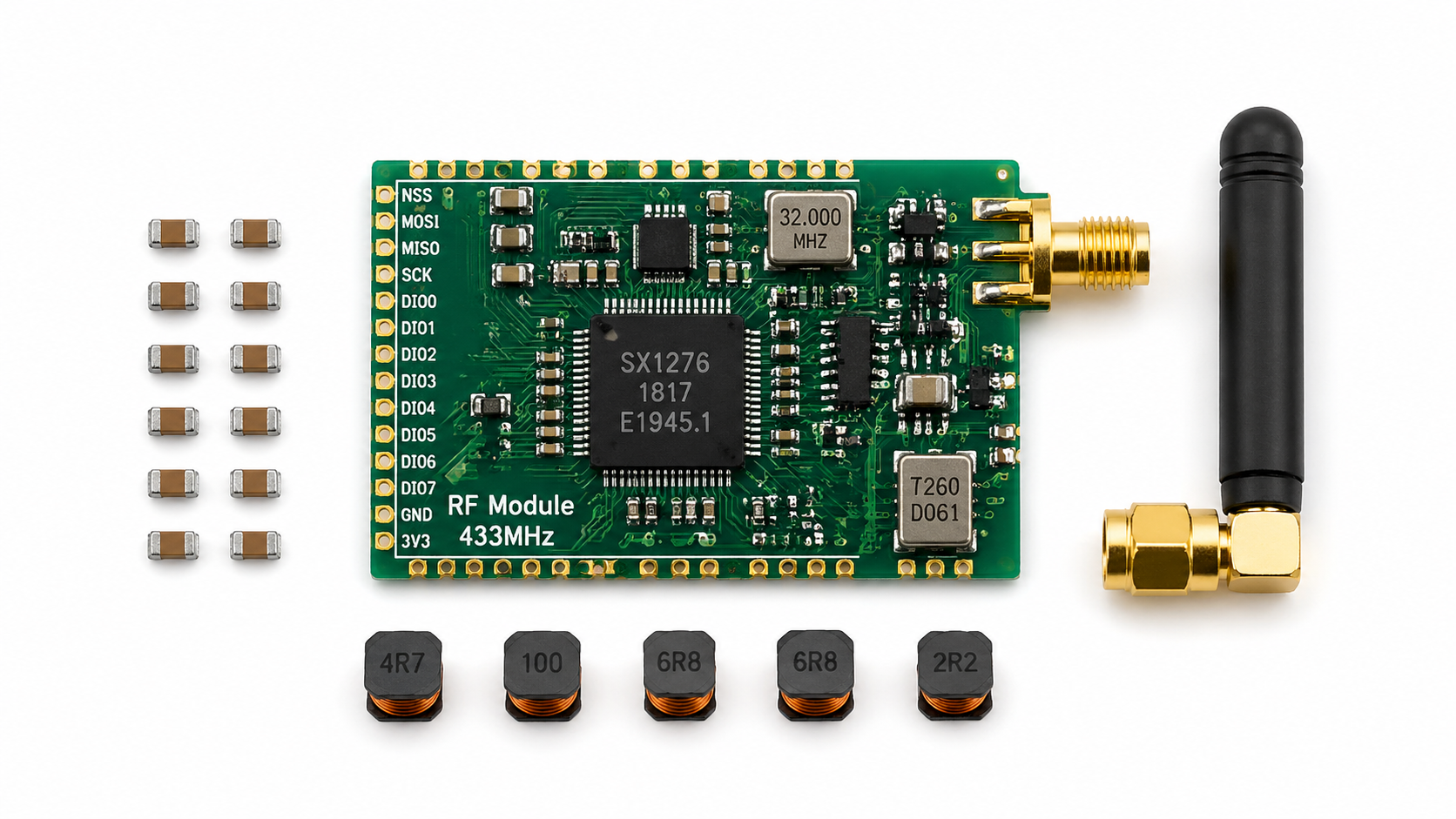
DETAILS
Understanding RF transceiver power draw starts with a practical truth: there is no single “normal” number. Power consumption depends on transmit power, receive duty cycle, modulation scheme, data rate, supply voltage, sleep behavior, matching network quality, PCB losses, and the surrounding component ecosystem. For engineers, evaluators, and buyers, the useful question is not simply “How much current does an RF transceiver use?” but “What should we expect in our actual operating state, and what will that mean for thermal margin, battery life, reliability, and cost?”
In most real designs, RF transceivers spend only a small portion of time in peak transmit mode and much more time in receive, standby, or sleep states. That is why average power draw often matters more than headline transmit current. At the same time, peak current still matters for power rail stability, capacitor sizing, PCB layout, EMI behavior, and long-term component stress. A sound evaluation should therefore separate peak, average, startup, and duty-cycle-based consumption rather than relying on one datasheet figure.
What power draw should you actually expect from an RF transceiver?
The short answer is: expect wide variation by application class.
For low-power wireless designs, RF transceiver current may range from microamps in deep sleep to a few milliamps in receive mode and tens of milliamps in transmit mode. For higher-performance industrial, broadband, or multi-band systems, receive and transmit currents can rise significantly, especially when linearity, sensitivity, output power, and fast switching are prioritized over battery efficiency.
A realistic expectation should include at least these operating states:
- Shutdown or deep sleep: usually the lowest draw, often critical for battery-backed systems
- Standby or idle: clocks or internal bias circuits may remain partially active
- Receive mode: the RF receiver, synthesizer, filtering, and baseband chain consume steady current
- Transmit mode: the RF transmitter and associated power amplification usually create the highest demand
- Startup and switching events: short-duration spikes can exceed steady-state assumptions
For technical assessments, average current should be modeled across the actual use profile, not guessed from the highest or lowest state alone. This is especially important in sensor nodes, handheld devices, industrial controllers, gateways, and mixed-duty communication equipment.
Why transmit current and receive current tell different stories
Many buyers and non-specialist reviewers focus too heavily on transmit current because it is often the largest published number. However, in many deployed systems, receive mode and standby time dominate total energy use.
Transmit current is mainly driven by output power level, PA efficiency, modulation linearity requirements, and supply voltage. If the application needs longer range, stronger penetration, or higher data rate, power draw usually rises. A transceiver operating at elevated RF output power may also place stricter demands on thermal design and voltage stability.
Receive current reflects the cost of keeping the RF receiver chain active: low-noise amplifiers, local oscillators, mixers, ADC-related functions, DSP blocks, and filtering resources. In systems that listen frequently or remain continuously available, receive current can have a larger impact on battery life than short transmit bursts.
This matters in procurement and design review because a part with slightly higher peak transmit current may still deliver lower overall energy consumption if it supports faster packet completion, lower retry rates, better sensitivity, or more efficient sleep transitions.
Which factors increase RF transceiver power consumption the most?
If you are trying to forecast power draw before prototype testing, the following variables usually have the largest effect:
- Transmit power setting: higher dBm output generally means higher current
- Duty cycle: frequent communication raises average power dramatically
- Receiver on-time: always-on listening can be expensive in low-power systems
- Data rate and modulation: some schemes shorten transmit time, while others increase processing or linearity demands
- Frequency band: performance and efficiency can vary across bands
- Supply voltage: device efficiency and regulator losses may change with rail choice
- Matching network quality: poor RF matching wastes energy and may force higher transmit settings
- PCB layout and material losses: inefficient routing, poor grounding, or dielectric inconsistency can degrade system efficiency
- Temperature: extreme thermal conditions can shift performance and current behavior
- External component selection: capacitors, inductors, filters, switches, and electromechanical interfaces all affect stability and efficiency
For organizations working across the semiconductor and EMS supply chain, these variables are not just design details. They directly affect product qualification, manufacturing repeatability, BOM cost, and warranty risk.
How circuit components influence transceiver power draw more than many teams expect
RF transceiver power behavior is not determined by the IC alone. Supporting circuit components can materially affect both measured current and real-world stability.
High-performance capacitors are especially important around power rails, PLL sections, and transient load points. Poor decoupling can cause voltage droop during transmit bursts, leading to spectral instability, retries, performance degradation, or increased effective energy use. Capacitor ESR, ESL, temperature stability, and aging profile all matter in high-frequency environments.
Industrial capacitors used in harsh or wide-temperature applications need to be evaluated for capacitance retention under DC bias and thermal stress. A nominal capacitor value on paper may not represent actual in-circuit behavior, especially where miniaturized ceramics are used aggressively.
Inductors and matching elements influence RF path efficiency. A poorly optimized matching network can reduce radiated efficiency and force the system to consume more power for the same communication result.
Electromechanical parts such as connectors, shields, relays, or antenna interfaces can introduce loss, variability, or grounding discontinuities. These may not appear in simplified power models but often emerge during validation and field deployment.
For this reason, a credible power assessment should include the full signal and supply chain, not only the transceiver datasheet.
What engineers and evaluators should measure instead of relying only on datasheet current
Datasheet values are useful starting points, but they are not enough for design approval or sourcing decisions. The most informative validation approach includes these measurements:
- Peak current during transmit bursts
- Steady receive current under normal sensitivity settings
- Sleep and standby leakage across temperature
- Startup current and settling time
- Average current across a realistic communication cycle
- Power rail ripple during mode transitions
- Thermal rise in enclosed or high-density PCB conditions
- Packet success rate versus power setting
- Retry behavior under degraded link conditions
These measurements help teams answer the questions that matter commercially and operationally: Will the battery target be met? Is the regulator sized correctly? Are the capacitors adequate? Will thermal margins hold in volume production? Can procurement accept alternate components without changing system behavior?
How power draw affects thermal management, compliance, and long-term reliability
Power draw is never just an energy issue. It also influences thermal stress, compliance behavior, and long-term durability.
Higher RF transceiver current can create localized heating in the IC, nearby regulators, matching components, and PCB copper paths. In tightly packed assemblies, this can interact with other hot components and reduce reliability margin. Temperature rise may also shift RF characteristics, creating a feedback loop between efficiency and thermal performance.
From a compliance perspective, unstable power rails or underspecified decoupling can contribute to spurious behavior, degraded signal integrity, and emission problems. This is particularly relevant where multi-layer PCB stack-up, dielectric consistency, and grounding strategy affect RF return paths and noise containment.
For quality and safety teams, the issue is lifecycle performance: repeated burst loading, thermal cycling, capacitor aging, solder joint fatigue, and connector degradation can all be accelerated when transient current is underestimated in early design stages.
What buyers, project managers, and finance approvers should ask before selection
Non-design stakeholders do not need to analyze every RF parameter, but they should ask the right questions to avoid hidden cost and qualification risk.
- Is the quoted power draw based on peak, average, or standby current?
- What duty cycle assumptions were used?
- Does the value include external losses from matching, regulation, and PCB implementation?
- How sensitive is performance to capacitor, inductor, or antenna tolerance?
- What happens to current draw across temperature and supply variation?
- Will alternate-source components change power behavior?
- Does lower current come at the cost of reduced range, sensitivity, or retry rate?
- What is the expected impact on thermal design and enclosure constraints?
These questions help procurement and business evaluators move beyond unit price and see total operating cost, design margin, and field reliability more clearly.
A practical method for estimating expected RF transceiver power draw
If you need a simple but decision-useful framework, estimate consumption in five steps:
- List all operating states — sleep, standby, receive, transmit, startup, scan, reconnect
- Assign current values from datasheets, reference designs, or lab measurements
- Estimate time spent in each state during a normal operating cycle
- Calculate average current using weighted duty cycle
- Add margin for temperature, tolerance, retries, aging, and manufacturing variation
Then validate the estimate on hardware using realistic antennas, PCB layouts, supply rails, and communication conditions. This prevents a common failure mode in RF projects: selecting a transceiver that looks efficient in a datasheet table but performs less efficiently in the final assembly.
Bottom line: what to expect from RF transceiver power draw
Expect RF transceiver power draw to vary widely by operating mode and implementation quality. Peak transmit current often gets the attention, but average system consumption usually depends just as much on receive behavior, standby strategy, and how efficiently the surrounding circuit components support the device. High-performance capacitors, industrial capacitors, matching networks, PCB construction, and electromechanical interfaces can all influence whether the transceiver meets its expected efficiency in practice.
For engineers, the right approach is measurement-based validation across real duty cycles. For buyers and evaluators, the right approach is to compare not just headline current but complete operating profiles, supporting component sensitivity, thermal implications, and reliability margin. The best decision is rarely the part with the lowest single current figure; it is the one that delivers stable RF performance, manufacturable implementation, and predictable lifecycle cost under actual operating conditions.
Recommended News
- RF ModulesHow dielectric constant affects impedance stability in RF modulesDielectric constant for RF modules directly affects impedance stability. Learn how Dk variation, stackup control, frequency, and fabrication impact RF performance.
- RF ModulesHow to Choose Low Power Wireless Modules for Battery-Driven DevicesWireless modules low power selection starts with real energy use, not datasheet claims. Learn how to compare RF, protocol fit, battery life, and reliability for smarter device design.
- RF ModulesEU WEEE Rule Takes Effect for Leaded RF ModulesEU WEEE rule now impacts leaded RF modules at import: Bluetooth and Wi-Fi shipments may be blocked without a Pb-exemption code. Learn key compliance steps to avoid customs delays.
- RF ModulesLow Power RF Transmitter Range Limits in Real DeploymentsLow power RF transmitter range depends on antennas, interference, enclosures, and regulations. Learn what really limits field performance and how to plan reliable deployment.
- RF ModulesRF Transmitter Price Breakdown: What Drives Total CostRF transmitter price depends on more than the quote. Discover how specs, certification, materials, and reliability testing shape total cost and smarter supplier decisions.
- RF ModulesVietnam to Require VCCI Pre-Approval for RF Module ImportsVietnam RF Module imports will require VCCI pre-approval from Aug 1, 2026. Learn how the new rule may affect customs clearance, supply chains, and sourcing plans.