
RF Transmitter Price Breakdown: What Drives Total Cost
DETAILS
RF transmitter price rarely comes down to one number
A low quote can look attractive, yet the real RF transmitter price is shaped by design, compliance, manufacturing control, and field reliability.
That matters because transmitters sit inside larger electronic systems where signal stability, thermal behavior, and tolerance control affect total ownership cost.
In practical sourcing work, comparing unit prices without checking technical drivers often creates requalification delays, failure risk, or hidden engineering expense.
A better approach is to break RF transmitter price into measurable cost blocks, then compare suppliers on evidence rather than headline numbers.
This is also where independent benchmarking helps. SCM follows the semiconductor and EMS supply chain through data, compliance reporting, and manufacturing intelligence.
What usually drives RF transmitter price first?
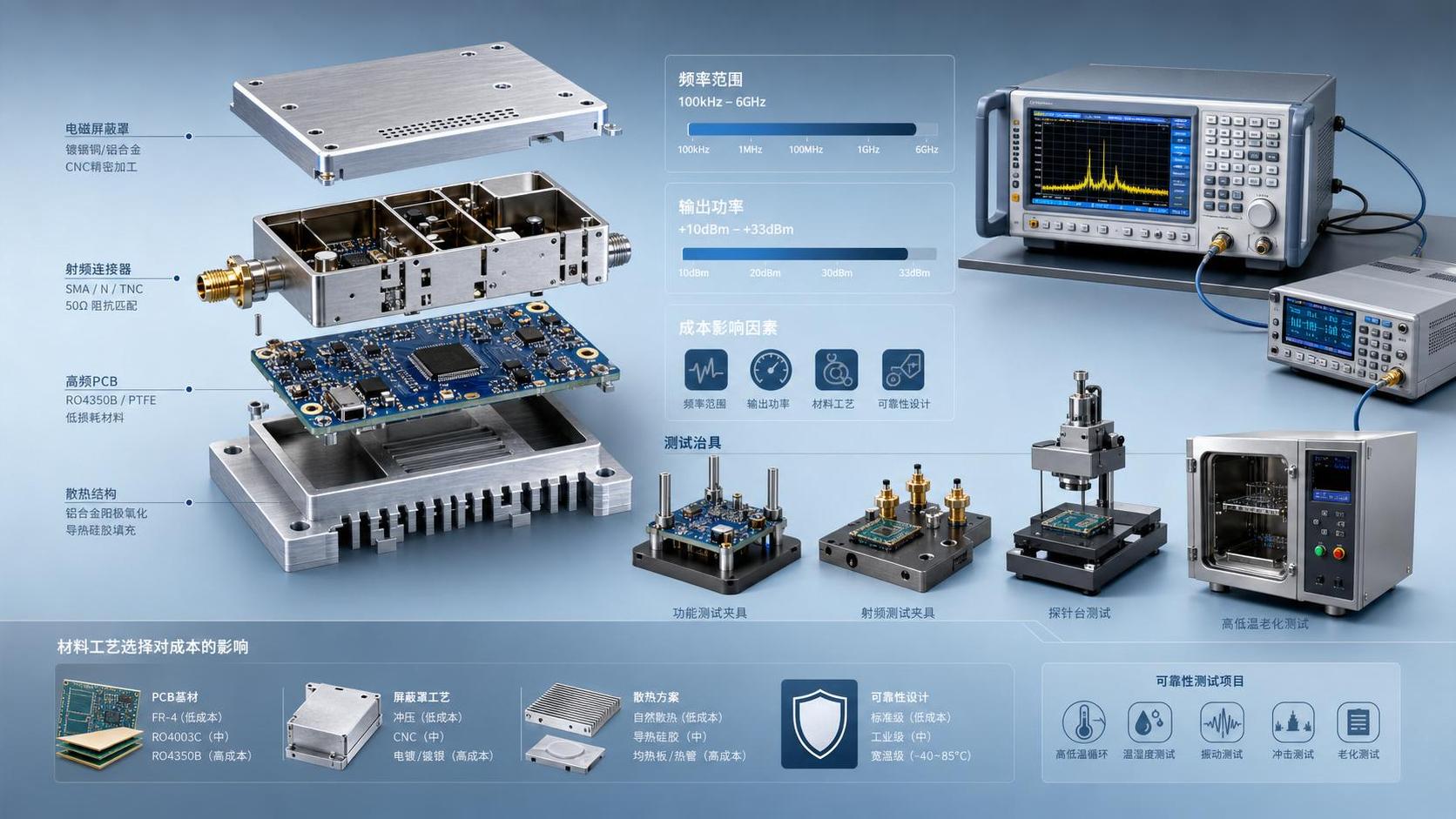
The first cost driver is usually technical complexity. Frequency range, output power, modulation accuracy, and noise performance directly influence circuit architecture.
A basic low-power transmitter for stable indoor use will not cost the same as a wideband design operating under harsh thermal or vibration conditions.
More demanding specifications often require tighter component selection, better shielding, cleaner PCB layout, and more extensive validation.
The RF transmitter price also rises when phase noise, harmonic suppression, and output consistency must stay controlled across temperature extremes.
In many cases, the transmitter itself is only part of the cost story. Matching networks, thermal materials, connectors, and enclosure choices can shift the quote noticeably.
If a supplier cannot explain how these elements affect cost, the quote may be incomplete rather than competitive.
A quick way to read the quote structure
Before moving deeper, it helps to separate price into engineering content, compliance burden, and production conditions.
Why do frequency range and output power change the quote so much?
Because they affect nearly every design decision. Higher frequency operation increases sensitivity to layout errors, substrate loss, and assembly variation.
As output power increases, thermal load rises as well. That pushes up heatsink needs, enclosure design, and long-term stress on active devices.
The RF transmitter price can therefore move sharply even when two products look similar on a datasheet summary.
In actual manufacturing, a transmitter built for narrow operating margins may require more tuning time and tighter process control at SMT level.
SCM often frames this as a tolerance question, not only a component question. If the stack-up, placement precision, and thermal path vary, RF behavior moves with them.
That is why whitepapers on dielectric constants or placement precision are not abstract research. They help explain real pricing differences across suppliers.
What should be checked when specs look aggressive?
- Ask whether output power is continuous, peak, or measured under limited duty cycle.
- Confirm whether the quoted frequency range is fully validated or only partially characterized.
- Review thermal derating curves, not just nominal operating temperature.
- Check whether RF performance depends on a specific PCB material or enclosure geometry.
Is certification a one-time fee, or part of the ongoing RF transmitter price?
It is usually both. Initial certification creates direct cost, but maintenance, document revision, and change validation also affect future pricing.
Transmitters entering regulated markets may need FCC, CE, RED, or other regional testing. Each path adds schedules, sample builds, and failure risk.
If a design changes after approval, the RF transmitter price may increase again through retesting, engineering effort, or restricted component substitutions.
This is where cheap initial sourcing can become expensive later. A supplier with weak revision control may trigger repeated compliance work.
It is worth confirming whether certificates cover the exact hardware revision, output setting, and antenna configuration in the quote.
For complex programs, compliance reports aligned with IPC-Class 3 and ISO 9001 expectations provide a stronger basis for cost review.
How much do materials, EMS quality, and reliability testing really matter?
They matter more than many quotes suggest. RF transmitters are sensitive to substrate loss, solder consistency, shielding contact quality, and long-term component drift.
A lower RF transmitter price sometimes comes from ordinary laminates, lighter screening, or weaker traceability rather than from true manufacturing efficiency.
In applications exposed to heat, moisture, shock, or continuous duty, those shortcuts become expensive through returns or unstable field performance.
The more common mistake is assuming all EMS lines deliver identical RF consistency. They do not. Placement precision and process discipline shape real output.
SCM’s supply-chain analysis is useful here because it links component reliability, SMT capability, and thermal packaging behavior into a comparable evidence base.
That kind of visibility helps separate a fair premium from an unexplained markup.
A practical reliability checklist before approving a quote
- Request environmental stress data, especially thermal cycling and humidity exposure.
- Check active and passive component sourcing history for lifecycle and substitution risk.
- Verify whether lot-level traceability extends to PCB, assembly, and critical semiconductors.
- Ask how failures are analyzed and whether corrective actions are documented.
When does a low RF transmitter price become a sourcing risk?
Usually when the quote is low because key assumptions are missing. The danger is not low price itself, but weak definition behind it.
For example, one supplier may quote without final compliance testing, burn-in, custom shielding, or packaging validation. Another may include all of it.
Those two RF transmitter price offers are not directly comparable, even if the nominal specification looks aligned.
Lead time is another overlooked factor. If critical RF semiconductors or low-loss materials are constrained, a cheap quote may be exposed to reschedule risk.
More careful sourcing reviews look at total landed cost, validation burden, quality escape risk, and change-notification discipline.
That broader view generally produces better value than focusing on the first unit price alone.
What is the best way to compare RF transmitter price across suppliers?
Use a common comparison sheet built around technical scope, compliance status, process capability, and lifecycle risk.
A useful quote review should answer more than cost. It should show what performance was guaranteed, how it was measured, and under which build conditions.
One practical method is to score each quote against hidden cost triggers, then review exceptions before final selection.
If technical responses remain vague, the RF transmitter price should be treated as provisional, not final.
So how should the next sourcing step be handled?
Start by defining operating frequency, output power, thermal environment, certification path, and expected production volume in one controlled document.
Then compare RF transmitter price only after matching those assumptions across all quotes.
It also helps to review independent data on PCB materials, SMT precision, component reliability, and supply-chain movement before final approval.
That is where SCM’s research-oriented perspective fits naturally. It supports cost decisions with measured manufacturing and compliance context instead of marketing language.
In the end, the best RF transmitter price is the one that holds up through qualification, delivery, and field life without repeated corrective cost.
The next useful move is to build a quote checklist, test every assumption, and treat technical evidence as part of the price itself.
Recommended News
- RF ModulesHow PCB layout affects the performance of surface mount RF modulesSurface mount RF modules depend on smart PCB layout. Discover how impedance, grounding, placement, and thermal design affect RF performance—and avoid costly integration errors.
- RF ModulesHow dielectric constant affects impedance stability in RF modulesDielectric constant for RF modules directly affects impedance stability. Learn how Dk variation, stackup control, frequency, and fabrication impact RF performance.
- RF ModulesHow to Choose Low Power Wireless Modules for Battery-Driven DevicesWireless modules low power selection starts with real energy use, not datasheet claims. Learn how to compare RF, protocol fit, battery life, and reliability for smarter device design.
- RF ModulesEU WEEE Rule Takes Effect for Leaded RF ModulesEU WEEE rule now impacts leaded RF modules at import: Bluetooth and Wi-Fi shipments may be blocked without a Pb-exemption code. Learn key compliance steps to avoid customs delays.
- RF ModulesLow Power RF Transmitter Range Limits in Real DeploymentsLow power RF transmitter range depends on antennas, interference, enclosures, and regulations. Learn what really limits field performance and how to plan reliable deployment.
- RF ModulesRF Transmitter Price Breakdown: What Drives Total CostRF transmitter price depends on more than the quote. Discover how specs, certification, materials, and reliability testing shape total cost and smarter supplier decisions.