
How to Cut RF Transmitter Interference Issues
DETAILS
RF transmitter interference is rarely caused by a single fault. In most electronics environments, it results from a combination of layout weaknesses, poor grounding, inadequate shielding, unstable power delivery, thermal drift, and inconsistent assembly quality. For engineers, operators, sourcing teams, and quality managers, the practical answer is clear: reducing interference requires a system-level approach that starts at design selection and continues through PCB fabrication, SMT assembly, reflow control, validation, and supplier quality management.
If you are trying to improve signal integrity, protect RF receiver performance, or reduce field failures, the most effective path is to focus on the areas that create the highest real-world impact: PCB stack-up and grounding, component placement, power integrity, shielding strategy, thermal control, soldering consistency, and compliance-based verification. These are the factors that most directly affect performance, cost, reliability, and procurement decisions.
What usually causes RF transmitter interference in real products?
When users search for how to cut RF transmitter interference issues, they are usually not looking for theory alone. They want to know why interference is happening in an actual device, board, module, or production line, and what actions will reduce it without creating new cost or reliability problems.
In practice, RF interference often comes from a few recurring sources:
- Poor PCB layout: Long trace runs, bad return paths, impedance discontinuities, and weak isolation between RF and digital sections.
- Inadequate grounding: Split grounds used incorrectly, high loop area, via bottlenecks, and insufficient ground stitching.
- Power supply noise: DC-DC converters, ripple, switching harmonics, and insufficient decoupling near sensitive RF stages.
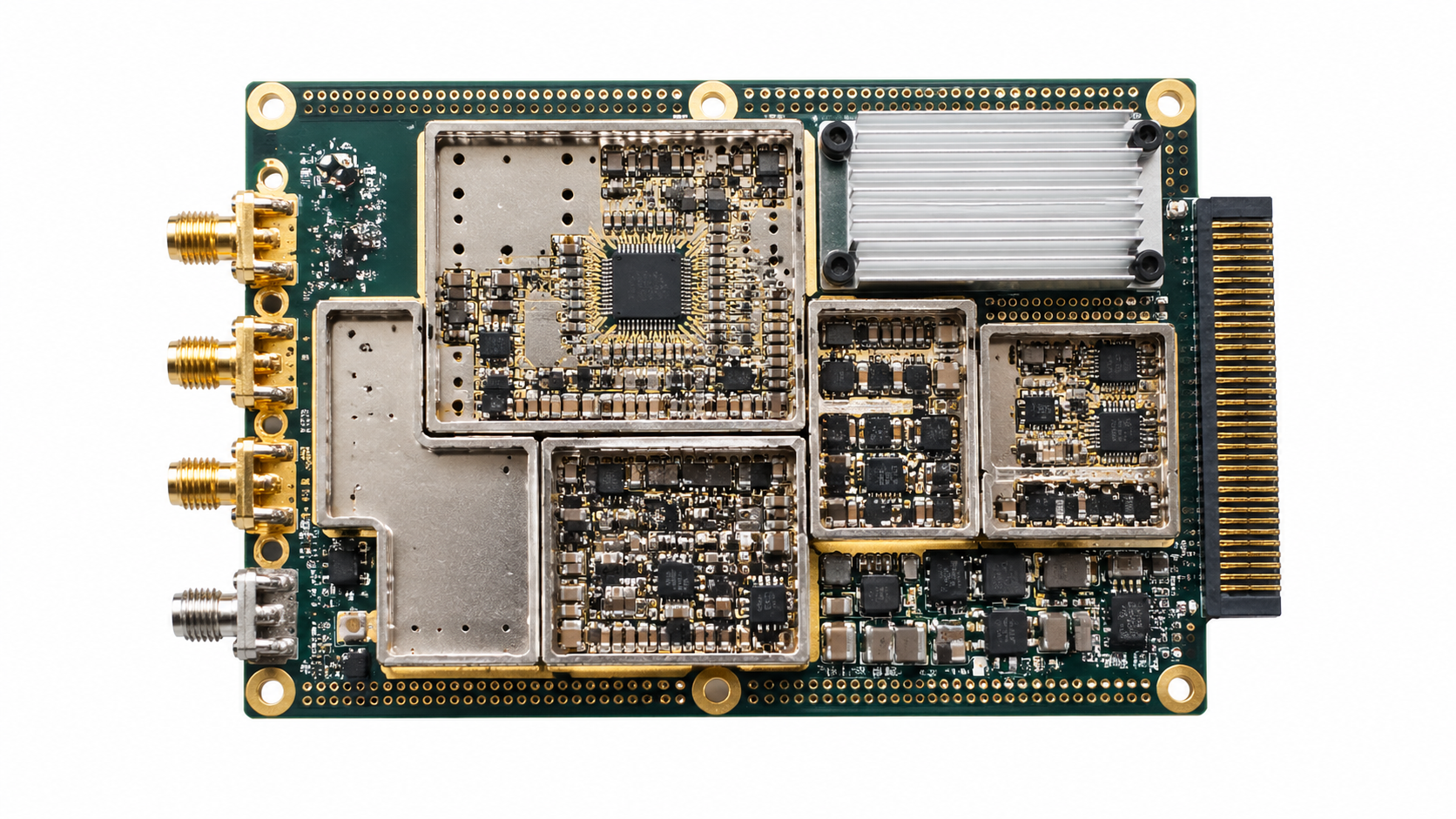
- Weak shielding: Missing or poorly implemented shielding cans, enclosure leakage, and cable-radiated emissions.
- Component interaction: Oscillators, amplifiers, processors, antennas, and high-speed interfaces coupling into one another.
- Thermal instability: Frequency drift, gain variation, and degraded noise behavior under elevated temperature.
- Assembly inconsistency: Voids, tombstoning, poor solder wetting, misalignment, or reflow profile variation affecting RF performance.
For technical evaluators and project owners, the important takeaway is that interference control should not be treated as a late-stage EMI fix. It should be built into component selection, layout rules, process control, and qualification testing from the start.
Where should teams focus first to get the biggest reduction in interference?
Not every corrective action delivers the same value. If time and budget are limited, teams should first prioritize the areas that usually create the largest performance improvement.
1. Fix return paths and grounding
Many RF interference issues are fundamentally return-path problems. Even when the signal trace looks acceptable, current may be forced into a noisy or elongated return path, increasing radiation and coupling. A solid reference plane, low-inductance grounding, and frequent stitching vias around RF zones can reduce this risk significantly.
2. Improve RF-to-digital isolation
Digital clocks, memory buses, switching regulators, and processor activity can easily pollute nearby RF sections. Physical separation, guard structures, layer planning, and routing discipline usually deliver better results than trying to suppress noise later with add-on filtering alone.
3. Control power integrity near the transmitter chain
Transmitters are highly sensitive to supply noise. A noisy rail can worsen phase noise, spectral purity, and adjacent channel behavior. Use local decoupling, ferrite isolation where appropriate, clean regulator selection, and careful placement of power conditioning networks close to active RF components.
4. Validate thermal behavior early
As power density rises, thermal effects become an RF issue, not just a reliability issue. Hotspots can shift operating behavior, detune matching structures, and change component characteristics. Thermal management compliance should therefore be part of RF stability planning, especially in compact modules and high-duty-cycle systems.
How PCB design choices directly affect RF transmitter interference
For engineers and sourcing teams evaluating design robustness, PCB design is one of the strongest predictors of RF performance. Material and stack-up choices influence loss, coupling, repeatability, and manufacturability.
Choose the right PCB stack-up and dielectric properties
Stable dielectric constants matter in RF circuits because impedance control and phase behavior depend on predictable material performance. Variability in dielectric properties across production lots can increase tuning difficulty and create inconsistent interference behavior across builds.
This is especially important in multi-layer boards where RF traces coexist with high-speed digital channels and power circuitry. Independent benchmarking of multi-layer PCB dielectric constants can help buyers and design teams assess whether a supplier can maintain the consistency needed for low-interference operation.
Keep RF traces short, controlled, and isolated
Trace geometry must support controlled impedance and avoid unnecessary discontinuities. Minimize stubs, avoid sharp routing transitions, and maintain consistent spacing from aggressor nets. Sensitive nodes such as oscillator lines, LNA inputs, PA outputs, and matching networks deserve special isolation treatment.
Use plane strategy carefully
Ground planes help reduce emissions and improve return behavior, but only when implemented correctly. Gaps, fragmented references, or poorly managed layer transitions can make interference worse. Every via transition should be evaluated for reference continuity, especially in high-frequency sections.
Pay attention to connector and cable exit points
Many products pass internal checks but fail in system use because interference escapes through cables, connectors, or enclosure seams. The board-to-cable boundary is often where common-mode noise becomes a practical field issue. Designers should review filtering, grounding, shield termination, and mechanical interface details together, not separately.
Why component selection and supplier quality matter more than many teams expect
Interference reduction is not only a layout problem. Component behavior, tolerance stability, package quality, and sourcing consistency all affect RF results. This matters not just to design engineers, but also to procurement leads, quality teams, and financial approvers assessing long-term risk.
Active components can introduce hidden variability
Oscillators, PLLs, amplifiers, mixers, and regulators can differ materially in phase noise, spurious response, temperature stability, and susceptibility to supply noise. Two parts that appear interchangeable on a basic datasheet may behave very differently in a dense RF environment.
Passive components influence matching and filtering precision
Capacitors and inductors used in matching, filtering, and decoupling networks need tight tolerance, stable behavior across temperature, and suitable high-frequency characteristics. Low-cost substitutions can quickly degrade RF isolation, increase reflected energy, or reduce filter effectiveness.
Compliance-driven sourcing reduces downstream interference risk
For procurement and commercial evaluators, the safer question is not only “Is this part available?” but also “Can this supplier deliver repeatable electrical and assembly performance under our operating conditions?” Standardized compliance reports, long-term reliability data, and supplier benchmarking can help reduce the chance of hidden interference issues caused by inconsistent materials or marginal component quality.
How SMT soldering and reflow practices influence RF performance
Many teams underestimate how strongly assembly quality affects RF transmitter interference. But at high frequencies, small physical deviations can change impedance, grounding effectiveness, shielding contact, and thermal behavior.
Placement precision affects RF repeatability
In RF layouts, component offset can alter parasitic capacitance and inductance enough to change performance. This is especially true in matching networks, filter sections, and tightly coupled transmission structures. SMT placement precision metrics therefore matter more in RF applications than in many general digital boards.
Reflow profile control protects electrical consistency
Improper reflow soldering can cause poor wetting, voiding, skew, or micro-joint reliability issues. In RF power sections and shield attachment points, these defects may increase contact resistance, weaken grounding, and change thermal transfer paths. A stable reflow process supports both signal integrity and long-term field reliability.
Solder joint quality impacts shielding and grounding
Shield cans, ground pads, thermal pads, and high-current RF paths must be assembled consistently. Even a mechanically acceptable joint may be electrically suboptimal at RF frequencies. Quality teams should inspect not just appearance, but also continuity, void levels where relevant, and process capability over repeated lots.
What role does thermal management play in cutting transmitter interference?
Thermal management is often viewed as a reliability issue, but in RF systems it is also a performance-control issue. Heat changes material properties, active device behavior, oscillator stability, and the consistency of power amplification stages.
When thermal conditions are not controlled, teams may see:
- Frequency drift over operating time
- Higher noise floors or degraded spectral purity
- Variation in transmit power
- Reduced receiver coexistence performance
- Intermittent failures during high-duty-cycle operation
Effective thermal management compliance includes heat path design, pad and via structure optimization, proper thermal interface selection, enclosure airflow evaluation, and validation under realistic environmental stress. For high-performance electronics, thermal packaging decisions should be reviewed alongside RF integrity, not afterward.
How should teams test and verify that interference is actually reduced?
One of the biggest concerns for technical evaluators, quality managers, and project leaders is verification. It is not enough to make a design change and assume the issue is solved. Teams need evidence that interference has been reduced in a repeatable and production-relevant way.
Use both bench diagnostics and system-level validation
Spectrum analysis, near-field probing, power rail noise checks, and thermal imaging can identify local problems quickly. But final decisions should also include system-level testing, because enclosure effects, cable routing, and real operating states often change interference behavior.
Test across temperature, load, and operating modes
A design that looks acceptable at room temperature and nominal load may fail at maximum output, elevated temperature, or under simultaneous digital activity. Interference validation should cover worst-case operating conditions, not just engineering lab snapshots.
Track process variation, not just one golden sample
For manufacturing and procurement decisions, a single passing prototype is not enough. Teams should evaluate multiple builds and, where possible, multiple lots to identify whether interference control is robust to supplier and process variation. This is where independent benchmarking and standardized compliance reporting add strategic value.
What decision-makers should ask before approving a redesign or supplier change
For procurement professionals, business evaluators, finance approvers, and project managers, RF interference mitigation should be assessed as a risk-and-return decision, not just an engineering preference.
Before approving a design revision, process change, or new supplier, ask:
- Will this change reduce interference at the root cause, or only mask symptoms?
- How will it affect PCB compliance, semiconductor compliance, and product certification risk?
- Does the supplier provide data on dielectric consistency, assembly precision, and long-term reliability?
- What is the expected effect on yield, rework rate, field failure rate, and support cost?
- Will the improvement remain stable across volume production and environmental stress?
- Does the proposed fix introduce cost, thermal, or sourcing risks elsewhere in the design?
This kind of structured review helps organizations avoid the common mistake of solving one EMI symptom while increasing lifecycle cost or supply chain exposure.
Practical checklist: the fastest way to reduce RF transmitter interference issues
If teams need a concise action plan, start with this sequence:
- Review RF layout, return paths, and grounding continuity.
- Separate RF, digital, and switching power zones more effectively.
- Improve local power filtering and decoupling around transmitter stages.
- Confirm controlled impedance and material consistency in the PCB stack-up.
- Reassess active and passive component quality for noise, tolerance, and temperature stability.
- Check SMT placement accuracy and reflow soldering consistency on RF-critical parts.
- Inspect shield attachment, grounding integrity, and enclosure leakage paths.
- Validate thermal behavior under worst-case operating conditions.
- Test multiple builds, not just prototypes, to confirm repeatability.
- Use compliance and benchmarking data to support supplier and design decisions.
Conclusion
Cutting RF transmitter interference issues requires more than adding a shield or tweaking a filter at the end of development. The most effective results come from a coordinated strategy that combines sound PCB design, stable materials, clean power delivery, proper component selection, controlled SMT assembly, disciplined reflow soldering, and realistic thermal and compliance validation.
For engineers, this means solving the true physical causes of interference. For procurement and business teams, it means choosing suppliers and processes that deliver repeatable electrical performance, not just nominal specification compliance. For quality and project leaders, it means verifying improvements across production conditions, not relying on isolated lab success.
In short, RF interference is best reduced when hardware is treated as a measurable system. That is the approach most likely to protect signal integrity, improve RF receiver coexistence, and deliver reliable, production-ready electronics performance.
- PCB
- PCB fabrication
- SMT assembly
- passive components
- thermal packaging
- signal integrity
- EMS
- thermal management
- multi-layer PCB
- dielectric constants
- SMT placement
- precision metrics
- active components
- environmental stress
- compliance reports
- PCB design
- passive component quality
- thermal management compliance
- PCB compliance
- semiconductor compliance
- component placement
- reflow soldering
- SMT soldering
- semiconductor
- high-performance
- RF transmitter
- RF receiver
- connectors
Recommended News
- RF ModulesHow dielectric constant affects impedance stability in RF modulesDielectric constant for RF modules directly affects impedance stability. Learn how Dk variation, stackup control, frequency, and fabrication impact RF performance.
- RF ModulesHow to Choose Low Power Wireless Modules for Battery-Driven DevicesWireless modules low power selection starts with real energy use, not datasheet claims. Learn how to compare RF, protocol fit, battery life, and reliability for smarter device design.
- RF ModulesEU WEEE Rule Takes Effect for Leaded RF ModulesEU WEEE rule now impacts leaded RF modules at import: Bluetooth and Wi-Fi shipments may be blocked without a Pb-exemption code. Learn key compliance steps to avoid customs delays.
- RF ModulesLow Power RF Transmitter Range Limits in Real DeploymentsLow power RF transmitter range depends on antennas, interference, enclosures, and regulations. Learn what really limits field performance and how to plan reliable deployment.
- RF ModulesRF Transmitter Price Breakdown: What Drives Total CostRF transmitter price depends on more than the quote. Discover how specs, certification, materials, and reliability testing shape total cost and smarter supplier decisions.
- RF ModulesVietnam to Require VCCI Pre-Approval for RF Module ImportsVietnam RF Module imports will require VCCI pre-approval from Aug 1, 2026. Learn how the new rule may affect customs clearance, supply chains, and sourcing plans.