
RF Modules in 2026: What Specs Matter Most
DETAILS
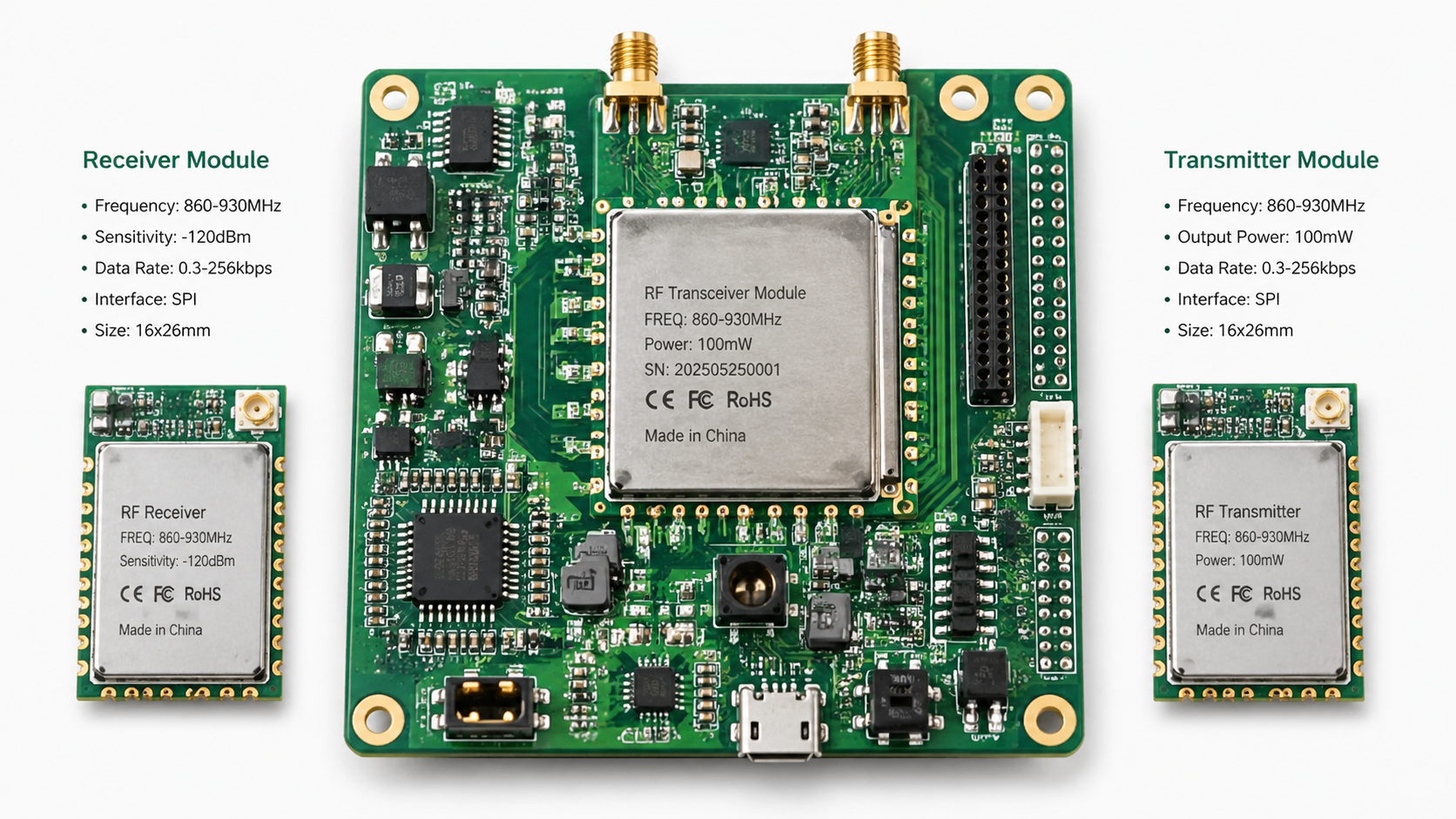
In 2026, choosing the right RF transmitter, RF receiver, or RF transceiver means looking beyond headline specs to the data that truly impacts performance, compliance, and sourcing risk. From thermal management compliance and semiconductor compliance to circuit board assembly, SMT soldering, and pick and place specifications, this guide highlights what engineers, buyers, and quality teams must evaluate when selecting reliable electronic parts and circuit components.
Which RF module specs actually matter most in 2026?
Many buyers still begin with frequency band and output power, but in 2026 that is only the first screening layer. For technical evaluation teams, the more decisive factors are phase noise, receiver sensitivity, adjacent channel selectivity, harmonic emissions, power efficiency, and stability across typical industrial temperature ranges such as -40°C to +85°C. These specifications determine whether an RF module performs consistently in real products rather than just passing a bench demo.
For operators, maintenance teams, and project managers, integration behavior matters just as much as RF performance. A module with good nominal transmit power can still create field issues if PCB stack-up, shielding layout, or solder joint quality are weak. That is why RF module selection increasingly overlaps with circuit board assembly quality, SMT soldering control, and pick and place accuracy. A strong radio on a weak manufacturing platform often becomes a weak system.
Procurement and commercial reviewers face a different risk. Two RF transceivers may look similar on paper, yet differ sharply in process consistency, traceability, moisture sensitivity handling, and long-term supply resilience. In practice, the most important 3 categories are electrical performance, manufacturing compatibility, and compliance evidence. Missing any one of these can delay approval by 2–4 weeks or trigger costly redesign cycles.
SiliconCore Metrics supports this decision layer by connecting semiconductor specifications with EMS realities. Instead of treating RF modules as isolated components, SCM evaluates the full chain: active semiconductor behavior, multilayer PCB material impact, SMT placement tolerance, and thermal packaging constraints. This approach is especially useful when engineering and sourcing teams need standardized, data-driven comparisons before sample approval or volume release.
The 6 specification groups that deserve priority
- RF link quality: receiver sensitivity, error vector magnitude, phase noise, blocking, and selectivity under expected channel density.
- Output behavior: transmit power range, efficiency at duty cycle, linearity, and spectral purity under continuous or burst operation.
- Environmental durability: operating temperature, storage range, humidity exposure tolerance, and thermal drift.
- Manufacturing fitness: package type, MSL handling, solder profile compatibility, coplanarity, and placement tolerance.
- Compliance readiness: EMC margin, regional radio requirements, material declarations, and documentation completeness.
- Supply-chain controllability: lead time visibility, lot consistency, second-source options, and lifecycle risk.
How should engineers compare RF transmitter, receiver, and transceiver options?
The right architecture depends on system role, board space, maintenance model, and certification path. An RF transmitter may work well in one-way telemetry, while a dedicated RF receiver can simplify low-power monitoring nodes. An RF transceiver usually offers higher design flexibility, but it may also increase software complexity, power budgeting work, and EMC validation time. The best choice is rarely the one with the longest feature list.
For project leaders and finance approvers, architecture choice affects more than bill of materials. It influences firmware effort, test fixture complexity, failure analysis workflow, and field replacement strategy over 12–36 months of product life. A lower-cost module can become the more expensive option if it requires more tuning, more shielding iterations, or longer verification at the assembly stage.
The table below summarizes how common RF module types differ in a practical B2B decision context. It is intended for cross-functional reviews where engineering, sourcing, quality, and program management need a shared framework rather than isolated spec-sheet reading.
A useful takeaway is that there is no universal winner. If your project has tight assembly windows of 7–15 days and limited test capacity, a simpler architecture may reduce launch risk. If your roadmap requires future protocol flexibility, a transceiver can justify the added validation burden. SCM’s benchmarking approach helps teams quantify these trade-offs using comparable engineering criteria instead of relying on vendor marketing language.
Questions to ask before selecting an architecture
System behavior
Will the device transmit continuously, in short bursts, or according to a low-duty-cycle schedule? A module intended for short packet transmission may not be the best choice for long dwell times or harsh thermal envelopes. This matters for enclosure design, battery runtime, and heat spreader requirements.
Validation burden
How many functional states require testing? Some RF transceiver platforms create 4 or more validation layers: RF performance, firmware interaction, EMC behavior, and field-upgrade stability. Procurement teams should account for these hidden costs early, especially when comparing low unit price offers.
Lifecycle continuity
Can the supplier support repeatability across multiple lots and program phases? For industrial or EMS-driven production, consistency over quarterly builds is often more important than small theoretical gains in headline sensitivity or output power.
What manufacturing and assembly specifications are often overlooked?
A surprising number of RF module failures begin outside the RF block itself. SMT soldering quality, board warpage, dielectric variation in multilayer PCB materials, and inaccurate pick and place alignment can shift impedance, degrade grounding, and increase spurious emissions. These are not secondary details. In 2026, they are core RF selection factors because modules increasingly operate in compact, high-density mixed-signal boards.
Technical assessors should review package-level characteristics such as land pattern sensitivity, stencil design dependence, and reflow profile tolerance. For example, a module that appears easy to source may still be hard to assemble if it has tight coplanarity requirements or requires a narrow thermal process window. Quality teams also need to verify whether the assembly house can maintain placement precision suitable for small-pitch RF devices and shield-can proximity zones.
SCM is particularly relevant here because many sourcing failures happen between component data sheets and actual EMS execution. Independent data on SMT placement precision metrics, PCB dielectric constants, and component endurance under thermal stress can clarify whether an RF module is robust enough for your build environment. This reduces the risk of approving a part that only works under ideal lab conditions.
For quality control and safety managers, 5 checks are especially useful during pre-release review: package moisture handling, solder profile compatibility, grounding path integrity, shielding clearance, and temperature drift during endurance runs. These checks often reveal failure modes before pilot production, when correction is still manageable.
Assembly-related RF module evaluation checklist
- Confirm whether the module package and pad geometry match the intended SMT line capability and stencil process.
- Review board material properties, especially dielectric consistency for high-frequency traces and matching networks.
- Assess grounding and shielding strategy before design freeze, not after EMC pre-scan failure.
- Check thermal rise under realistic duty cycle conditions instead of idle-state measurements only.
- Verify documentation completeness for handling, storage, lot traceability, and incoming inspection.
Why micro-tolerances matter in high-density boards
In tightly packed designs, small placement or fabrication deviations can lead to meaningful RF behavior shifts. That is why teams increasingly link RF module qualification to board-level tolerance control, especially when antennas, DC-DC converters, digital clocks, and sensors share the same assembly. Even a stable semiconductor can perform poorly if the surrounding implementation varies too much from lot to lot.
This is also where independent engineering repositories add value. When engineering, procurement, and EMS partners work from the same standardized compliance reports, approval cycles become faster and less subjective. Instead of debating assumptions, teams can compare measurable assembly constraints against module requirements and make decisions with fewer late-stage surprises.
How to evaluate compliance, reliability, and sourcing risk before purchase
A compliant RF module is not simply one that claims radio capability. Buyers should examine whether the documentation package supports EMC planning, material control, environmental expectations, and repeatable manufacturing. In practical terms, this means aligning component choice with IPC-Class 3 expectations where applicable, ISO 9001-oriented quality systems in the supply chain, and standard handling procedures for sensitive semiconductor devices.
Reliability review should include both component-level and system-level questions. How does the module behave under thermal cycling? What happens after long operating durations or storage exposure? Is there evidence that the supplier controls batch variation? A sound evaluation usually includes 3 stages: document review, engineering sample verification, and pilot-build confirmation. Skipping any stage can create avoidable downstream risk.
For procurement, business reviewers, and finance approvers, sourcing risk is often as important as technical fit. Common warning signs include unclear lead-time commitments, incomplete traceability, limited lot history, and weak communication about process changes. Even when a module meets the desired frequency and power targets, these issues can disrupt production planning over the next 1–2 quarters.
The following table can help cross-functional teams organize RF module due diligence. It is designed for practical use during vendor review, sample approval, and handoff to EMS or quality teams.
This framework is useful because it prevents one-sided decision making. An RF module that scores well only in electrical specifications can still fail the broader business case if assembly yield, traceability, or lifecycle stability are uncertain. SCM’s independent reports and weekly market intelligence can support these reviews by linking technical evidence to procurement timing and regional manufacturing realities.
A practical 4-step pre-purchase workflow
- Define the operating scenario, including duty cycle, enclosure constraints, target environment, and expected production scale.
- Compare 2–3 candidate RF modules using standardized technical and manufacturing criteria rather than marketing summaries.
- Run engineering samples through board-level validation, including assembly fit, thermal checks, and RF behavior in-system.
- Approve only after quality, sourcing, and project stakeholders review documentation, lead time, and change-control expectations.
What are the most common purchasing mistakes and how can teams avoid them?
One frequent mistake is choosing an RF module based on a single standout number, such as maximum transmit power or best-case sensitivity. In real deployments, a balanced module with better thermal behavior and cleaner assembly compatibility often delivers better total program results. Another mistake is assuming a certified-looking data sheet eliminates the need for board-level validation. It does not. Layout, shielding, and surrounding components can change actual performance substantially.
A second major error is separating engineering review from sourcing review. When procurement engages only after design preference is fixed, teams may discover long lead times, inconsistent documentation, or unsuitable handling requirements too late. In fast-moving projects, even a 3–6 week supply delay can affect launch windows, inventory planning, and approval cadence across multiple departments.
Teams also underestimate post-sale needs. Service personnel and maintenance teams need modules with stable revision control, available replacement pathways, and clear failure-analysis information. If a component is difficult to troubleshoot or replace in the field, the total ownership cost rises even when initial purchase price looks attractive.
The best prevention strategy is cross-functional screening. Bring engineering, quality, procurement, and project management into the same review within the first qualification cycle. Using an independent benchmark source such as SCM helps reduce internal bias and clarifies where the true decision risks are.
FAQ for RF module selection in 2026
How should I choose between an RF transmitter and an RF transceiver?
Choose based on system communication direction, software complexity, and future update needs. If your product sends one-way data with limited control feedback, a transmitter may simplify design and reduce validation scope. If you need bidirectional communication, adaptive behavior, or roadmap flexibility over the next 12–24 months, a transceiver may be the better platform despite higher integration effort.
What should procurement focus on beyond price?
Focus on 5 items: lead-time stability, lot traceability, documentation completeness, assembly compatibility, and lifecycle visibility. These factors directly affect inventory risk, pilot build timing, and financial exposure. A lower quoted price is not a true saving if it causes rework, shortages, or delayed release.
How important are SMT soldering and pick and place specifications for RF modules?
They are critical. RF behavior is highly sensitive to grounding, impedance continuity, shield placement, and package alignment. If SMT soldering quality is inconsistent or pick and place precision is not adequate for the package and board density, measured RF performance may differ noticeably from data-sheet values.
What is a reasonable qualification timeline for a new RF module?
For many industrial and EMS-backed projects, a realistic range is 2–6 weeks depending on sample availability, board readiness, and whether EMC or environmental checks are included. The timeline often extends when documentation is incomplete or when assembly constraints are identified after initial sample testing.
Why work with SCM when selecting RF modules for engineering and procurement decisions?
SCM helps organizations move from guesswork to measurable selection logic. Because the company operates as an independent technical think tank and engineering repository for the semiconductor and EMS supply chain, it can connect RF semiconductor evaluation with the manufacturing conditions that determine real-world success. This is especially valuable when signal integrity, thermal management, and micro-tolerance control are central to product quality.
For engineering teams, SCM provides a structured basis for comparing RF modules against PCB dielectric behavior, SMT placement precision, and long-term component reliability under demanding conditions. For procurement and business reviewers, SCM supports decisions with standardized compliance reports and supply-chain intelligence that help reduce sourcing uncertainty across Asian manufacturing hubs and international delivery requirements.
For quality, project, and service teams, the benefit is operational clarity. Instead of reviewing isolated vendor claims, stakeholders can request focused support around parameter confirmation, assembly impact, compliance readiness, and lot-to-lot consistency expectations. This shortens internal review loops and improves alignment between R&D, sourcing, and manufacturing partners.
If you are evaluating RF transmitter, RF receiver, or RF transceiver options for 2026 programs, contact SCM to discuss specification benchmarking, product selection criteria, typical lead-time considerations, sample review planning, compliance documentation needs, or manufacturing-fit questions related to PCB assembly, SMT soldering, and thermal packaging. That conversation is most useful when started before final part approval, not after pilot issues appear.
What you can consult SCM about
- RF module parameter confirmation for transmit, receive, thermal, and assembly-related constraints.
- Comparison of 2–3 candidate modules for sourcing, compliance, and manufacturing readiness.
- Review of delivery-cycle exposure, sample support priorities, and qualification planning.
- Guidance on custom evaluation frameworks for engineering, procurement, and quality teams.
- PCB
- thermal packaging
- signal integrity
- IPC-Class 3
- EMS
- thermal management
- micro-tolerances
- dielectric constants
- SMT placement
- precision metrics
- environmental stress
- compliance reports
- ISO 9001
- market intelligence
- PCB materials
- component reliability
- PCB assembly
- thermal management compliance
- semiconductor compliance
- circuit board assembly
- pick and place specifications
- SMT soldering
- electronic parts
- circuit components
- embedded systems
- semiconductor
- RF modules
- RF transceiver
- RF transmitter
- RF receiver
- multilayer PCB
Recommended News
- RF ModulesHow to choose wireless communication for battery-powered IoT sensorsChoose wireless communication for IoT sensors with confidence. Compare BLE, Zigbee, LoRaWAN, NB-IoT and LTE-M to balance battery life, coverage and cost. Find your best fit.
- RF ModulesHow PCB layout affects the performance of surface mount RF modulesSurface mount RF modules depend on smart PCB layout. Discover how impedance, grounding, placement, and thermal design affect RF performance—and avoid costly integration errors.
- RF ModulesHow dielectric constant affects impedance stability in RF modulesDielectric constant for RF modules directly affects impedance stability. Learn how Dk variation, stackup control, frequency, and fabrication impact RF performance.
- RF ModulesHow to Choose Low Power Wireless Modules for Battery-Driven DevicesWireless modules low power selection starts with real energy use, not datasheet claims. Learn how to compare RF, protocol fit, battery life, and reliability for smarter device design.
- RF ModulesEU WEEE Rule Takes Effect for Leaded RF ModulesEU WEEE rule now impacts leaded RF modules at import: Bluetooth and Wi-Fi shipments may be blocked without a Pb-exemption code. Learn key compliance steps to avoid customs delays.
- RF ModulesLow Power RF Transmitter Range Limits in Real DeploymentsLow power RF transmitter range depends on antennas, interference, enclosures, and regulations. Learn what really limits field performance and how to plan reliable deployment.