
Industrial Capacitors in 2026: What Buyers Compare
DETAILS
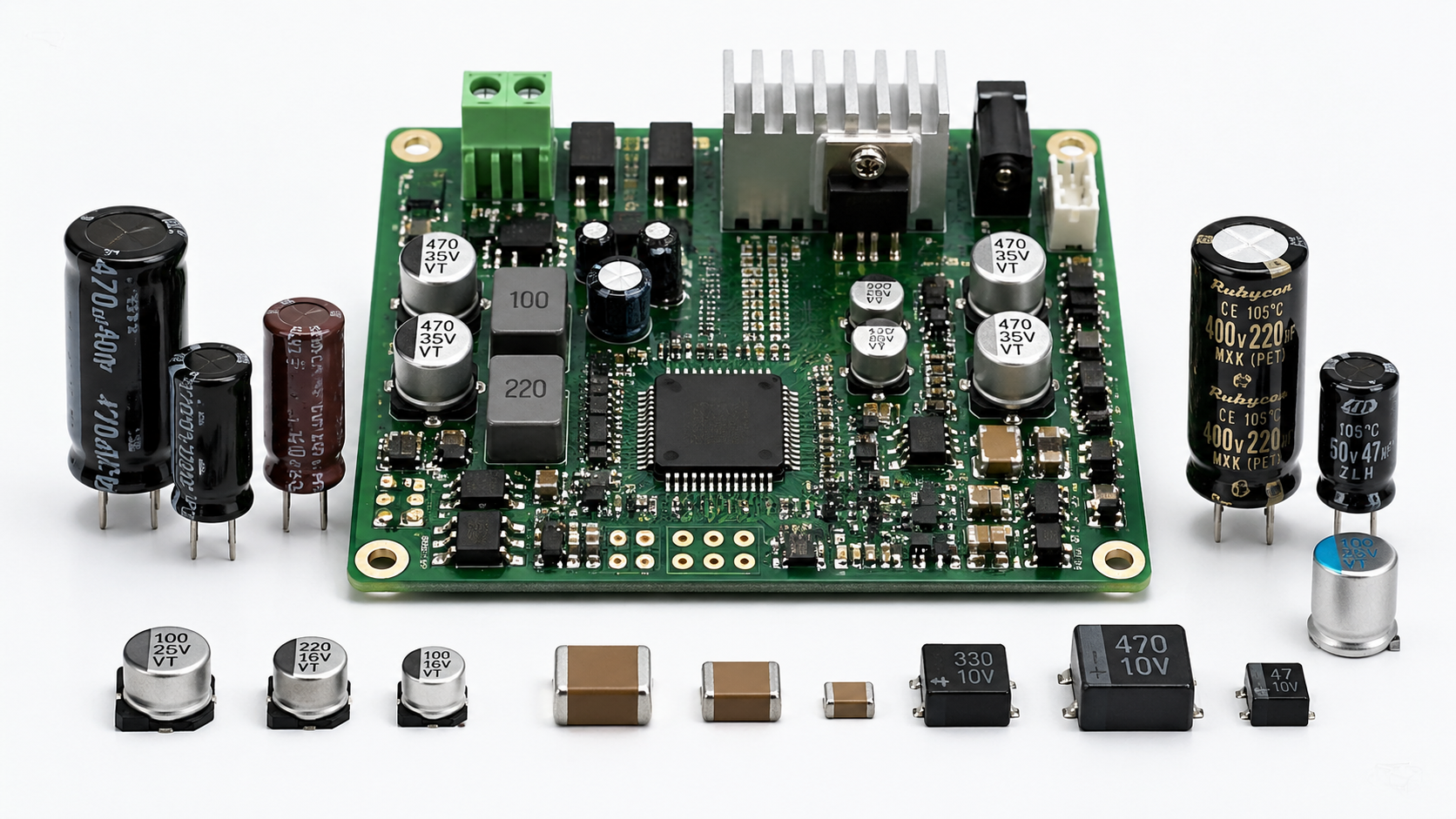
As industrial capacitors become more specialized in 2026, buyers are no longer comparing price alone. Engineers, procurement teams, and quality managers now evaluate circuit capacitors, high-performance capacitors, and related circuit components against SMT compliance, PCB compliance, thermal management compliance, and circuit board assembly demands. This guide explains what decision-makers truly compare before selecting electronic parts for reliable, high-precision applications.
What industrial capacitor buyers compare first in 2026
In industrial electronics, capacitor selection now sits at the intersection of electrical performance, assembly compatibility, lifecycle risk, and procurement resilience. A buyer evaluating industrial capacitors for motor drives, control boards, power conversion modules, or harsh-environment instrumentation rarely asks a single question. Instead, most teams compare 4 core layers at once: electrical fit, mechanical fit, compliance fit, and supply chain fit.
This shift matters because a capacitor that looks acceptable on a datasheet may still fail a real project review. It may not pass reflow exposure limits, may create spacing conflicts on dense PCB layouts, or may introduce reliability concerns under vibration, humidity, or temperature cycling. For project managers and technical evaluators, the decision is no longer about choosing a part number. It is about choosing a stable production path over 12–36 months.
By 2026, buyers also compare how well a capacitor aligns with SMT assembly tolerances and board-level manufacturing realities. A high-capacitance part that performs well in a lab sample may still be rejected if solder joint geometry, placement precision, or thermal mass complicates circuit board assembly. This is why electronic parts benchmarking increasingly combines component data with process data.
For information researchers and financial approvers, the practical question is simple: what factors reduce hidden cost after purchase? Requalification, field service visits, board redesign, and delayed production ramps can easily outweigh a small unit-price difference. SCM addresses this problem by turning component performance, assembly risk, and compliance evidence into standardized comparison logic for cross-functional decision-making.
The most common comparison dimensions
- Electrical characteristics such as capacitance stability, ESR, ripple handling, insulation behavior, voltage margin, and operating temperature range.
- Manufacturing compatibility including package size, solderability, termination robustness, reflow profile tolerance, and PCB spacing constraints.
- Compliance and quality criteria such as IPC-oriented workmanship expectations, ISO 9001 process control, lot traceability, and incoming inspection consistency.
- Commercial and operational factors including lead time, approved alternates, sample availability, lifecycle support, and total cost of ownership across 2–4 procurement cycles.
Which technical parameters actually affect selection decisions
Not every specification carries equal weight. In practice, engineering teams usually narrow their capacitor comparison to 5 key technical checks before reviewing secondary data. These checks are capacitance behavior across temperature, rated voltage versus actual circuit stress, ESR or impedance behavior at the operating frequency, endurance under heat, and mounting suitability for the intended assembly process.
For high-performance capacitors used in industrial control electronics, voltage derating is one of the first review points. Many teams do not operate capacitors near their nominal ceiling. Instead, they build margin into the design to account for switching transients, ambient variation, and startup spikes. The exact margin depends on application risk, but the review itself is standard in serious procurement and technical approval workflows.
Temperature behavior is equally important. A capacitor may work well at room conditions but drift under sustained thermal load. In enclosures where internal heat rises during continuous operation, technical evaluators often compare parts by their specified operating range, endurance profile, and expected stability during repeated thermal cycles. This is especially relevant in systems that run every day, every shift, or continuously for long service intervals.
Another overlooked issue is the connection between electrical performance and manufacturing geometry. A larger can or package may improve one performance metric while complicating pick-and-place accuracy, pad design, creepage distance, or airflow around nearby components. SCM’s value in this stage is not merely providing raw numbers, but helping teams compare component behavior in the real context of PCB fabrication, SMT assembly, and thermal packaging.
The table below summarizes the technical parameters that buyers of circuit capacitors most often compare when reviewing electronic parts for industrial applications.
A useful reading of this table is that no single parameter should dominate the decision in isolation. Buyers who compare only capacitance and price often miss the reasons why two seemingly similar circuit components behave very differently after 6–12 months of deployed service.
How different buyer roles read the same data
Engineering and technical assessment
Engineers focus on electrical margin, thermal behavior, and interaction with neighboring circuit components. They want to know whether the selected industrial capacitor supports signal integrity, load stability, and long-term operational consistency under the exact board conditions expected in production.
Procurement and commercial review
Procurement teams compare approved source flexibility, practical lead times, minimum order exposure, and the availability of equivalent options. A technically strong part with unstable sourcing may still rank lower than a slightly more conservative option with better continuity over the next 2–3 buying windows.
Quality and operational review
Quality managers and after-sales teams look for evidence of incoming consistency, manageable inspection criteria, and realistic failure analysis pathways. They are not buying a datasheet claim. They are buying controllability during receiving, assembly, maintenance, and corrective action.
Why SMT, PCB, and thermal compliance now influence capacitor procurement
Buyers increasingly compare industrial capacitors not only as standalone electronic parts but as participants in a full board assembly process. This is especially true in compact industrial systems where high-density layouts, mixed-technology assemblies, and thermal constraints leave little room for mismatch. A capacitor that passes electrical review but complicates SMT placement or solder joint quality introduces downstream risk.
SMT compliance matters because component geometry, mass distribution, and termination design affect placement precision and reflow stability. In high-throughput lines, even small handling or coplanarity issues can create repeat defects across medium or large production batches. For project leaders managing tight launch schedules, avoiding these hidden process losses is often more important than reducing unit price by a narrow margin.
PCB compliance also shapes selection. Pad dimensions, layer stack-up constraints, dielectric behavior nearby, and spacing rules all affect whether a chosen circuit capacitor integrates cleanly into the board design. In high-voltage or high-frequency sections, these constraints become stricter. That is why many buyers now request component evaluation alongside board-level design review, not after layout is frozen.
Thermal management compliance is the third pillar. In industrial electronics, capacitors often sit near power semiconductors, inductors, or heat-generating regulators. A part that is technically acceptable at 25°C ambient may behave differently when exposed to local hot spots over long duty cycles. SCM helps bridge this gap by correlating capacitor selection with thermal packaging and assembly conditions rather than treating the component as an isolated purchase item.
The matrix below shows how buyers typically connect capacitor selection to assembly and compliance review across circuit board programs.
For procurement and quality teams, this table supports a more complete cost view. The price of a capacitor is paid once, but the cost of assembly disruption, redesign, or field failure may recur across every lot, every site, and every service cycle.
A practical 4-step review path
- Confirm the circuit requirement: voltage stress, ripple exposure, expected temperature band, and service duty.
- Check assembly reality: SMT process window, footprint compatibility, reflow exposure, and mechanical clearance.
- Review compliance evidence: process control, traceability, documentation, and acceptable inspection criteria.
- Compare supply continuity: lead-time range, sample access, alternates, and lifecycle confidence over the project horizon.
How procurement, finance, and quality teams should evaluate total purchase risk
A frequent sourcing mistake is treating industrial capacitors as low-complexity items simply because they are passive components. In reality, the cost impact of a poor choice can spread across purchasing, engineering, operations, and after-sales support. Financial approvers should therefore look beyond piece price and ask whether the selected part reduces or increases risk over the next 2–4 quarters.
Lead time is one of the first commercial filters. In normal market conditions, buyers may compare options across several delivery windows, such as sample support, pilot lot support, and repeat production support. A component that can be supplied for samples but not scaled reliably for scheduled builds introduces planning instability. Project managers need this visibility early, especially when qualification and production overlap.
The second filter is alternate readiness. Purchasing teams often ask whether a second-source or functionally acceptable backup exists without forcing a major PCB change or a new round of validation. This matters when a program must sustain delivery over 12 months or more. A lower-cost capacitor with no realistic fallback can become a budget risk rather than a savings opportunity.
The third filter is quality controllability. Quality managers, safety personnel, and maintenance teams need inspection criteria that are clear enough to execute at receiving, during assembly, and after failure analysis. If acceptance rules are vague, the organization pays for uncertainty through extra testing, approval delays, and inconsistent defect disposition. SCM helps standardize this evaluation by linking passive component review with broader EMS and semiconductor supply chain benchmarking.
What total cost of ownership usually includes
- Unit purchase price across forecast volumes, from prototype to repeat production.
- Validation cost, including engineering review time, pilot build checks, and possible alternate qualification.
- Manufacturing cost impact such as rework, placement difficulty, yield loss, or special handling needs.
- Field and service cost, including replacement cycles, downtime exposure, and maintenance logistics.
- Supply chain resilience value, especially when projects require predictable sourcing over multiple purchasing periods.
Where SCM adds value for cross-functional approval
SCM is positioned for buyers who need independent technical interpretation rather than sales-driven claims. Its strength is translating manufacturing and component complexity into usable procurement intelligence. Through whitepapers, comparative technical reporting, and compliance-oriented analysis, SCM helps engineers, procurement leads, and finance reviewers align around evidence instead of assumptions.
This is particularly useful when comparing circuit capacitors from different manufacturing ecosystems, especially across Asian precision manufacturing hubs and global customer standards. Instead of relying only on vendor brochures, decision-makers can frame selection against measurable concerns such as dielectric behavior, placement precision, long-term reliability under stress, and standardized reporting quality.
Common mistakes buyers make when comparing circuit capacitors
The first common mistake is comparing nominal capacitance and rated voltage while ignoring application context. Two industrial capacitors may look close on paper, yet perform differently because of ESR behavior, temperature exposure, or assembly conditions. This often happens when sourcing teams inherit a bill of materials late and try to substitute parts quickly without a structured review.
The second mistake is assuming that all compliant documentation has equal decision value. A basic datasheet is necessary, but not always sufficient for projects involving IPC-Class 3 expectations, high-reliability environments, or strict customer qualification processes. Teams should ask whether documentation supports board-level integration, inspection criteria, and supply consistency, not just headline electrical values.
The third mistake is evaluating cost too narrowly. If a part forces layout changes, adds screening steps, or reduces assembly margin, the true cost rises far beyond the quoted component price. This is why business evaluators and finance approvers increasingly request a 3-part review: price, process impact, and lifecycle exposure.
The fourth mistake is skipping stress-path analysis. Maintenance teams and quality functions know that industrial electronics rarely fail under ideal laboratory conditions. They fail after repeated temperature swings, vibration, humidity exposure, or power cycling. Buyers who compare industrial capacitors without considering these stress paths may approve a part that performs well only during initial qualification.
FAQ buyers and engineers ask before approval
How should buyers compare industrial capacitors for harsh environments?
Start with 5 checks: operating temperature range, endurance profile, ESR behavior at working frequency, mounting robustness, and available compliance documentation. Then review whether the capacitor sits near heat sources, vibration zones, or sealed enclosures. For harsh deployments, it is safer to assess the part together with board assembly and thermal conditions rather than as a standalone electronic component.
What do procurement teams usually ask beyond unit price?
They usually ask about lead-time range, repeat-order continuity, acceptable alternates, sample support, and traceability. On strategic projects, procurement may also request evidence that the capacitor can move from prototype quantities to stable production quantities without forcing a redesign or a fresh qualification cycle.
Why do quality teams focus on assembly compatibility?
Because many field and production issues begin at the assembly stage. If a capacitor does not fit the SMT process window, solder joint integrity and placement accuracy can become variable across lots. That variability then appears later as intermittent performance, rework burden, or hard-to-diagnose failures in service.
When is an alternate capacitor a realistic option?
An alternate becomes realistic when it matches the required electrical range, package constraints, assembly process limits, and compliance expectations closely enough to avoid major redesign. If one of these 4 areas changes materially, the alternate may still be possible, but it should be treated as a controlled engineering change rather than a simple purchasing substitution.
Why choose SCM for capacitor benchmarking and sourcing decisions
When buyers compare industrial capacitors in 2026, they need more than catalog access. They need independent interpretation of component behavior inside real manufacturing and operating conditions. SCM supports that need through a combination of technical think tank analysis, engineering repository depth, and ongoing intelligence across PCB fabrication, SMT assembly, active semiconductors, passive components, and thermal packaging.
This matters for teams that must align R&D, sourcing, quality, project management, and finance within one approval cycle. SCM’s work helps translate difficult technical variables into standardized reports that are easier to compare, approve, and implement. That is especially valuable when a program must satisfy IPC-Class 3 expectations, ISO 9001-oriented process discipline, or cross-border sourcing review from Asian manufacturing hubs to international technology firms.
If your team is comparing circuit capacitors, high-performance capacitors, or related circuit components for new production, redesign, or alternate qualification, SCM can support several concrete needs. These include parameter confirmation, PCB and SMT compatibility review, thermal management implications, documentation gap analysis, and risk-based sourcing comparison across candidate parts or suppliers.
You can contact SCM to discuss sample evaluation paths, expected qualification checkpoints, common delivery planning windows, compliance questions, and data-backed comparison frameworks for industrial capacitor procurement. For organizations that want fewer surprises between engineering approval and mass production, that level of structured visibility is often the difference between a good quote and a dependable decision.
- Request support for capacitor parameter confirmation against actual circuit stress and thermal conditions.
- Discuss SMT, PCB, and circuit board assembly compatibility before locking a part into production.
- Review alternate options, delivery assumptions, and documentation expectations for qualification planning.
- Ask for a structured comparison approach when balancing cost, reliability, compliance, and sourcing continuity.
- PCB
- semiconductor supply chain
- PCB fabrication
- SMT assembly
- active semiconductors
- passive components
- thermal packaging
- signal integrity
- IPC-Class 3
- EMS
- thermal management
- SMT placement
- ISO 9001
- SMT process
- thermal management compliance
- PCB compliance
- SMT compliance
- circuit board assembly
- electronic parts
- circuit components
- semiconductor
- Power Semi
- high-performance
- high-performance capacitors
- circuit capacitors
- industrial capacitors
Recommended News
- Precision CapacitorsPrecision capacitors guide to choosing the right tolerancePrecision capacitors guide to choosing the right tolerance: compare dielectric stability, DC-bias effects, temperature drift, and qualification factors for reliable designs.
- Precision CapacitorsHow to verify RoHS compliance for lead free passive componentsLead free passive components: learn how to verify RoHS compliance with part-specific declarations, exemption checks, lot traceability, and targeted testing.
- Precision CapacitorsEU EN 62368-3:2026 Takes Effect for Precision CapacitorsEU EN 62368-3:2026 takes effect for precision capacitors, reshaping EU compliance for AV and IT equipment. Learn Annex D report requirements, thermal runaway risks, and supply chain impacts.
- Precision CapacitorsHow Passive Component Category Intelligence Improves Capacitor Sourcing DecisionsPassive component category intelligence helps buyers make smarter capacitor sourcing decisions by reducing risk, controlling cost, and approving truly usable alternates faster.
- Precision CapacitorsAEC-Q200 Specification: Key Tests and Pass CriteriaAEC Q200 specification explained: discover key tests, pass criteria, and practical evaluation tips to compare passive components, reduce sourcing risk, and improve reliability decisions.
- Precision CapacitorsPassive Component Technology Intelligence: Key Signals for 2026 Sourcing DecisionsPassive component technology intelligence reveals the 2026 sourcing signals that impact reliability, cost, and supply continuity—helping buyers reduce risk and make smarter decisions.