
How to Pick an RF Transceiver for New Designs
DETAILS
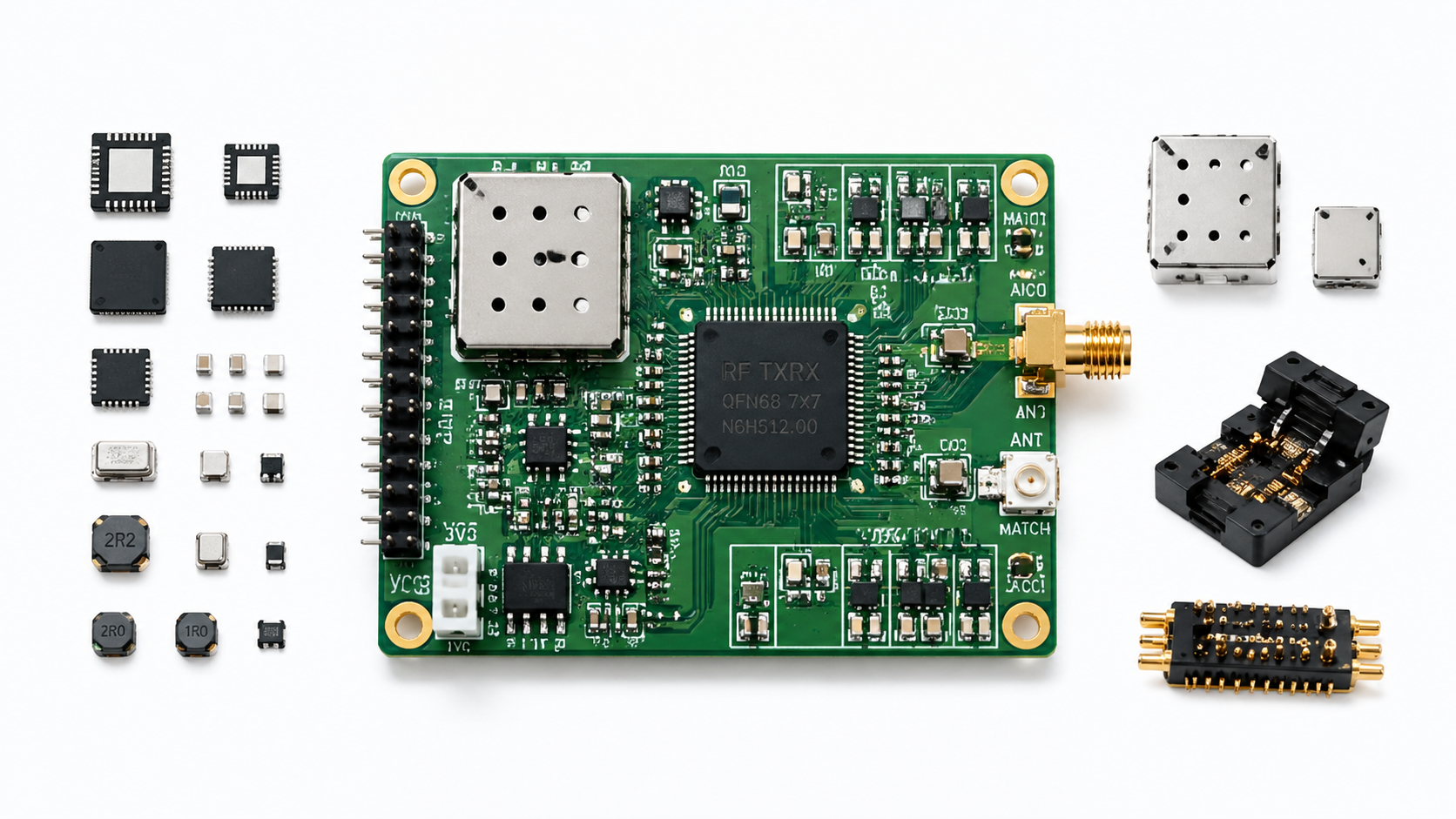
Selecting the right RF transceiver for a new design requires more than matching an RF transmitter with an RF receiver. Engineers, buyers, and project teams must assess circuit components, electronic parts, thermal management compliance, SMT compliance, and semiconductor compliance to ensure stable performance, manufacturability, and long-term reliability. This guide outlines the key technical and sourcing factors that matter most.
In practice, RF transceiver selection affects not only wireless range and data integrity, but also PCB stack-up, component availability, assembly yield, and field maintenance costs over a product life cycle that may last 3 to 7 years. For R&D teams, the wrong device can trigger redesigns late in validation. For procurement and quality teams, weak supplier screening can increase schedule risk, cost volatility, and non-conformance exposure.
For organizations operating across the semiconductor and EMS supply chain, a disciplined selection method helps align electrical performance with manufacturing reality. That means evaluating RF specifications, package behavior, thermal paths, compliance documentation, sourcing resilience, and test strategy together rather than as isolated decisions.
Define the RF system requirements before comparing devices
The first step in choosing an RF transceiver is to define the actual operating envelope. A device that performs well at 2.4 GHz for short-range telemetry may be unsuitable for sub-1 GHz industrial sensing, and a transceiver optimized for low-power burst traffic may fail in continuous streaming applications. Teams should document at least 6 baseline items: frequency band, transmit power, receiver sensitivity, data rate, duty cycle, and target range.
Application conditions matter just as much as headline RF figures. A design intended for indoor medical or lab equipment may operate between 0°C and 50°C, while industrial, automotive-adjacent, or outdoor systems may require -40°C to 85°C or wider. Environmental limits influence oscillator stability, front-end margin, passive component drift, and long-term reliability under thermal cycling.
It is also important to define channel density and interference exposure early. In dense wireless environments, adjacent-channel rejection, blocking performance, and coexistence behavior can be more important than nominal transmit power. A transceiver with a stronger link budget on paper may still underperform if its filtering strategy and phase noise profile are weak in a crowded spectrum.
For project managers and financial approvers, requirement clarity reduces expensive iteration. A single PCB respin can add 2 to 6 weeks, depending on stack-up complexity and validation queues. When multiple stakeholders agree on technical thresholds at the start, downstream decisions become easier to defend across engineering, sourcing, and quality review gates.
Core requirement checklist
- Operating frequency and regional deployment needs, such as sub-1 GHz, 2.4 GHz, or dual-band designs.
- Required link budget, including transmit power, antenna efficiency, and minimum receiver sensitivity.
- Traffic model, including latency, packet size, update interval, and whether the product transmits every 100 ms or every 10 minutes.
- Power architecture, such as coin-cell, Li-ion, or fixed 12 V / 24 V systems, with clear current consumption limits.
- Operating environment, including vibration, humidity, enclosure material, and expected service life.
Typical requirement trade-offs
Many new designs over-prioritize range while underestimating total system cost. For example, pushing higher transmit power may increase thermal load, current draw, shielding requirements, and certification effort. In battery-powered products, a 15% to 25% increase in RF power consumption can materially reduce runtime if sleep strategies are not carefully tuned.
Similarly, choosing the highest data rate is not always beneficial. Faster air rates may reduce on-air time, but they can also tighten receiver margin and worsen performance through walls, metal enclosures, or noisy factory floors. The correct selection depends on the combination of path loss, antenna placement, and packet retry tolerance.
This table shows why RF transceiver selection should begin with system constraints rather than distributor availability alone. When these parameters are documented upfront, engineering and procurement teams can screen devices more quickly and avoid comparing parts that were never suitable for the design intent.
Evaluate RF performance with board-level and component-level reality in mind
An RF transceiver datasheet is only the starting point. Actual performance depends on the matching network, PCB dielectric consistency, grounding strategy, shielding layout, and nearby digital noise sources. A transceiver rated for strong receiver sensitivity can lose several dB of usable margin if the board stack-up, return paths, or antenna feed are poorly controlled.
For technical evaluators, the key is to review not only RF output power and sensitivity, but also phase noise, error vector behavior where applicable, reference clock tolerance, and front-end matching requirements. In compact devices, the interaction between the transceiver, PMIC, MCU, and high-speed digital traces can create emissions or desense problems that do not appear in schematic review alone.
Component selection around the transceiver also matters. Inductors and capacitors used in the matching and filtering path should be chosen for RF stability across temperature and tolerance drift, not only nominal value. In many production environments, moving from ±0.1 pF assumptions on paper to realistic passive variation can change tuning behavior enough to reduce margin across large lot sizes.
Thermal behavior should not be treated as a secondary issue. Even when RF transceivers are not the hottest devices on the board, elevated junction temperature can affect output consistency, oscillator accuracy, and long-term reliability. In sealed enclosures or high-duty-cycle systems, a 10°C to 15°C rise above expected board temperature may shift validation outcomes and accelerate aging of surrounding components.
Board-level factors that influence RF results
- PCB material and dielectric stability, especially for multi-layer designs with controlled impedance traces.
- Ground return integrity under the RF path and around sensitive analog sections.
- Antenna location relative to metal shields, batteries, displays, and cable harnesses.
- Placement of DC-DC converters and clocks that may inject harmonic noise.
- Assembly repeatability, including SMT placement precision and solder joint consistency for fine-pitch packages.
Why SMT precision matters
In high-frequency layouts, small physical deviations can produce measurable electrical effects. SMT placement variation in the sub-millimeter range can alter parasitic behavior around matching components and filters. For dense RF sections, consistent placement, stencil control, and reflow profile management support repeatable tuning across pilot and mass-production builds.
The following comparison highlights the difference between evaluating only RF headline numbers and evaluating the full board-level design impact.
The practical takeaway is clear: a strong RF transceiver is not defined by the chip alone. It is defined by how well the silicon, passives, PCB materials, and manufacturing process work together under real operating conditions.
Check manufacturability, compliance, and supply chain resilience early
For procurement teams and project owners, an RF transceiver that meets electrical targets but creates sourcing or compliance risk is not a safe design choice. Lead times in semiconductor categories can fluctuate from 8 weeks to more than 26 weeks depending on node maturity, package type, and regional demand. Early screening should cover lifecycle status, second-source options where possible, packaging format, and document completeness.
Manufacturability starts with the package. Fine-pitch QFN, BGA, or wafer-level options may support compact layouts, but they can increase assembly control demands and inspection complexity. If the chosen EMS partner does not have stable process capability for the package, pilot yield may drop and debug time may increase. That is especially relevant for products targeting IPC-Class 3 quality expectations or harsh-environment deployment.
Compliance review should include material declarations, reliability information, MSL handling, recommended reflow profile, and any regional RF certification implications. Quality and safety teams often need this information before final approval, not after prototype success. Missing documentation can delay PPAP-like internal reviews, customer qualification, or shipment release.
A robust sourcing decision also considers supplier transparency. Buyers should ask whether the vendor provides clear PCN support, lot traceability, and long-term availability guidance. Even for common wireless categories, a part that appears cost-effective in quarter one may create redesign pressure within 12 to 24 months if lifecycle visibility is poor.
Procurement and quality review points
- Confirm lifecycle status: active, mature, NRND risk, or uncertain roadmap position.
- Verify package compatibility with current SMT line capability, AOI coverage, and rework policy.
- Request MSL, storage, and reflow guidance to prevent moisture-related defects.
- Review documentation for material compliance, reliability expectations, and change notification process.
- Assess geographic supply exposure and buffer stock strategy for the next 2 to 4 forecast cycles.
The table below can be used as a practical cross-functional screening tool before final part approval.
Using a matrix like this helps finance, sourcing, quality, and engineering teams evaluate the same part through a shared decision framework. That improves internal alignment and reduces the chance that a hidden supply chain issue undermines an otherwise good technical design.
Build a validation plan that connects lab results to production release
Even the best RF transceiver shortlist needs a structured validation path. A practical qualification plan usually moves through 3 stages: bench evaluation, integrated prototype testing, and pilot production verification. Each stage should have pass-fail criteria tied to RF performance, thermal behavior, assembly repeatability, and functional stability under expected field conditions.
Bench evaluation should confirm the basics: link budget, current consumption, clock stability, startup timing, and sensitivity under known conditions. During integrated testing, teams should add enclosure effects, real antenna placement, power supply noise, and interference scenarios. In pilot builds, the focus shifts to lot-to-lot repeatability, SMT yield, tuning consistency, and field update robustness.
A common mistake is to validate only one golden sample. That may hide variability that appears when 20, 50, or 100 boards are assembled across different component lots. Quality-conscious teams usually define a minimum sample set for pilot review and check whether RF tuning, thermal rise, and packet performance remain within acceptable range after production handling and environmental exposure.
Validation should also include serviceability thinking. If an RF issue appears in the field, can technicians isolate whether the cause is antenna damage, power rail instability, solder degradation, or silicon failure? Good design selection includes test points, firmware diagnostics, and documentation that allow after-sales and maintenance teams to shorten root-cause analysis from days to hours.
Suggested qualification flow
- Screen 2 to 3 candidate RF transceivers against defined system requirements.
- Build engineering samples and test RF metrics across temperature and voltage corners.
- Integrate into final or near-final PCB layout with target enclosure and antenna geometry.
- Run pilot builds to assess SMT yield, tuning repeatability, and thermal spread.
- Freeze approved BOM and release sourcing controls, test limits, and change management rules.
Metrics worth tracking during validation
Useful metrics include packet error rate at defined distances, RX sensitivity margin, TX current at multiple output levels, sleep current, startup time, board hot-spot temperature, and assembly defect rate. Tracking these values across at least 3 test conditions gives teams a more reliable picture than a single-room, single-sample demonstration.
A disciplined validation process lowers the risk of late-stage surprises. It also creates a stronger audit trail for internal approval, customer qualification, and future redesign decisions when a component goes through process change or allocation pressure.
Common selection mistakes, practical FAQs, and what decision-makers should prioritize
Many RF transceiver problems begin with incomplete cross-functional review. Engineering may choose a technically strong part without confirming package fit on the intended EMS line. Procurement may prioritize unit price without accounting for lead-time volatility. Program managers may push schedule speed while underestimating the time required for RF tuning and certification. Strong decisions come from balancing performance, manufacturability, and continuity together.
Another common error is copying a reference design too literally. Reference layouts are helpful, but they rarely reflect the exact stack-up, enclosure shape, shielding density, or noise environment of a new product. Even small differences in dielectric thickness, ground slot placement, or antenna keep-out area can change measured behavior enough to require retuning.
For quality and maintenance teams, documentation depth should be part of the selection criteria. A part with strong support files, application notes, and failure-analysis guidance can reduce debug effort significantly. Over a 24- to 60-month deployment window, that operational advantage may outweigh a modest purchase price difference.
Decision-makers should therefore rank RF transceivers using at least 4 lenses: electrical suitability, production readiness, supply stability, and serviceability. That approach aligns technical targets with real business outcomes such as launch timing, field returns, and total lifecycle cost.
FAQ: How many RF transceivers should be compared in a new design?
In most projects, comparing 2 to 3 serious candidates is enough. Fewer than 2 limits negotiating and risk analysis. More than 3 can slow validation without adding useful clarity unless the application is highly specialized or supply constraints are severe.
FAQ: Which specifications matter most during early screening?
Start with frequency support, link budget, current consumption, package type, operating temperature range, and lifecycle visibility. These 6 items usually eliminate unsuitable devices quickly before deeper lab work begins.
FAQ: When should procurement join the transceiver selection process?
Procurement should join during the shortlist stage, not after engineering lock-in. Early involvement helps verify lead times, approved channel access, packaging constraints, and price stability before validation resources are committed.
FAQ: What is the biggest risk in RF transceiver selection?
The biggest risk is treating the RF transceiver as a standalone chip instead of part of a complete manufacturing system. Most failures in new designs come from interactions between silicon, PCB materials, passives, antenna integration, assembly precision, and supply chain reality.
Choosing an RF transceiver for a new design is ultimately a multidisciplinary decision. The best outcome comes from defining requirements early, validating against real board and enclosure conditions, and screening suppliers for compliance and continuity with the same rigor used for electrical testing. For organizations that need deeper benchmarking across semiconductor, PCB, SMT, and reliability factors, SiliconCore Metrics can help translate complex manufacturing variables into clearer technical and sourcing decisions. Contact us to discuss your design criteria, request a tailored evaluation framework, or explore more solutions for RF-ready product development.
Recommended News
- RF ModulesHow PCB layout affects the performance of surface mount RF modulesSurface mount RF modules depend on smart PCB layout. Discover how impedance, grounding, placement, and thermal design affect RF performance—and avoid costly integration errors.
- RF ModulesHow dielectric constant affects impedance stability in RF modulesDielectric constant for RF modules directly affects impedance stability. Learn how Dk variation, stackup control, frequency, and fabrication impact RF performance.
- RF ModulesHow to Choose Low Power Wireless Modules for Battery-Driven DevicesWireless modules low power selection starts with real energy use, not datasheet claims. Learn how to compare RF, protocol fit, battery life, and reliability for smarter device design.
- RF ModulesEU WEEE Rule Takes Effect for Leaded RF ModulesEU WEEE rule now impacts leaded RF modules at import: Bluetooth and Wi-Fi shipments may be blocked without a Pb-exemption code. Learn key compliance steps to avoid customs delays.
- RF ModulesLow Power RF Transmitter Range Limits in Real DeploymentsLow power RF transmitter range depends on antennas, interference, enclosures, and regulations. Learn what really limits field performance and how to plan reliable deployment.
- RF ModulesRF Transmitter Price Breakdown: What Drives Total CostRF transmitter price depends on more than the quote. Discover how specs, certification, materials, and reliability testing shape total cost and smarter supplier decisions.