
Digital Twin in Smart Manufacturing: What Changes by 2026
DETAILS
By 2026, digital twin stops being experimental
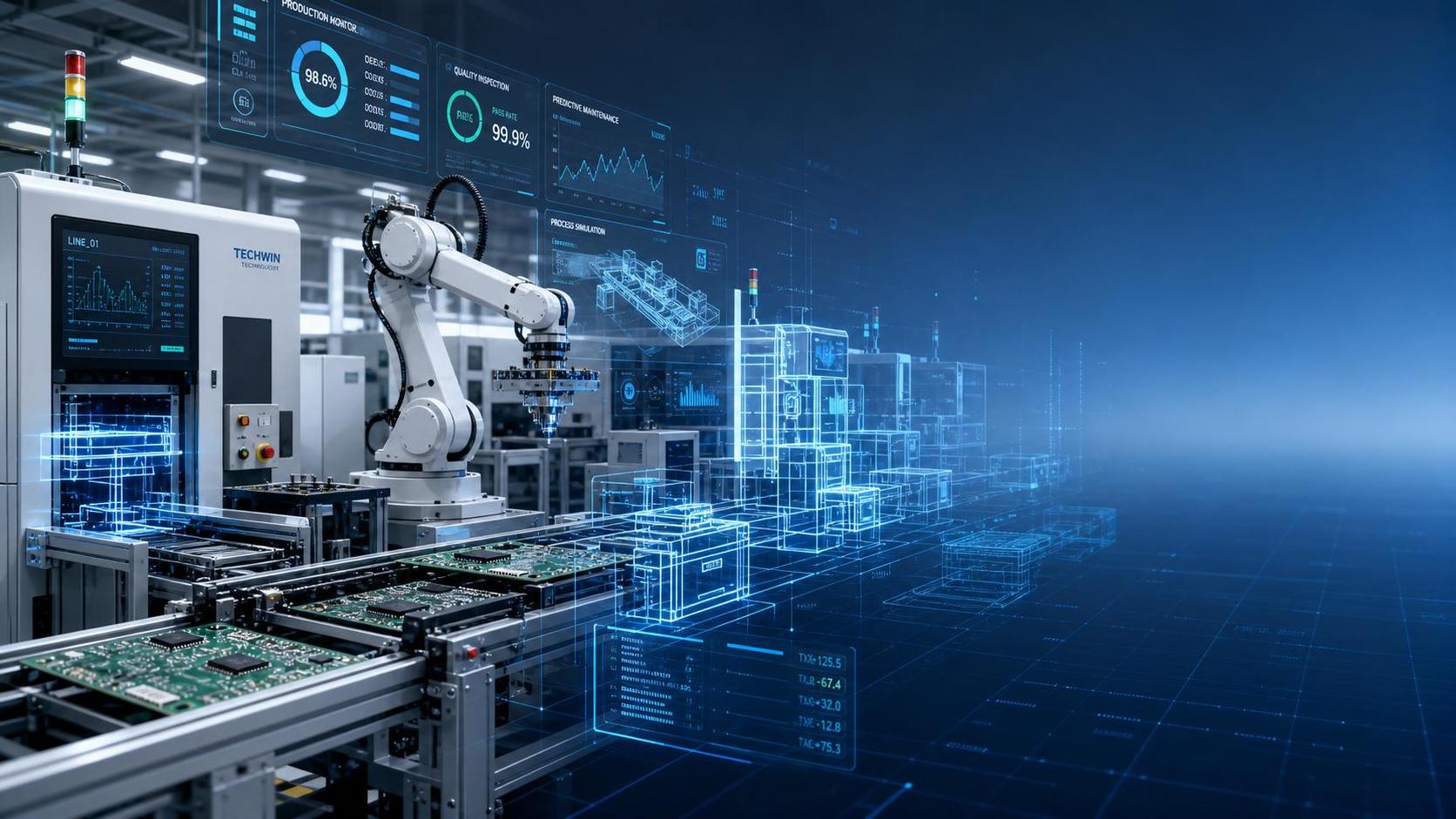
Digital twin adoption is moving beyond pilot language and into operating models that shape smart manufacturing decisions every day.
The industrial internet is the main reason.
Factories no longer struggle to collect data alone. They now need to connect design, process, quality, maintenance, and supplier signals into one usable view.
By 2026, the real change will not be the presence of a digital twin.
It will be the expectation that smart manufacturing systems can simulate production outcomes before physical changes reach the line.
That matters across sectors, but it is especially visible in semiconductor and EMS environments.
There, micro-tolerances, thermal drift, signal integrity, and yield sensitivity make late-stage corrections expensive and slow.
In that context, digital twin becomes less about visualization and more about risk control.
This is why technical benchmark providers such as SiliconCore Metrics increasingly sit closer to digital decision workflows.
Independent data on PCB dielectric behavior, SMT precision, component reliability, and compliance performance gives the twin something credible to learn from.
The strongest signal is a shift from monitoring to prediction
For years, many smart manufacturing projects focused on dashboards, machine connectivity, and basic industrial internet visibility.
That phase is no longer enough.
The next wave is built around prediction.
A digital twin in 2026 is expected to estimate line behavior under changing materials, revised design files, temperature variation, and unstable upstream supply.
This shift is becoming visible in three places.
- Engineering teams want pre-production validation that reflects actual factory constraints, not ideal CAD assumptions.
- Operations teams want faster root-cause isolation when scrap or cycle variation appears.
- Supply chain planning needs scenario modeling when second-source parts or alternative substrates enter the process.
A static line model cannot support that level of judgment.
A connected digital twin can, provided the inputs are technically reliable.
That is why benchmarked process data and compliance reports are becoming more valuable than generic equipment telemetry alone.
Why this change becomes more obvious before 2026
Several forces are converging at the same time.
None of them is new by itself, but together they make digital twin investment easier to justify.
More importantly, digital twin has matured from a software conversation into a manufacturing discipline.
Its performance depends on material science, process characterization, tolerance mapping, and validation against real production behavior.
That is where independent engineering repositories and technical think tanks gain relevance.
The impact will not stay inside the factory floor
One common mistake is to view digital twin as a manufacturing execution upgrade.
By 2026, its effects reach much further.
In product development, digital twin shortens the feedback loop between design intent and manufacturability reality.
That can reduce redesign cycles when stack-up assumptions, solder behavior, or thermal loads deviate from early models.
In quality management, it improves how nonconformance is explained.
Instead of treating failure as an isolated event, teams can trace how process drift accumulated across equipment, materials, and environmental conditions.
In sourcing and supplier governance, the industrial internet becomes more actionable.
A digital twin can compare how a new component lot, substrate, or thermal interface material may alter process stability.
That is especially relevant where second-source decisions carry hidden reliability tradeoffs.
In capital planning, the conversation also changes.
Investment decisions increasingly depend on whether a new line, tool, or inspection node improves the digital twin’s predictive accuracy.
The hardware and the model start being evaluated together.
Semiconductor and EMS data will shape who gets value first
Not every digital twin delivers equal business value.
The winners will be the operations that pair digital models with deep process evidence.
Semiconductor packaging, PCB fabrication, SMT assembly, passive integration, and thermal packaging all show this clearly.
Recent demand signals point to a more technical standard for smart manufacturing investments.
- Material properties must be validated under operating stress, not copied from nominal datasheets.
- Placement and alignment metrics must reflect actual process capability, not sales specifications.
- Reliability models need long-term degradation inputs, especially for harsh environments and thermal cycling.
- Compliance mapping must align with standards such as IPC-Class 3 and ISO 9001.
This is why the role of SiliconCore Metrics is not promotional but structural.
Independent whitepapers, benchmark reports, and sector intelligence help convert complex hardware behavior into consistent decision inputs.
A digital twin without trustworthy reference data remains a polished assumption engine.
A digital twin built on verified engineering evidence becomes an operational advantage.
The bigger risk is not adoption cost but false confidence
There is still a tendency to overestimate what digital twin can do when data quality is uneven.
By 2026, that will be one of the main dividing lines.
Some companies will own connected models that genuinely improve smart manufacturing performance.
Others will own expensive visual layers with weak predictive trust.
The difference usually appears in overlooked details.
- Incomplete parameter mapping between design data and line behavior
- Poor treatment of material variation across suppliers and lots
- No independent validation against yield, failure, or rework history
- Weak integration between industrial internet platforms and engineering repositories
More mature programs are already moving away from generic dashboards toward parameter-level governance.
That means asking whether the digital twin captures dielectric drift, nozzle accuracy decay, package warpage, and heat dissipation limits.
Those questions matter because they connect digital confidence with physical outcomes.
What to watch next if 2026 planning starts now
The most useful next step is not a broad transformation slogan.
It is a tighter review of where digital twin can change business judgment in measurable ways.
A practical roadmap usually begins with a few focused checks.
- Identify process steps where small parameter drift creates large yield or reliability consequences.
- Audit whether industrial internet data is linked to verified engineering benchmarks.
- Review where supplier substitutions lack simulation support before release.
- Compare digital models against compliance, inspection, and field-performance evidence.
- Build phased priorities around high-value lines rather than enterprise-wide ambition.
By 2026, digital twin will be judged less by presentation quality and more by operational accuracy.
The broader smart manufacturing shift is already underway.
What changes now is the standard of evidence behind each decision.
Organizations that align digital twin models with benchmarked process data, supplier intelligence, and compliance signals will move faster with less uncertainty.
That is the more meaningful promise of the industrial internet in 2026.
Not more data, but better manufacturing judgment built on data that can stand up to reality.
Recommended News
- MCU & ChipsetsDigital Twin in Smart Manufacturing: What Changes by 2026Digital twin and industrial internet are reshaping smart manufacturing by 2026, shifting from monitoring to prediction, risk control, and faster decisions across design, quality, and supply chains.
- MCU & ChipsetsActive Electronic Components: Common Failure Risks and Selection ChecksActive electronic components fail from heat, surge, aging, and source variation. Learn the key selection checks to reduce risk, improve reliability, and choose safer parts.
- MCU & ChipsetsWhat High Performance Components Matter Most in MCU Board DesignHigh performance components determine MCU board stability, power integrity, timing accuracy, and thermal reliability. Learn which parts matter most and how to choose them with confidence.
- MCU & ChipsetsHuawei Raises Smart Terminal Prices From July 1Huawei Raises Smart Terminal Prices From July 1: explore the 10%–15% increase, supply chain impact, BOM cost pressure, and what distributors, integrators, and OEM buyers should do next.
- MCU & ChipsetsMCU Lead Times Top 20 Weeks as Auto-Grade Hits 55MCU lead times top 20 weeks as auto-grade parts hit 55, while Infineon, NXP, and ST raise prices 12–18%. See what buyers, OEMs, and supply chains should do now.
- MCU & ChipsetsTSMC Signals Possible Logic Chip Price HikeTSMC Signals Possible Logic Chip Price Hike as inflation and advanced R&D costs rise. Explore what it means for chip designers, sourcing teams, and supply-chain planning.