
Thermal Management Testing Methods That Cut Failure Risk
DETAILS
For quality control and safety teams, thermal management testing is a critical safeguard against overheating, premature component drift, and field failure. By applying data-driven validation across materials, assemblies, and operating conditions, manufacturers can detect hidden thermal risks early, strengthen compliance confidence, and improve long-term product reliability in semiconductor and EMS environments.
Why thermal management testing matters more than many factories admit
In semiconductor and electronics manufacturing, heat is not just a performance issue. It is a reliability, safety, and procurement risk. A board that passes electrical inspection can still fail in service if thermal paths are inconsistent, interface materials age too fast, or assembly tolerances create local hot spots.
For quality control personnel, the challenge is practical. Thermal faults often remain invisible during routine incoming inspection. For safety managers, the concern is broader. Excess temperature can trigger insulation degradation, solder fatigue, component derating violations, and unstable operation under real load profiles.
This is why thermal management testing should be treated as a structured validation discipline, not a late-stage troubleshooting step. In high-mix EMS supply chains, the ability to compare materials, process windows, and reliability trends using independent data can reduce costly escapes before products move to field deployment.
- It verifies whether thermal design intent survives real manufacturing variation.
- It reveals if supplier substitutions change heat dissipation behavior.
- It supports compliance evidence for products operating under elevated ambient conditions.
- It gives procurement teams measurable criteria beyond price and lead time.
Where the hidden failure risk usually starts
Thermal failure rarely comes from a single cause. More often, risk builds across the stack: PCB thermal conductivity variation, imperfect copper balance, voiding under power devices, heatsink flatness issues, unstable TIM application, and ambient loading different from design assumptions.
SCM focuses on this gap between nominal specification and real production behavior. Independent benchmarking across PCB fabrication, SMT precision, active components, passive components, and thermal packaging allows teams to judge whether a supplier’s thermal claims remain credible under stress and over time.
What thermal management testing should include in a modern QC workflow
Many teams use the phrase thermal management testing broadly, but not every test answers the same question. Some methods validate design margin. Others evaluate process capability, supplier consistency, or long-term drift. A useful program maps methods to failure modes and purchasing decisions.
The table below shows how common thermal management testing methods align with quality and safety priorities in semiconductor and EMS environments.
A mature thermal management testing plan combines at least one real-time mapping method with one accelerated reliability method. That combination is especially useful when supplier qualification, process transfer, or engineering change notices may alter thermal pathways without obvious visual defects.
Which methods are most useful at each production stage
The best method depends on where risk is highest. Early design validation benefits from thermal simulation correlation and instrumented prototypes. Pilot builds need assembly-sensitive testing such as IR imaging and interface resistance checks. Production monitoring needs repeatable pass-fail indicators tied to actual process drift.
- During design verification, confirm component derating and enclosure airflow assumptions.
- During supplier approval, compare board stack-up, copper distribution, and thermal material consistency.
- During pilot assembly, inspect voiding, placement precision, and contact pressure effects.
- During ongoing quality control, trend thermal signatures against lot, line, and material changes.
How to choose the right thermal management testing method for your risk profile
Quality managers often ask a simple question: which thermal management testing method gives the strongest return for limited budget and tight schedules? The answer depends on product power density, mission profile, regulatory exposure, and supply chain variability.
The next table compares testing options from a selection and implementation perspective, helping teams decide what to prioritize when time, cost, and evidence requirements compete.
For many organizations, the most effective starting point is not the most expensive test. It is the method that best closes a known decision gap. If supplier thermal claims are uncertain, material characterization matters first. If field failures appear only under load, power cycling and localized measurement deserve priority.
A practical selection checklist
- Define the failure mode you are trying to prevent, not just the test you want to run.
- Check whether your thermal management testing data must support qualification, incoming control, or root-cause analysis.
- Compare supplier specifications against measured process variation, not nominal catalog values alone.
- Look for repeatability across lots, assemblies, and environmental conditions.
- Require reporting formats that can be used by engineering, procurement, and compliance teams together.
Which parameters should quality and safety teams track closely?
A weak testing program often collects temperature values without context. Strong thermal management testing connects measured data to acceptance limits, assembly conditions, and product life expectations. The goal is not just to know the temperature. It is to know why it changes, when it becomes unsafe, and which supplier or process variable drives it.
Key parameters worth monitoring
- Peak surface and component-adjacent temperatures under rated and worst-case load.
- Temperature rise above ambient, especially in enclosed or poorly ventilated systems.
- Thermal resistance across interfaces such as package-to-heatsink or board-to-chassis.
- Cycle-induced drift in electrical behavior after repeated thermal stress.
- Lot-to-lot variation in TIM thickness, copper balance, or solder voiding that shifts heat flow.
SCM’s value is particularly strong when teams need neutral, comparable data across different manufacturers. Independent reports on PCB material behavior, SMT precision, and long-term component reliability can reveal why two nominally similar builds show different thermal performance in production.
Common mistakes that reduce the value of thermal management testing
Even organizations that invest in thermal management testing can still miss critical risk if the method is poorly framed. The most common problem is testing under unrealistic conditions. A board evaluated on an open bench may appear safe while the same design overheats inside its final enclosure at elevated ambient temperature.
Another issue is overreliance on datasheets. Thermal conductivity, junction resistance, and package ratings are useful, but they do not fully describe assembled behavior after reflow, mounting pressure variation, or supplier process drift.
- Using a single sample or lot and assuming it represents stable production performance.
- Ignoring emissivity correction in infrared measurements and drawing false conclusions.
- Skipping long-duration or cyclic stress when the product will face repeated thermal load in service.
- Treating material substitution as harmless because electrical checks still pass.
- Failing to connect thermal data with IPC-Class 3, ISO 9001 documentation, or internal compliance criteria.
Why independent benchmarking changes decisions
When a factory validates its own parts and process, the data may still be useful, but it is often difficult for buyers and compliance teams to compare across sources. Independent benchmarking helps normalize the evidence. That matters when supplier selection, corrective action, or risk escalation requires a neutral technical basis.
SCM supports this need by translating complex manufacturing behavior into standardized reports that technical and procurement stakeholders can both use. In practice, this shortens dispute cycles, improves cross-border sourcing confidence, and reduces the risk of approving components that only appear equivalent on paper.
How thermal management testing supports compliance and supplier control
For safety managers, thermal evidence is often needed beyond engineering curiosity. It supports design reviews, corrective actions, customer audits, and internal sign-off for high-reliability electronics. In regulated or quality-sensitive environments, thermal management testing should feed into document control and supplier governance, not remain isolated in engineering notes.
The following table outlines where testing evidence is most useful from a compliance and control perspective.
This is where SCM’s reporting discipline becomes valuable. By linking laboratory findings to supplier evaluation and compliance needs, teams can move from scattered thermal data to actionable evidence that supports approval, rejection, or corrective action.
FAQ: thermal management testing questions buyers and quality teams often ask
How often should thermal management testing be repeated?
Repeat testing is advisable when a supplier changes material source, PCB stack-up, package type, assembly profile, or thermal interface material. It is also important after field failures, reliability complaints, or process transfers between factories. Annual revalidation may be useful for high-risk or high-power applications even without obvious changes.
Is infrared imaging enough on its own?
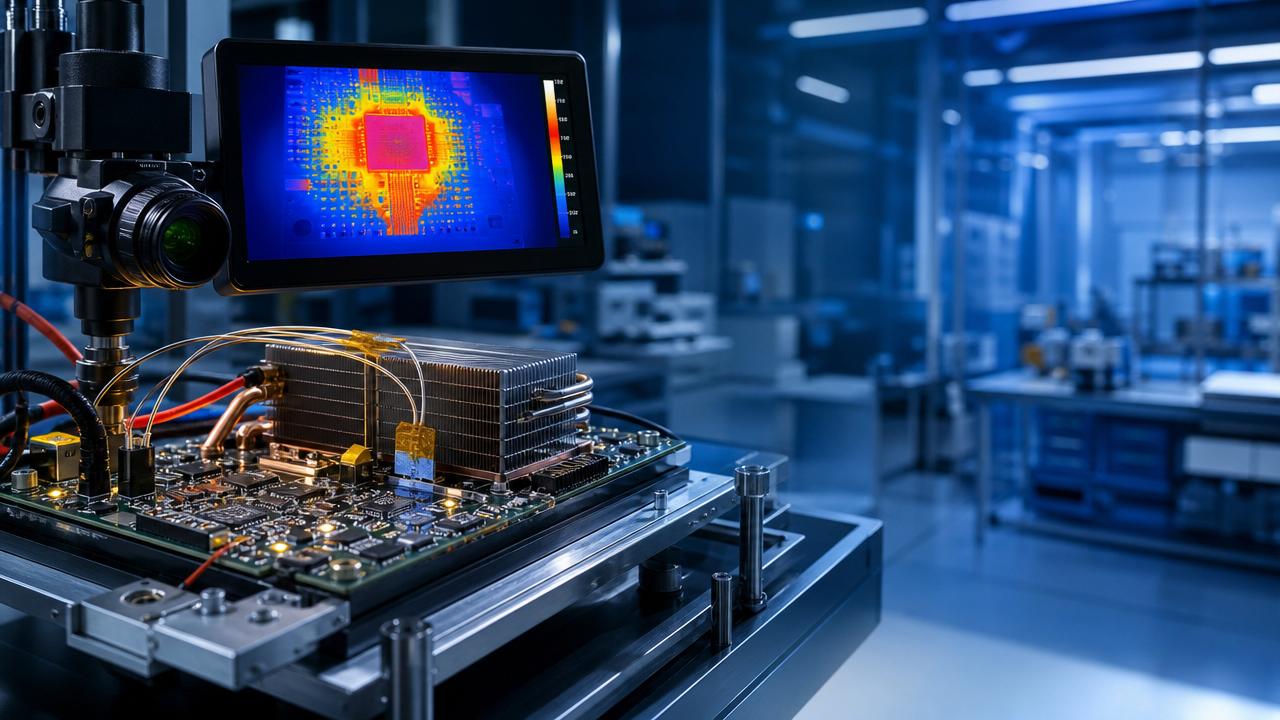
Usually not. Infrared imaging is excellent for fast visualization, but it can mislead if emissivity is not controlled or if internal heat paths matter more than surface appearance. It works best when combined with contact measurement, stress testing, or material-level analysis.
What should procurement teams request from suppliers?
Request more than brochure values. Ask for thermal characterization conditions, test setup details, lot consistency information, material traceability, and any reliability data under thermal cycling or power cycling. If data from different suppliers cannot be compared directly, independent benchmarking becomes highly valuable.
Which products benefit most from thermal management testing?
High-density PCBs, power modules, active semiconductor assemblies, LED systems, compact enclosed electronics, and any IPC-Class 3 oriented product benefit significantly. The same is true for assemblies exposed to high ambient temperature, long duty cycles, vibration, or repeated on-off loading.
Why choose us for thermal management testing insight and sourcing decisions
Thermal management testing is most useful when it answers a decision, not when it generates isolated numbers. SCM serves quality, safety, engineering, and procurement teams that need independent technical clarity across the semiconductor and EMS supply chain. Our strength is not generic commentary. It is rigorous benchmarking that connects material behavior, assembly precision, and reliability exposure.
If you are evaluating a new supplier, validating a process change, investigating overheating risk, or comparing component and PCB options across Asian manufacturing sources, SCM can support the technical review with structured evidence and industry-relevant interpretation.
- Confirm thermal parameters relevant to your boards, packages, or interface materials.
- Discuss selection criteria for PCB fabrication, SMT assembly, active devices, passive components, or thermal packaging.
- Review compliance-related documentation needs tied to IPC-Class 3 or ISO 9001 quality systems.
- Assess delivery risk, supplier comparability, sample support expectations, and reporting requirements.
- Request guidance on benchmarking scope, test method fit, and quotation discussions for custom evaluation work.
If your team needs clearer thermal risk visibility before qualification, sourcing, or corrective action, contact SCM with your target application, thermal concerns, expected operating conditions, and supplier context. That allows a faster discussion around test priorities, reporting depth, and the most relevant path to reduce failure risk.
Recommended News
- Heat DissipationHow to prevent overheating in automotive PCB power distributionPrevent overheating in automotive PCB power distribution with practical tips on copper layout, thermal paths, and testing. Discover how to reduce hotspots and improve reliability.
- Heat DissipationCan heat spreading intelligence identify hot spots in PCB designs?Discover how heat spreading intelligence identifies PCB hot spots before fabrication. Learn to assess thermal models, validate predictions, and choose design changes that improve reliability.
- Heat DissipationWhich heat sink materials suit high-power electronics made in Germany?Heat sink materials Germany: compare aluminum, copper, graphite, and hybrid designs for high-power electronics. Find the right balance of thermal performance, weight, cost, and manufacturability.
- Heat DissipationHow to assess a graphite materials supplier's capability for thermal partsGraphite materials supplier assessment starts with more than machining. Discover how to evaluate thermal performance, purity, precision, cleanliness, traceability, and testing for reliable thermal parts.
- Heat DissipationHow to assess a heat dissipation supplier before placing an orderHeat dissipation supplier assessment guide: verify thermal performance, materials, process control, samples, capacity, and total risk before placing an order.
- Heat DissipationHow automotive PCB material selection affects thermal reliabilityAutomotive PCB material selection shapes thermal reliability. Explore CTE, Tg, moisture resistance, stack-up design, and proven qualification strategies for demanding vehicle electronics.