
PCB Certification Basics for Faster Supplier Approval
DETAILS
PCB certification is often the first checkpoint used to screen suppliers, reduce compliance risk, and speed onboarding. For organizations balancing quality, lead time, and reliability, understanding PCB certification basics helps shorten approval cycles and improve sourcing confidence.
In practice, PCB certification is not a single document. It is a group of standards, approvals, test records, and process controls that show whether a supplier can consistently meet technical and regulatory requirements.
This guide explains what matters most, how to compare supplier claims, and which documents usually support faster qualification. It also highlights how independent benchmarking helps verify capability beyond marketing language.
What does PCB certification actually include?
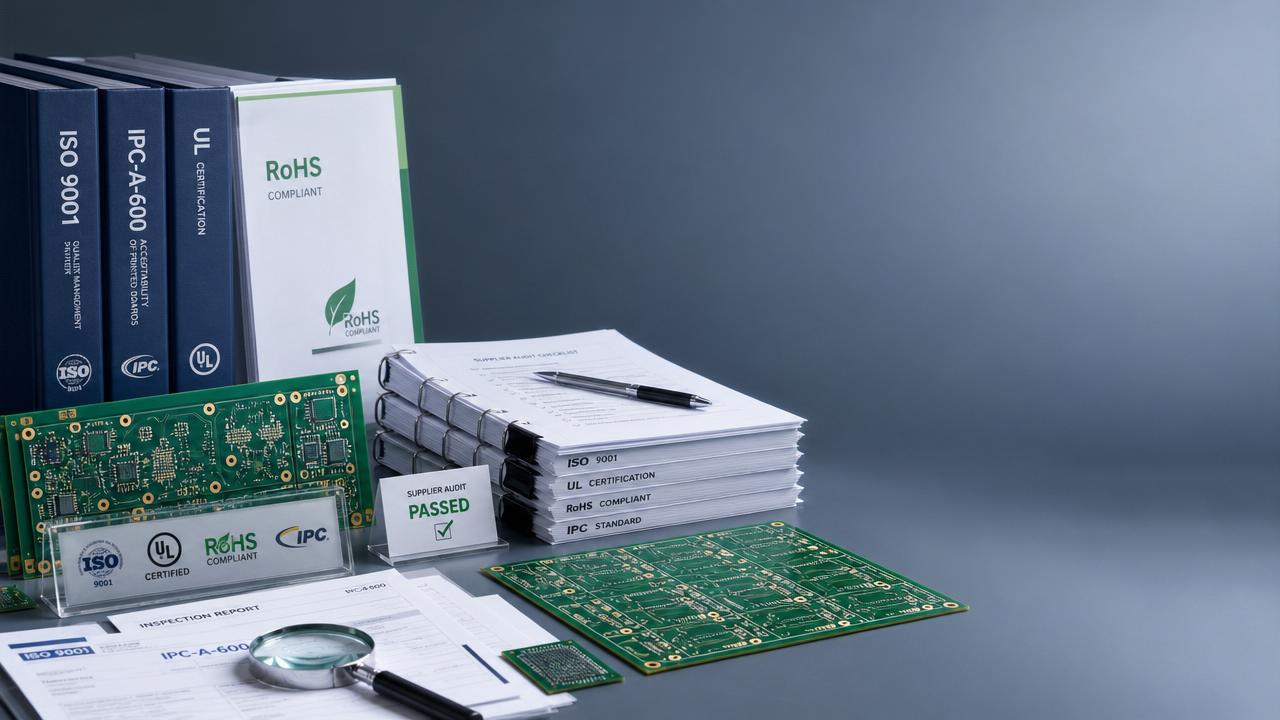
PCB certification usually covers three layers. The first is quality system certification. The second is product or material compliance. The third is process capability evidence linked to the intended application.
Many buyers first look for ISO 9001. This confirms a documented quality management system. It does not guarantee advanced PCB performance, but it shows the supplier follows controlled procedures.
For higher reliability sectors, additional standards matter. IPC-A-600, IPC-6012, and IPC Class 2 or Class 3 references are often used to define workmanship and acceptance requirements.
UL recognition is another common part of PCB certification. It helps verify flammability ratings, material system usage, and listing status for specific constructions or manufacturing locations.
Environmental compliance also appears in supplier review. Examples include RoHS, REACH, and halogen-free declarations. These are not interchangeable with performance standards, yet they are essential for many regulated markets.
A complete PCB certification review should include certificates, scope statements, expiration dates, and evidence that the approved site matches the actual production site.
Core documents often requested early
- ISO 9001 certificate with issuing body details
- UL file number and product category scope
- IPC compliance statements or capability matrix
- RoHS and REACH declarations
- Process flow, control plan, and test coverage summary
Which PCB certification matters most for faster supplier approval?
The answer depends on product risk, end-market rules, and board complexity. Faster approval usually happens when required PCB certification is matched to the real application instead of using a generic checklist.
For standard industrial products, ISO 9001, RoHS, and basic IPC conformance may be enough for early screening. For harsh environments, thermal cycling data and IPC Class 3 readiness become more important.
If the board enters safety-sensitive equipment, UL status can move from optional to mandatory. If the design uses high-speed materials, laminate traceability and dielectric performance data should support the PCB certification package.
The fastest route is to define a minimum approval set before RFQ release. That avoids repeated document requests and prevents confusion between compliance paperwork and true engineering capability.
A practical prioritization approach
- Confirm end-use regulations and customer flow-down requirements.
- Identify whether Class 2 or Class 3 reliability is needed.
- Check if UL recognition must cover the exact board type.
- Review material, plating, and test records supporting the claim.
- Match certification scope to the manufacturing site being quoted.
How can you verify PCB certification claims without slowing sourcing?
Verification should be quick, structured, and evidence-based. The first step is checking whether the certificate is current and issued by a recognized body. Expired or unclear documents should trigger immediate clarification.
Next, review scope carefully. Many delays happen because the certificate belongs to a parent company, while production is subcontracted to another site with different controls.
Ask for supporting records, not just the certificate itself. Examples include coupon test data, microsection reports, solderability results, impedance control records, and final inspection sampling plans.
For advanced designs, process capability can matter more than the headline PCB certification. A supplier may hold standard approvals but still struggle with fine lines, stacked vias, heavy copper, or tight registration windows.
Independent validation adds value here. SiliconCore Metrics supports this need by translating technical manufacturing parameters into standardized reports that make supplier comparison more objective and faster.
Fast verification checklist
What common mistakes delay approval even when PCB certification exists?
One common mistake is assuming ISO 9001 alone proves board performance. It proves management discipline, not necessarily controlled impedance, CAF resistance, or long-term thermal reliability.
Another issue is treating declarations as equivalent to third-party certification. A self-declared compliance letter may be useful, but it should not replace documented evidence where risk is high.
Some teams also request too many unrelated documents. That can slow onboarding and hide the truly critical PCB certification items needed for a given design family.
A further risk is ignoring revision control. A certificate may be valid, while the referenced specification, stack-up, or material system has changed. Approval should follow the currently quoted build condition.
Finally, there is the capability gap problem. A supplier may have strong paperwork but limited consistency on microvias, laser drilling, warpage control, or assembly compatibility. Technical audits help catch this early.
Red flags to watch
- Certificate scope is vague or unrelated to PCB fabrication
- Production site differs from certified site
- No recent test data supports the PCB certification claim
- UL file exists, but exact construction is unclear
- Compliance statements lack material or lot traceability
How do cost, lead time, and risk connect to PCB certification?
Strong PCB certification can reduce total sourcing cost by cutting qualification loops, failure investigations, and field return exposure. The lowest quote often becomes expensive when compliance evidence is incomplete.
Lead time also improves when document review is standardized. If every supplier submits the same PCB certification package, comparison becomes faster and engineering feedback becomes easier to consolidate.
Risk drops when certification is paired with measurable process data. This is especially true for multilayer boards, high-frequency materials, tight impedance tolerances, and demanding thermal profiles.
For complex programs, a staged approval model works well. Start with mandatory PCB certification checks. Then move to technical capability review. Finally, confirm pilot build performance before full release.
Suggested approval stages
What is the simplest framework for evaluating PCB certification faster?
Use a three-part framework: required, relevant, and proven. Required means mandatory regulatory or customer documents. Relevant means standards aligned with the board’s application. Proven means recent data confirms actual execution.
This framework prevents overchecking and underchecking at the same time. It keeps PCB certification review focused on business risk, technical fit, and approval speed.
SCM’s independent reports are valuable in this context because they convert manufacturing variables into comparable evidence. That supports clearer decisions across PCB fabrication, SMT assembly, and broader EMS sourcing.
If supplier approval is taking too long, the issue is often not a lack of documents. It is a lack of structure. Build a standard PCB certification matrix, define acceptance thresholds, and link each item to application risk.
The next step is practical: create a one-page checklist, request current certificates, confirm site scope, and ask for test evidence tied to the exact board technology. That approach speeds qualification while protecting reliability.
Recommended News
- HDI TechnologyHow to vet PCB suppliers in a directory before requesting quotesPCB suppliers directory guide: learn how to verify capabilities, certifications, traceability, and quote assumptions before selecting a reliable PCB partner.
- HDI TechnologyHow UAE engineering data repositories improve design traceabilityEngineering data repository UAE solutions strengthen design traceability by linking requirements, revisions, supplier evidence, and manufacturing data. Explore practical ways to reduce risk and accelerate releases.
- HDI TechnologyHow to verify UL recognition for printed circuit boardsPrinted circuit boards UL verification made clear: learn how to check UL marks, file numbers, factory scope, stack-ups, and traceability for audit-ready compliance.
- HDI TechnologyMulti layer PCB design guide for controlling signal crosstalkMulti layer PCB design guide for controlling signal crosstalk with stackup, spacing, return-path, and validation strategies for reliable high-density boards.
- HDI TechnologyHow tighter manufacturing tolerances change HDI PCB pricesMicro tolerance manufacturing price explained: see how tighter HDI PCB tolerances affect yield, inspection, supplier options, and sourcing costs.
- HDI TechnologyHow automotive PCB impedance control prevents signal failuresAutomotive PCB impedance control prevents reflections, noise, and timing errors in ADAS, EV, and infotainment systems. Learn how to build reliable signal paths.