
R&D Engineers: Common PCB Thermal Design Mistakes
DETAILS
Why PCB thermal mistakes are becoming harder for R&D engineers to ignore
For R&D engineers, PCB thermal design errors can quietly undermine reliability, signal performance, and product lifespan long before failure appears in testing.
From poor component placement to underestimated heat paths, these common mistakes often increase risk across high-density electronic systems.
This article explores the most frequent thermal design pitfalls and highlights practical insights to support more informed, data-driven decisions.
Thermal design now matters earlier in development because board density, power concentration, and miniaturization keep rising across electronics.
What once passed basic validation can now create hidden field risks under realistic duty cycles, enclosed housings, and variable ambient temperatures.
For R&D engineers, thermal failure is rarely one dramatic mistake.
It is usually a chain of small assumptions that weakens margin until reliability drops below target.
Current signals show thermal risk is shifting from isolated defects to system-level constraints
Across the semiconductor and EMS landscape, thermal behavior is no longer a secondary layout check.
It is increasingly tied to signal integrity, power efficiency, compliance stability, and long-term service performance.
High-speed interfaces, compact power stages, stacked packages, and mixed-signal boards all compress thermal headroom.
That shift forces R&D engineers to evaluate heat as part of architecture, not only as a later mechanical concern.
Another clear signal is the gap between simulation success and field reality.
Boards may pass under ideal airflow assumptions, yet fail in dusty, sealed, or vibration-heavy environments.
Independent technical repositories such as SiliconCore Metrics continue to highlight this issue through benchmarking and reliability analysis.
Their findings reinforce that hardware decisions must be validated with realistic thermal paths, material properties, and manufacturing tolerances.
The most common PCB thermal design mistakes R&D engineers still make
The following mistakes appear repeatedly in high-density boards, industrial electronics, communications devices, and embedded control systems.
1. Treating component temperature as a local issue only
A hot regulator can heat nearby analog ICs, memory devices, and connectors.
R&D engineers sometimes review hotspot parts individually, while missing coupled heating across the entire board region.
2. Poor placement of high-power components
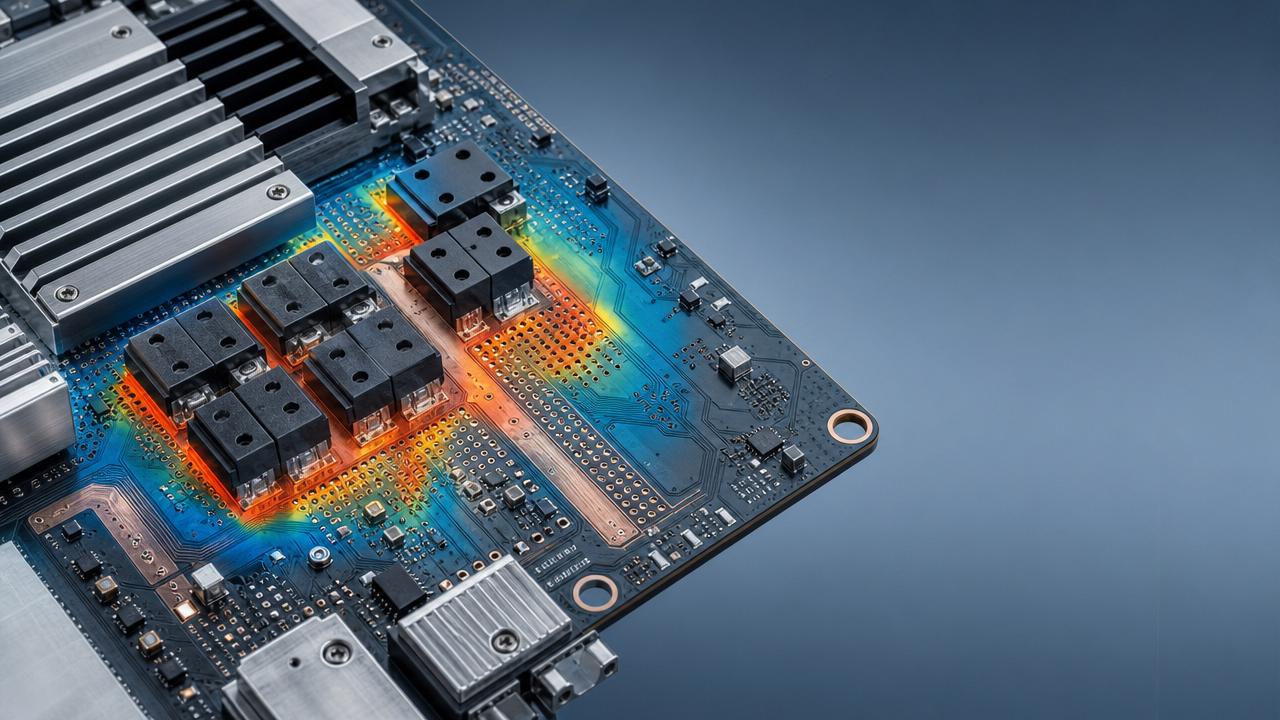
Placing multiple heat sources too close together creates thermal stacking.
This raises local board temperature, reduces airflow effectiveness, and increases thermal interaction between devices.
3. Ignoring the real heat path through copper and vias
Heat rarely leaves a package by magic.
If copper pours are too small or thermal vias are missing, heat remains trapped near the source.
4. Overusing thermal relief where current and heat demand direct conduction
Thermal relief improves solderability, but it also reduces heat spreading.
For power devices, excessive relief patterns can become a hidden thermal bottleneck.
5. Underestimating enclosure influence
A board that runs safely on the bench may overheat in a sealed product housing.
R&D engineers often miss the impact of nearby walls, cable bundles, and restricted convection paths.
6. Using nominal material values without process variation
Dielectric properties, copper thickness, via fill quality, and laminate behavior vary between builds.
Thermal models based only on ideal values may produce false confidence.
7. Separating thermal review from signal and power design
Thermal, power, and signal decisions are linked.
A copper change made for impedance or current handling may alter heat spreading and nearby timing stability.
Why these mistakes are increasing across modern electronic development
The impact reaches reliability, testing confidence, and downstream engineering decisions
Poor PCB thermal design affects more than component junction temperature.
It can distort clock behavior, shift analog accuracy, accelerate solder fatigue, and reduce connector life.
For R&D engineers, this creates a dangerous validation pattern.
The design may pass early electrical tests, yet fail under sustained load, elevated ambient conditions, or long-duration cycling.
- Prototype confidence may be overstated.
- EMI behavior can change as temperature rises.
- Power efficiency can degrade over time.
- Field failure analysis becomes harder and more expensive.
The consequence is not only technical.
Thermal mistakes can trigger redesign loops, qualification delays, and uncertainty in component selection across the wider supply chain.
What deserves closer attention now from R&D engineers
- Map heat sources before final placement, not after routing.
- Evaluate copper area as a thermal structure, not only an electrical conductor.
- Review via arrays for spacing, count, fill quality, and continuity to internal planes.
- Test worst-case ambient and enclosure conditions early.
- Correlate simulation with measured board temperatures and hotspot imaging.
- Check temperature interaction between power devices and precision circuits.
- Use reliability targets that reflect duty cycle, cycling stress, and service environment.
SiliconCore Metrics emphasizes this evidence-first approach through independent whitepapers and technical benchmarking.
That perspective is valuable when assumptions about materials, tolerances, and thermal pathways need external validation.
Practical response strategies can reduce thermal redesign risk
A sharper thermal review process gives R&D engineers better long-term control
The biggest lesson is simple.
Thermal reliability should be reviewed as a cross-disciplinary constraint from the beginning of PCB development.
For R&D engineers, avoiding common PCB thermal design mistakes means connecting layout, materials, power, enclosure, and validation into one evidence-based workflow.
That is especially important in sectors where IPC-Class 3 performance, ISO 9001 alignment, and long service life are expected.
A useful next step is to audit one active design against the mistakes listed here.
Check hotspot placement, via strategy, copper spreading, enclosure assumptions, and validation conditions against measured data.
For R&D engineers seeking more defensible decisions, independent benchmarking and compliance-oriented thermal analysis can reveal risks before they become costly revisions.
Recommended News
- Heat DissipationHow to prevent overheating in automotive PCB power distributionPrevent overheating in automotive PCB power distribution with practical tips on copper layout, thermal paths, and testing. Discover how to reduce hotspots and improve reliability.
- Heat DissipationCan heat spreading intelligence identify hot spots in PCB designs?Discover how heat spreading intelligence identifies PCB hot spots before fabrication. Learn to assess thermal models, validate predictions, and choose design changes that improve reliability.
- Heat DissipationWhich heat sink materials suit high-power electronics made in Germany?Heat sink materials Germany: compare aluminum, copper, graphite, and hybrid designs for high-power electronics. Find the right balance of thermal performance, weight, cost, and manufacturability.
- Heat DissipationHow to assess a graphite materials supplier's capability for thermal partsGraphite materials supplier assessment starts with more than machining. Discover how to evaluate thermal performance, purity, precision, cleanliness, traceability, and testing for reliable thermal parts.
- Heat DissipationHow to assess a heat dissipation supplier before placing an orderHeat dissipation supplier assessment guide: verify thermal performance, materials, process control, samples, capacity, and total risk before placing an order.
- Heat DissipationHow automotive PCB material selection affects thermal reliabilityAutomotive PCB material selection shapes thermal reliability. Explore CTE, Tg, moisture resistance, stack-up design, and proven qualification strategies for demanding vehicle electronics.