
Material Breakthroughs Changing PCB Thermal Performance in 2026
DETAILS
In 2026, material breakthroughs are redefining PCB thermal performance, turning substrate selection and thermal interface design into strategic evaluation points for global sourcing and engineering teams. For business assessors, understanding how next-generation laminates, copper structures, and advanced fillers affect reliability, cost, and compliance is essential to making informed decisions in a highly competitive electronics supply chain.
For readers evaluating suppliers, technologies, or sourcing strategies, the core takeaway is clear: the most important material breakthroughs are no longer just laboratory talking points. They now influence field reliability, power density, qualification cycles, and total procurement risk. The right thermal material stack can improve heat dissipation and product lifespan, but the wrong one can raise cost without delivering measurable performance gains.
The practical search intent behind this topic is not simply to learn what new materials exist. It is to understand which material innovations are commercially relevant, where they create real business value, what trade-offs they introduce, and how to assess them before committing to design-in or supplier approval. That is especially true for business assessors who must connect technical performance with commercial decision-making.
What Is Actually Changing PCB Thermal Performance in 2026?
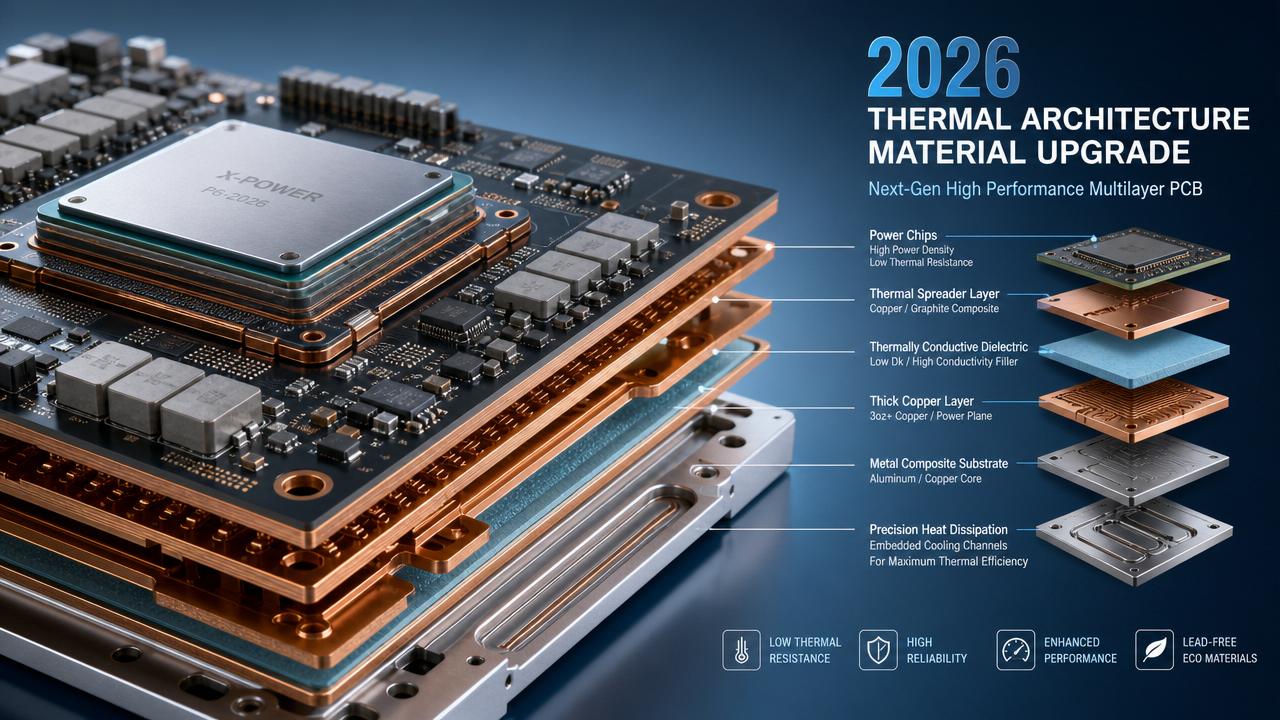
PCB thermal performance in 2026 is being reshaped by a combination of advances rather than one single disruptive invention. The most relevant material breakthroughs include low-loss and high-thermal-conductivity laminates, resin systems with improved thermal stability, ceramic-filled dielectrics, thicker and more engineered copper structures, metal-core and hybrid-core constructions, and better thermal interface materials integrated into assembly strategy.
These developments matter because thermal problems in electronics are increasingly system-level issues. Higher power densities, compact form factors, faster switching devices, and stricter reliability expectations mean that traditional FR-4 choices often reach their practical limits. As a result, thermal performance is becoming a strategic differentiator in sectors such as automotive electronics, AI hardware, industrial controls, telecom infrastructure, and power conversion systems.
For business assessors, the critical point is that improved thermal performance does not come only from selecting a material with a better thermal conductivity number on a datasheet. Real-world results depend on stack-up design, copper balancing, via structures, assembly processes, and long-term material stability under thermal cycling. Evaluation should therefore focus on validated performance in application-relevant conditions, not specification marketing alone.
Which Material Breakthroughs Deserve Serious Commercial Attention?
Among current material breakthroughs, thermally enhanced laminates deserve close attention because they offer a practical path between standard FR-4 and much more expensive ceramic or metal-core solutions. These laminates typically use resin systems loaded with ceramic or mineral fillers that increase through-plane and in-plane heat transfer while preserving manufacturability for multi-layer boards.
Another high-impact area is copper innovation. Heavier copper, embedded copper coins, and localized copper thickening are becoming more common for thermal spreading in power-intensive designs. These approaches are often more cost-effective than shifting the entire board platform to an exotic substrate, especially when the thermal bottleneck is local rather than system-wide.
Hybrid constructions are also gaining traction. Instead of specifying a premium material across the entire PCB, manufacturers are combining standard materials with thermally optimized inserts, insulated metal substrates, or selective high-performance layers. For procurement and evaluation teams, this matters because hybridization can reduce material cost while still solving critical thermal issues in defined zones.
Finally, advanced dielectric fillers are emerging as a more nuanced differentiator. In 2026, some of the most meaningful progress lies in balancing thermal conductivity, dielectric stability, mechanical strength, and processing consistency. This matters for buyers because a material that performs well thermally but creates drilling, lamination, or delamination issues may increase overall manufacturing risk.
Why Business Assessors Should Not Look at Thermal Conductivity Alone
A common evaluation mistake is to compare materials by a single thermal conductivity value. While that metric is important, it rarely predicts actual board-level thermal performance on its own. Some materials show strong bulk thermal properties but deliver only modest improvement once copper geometry, via density, solder interfaces, and enclosure constraints are included.
Business assessors should instead review a broader set of performance indicators. These include glass transition temperature, decomposition temperature, coefficient of thermal expansion, z-axis expansion, thermal cycling endurance, moisture absorption, dielectric behavior, and process compatibility. In high-reliability applications, these variables can influence whether a thermal gain translates into a durable commercial advantage.
This broader perspective is especially useful during supplier comparison. A vendor may offer a material positioned as a thermal upgrade, but if it requires tighter processing windows, lower production yield, or special handling in lamination and drilling, the effective cost can rise well beyond the raw laminate premium. Good assessment connects thermal value with manufacturability and supply chain execution.
How New Materials Affect Reliability, Not Just Heat Dissipation
Thermal management and reliability are inseparable. Better heat spreading helps reduce hot spots, lower junction temperatures, and protect adjacent components. However, new materials can also introduce new stress patterns. Differences in thermal expansion between resin, copper, fillers, and mounted components may create fatigue risks during repeated thermal cycling.
That is why the most meaningful material breakthroughs in 2026 are those that improve thermal performance without undermining structural durability. For example, a filled laminate with higher thermal conductivity may look attractive, but if it becomes too brittle or behaves inconsistently during reflow and field operation, it may create failures that erase any efficiency gain.
Procurement and business review teams should ask for reliability evidence linked to the target use case. Relevant data may include thermal shock results, interconnect stress testing, conductive anodic filament resistance, solder joint fatigue outcomes, and multi-cycle operating life under high humidity or power loading. Thermal performance should always be assessed as part of reliability economics, not as an isolated feature.
Where the Best ROI Usually Comes From
Not every application justifies premium thermal materials. The best return on investment typically appears in products where thermal limitations directly affect uptime, warranty exposure, or performance density. Examples include power modules, LED systems, EV control electronics, telecom radios, server accelerators, and industrial power conversion boards.
In these environments, a targeted material upgrade can create measurable business value by extending service life, enabling smaller form factors, increasing current handling, or reducing the need for secondary cooling hardware. When that happens, the thermal material decision supports both technical and commercial optimization.
By contrast, for lower-power or cost-sensitive applications, a full transition to advanced materials may offer poor ROI. In many cases, layout optimization, via redesign, heat spreaders, or selective copper enhancement can solve the problem more economically. Business assessors should therefore distinguish between applications that need material innovation and those that mainly need design discipline.
What Questions to Ask Suppliers About Material Breakthroughs
When suppliers promote material breakthroughs, business assessors should move beyond brochures and ask structured questions. First, request comparative data against a known baseline such as standard FR-4 or the incumbent stack-up. The goal is to quantify actual thermal improvement in realistic board conditions, not theoretical laboratory values.
Second, ask how the material affects fabrication yield and process control. Does it change drilling wear, lamination pressure requirements, resin flow behavior, warpage risk, or plating quality? A material that improves thermal metrics but complicates volume production may create hidden cost and delivery instability.
Third, evaluate supply continuity. Are the resin, filler, and copper inputs regionally concentrated? Is there a second qualified source? Can the supplier support consistent material lots for global programs? In 2026, supply resilience remains a critical part of technical qualification, particularly for enterprises operating across multiple manufacturing regions.
Fourth, request evidence of compliance and qualification history. For many buyers, compatibility with IPC expectations, ISO quality systems, flammability standards, and customer-specific reliability protocols is as important as the thermal performance itself. Strong suppliers can explain not only what changed in the material, but also how it has been validated.
How to Compare Competing Material Options More Effectively
A practical evaluation framework begins with use-case segmentation. Assess whether the product challenge is hotspot removal, overall temperature reduction, dimensional stability, or long-life reliability under thermal cycling. Different thermal problems point to different material choices, and this prevents overbuying premium material where it is not needed.
Next, compare options across five dimensions: thermal improvement, manufacturability, reliability, cost impact, and sourcing resilience. This framework helps teams avoid a narrow engineering decision that later creates procurement or operational problems. It also gives non-engineering stakeholders a clearer basis for decision-making.
Decision teams should also separate direct cost from system cost. A more expensive laminate may lower total system cost if it reduces heatsink mass, cuts field failures, or improves product density. Conversely, a cheaper option may become more expensive if it increases rework, slows qualification, or shortens service life. The strongest sourcing decisions come from this whole-life perspective.
What Trends Will Likely Shape PCB Thermal Strategy Beyond 2026
Looking ahead, thermal materials will increasingly be evaluated as part of platform strategy rather than individual board selection. As semiconductor power density rises, more OEMs will align substrate choices with package design, enclosure modeling, and cooling architecture from the start of development. This creates stronger demand for suppliers that can provide data-rich, application-specific recommendations.
Another likely trend is deeper integration between thermal and electrical performance requirements. Materials that balance heat management with stable dielectric behavior, signal integrity support, and mechanical reliability will gain priority over single-attribute solutions. This is especially relevant in high-speed and high-power mixed environments where thermal and signal constraints interact.
Finally, expect more scrutiny of verification quality. Buyers are becoming less willing to accept generic thermal claims without third-party benchmarking or robust qualification evidence. Independent technical validation, standardized reporting, and comparative reliability data will become even more valuable as material breakthroughs multiply and marketing language becomes harder to distinguish from true engineering progress.
How Business Assessors Can Make Better Decisions Right Now
The smartest approach in 2026 is to treat PCB thermal materials as a value decision, not just a component specification. Start by identifying whether thermal constraints are actually limiting product reliability, density, or cost efficiency. Then determine whether the answer lies in new material adoption, copper architecture changes, hybrid stack-up design, or broader thermal system redesign.
From there, require evidence that connects claimed material breakthroughs to measurable outcomes: lower operating temperatures, better reliability under cycling, reduced cooling hardware, improved power handling, or stronger compliance positioning. Prioritize solutions with manufacturable process windows, stable sourcing, and application-specific qualification data.
For organizations managing global electronics programs, the best decisions will come from combining engineering validation with procurement discipline. That means comparing thermal materials not only by performance claims, but also by supply chain resilience, certification readiness, production repeatability, and total lifecycle economics.
In short, material breakthroughs are changing PCB thermal performance in meaningful ways, but not every new material deserves immediate adoption. The winners for business assessors will be the solutions that convert thermal improvement into reliable, scalable, and commercially defensible outcomes. In a market where heat increasingly defines performance limits, informed material selection is becoming a direct competitive advantage.
Recommended News
- Heat DissipationHow to prevent overheating in automotive PCB power distributionPrevent overheating in automotive PCB power distribution with practical tips on copper layout, thermal paths, and testing. Discover how to reduce hotspots and improve reliability.
- Heat DissipationCan heat spreading intelligence identify hot spots in PCB designs?Discover how heat spreading intelligence identifies PCB hot spots before fabrication. Learn to assess thermal models, validate predictions, and choose design changes that improve reliability.
- Heat DissipationWhich heat sink materials suit high-power electronics made in Germany?Heat sink materials Germany: compare aluminum, copper, graphite, and hybrid designs for high-power electronics. Find the right balance of thermal performance, weight, cost, and manufacturability.
- Heat DissipationHow to assess a graphite materials supplier's capability for thermal partsGraphite materials supplier assessment starts with more than machining. Discover how to evaluate thermal performance, purity, precision, cleanliness, traceability, and testing for reliable thermal parts.
- Heat DissipationHow to assess a heat dissipation supplier before placing an orderHeat dissipation supplier assessment guide: verify thermal performance, materials, process control, samples, capacity, and total risk before placing an order.
- Heat DissipationHow automotive PCB material selection affects thermal reliabilityAutomotive PCB material selection shapes thermal reliability. Explore CTE, Tg, moisture resistance, stack-up design, and proven qualification strategies for demanding vehicle electronics.