
How to Evaluate Thermal Management Quality in High-Power Electronics
DETAILS
In high-power electronics, thermal management quality directly affects reliability, efficiency, and long-term performance. For technical evaluators, assessing heat dissipation is not just about temperature readings, but about understanding materials, design tolerances, interface stability, and real-world operating stress. This article outlines the key indicators and practical methods used to evaluate thermal management quality with greater accuracy and confidence.
What Thermal Management Quality Means in High-Power Electronics
Thermal management quality refers to how effectively an electronic product controls, transfers, and dissipates heat across its operating life. In high-power systems, this includes the complete thermal path: semiconductor junctions, substrates, solder layers, thermal interface materials, heat spreaders, heat sinks, enclosures, airflow channels, and the surrounding environment. A technically sound evaluation does not stop at whether a device runs “cool enough” in a lab. It asks whether the thermal design remains stable under power cycling, transient loading, contamination, vibration, and production variation.
For technical evaluators, thermal management quality is best understood as a measurable combination of design capability and manufacturing consistency. A design may appear strong in simulation, yet poor flatness control, voiding, interface pump-out, or uneven mounting pressure can degrade thermal performance in field conditions. This is why thermal management quality is closely tied to component reliability, assembly precision, and long-term compliance with quality standards such as IPC-Class 3 and ISO 9001-oriented process control.
Why the Industry Pays Close Attention to Thermal Management Quality
Across the semiconductor and EMS supply chain, power density continues to rise while package sizes shrink. Devices in power conversion, EV charging, industrial automation, AI infrastructure, RF modules, and telecom backplanes are expected to deliver more output in less space. Under these conditions, thermal management quality becomes a strategic engineering concern rather than a secondary mechanical issue.
Poor heat control can trigger parameter drift, reduced switching efficiency, accelerated dielectric aging, solder fatigue, and early component failure. In multilayer PCB assemblies, localized hot spots may also affect signal integrity and mechanical stability. For procurement and quality teams, weak thermal performance introduces hidden supply chain risks because thermal defects often do not appear in basic incoming inspection. They emerge after stress, cycle aging, or installation in variable field environments.
This is where independent, data-driven benchmarking becomes valuable. Organizations such as SiliconCore Metrics support technical evaluators by translating complex manufacturing variables into comparable evidence. Instead of relying only on supplier claims, evaluators can compare thermal paths, interface behavior, material tolerances, and environmental durability using standardized test logic.
Core Indicators Used to Evaluate Thermal Management Quality
A rigorous assessment of thermal management quality should include both direct thermal measurements and the upstream factors that influence them. The following indicators are among the most important.
Junction and Case Temperature Performance
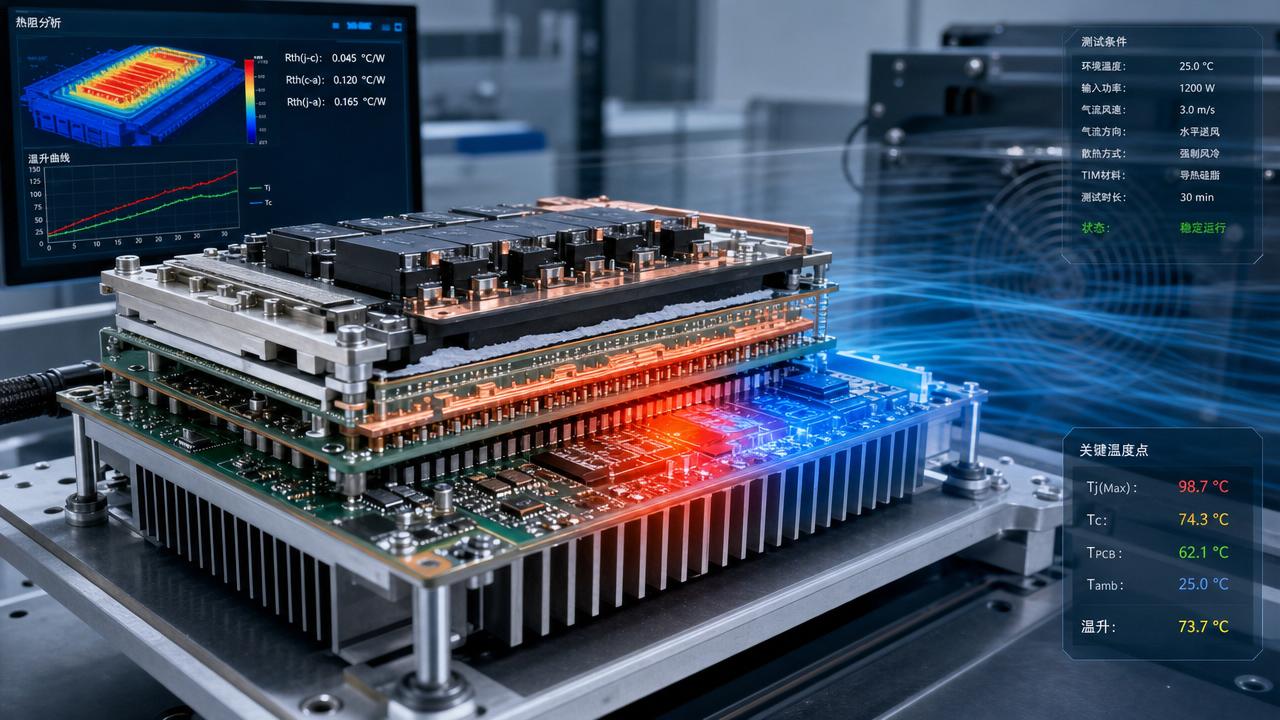
The first checkpoint is the temperature rise at the semiconductor junction, case, and board level under defined power loads. Evaluators should verify not only the peak temperature but also temperature distribution and time to stabilization. A low average temperature can still hide dangerous hot spots.
Thermal Resistance Across the Heat Path
Thermal resistance values, such as junction-to-case and case-to-ambient, help quantify how efficiently heat flows through the assembly. However, these values must be examined under realistic mounting and airflow conditions. Datasheet values alone are rarely enough for evaluating thermal management quality in finished products.
Thermal Interface Material Stability
Thermal greases, pads, phase-change materials, and gap fillers often determine whether a good design performs well in production. Evaluators should look for pump-out resistance, dry-out behavior, compression set, thickness control, and resistance to repeated thermal cycling. Interface instability is one of the most common hidden causes of declining thermal management quality over time.
Mechanical and Assembly Precision
Flatness, coplanarity, mounting torque, solder voiding, substrate warpage, and heat sink contact pressure all affect thermal transfer. In high-power electronics, even small micro-tolerance errors can create measurable thermal penalties. This is especially relevant in assemblies where SMT precision and package alignment determine effective heat spreading.
Durability Under Environmental Stress
Thermal management quality should remain acceptable after humidity exposure, power cycling, vibration, dust loading, and elevated ambient temperature. A system that performs well on day one but degrades rapidly under stress cannot be considered robust.
Industry Overview: Key Evaluation Dimensions
For technical evaluators working across semiconductor devices, PCB assemblies, and thermal packaging, the table below summarizes the most practical dimensions used to judge thermal management quality.
Where Thermal Management Quality Delivers the Most Practical Value
Evaluating thermal management quality has clear value across several technical and business functions. For design engineers, it improves confidence in safe operating limits and product lifetime models. For validation teams, it provides a structured basis for comparing prototypes, package options, and supplier builds. For procurement and supply chain professionals, it reduces the risk of selecting components or assemblies that meet nominal specifications but fail under realistic thermal stress.
The value is especially high in products where thermal margins are narrow. Examples include power modules, LED drivers, server power supplies, motor control inverters, battery management systems, telecom amplifiers, and dense compute hardware. In these products, small weaknesses in thermal management quality can lead to large downstream costs through derating, warranty returns, unexpected fan noise, or reduced service life.
Typical Objects of Evaluation in the Electronics Supply Chain
Thermal management quality should be assessed differently depending on the object being evaluated. The thermal risks of a bare semiconductor package are not the same as those of a full PCB assembly or a complete enclosure-level system.
Practical Methods for a More Accurate Evaluation
A dependable evaluation process should combine measurement, inspection, and comparative analysis. First, define realistic operating profiles, including steady-state and transient loads. Many thermal failures occur during start-up spikes, cyclic loads, or partial airflow blockage rather than during ideal steady operation.
Second, use multiple measurement methods. Thermocouples, infrared imaging, embedded sensors, and resistance-based junction estimation each reveal different aspects of thermal behavior. Cross-checking methods helps identify errors caused by emissivity settings, sensor placement, or delayed response.
Third, connect thermal data to physical evidence. If thermal resistance increases after cycling, inspect for solder void growth, interface material migration, warpage, or mounting relaxation. Thermal management quality is strongest when the measured outcome and the physical root cause align clearly.
Fourth, compare production samples rather than relying on a single engineering prototype. Variability between lots often exposes whether the supplier’s thermal process is mature. For technical evaluators, repeatability is as important as peak performance.
Common Evaluation Gaps to Avoid
Several mistakes can distort judgments about thermal management quality. One common gap is overreliance on datasheet conductivity values without checking bond-line thickness and contact quality. Another is evaluating only room-temperature operation while ignoring high ambient conditions. Evaluators also sometimes focus on heat sink size while overlooking PCB stack-up, copper distribution, and local thermal bottlenecks near power devices.
A further risk is separating thermal assessment from manufacturing quality review. In reality, thermal behavior is deeply influenced by SMT accuracy, substrate condition, and process discipline. Independent benchmark reports are useful because they connect these domains instead of treating thermal issues as isolated test results.
How Technical Evaluators Can Build a Stronger Decision Framework
A robust framework for evaluating thermal management quality should include five elements: defined test conditions, measurable acceptance limits, material and process traceability, environmental stress validation, and comparative supplier evidence. When these elements are documented together, engineering, quality, and sourcing teams can make decisions on shared facts rather than assumptions.
For organizations managing global semiconductor and EMS sourcing, this approach also improves communication between manufacturing hubs and international design teams. Standardized thermal reports, tolerance data, and reliability findings reduce ambiguity and speed up technical review cycles. That is especially important when selecting high-performance components intended for demanding industrial or mission-critical applications.
Conclusion and Next-Step Guidance
Thermal management quality is not a single number. It is the combined result of thermal design, material behavior, assembly precision, and long-term environmental reliability. For technical evaluators, the most effective assessments go beyond surface temperature checks and examine the full heat path, the stability of interfaces, and the consistency of production processes.
In today’s high-density electronics landscape, careful evaluation of thermal management quality helps reduce failure risk, improve confidence in supplier selection, and support stronger product reliability. If your team needs clearer benchmarking across PCB fabrication, SMT assembly, active devices, passive components, or thermal packaging, an independent technical intelligence model can provide the evidence required to make better engineering decisions with greater confidence.
- PCB
- substrates
- PCB fabrication
- SMT assembly
- active semiconductors
- passive components
- thermal packaging
- signal integrity
- IPC-Class 3
- EMS
- thermal management
- environmental stress
- compliance reports
- supply chain risks
- high-performance components
- ISO 9001
- component reliability
- thermal interface materials
- PCB assembly
- thermal management quality
- semiconductor
- power electronics
- high-performance
- RF modules
- industrial automation
- heat dissipation
- heat sinks
- multilayer PCB
Recommended News
- Heat DissipationHow to prevent overheating in automotive PCB power distributionPrevent overheating in automotive PCB power distribution with practical tips on copper layout, thermal paths, and testing. Discover how to reduce hotspots and improve reliability.
- Heat DissipationCan heat spreading intelligence identify hot spots in PCB designs?Discover how heat spreading intelligence identifies PCB hot spots before fabrication. Learn to assess thermal models, validate predictions, and choose design changes that improve reliability.
- Heat DissipationWhich heat sink materials suit high-power electronics made in Germany?Heat sink materials Germany: compare aluminum, copper, graphite, and hybrid designs for high-power electronics. Find the right balance of thermal performance, weight, cost, and manufacturability.
- Heat DissipationHow to assess a graphite materials supplier's capability for thermal partsGraphite materials supplier assessment starts with more than machining. Discover how to evaluate thermal performance, purity, precision, cleanliness, traceability, and testing for reliable thermal parts.
- Heat DissipationHow to assess a heat dissipation supplier before placing an orderHeat dissipation supplier assessment guide: verify thermal performance, materials, process control, samples, capacity, and total risk before placing an order.
- Heat DissipationHow automotive PCB material selection affects thermal reliabilityAutomotive PCB material selection shapes thermal reliability. Explore CTE, Tg, moisture resistance, stack-up design, and proven qualification strategies for demanding vehicle electronics.