
Heat Sink Attachment Methods: Pros and Cons
DETAILS
Introduction to Heat Sink Attachment Methods
Selecting the optimal heat sink attachment method is critical for effective thermal management in electronic systems. This technical analysis compares the pros and cons of various solutions - from thermal adhesives to mechanical fasteners - for engineers, procurement specialists, and decision-makers evaluating cooling performance, EMI protection, and long-term reliability. Whether designing RF shielding enclosures or industrial connectors, understanding these attachment techniques ensures proper heat dissipation while maintaining signal integrity in demanding applications.
Mechanical Fastening Solutions
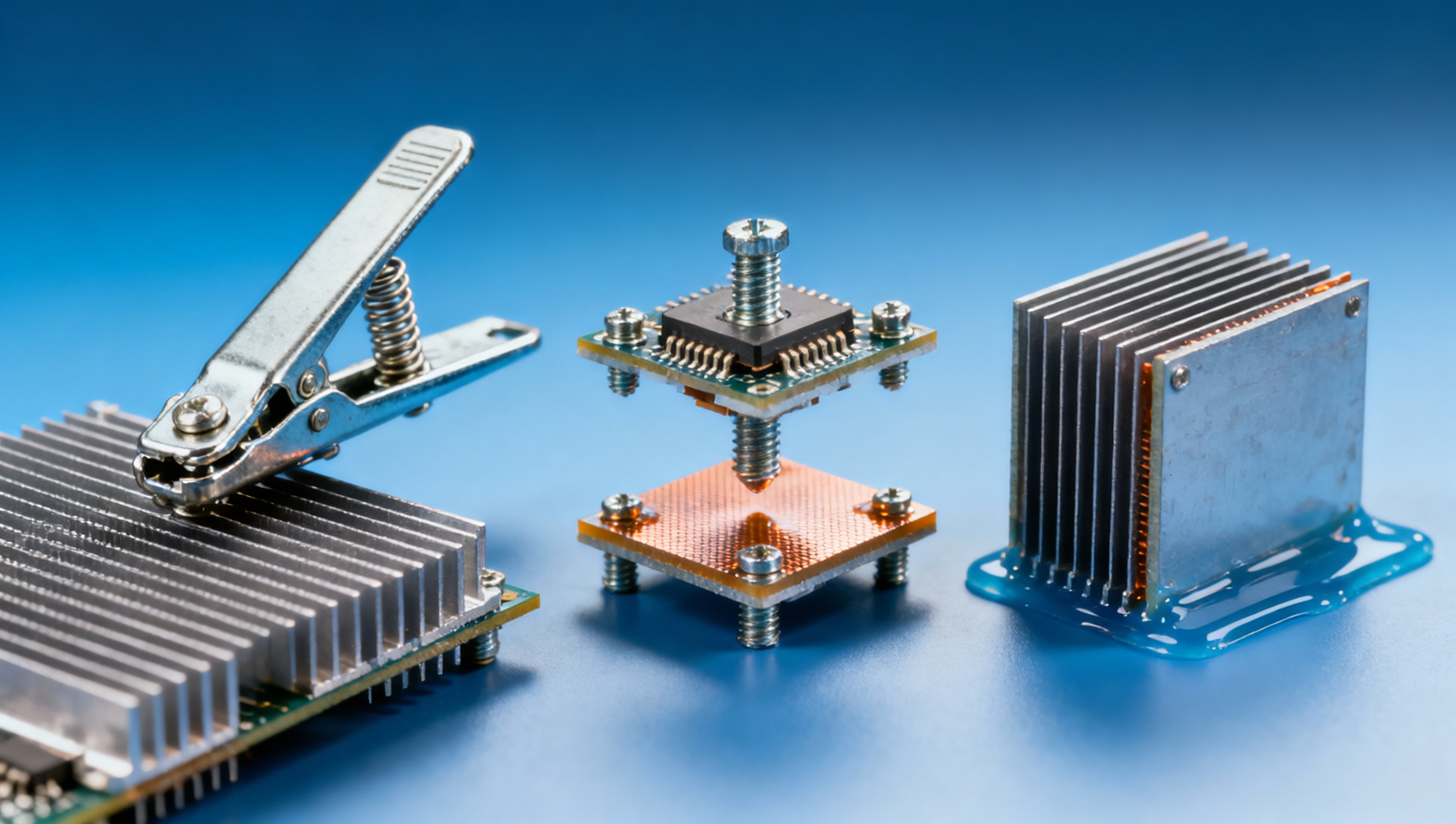
Mechanical fasteners remain the most widely used heat sink attachment method in industrial applications. These solutions typically include spring clips, screws, and push-pin systems, offering reworkability and consistent clamping force. According to industry benchmarks, mechanical fasteners maintain thermal interface material (TIM) thickness within ±0.05mm variance, critical for high-power semiconductor applications.
While mechanical solutions offer excellent thermal performance (typically 0.15-0.30°C/W thermal resistance), they require precise PCB mounting hole placement (±0.1mm tolerance) and often increase assembly time by 15-30% compared to adhesive methods. Vibration resistance varies significantly between fastener types, with spring clips maintaining 85% clamping force after 500 hours of 5G vibration testing.
Key Considerations for Mechanical Attachment
- Board flexure requirements (typically 0.5-1.5mm deflection allowance)
- Z-axis height tolerance stack-up (components, PCB, and heat sink)
- EMI grounding requirements (often requiring conductive gaskets)
- Maintenance accessibility for field service scenarios
Thermal Adhesive Technologies
Thermal adhesives provide permanent bonding solutions with excellent thermal conductivity (1-8 W/mK) and minimal interface resistance. Epoxy-based systems dominate the market, with 70% of industrial applications using two-part formulations that cure at room temperature in 4-24 hours. Recent advancements in silicone-based adhesives offer improved flexibility for applications experiencing thermal cycling between -40°C to +150°C.
Adhesive selection requires careful evaluation of bond line thickness (BLT), with optimal performance achieved at 0.05-0.15mm. Excessive BLT increases thermal resistance by 15-25% per 0.1mm beyond recommended ranges. For high-volume production, UV-curable adhesives reduce processing time to 30-90 seconds but require specialized equipment investments of $25,000-$75,000.
Adhesive Application Best Practices
- Surface preparation (cleaning and activation) improves adhesion by 40-60%
- Controlled dispensing systems maintain ±5% volume accuracy
- Cure monitoring prevents premature thermal cycling stress
- Post-cure thermal conditioning enhances long-term reliability
Advanced Attachment Solutions
Emerging technologies are transforming heat sink attachment methodologies. Sintered silver solutions offer thermal conductivity up to 250 W/mK but require specialized equipment operating at 200-300°C under 5-15MPa pressure. These solutions demonstrate 10-year reliability in automotive power modules with less than 5% thermal resistance degradation.
Phase change materials (PCMs) provide reworkable solutions for prototypes and low-volume production. Modern PCMs achieve thermal resistances of 0.05-0.15°C·in²/W while maintaining 80% of initial performance through 50+ thermal cycles. Their application temperature ranges from 45-120°C, making them ideal for telecom equipment experiencing frequent thermal cycling.
Comparative Performance Analysis
When evaluating attachment methods, consider these critical parameters:
- Thermal resistance stability under vibration (mechanical > adhesive > PCM)
- Assembly time per unit (PCM > mechanical > adhesive)
- Reworkability index (1-10 scale with 10 being easiest)
- Total cost of ownership including equipment and labor
Selection Criteria for Different Applications
The optimal attachment method varies significantly by application requirements. Industrial automation controllers typically prioritize vibration resistance, favoring mechanical fasteners with locking washers. Consumer electronics emphasize low-profile solutions, making thermally conductive tapes (0.2-0.5mm thickness) the preferred choice for smartphones and tablets.
For high-reliability military applications, epoxy adhesives with MIL-STD-883 certification provide the necessary environmental resistance. These formulations withstand 1000+ thermal cycles (-55°C to +125°C) while maintaining bond integrity. Aerospace applications often combine mechanical fasteners with conductive adhesives to meet both thermal and EMI shielding requirements.
Industry-Specific Recommendations
- Automotive: Spring clips with conductive pads (meets ISO 16750 vibration standards)
- Medical: Silicone adhesives (biocompatible, reworkable with solvents)
- Telecom: Phase change materials (accommodates frequent board swaps)
- Industrial: Epoxy adhesives (chemical resistance for harsh environments)
Conclusion and Implementation Guidance
Selecting the proper heat sink attachment method requires balancing thermal performance, mechanical requirements, and production constraints. Mechanical fasteners offer reliability for high-vibration environments, while adhesives provide permanent solutions with excellent thermal transfer. Advanced materials like sintered metals and PCMs address specialized needs in power electronics and prototyping.
For procurement teams, consider these evaluation factors:
- Thermal resistance requirements (junction-to-ambient targets)
- Environmental stress factors (vibration, thermal cycling, humidity)
- Production volume and assembly line capabilities
- Field service and rework requirements
- Total system cost including TIM and attachment
Contact our thermal engineering specialists for customized recommendations based on your specific application parameters and performance requirements. Our team provides comprehensive benchmarking data across 50+ attachment configurations to optimize your thermal management strategy.
Recommended News
- Heat DissipationHow to prevent overheating in automotive PCB power distributionPrevent overheating in automotive PCB power distribution with practical tips on copper layout, thermal paths, and testing. Discover how to reduce hotspots and improve reliability.
- Heat DissipationCan heat spreading intelligence identify hot spots in PCB designs?Discover how heat spreading intelligence identifies PCB hot spots before fabrication. Learn to assess thermal models, validate predictions, and choose design changes that improve reliability.
- Heat DissipationWhich heat sink materials suit high-power electronics made in Germany?Heat sink materials Germany: compare aluminum, copper, graphite, and hybrid designs for high-power electronics. Find the right balance of thermal performance, weight, cost, and manufacturability.
- Heat DissipationHow to assess a graphite materials supplier's capability for thermal partsGraphite materials supplier assessment starts with more than machining. Discover how to evaluate thermal performance, purity, precision, cleanliness, traceability, and testing for reliable thermal parts.
- Heat DissipationHow to assess a heat dissipation supplier before placing an orderHeat dissipation supplier assessment guide: verify thermal performance, materials, process control, samples, capacity, and total risk before placing an order.
- Heat DissipationHow automotive PCB material selection affects thermal reliabilityAutomotive PCB material selection shapes thermal reliability. Explore CTE, Tg, moisture resistance, stack-up design, and proven qualification strategies for demanding vehicle electronics.