
How to Tune Reflow Soldering for Lead-Free Boards
DETAILS
Lead-free reflow soldering demands tighter control over thermal profiles, SMT soldering windows, and circuit board assembly quality. For engineers, buyers, and compliance teams evaluating electronic parts, circuit components, and electromechanical parts, this guide explains practical soldering techniques to tune reflow performance while supporting PCB compliance, SMT compliance, semiconductor compliance, and thermal management compliance.
Compared with tin-lead processes, lead-free boards typically run at peak temperatures that are 15°C to 30°C higher, while offering a narrower process window for wetting, void control, warpage management, and intermetallic growth. That makes reflow tuning a cross-functional task involving manufacturing engineers, quality teams, sourcing managers, and project leads rather than a simple oven recipe adjustment.
For B2B decision-makers, the practical question is not only how to pass first article inspection, but how to maintain repeatable output across lot changes, mixed component populations, multilayer PCB designs, and supplier variation. A well-tuned lead-free reflow profile reduces rework, protects component reliability, and improves confidence in both technical approval and procurement decisions.
Why Lead-Free Reflow Tuning Is More Demanding
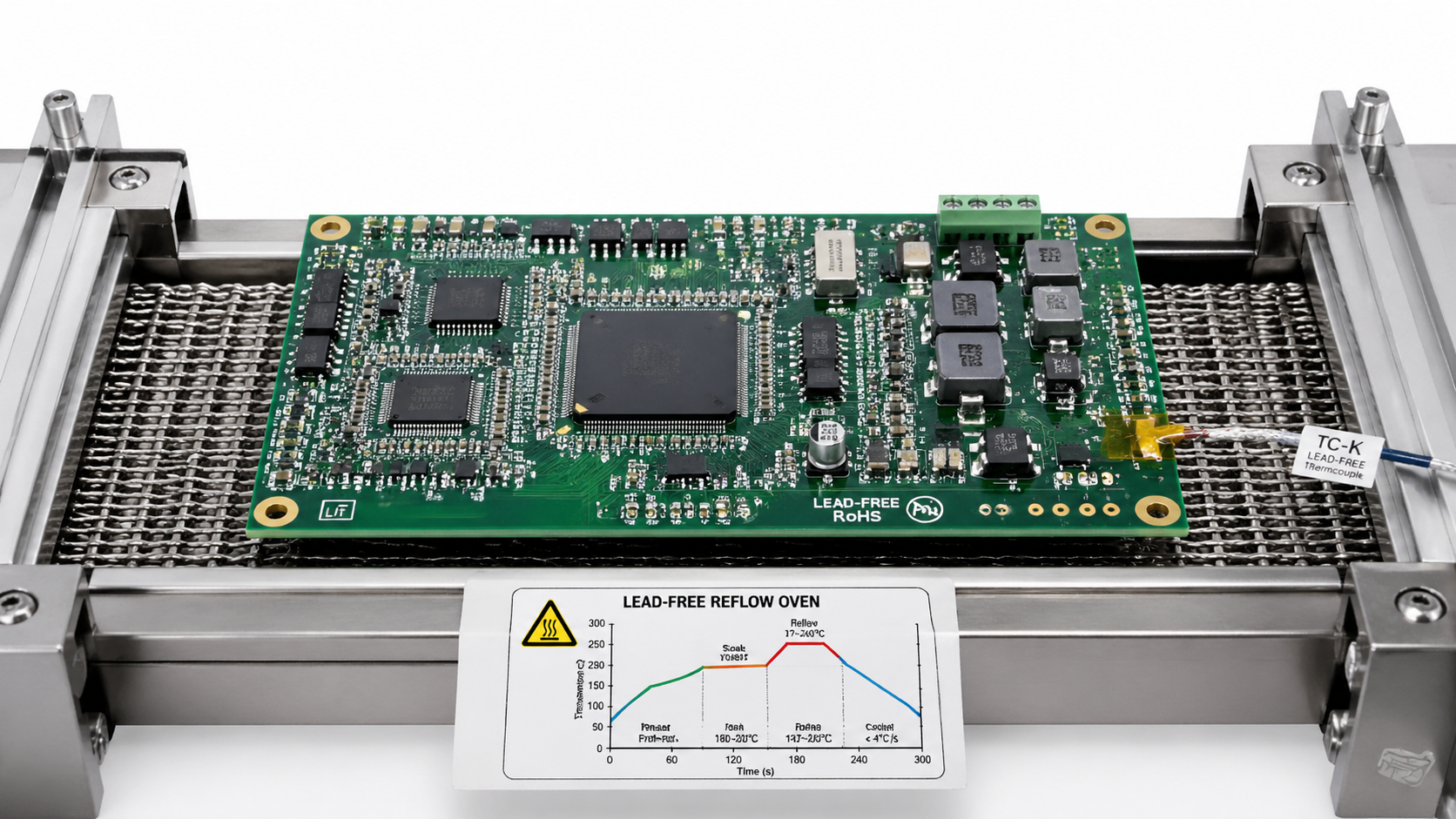
Lead-free soldering is less forgiving because common alloys such as SAC305 require higher melting points than traditional SnPb systems. In practical SMT assembly, liquidus is often around 217°C, and many production lines target peak board temperatures in the 235°C to 250°C range depending on board mass, component density, and package sensitivity.
Those higher temperatures increase risk in at least 4 areas: PCB discoloration, package warpage, flux exhaustion, and solder joint brittleness if time above liquidus is not controlled. For high-layer-count boards or assemblies carrying BGAs, QFNs, power devices, and large passive components, the thermal spread across the panel can exceed 10°C if profiling is not calibrated carefully.
This matters to more than line operators. Procurement and commercial teams need to know whether a supplier’s SMT line can hold repeatable ramp rates, conveyor stability, and zone uniformity. Quality and compliance teams need evidence that process limits align with IPC workmanship expectations, product reliability goals, and customer-specific thermal management constraints.
From a business perspective, even a 1% to 3% increase in solder-related defects can create cascading costs through X-ray inspection, touch-up labor, delayed shipment, field returns, and engineering review cycles. Reflow tuning should therefore be treated as a process capability issue, not only an operator setup issue.
Key process variables that shift in lead-free assembly
- Peak temperature usually rises by 15°C to 30°C compared with SnPb profiles.
- Time above liquidus often falls within 45 to 90 seconds depending on paste chemistry and component mix.
- Ramp-up rates are commonly held near 0.8°C to 1.5°C per second to limit thermal shock.
- Cool-down rates are often managed between 2°C and 4°C per second to balance grain structure and warpage risk.
What teams should verify before changing the profile
Before tuning starts, confirm 5 baseline conditions: solder paste datasheet limits, PCB thickness, copper loading, largest thermal mass component, and moisture sensitivity classification for critical packages. If one of these inputs is uncertain, profile optimization can be misleading because the oven may appear stable while the assembly itself is not.
The table below summarizes the most common thermal targets used as a starting framework. Actual values should still be validated on the real board and component set.
The main takeaway is that lead-free tuning is a balancing act. A profile that improves wetting on one connector or ground pad may also raise the risk of head-in-pillow, voids under bottom-terminated components, or laminate stress on heavier boards.
How to Build a Stable Thermal Profile
A stable profile starts with measurement discipline. Use a profiler with at least 4 to 6 thermocouples placed on the hottest and coldest zones of the assembly, including one on a high-mass pad, one near a small passive cluster, one on a BGA corner, and one at a board edge. For complex boards, 8-channel profiling is often justified.
Zone-by-zone tuning should focus on board response rather than air setpoint alone. Two ovens can show the same programmed temperatures but deliver very different effective heating due to airflow pattern, rail width, conveyor speed, and maintenance condition. A conveyor speed shift from 70 cm/min to 85 cm/min can materially shorten soak and liquidus time.
Engineers should begin by defining the process target hierarchy: first protect component thermal limits, second achieve complete solder wetting, third control voiding and cosmetic defects, and fourth maximize throughput. When throughput is prioritized too early, the line may pass visual inspection while hiding long-term reliability risks.
In mixed-technology assemblies, a single profile may not perfectly suit every package. That is why line qualification should include worst-case combinations such as large shield cans, low-standoff QFNs, fine-pitch ICs, and heat-sinking planes on the same panel.
A practical 5-step tuning sequence
- Confirm paste chemistry, stencil design, and MSL handling before changing oven settings.
- Run a baseline profile using current line speed and all active heating zones.
- Adjust soak and peak in small increments, typically 3°C to 5°C per zone change.
- Validate time above liquidus, delta-T across the board, and post-reflow defect modes.
- Lock the recipe only after at least 3 repeat runs show consistent results.
Recommended control priorities
First, keep board delta-T under control. Many high-reliability programs aim for less than 8°C to 10°C difference across critical measurement points at peak. Second, align time above liquidus with paste supplier guidance. Third, verify that the coolest solder joints still fully reflow while the hottest components remain below maximum tolerance.
The table below links common line adjustments to the defects they most often influence. This helps technical and purchasing teams evaluate whether a supplier’s reflow tuning approach is evidence-based or trial-and-error.
In most factories, the best results come from small, documented adjustments rather than broad recipe changes. Change one variable, record the result, inspect the joint quality, and only then move to the next variable. This disciplined method shortens debug cycles and supports later compliance review.
Defects, Root Causes, and Corrective Actions
Reflow tuning should be anchored to actual defect signatures. Common lead-free problems include insufficient wetting, solder beads, tombstoning, head-in-pillow, BGA voiding, graping, and charred flux residue. Each defect points to a different interaction between thermal profile, paste behavior, pad design, and component geometry.
For example, tombstoning often reflects imbalance in pad heating or solder paste volume rather than peak temperature alone. BGA head-in-pillow may be linked to package warpage near peak, especially when the top-side component body and substrate expand differently above 230°C. Large voids under BTCs can result from both stencil aperture design and excessive time in the upper thermal zones.
A strong corrective approach combines reflow data with AOI, X-ray, solder paste inspection, and cross-section review where needed. Looking only at the oven profile can lead to false conclusions, because defects frequently originate upstream in printing, storage conditions, board finish variation, or component coplanarity.
Quality teams should also segment defects into functional and non-functional classes. A cosmetic flux discoloration may be acceptable in one program, while a 25% void under a thermal pad may be unacceptable in power electronics or long-life industrial assemblies.
Common failure modes to check during line review
- Cold joints on high-copper or shielded locations
- Excessive voiding under QFN and power packages
- Warp-related opens on BGA corners
- Pad cratering risk after over-aggressive thermal cycling
- Delamination or discoloration on moisture-sensitive laminates
Defect mapping framework
The table below helps convert visible symptoms into process actions. This is useful for engineers tuning the line and for sourcing or audit teams reviewing whether a contract manufacturer can manage lead-free soldering systematically.
When teams connect defect type to thermal evidence, improvement becomes faster and more repeatable. It also creates a documented basis for supplier qualification, corrective action requests, and financial approval of process upgrades.
Compliance, Qualification, and Supplier Evaluation
For organizations buying assembled boards or critical subassemblies, reflow tuning cannot be separated from compliance and supplier capability. A line that can hit nominal peak temperature is not automatically capable of supporting PCB compliance, SMT compliance, semiconductor compliance, or thermal management compliance across different products and revisions.
Technical evaluation should therefore review 4 layers of evidence: equipment capability, process control, inspection coverage, and document traceability. In many supplier assessments, the missing link is not machinery but the ability to correlate profile data with real defect outcomes and corrective actions over time.
Procurement and commercial teams can reduce sourcing risk by asking for profile validation records on comparable assemblies, especially if the project involves IPC-Class 3 requirements, thick copper boards, high-pin-count BGAs, or power electronics. A supplier that cannot show repeat profiling discipline may create hidden cost later in rework, warranty exposure, or field reliability claims.
For finance and project management stakeholders, the goal is to compare process maturity against total cost of ownership. A lower piece price can be offset quickly if defect escapes increase by even 2% or if qualification takes an extra 2 to 4 weeks due to unstable reflow settings.
What to ask during a supplier or line capability review
- How many thermocouples are used for first article and periodic revalidation?
- What is the accepted delta-T limit across critical board locations?
- How often are ovens cleaned, calibrated, and airflow-checked?
- Which defect criteria are verified by AOI, X-ray, and destructive analysis?
- How are profile changes approved after paste, board, or component supplier changes?
Supplier review criteria for procurement and quality teams
The table below provides a practical supplier evaluation matrix. It helps technical and business teams align on process readiness before awarding production volume.
A structured review like this is especially useful when comparing Asian high-precision manufacturing partners, where capability differences may not be obvious from brochure claims alone. Independent benchmarking and standardized reporting can make supplier selection more objective and auditable.
Ongoing Control, Maintenance, and FAQ for Better Yield
Once a lead-free profile is approved, the work is not finished. Ongoing control is necessary because solder paste batches, laminate constructions, component sources, and oven condition all drift over time. A recipe validated in week 1 can perform differently in week 10 if filters clog, flux residue accumulates, or board thermal mass changes after an ECO.
A practical control plan should include periodic profiling, daily oven checks, and trigger rules for requalification. Many operations reprofile every 1 to 4 weeks for stable products, and immediately after any major change in paste brand, board finish, conveyor width, zone repair, or package mix.
For after-sales and field support teams, a stable reflow process also improves service outcomes. Lower incidence of latent solder defects means fewer intermittent failures, fewer returns tied to thermal cycling fatigue, and more predictable warranty performance in industrial, telecom, automotive-adjacent, and high-uptime electronics applications.
The final objective is operational consistency: acceptable joints on day 1, equivalent joints on lot 50, and documented evidence for customers, auditors, and internal gate reviews.
Routine control checklist
- Verify oven warm-up stability before production start.
- Check conveyor speed and zone readings against the approved recipe.
- Review paste age, storage, and floor life before each run.
- Audit AOI and X-ray defect trends at least once per shift for critical products.
- Trigger reprofile if defect rate, board design, or material source changes materially.
How often should a lead-free profile be revalidated?
For stable, repeat products, every 2 to 4 weeks is a common interval, with immediate revalidation after line maintenance, paste change, or new component introduction. High-reliability products may require more frequent checks, especially during the first 3 production lots.
What is the most common mistake in lead-free reflow tuning?
The most common mistake is chasing peak temperature alone. Good lead-free soldering depends on the full thermal profile, including ramp, soak, time above liquidus, and controlled cooling. Raising peak without controlling the rest often shifts the defect type instead of solving the root cause.
Which metrics matter most for buyers and auditors?
The most useful metrics are repeatability of board profile, delta-T across the assembly, documented inspection results, and change-control discipline. These indicators say more about future delivery risk than nominal oven model or brochure specifications.
Tuning reflow soldering for lead-free boards requires a disciplined blend of thermal profiling, defect analysis, supplier control, and compliance awareness. Organizations that treat reflow as a measurable engineering process gain better yield, stronger reliability, and more defensible sourcing decisions across PCB fabrication, SMT assembly, semiconductor handling, and thermal packaging programs.
SiliconCore Metrics supports this decision process with data-driven benchmarking, technical intelligence, and standardized reporting for the global semiconductor and EMS supply chain. If your team is evaluating lead-free process capability, supplier readiness, or board-level reliability risk, contact SCM to get a tailored assessment, request deeper technical guidance, or explore more solutions for compliant high-performance electronic manufacturing.
- PCB
- PCB fabrication
- SMT assembly
- passive components
- thermal packaging
- IPC-Class 3
- EMS
- thermal management
- high-precision manufacturing
- component reliability
- PCB design
- thermal management compliance
- PCB compliance
- SMT compliance
- semiconductor compliance
- electronic manufacturing
- circuit board assembly
- reflow soldering
- SMT soldering
- soldering techniques
- electronic parts
- circuit components
- semiconductor
- power electronics
- high-performance
- electromechanical parts
- multilayer PCB
Recommended News
- Reflow SolderingHow to compare thermal profiles for reflow process benchmarkingImprove reflow process benchmarking by comparing thermal profiles, process windows, and repeatability. Discover how to evaluate ovens and suppliers with reliable, auditable data.
- Reflow SolderingHow thermal cycling reliability testing reveals solder joint fatigueThermal cycling reliability testing reveals solder joint fatigue through CTE mismatch, crack monitoring, and failure analysis—learn how to build more reliable electronics.
- Reflow SolderingHow automotive PCB assembly processes prevent solder joint failuresPCB assembly process automotive controls help prevent solder joint failures through DFM, paste inspection, precise reflow profiling, and risk-based validation. Learn proven reliability practices.
- Reflow SolderingWhat SMT process capability evidence is needed for AEC-Q100 projects?SMT process capability AEC Q100 evidence: learn the essential controls for reflow, MSL, solder-joint inspection, traceability, and automotive release.
- Reflow SolderingWhen does FR4 PCB assembly need tighter reflow temperature control?FR4 PCB assembly needs tighter reflow control when thermal mass, fine-pitch components, moisture, and reliability demands narrow the process window. Learn key profiling factors.
- Reflow SolderingWhat BGA defects reveal weak SMT process capabilitySMT process capability BGA insights: learn how BGA defects expose weak printing, placement, reflow, and inspection control—and what they mean for reliability, audits, and supplier risk.