
0201 Application Notes: Common Placement and Soldering Mistakes
DETAILS
Why do 0201 application notes focus so heavily on tiny placement errors?
0201 parts are small enough that a barely visible offset can change solder wetting, joint symmetry, and electrical stability.
That is why practical 0201 application notes spend less time on theory and more time on process discipline.
In dense SMT assembly, the real issue is not only whether a part lands on the pad.
The issue is whether it lands with enough positional control to survive reflow, handling, and long-term field stress.
A common misunderstanding is that 0201 defects come mostly from bad components.
In practice, many failures begin with feeder tolerance, stencil variation, nozzle wear, or reflow imbalance.
That broader view matters across the semiconductor and EMS supply chain.
SiliconCore Metrics tracks these interactions because micro-tolerance errors rarely stay isolated to one workstation.
They affect yield, rework volume, reliability reports, and compliance confidence under IPC-Class 3 expectations.
So when people search for 0201 application notes, they are usually asking a practical question.
Where do the most frequent placement and soldering mistakes actually start, and how can they be stopped early?
Which placement mistakes cause the most trouble on the line?
The most damaging mistakes are usually simple, repeatable, and easy to underestimate.
They often appear before soldering even begins.
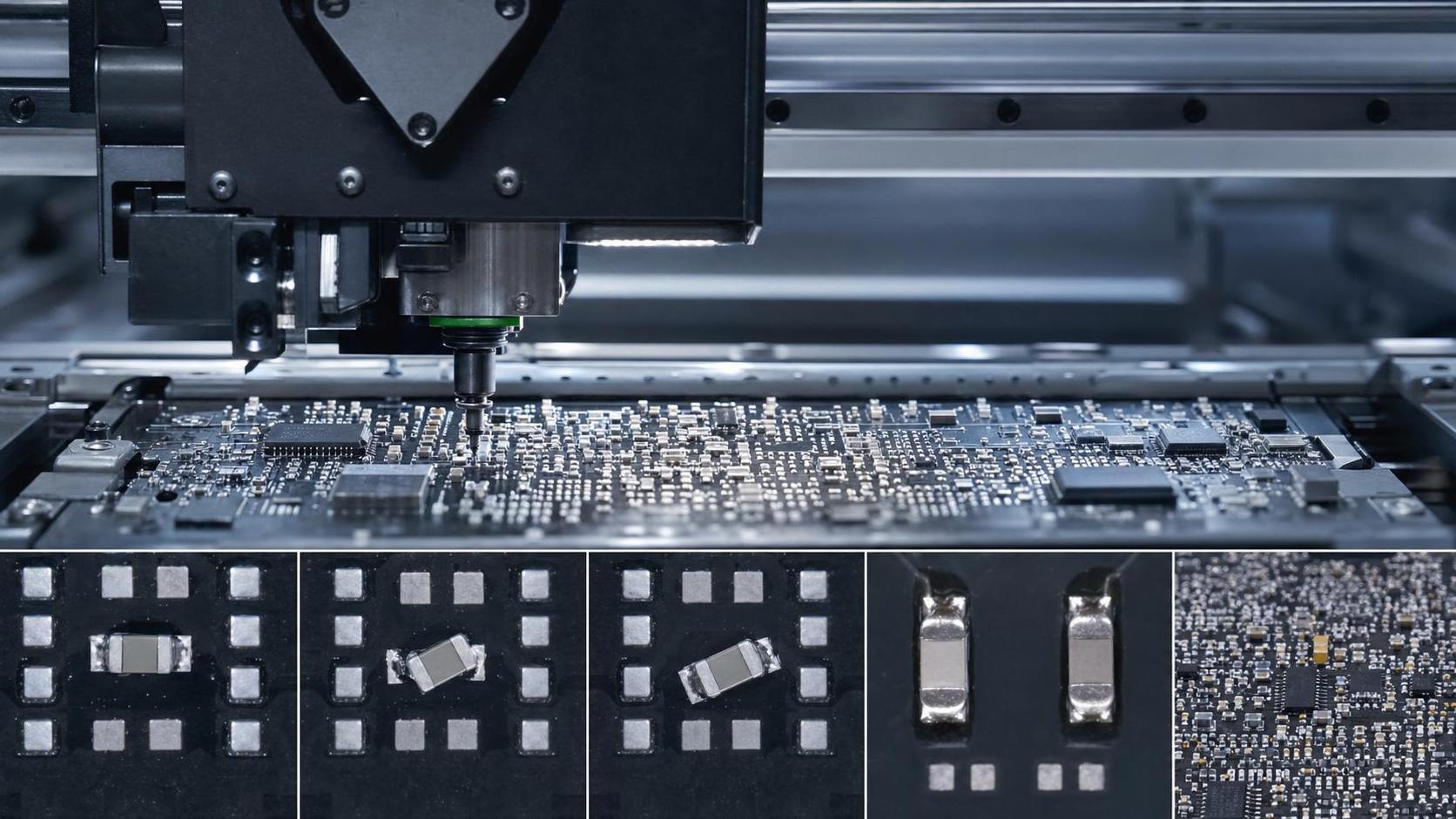
- Incorrect vision centering, which places the body correctly but leaves terminations poorly aligned to the pads.
- Nozzle mismatch or wear, causing tilt, dropped parts, or slight rotational error.
- Feeder pitch inconsistency, which creates random but recurring pickup variation.
- Excessive placement force, which can push paste outward and reduce joint symmetry.
- Board support weakness, especially on thin panels that flex during placement.
More subtle cases are often harder to catch.
For example, a placement offset that looks acceptable under standard magnification may still increase tombstoning risk.
This happens when one termination reaches a stronger wetting force first during reflow.
Good 0201 application notes usually recommend checking the relationship between pickup accuracy, board warpage, and paste deposit shape together.
Looking at only one parameter can hide the real cause.
A quick fault pattern guide
When a defect repeats, the visual pattern often points to the source faster than broad troubleshooting.
Why do soldering problems remain even when placement looks acceptable?
Because acceptable placement does not guarantee balanced solder behavior.
With 0201 devices, solder volume and heating symmetry become highly sensitive.
A board can pass visual inspection after placement and still fail during reflow.
The usual soldering mistakes include oversized paste deposits, under-printing, poor stencil release, and profile settings copied from larger packages.
That last point is especially common.
A reflow profile that works for 0603 or 0402 may be too blunt for 0201 behavior.
More heat is not automatically safer.
Long soak times can dry flux activity too early, while aggressive ramps can amplify component movement.
These 0201 application notes are useful when they connect print quality to downstream reliability, not just cosmetic appearance.
In actual use, one weak joint may not fail immediately.
It may show up later as intermittent contact, thermal cycling weakness, or unstable signal behavior.
That is why independent benchmarking, like the work SCM publishes, matters for process decisions.
It separates assumptions from measured repeatability.
How can you tell whether the root cause is paste, placement, or profile?
The fastest method is comparative isolation, not broad adjustment.
If everything changes at once, the data becomes much less useful.
A better approach is to narrow the failure mode first.
- If defects repeat in the same board region, inspect support, warpage, and local thermal mass.
- If defects follow a feeder lane, focus on pickup mechanics and component presentation.
- If defects spread across many references after stencil cleaning intervals, check paste transfer efficiency.
- If defects appear after profile changes, compare wetting balance and peak dwell rather than only peak temperature.
Needle-in-a-haystack debugging usually wastes time.
More useful 0201 application notes recommend pairing SPI, AOI, and reflow observations as one evidence chain.
That combination shows whether the defect started with deposit shape, placement geometry, or thermal response.
Where data discipline is weak, teams often over-correct the wrong station.
The result is temporary improvement followed by recurring escapes.
What operating habits reduce 0201 defects without slowing the line too much?
The best habits are the ones that stabilize variation before it becomes visible scrap.
That does not always require slower throughput.
It usually requires tighter setup discipline and clearer trigger limits.
- Verify nozzle condition at fixed intervals instead of waiting for obvious pickup loss.
- Use component library validation whenever a new 0201 source lot or package style is introduced.
- Review stencil cleanliness by transfer consistency, not only by elapsed time.
- Confirm board support under dense 0201 zones before first article approval.
- Separate cosmetic variation from reliability risk in inspection criteria.
That last point is easy to miss.
Some lines chase harmless visual differences while missing weak solder geometry that matters more in service life.
In reliability-focused environments, process windows should be defined by measured joint performance, not habit alone.
SCM’s engineering reports are relevant here because they frame SMT precision as a data problem.
That mindset helps connect routine setup choices with long-term field outcomes.
When should a recurring 0201 issue be treated as a design or supply-chain problem?
Not every persistent defect belongs to the line.
Sometimes the assembly process is only exposing an upstream weakness.
A repeated failure deserves broader review when process settings remain stable but defect signatures continue across builds.
Typical triggers include inconsistent termination quality, pad geometry that favors unbalanced wetting, laminate movement under heat, or lot-to-lot component dimensional drift.
This is where 0201 application notes become more than shop-floor tips.
They help define when a yield issue should escalate into design review, incoming quality screening, or supplier comparison.
In complex electronics manufacturing, that distinction protects both cycle time and credibility.
If a process is repeatedly tuned around unstable material behavior, the apparent fix may carry hidden reliability cost.
A more durable response is to document the failure mode, link it to measurable parameters, and compare it against validated standards.
That is especially important where compliance reporting, traceability, and cross-site manufacturing consistency matter.
What should the next step look like if 0201 errors keep returning?
Start with a narrow review, not a full process reset.
Map the defect by location, component code, feeder source, paste age, and thermal zone response.
Then compare that map against actual line data rather than operator memory.
Strong 0201 application notes are valuable because they turn repeated shop-floor frustration into structured decision points.
If the issue centers on transfer variation, tighten print control first.
If it follows pickup lanes, audit feeders, nozzles, and package presentation.
If it survives both checks, review pad symmetry, heat distribution, and incoming component consistency.
That sequence keeps troubleshooting practical and measurable.
For teams working with high-density boards, the most useful next move is often to build a simple internal standard.
Define acceptable offsets, paste transfer limits, cleaning triggers, and escalation thresholds for recurring 0201 behavior.
Then compare those limits with external benchmarks, reliability data, and compliance-oriented references from sources such as SCM.
That kind of process discipline reduces defects, supports stable output, and gives future 0201 application notes a more useful starting point.
Recommended News
- Pick & Place Specs0201 Application Notes: Common Placement and Soldering Mistakes0201 application notes explain the most common placement and soldering mistakes, from nozzle wear to reflow imbalance, helping teams cut defects, improve yield, and boost SMT reliability.
- Pick & Place SpecsPCB Assembly Cost Drivers That Impact Quote AccuracyPCB assembly quote accuracy depends on BOM risk, process complexity, testing, and schedule. Learn the key cost drivers to compare suppliers smarter and avoid hidden expenses.
- Pick & Place SpecsHow to Compare SMT Equipment Manufacturers for Stable High-Mix OutputSMT equipment manufacturer comparison guide for stable high-mix output. Learn how to evaluate accuracy, changeover speed, software, support, and total cost for smarter sourcing.
- Pick & Place Specs01005 SMT Components: Placement Accuracy Limits and Yield Risks01005 SMT components demand extreme placement accuracy. Learn how offset, paste variation, and reflow instability drive yield loss, hidden defects, and reliability risk.
- Pick & Place SpecsPCB Supply Intelligence: How to Spot Risk Before OrderingPCB supply intelligence helps buyers spot supplier risk before ordering. Learn how to compare PCB vendors beyond price, verify compliance, and avoid costly quality or delivery surprises.
- Pick & Place SpecsEMS Selection Guide: Comparing Quality, Cost, and Lead TimeElectronics manufacturing services selection made practical: compare quality, total cost, and lead time with clear criteria to choose the right EMS partner with confidence.