
01005 SMT Components: Placement Accuracy Limits and Yield Risks
DETAILS
01005 SMT Components: Placement Accuracy Limits and Yield Risks
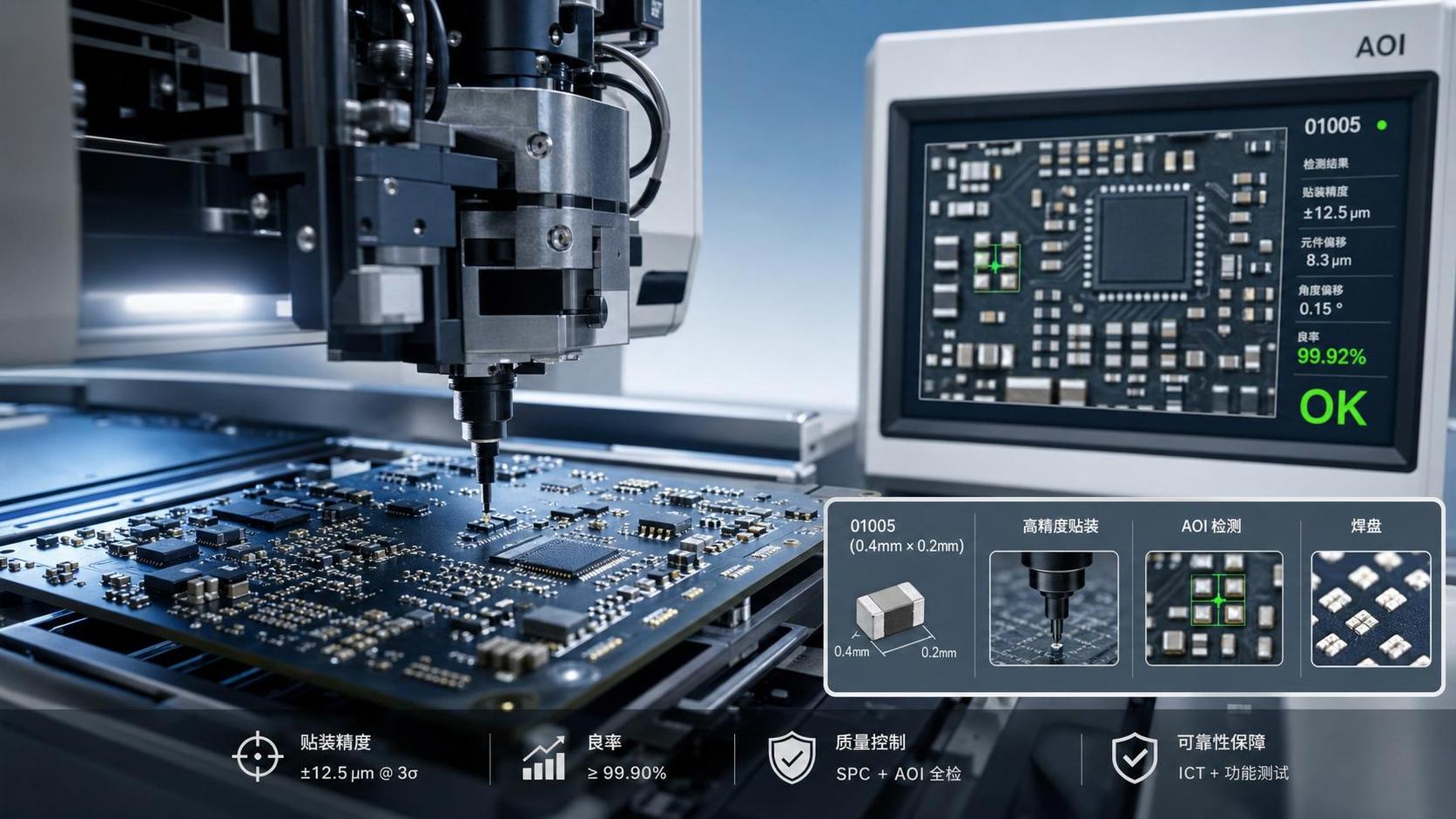
As 01005 SMT components push assembly lines toward micron-level tolerances, even minor placement deviations can trigger solder defects, electrical instability, and costly yield loss.
Understanding those limits matters when process stability, safety margins, and outgoing quality depend on parts almost invisible to the naked eye.
In practical terms, 01005 SMT components shrink the room for error across printing, placement, reflow, inspection, and field reliability.
That is why placement accuracy is no longer a machine brochure metric. It becomes a yield control issue and a risk management issue.
Why 01005 SMT Components Create a Different Risk Profile
01005 SMT components are small enough that ordinary process variation quickly becomes a major defect source.
A slight feeder drift, nozzle wear, board warp, or solder paste inconsistency can shift component position beyond acceptable tolerance.
With larger packages, the process may absorb that variation. With 01005 SMT components, the same variation often creates visible or hidden failure.
The issue is not only placement offset. Rotation error, tombstoning tendency, wetting imbalance, and pad geometry sensitivity also rise sharply.
This also means first-pass yield can look acceptable while latent reliability drops, especially under vibration, thermal cycling, or moisture exposure.
What Placement Accuracy Really Means at 01005 Scale
Placement accuracy for 01005 SMT components cannot be judged by headline machine repeatability alone.
A vendor may quote excellent micron performance under ideal conditions, using selected components, controlled boards, and low-speed demonstration settings.
Actual line performance depends on a chain of variables:
- feeder pitch stability
- pickup nozzle condition
- component dimensional tolerance
- vision centering algorithm
- PCB registration accuracy
- paste volume consistency
- reflow thermal uniformity
For 01005 SMT components, effective accuracy should be evaluated as process capability, not as a single equipment number.
A realistic question is simple: can the full line hold placement and solder joint acceptance across normal production variation?
Typical Yield Risks Linked to Poor Placement Control
When 01005 SMT components drift outside a stable window, yield loss appears in several ways.
1. Tombstoning and Side Lift
Small imbalance in wetting force can pull one end upward during reflow.
Placement offset and rotation error increase that risk, especially when pad design and paste deposits are already near the limit.
2. Insufficient Solder Joint Formation
If 01005 SMT components land off-center, one terminal may receive weak wetting or reduced solder coverage.
The board may pass basic inspection but fail under thermal shock or electrical load cycling.
3. Bridging and Adjacent Contamination
At this package size, excess paste and placement shift can interact fast, especially on dense RF or power-management layouts.
That creates shorting risk and raises rework rates, which often damage surrounding micro-components.
4. Hidden Reliability Drift
The most expensive failures are not always visible at ICT or AOI.
Misplaced 01005 SMT components can leave marginal joints that degrade over time, causing intermittent faults and hard-to-trace field returns.
How to Define a Practical Accuracy Limit
A practical limit should combine design tolerance, process drift, and inspection sensitivity.
In other words, the line must stay accurate enough that normal variation never pushes 01005 SMT components into a weak solder condition.
The following table helps frame that evaluation:
A line is ready for 01005 SMT components only when these factors stay controlled together.
Process Signals That Usually Appear Before Yield Loss
In many factories, yield decline does not begin as a dramatic event. It begins as small, repeated warnings.
More obvious signals include rising placement correction counts, feeder-specific defects, and increasing AOI review time on dense boards.
Other early signs are less visible:
- higher variation in solder paste inspection results
- more frequent nozzle cleaning events
- component pickup retries
- localized rework on the same part number
- field returns with intermittent resistance shifts
Tracking these signals by lot, feeder, board design, and supplier date code gives a more useful risk picture.
How to Reduce Placement Risk Without Slowing the Entire Line
The most effective response is rarely one machine adjustment. It is a focused control strategy around 01005 SMT components.
Tighten the Input Conditions
Qualify component packaging stability, tape pocket consistency, and dimensional tolerance before full release.
For 01005 SMT components, poor incoming uniformity can erase the benefit of an otherwise capable placement platform.
Tune the Board and Stencil Together
Pad geometry, stencil aperture, and paste type should be optimized as one system.
This is where many 01005 SMT components programs recover yield without adding cycle time.
Use Capability Data, Not Single Defect Counts
Trend Cpk, offset distribution, and reflow defect correlation over time.
That approach shows whether 01005 SMT components are operating inside a stable process window or only surviving by chance.
Separate Pilot Lots From Full Production
Do not treat a successful sample run as proof of scalable control.
Pilot data for 01005 SMT components should include repeated runs, line changes, and operator variation.
What Strong Oversight Looks Like in Daily Operations
Strong oversight is practical, repeatable, and data-based.
A useful daily routine for 01005 SMT components usually includes:
- verify feeder and nozzle condition before critical builds
- review SPI and AOI trend shifts, not only pass rates
- audit first-off placement centering on high-density boards
- lock approved stencil, paste, and profile combinations
- trace recurring defects to lot, supplier, and machine position
This kind of discipline turns 01005 SMT components from a chronic yield threat into a controlled manufacturing capability.
A Smarter Way to Protect Yield and Reliability
01005 SMT components reward precision, but they also expose weak process control very quickly.
The real limit is not what the placement machine claims. It is what the whole manufacturing system can repeat with confidence.
For teams managing quality risk, the right move is clear.
Measure 01005 SMT components through line capability, incoming consistency, solder behavior, and long-term reliability together.
That is how yield stays predictable, hidden failures stay low, and high-density assemblies remain commercially safe.
Recommended News
- Pick & Place SpecsHow to Compare SMT Equipment Manufacturers for Stable High-Mix OutputSMT equipment manufacturer comparison guide for stable high-mix output. Learn how to evaluate accuracy, changeover speed, software, support, and total cost for smarter sourcing.
- Pick & Place Specs01005 SMT Components: Placement Accuracy Limits and Yield Risks01005 SMT components demand extreme placement accuracy. Learn how offset, paste variation, and reflow instability drive yield loss, hidden defects, and reliability risk.
- Pick & Place SpecsPCB Supply Intelligence: How to Spot Risk Before OrderingPCB supply intelligence helps buyers spot supplier risk before ordering. Learn how to compare PCB vendors beyond price, verify compliance, and avoid costly quality or delivery surprises.
- Pick & Place SpecsEMS Selection Guide: Comparing Quality, Cost, and Lead TimeElectronics manufacturing services selection made practical: compare quality, total cost, and lead time with clear criteria to choose the right EMS partner with confidence.
- Pick & Place SpecsProcurement Planning Application Note: Steps to Prevent Costly DelaysProcurement planning application note guide for electronics sourcing: learn how to prevent costly delays, reduce qualification risk, and align suppliers, compliance, and lead times before release.
- Pick & Place SpecsMicro-Tolerances Explained: When Small Deviations Become Assembly FailuresMicro-tolerances explained: learn how tiny deviations trigger assembly failures in PCB, SMT, packaging, and thermal design—and how data-driven analysis reduces yield loss and supplier risk.