
Micro-Tolerances Explained: When Small Deviations Become Assembly Failures
DETAILS
Micro-Tolerances Explained: When Small Deviations Become Assembly Failures
In advanced electronics manufacturing, micro-tolerances often decide whether a product ships smoothly or stalls at final assembly.
A deviation measured in microns may look harmless on paper.
In practice, it can disrupt fit, placement, heat flow, or electrical stability.
That is why micro-tolerances matter across PCB fabrication, SMT assembly, semiconductor packaging, and thermal interface design.
For organizations managing global sourcing, the real challenge is not one isolated defect.
The challenge is knowing when small deviations cross the line into repeatable assembly failures.
This is where data-driven tolerance analysis becomes essential.
It helps teams connect dimensional variation with yield, reliability, and supplier risk before issues become expensive.
What Micro-Tolerances Really Mean
Micro-tolerances are very small allowable variations in dimensions, position, flatness, thickness, or alignment.
They usually sit in the micron range and appear throughout high-precision manufacturing.
Examples include solder paste height, pad registration, ball placement, lead coplanarity, substrate thickness, and connector pitch accuracy.
On their own, these numbers may seem minor.
But assembly is a stack of interacting dimensions, not a single measurement.
A board can be within tolerance.
A component can also be within tolerance.
Yet the combined result may still cause interference, weak solder joints, or unacceptable stress.
Why Small Deviations Cause Big Assembly Problems
The turning point comes from accumulation.
One small deviation rarely causes a full failure by itself.
Several small deviations, however, often align in the worst possible direction.
This is commonly known as tolerance stack-up.
In electronics, stack-up effects appear fast because spacing is tight and process windows are narrow.
A few typical failure paths stand out:
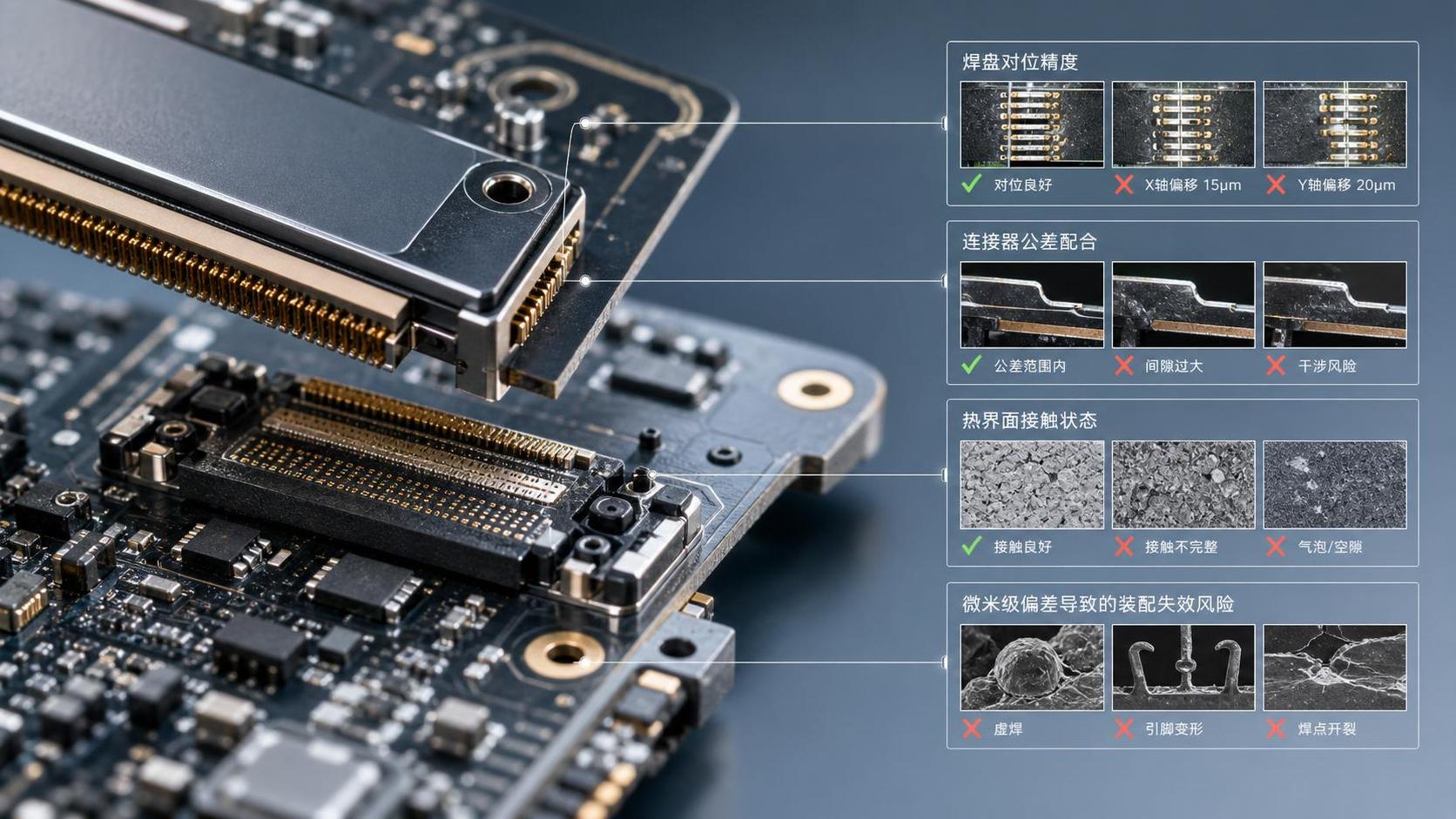
- Misalignment between PCB pads and component leads creates opens or weak solder wetting.
- Package warpage combined with uneven paste volume causes head-in-pillow defects.
- Slight mechanical offset in connectors raises insertion force or damages mating surfaces.
- Thickness variation in thermal pads increases interface resistance and hot spot risk.
- Via, trace, or laminate variation changes impedance and undermines signal integrity.
From a recent industry perspective, the signal is getting clearer.
As devices shrink and power density rises, acceptable micro-tolerances become harder to maintain consistently.
That also means tolerance risk is no longer just a manufacturing issue. It is a sourcing and qualification issue too.
Key Areas Where Micro-Tolerances Matter Most
PCB Fabrication
Micro-tolerances influence layer registration, drill accuracy, copper thickness, and dielectric consistency.
These variables affect both assembly fit and electrical behavior.
A small registration shift can reduce annular ring margin, while dielectric variation can shift impedance outside design targets.
SMT Assembly
In SMT lines, micro-tolerances show up in stencil thickness, paste deposition, placement precision, and reflow profile response.
A slight placement offset may still pass vision checks.
Yet it can reduce joint reliability under vibration or thermal cycling.
Semiconductor Packaging
Micro-tolerances are critical in bump pitch, substrate flatness, die attach thickness, and package coplanarity.
When these drift, assembly yield drops quickly.
Long-term reliability can also fall because stress distribution changes inside the package.
Thermal Packaging
Thermal systems depend on contact quality.
Micro-tolerances in surface flatness, gap pad thickness, and clamping pressure directly affect heat transfer.
In dense electronics, even a small air gap can turn into a major thermal bottleneck.
When a Tolerance Becomes a Failure Threshold
Not every deviation causes rejection.
The real question is when variation pushes performance beyond a functional limit.
That limit may be mechanical, electrical, thermal, or reliability-based.
A practical way to judge micro-tolerances is to map them against these thresholds:
This is why static drawings alone are not enough.
A tolerance only makes sense when linked to process capability and end-use stress.
If a supplier can hold a nominal value but not the required consistency, the assembly risk remains high.
How to Evaluate Micro-Tolerances with Better Data
The best evaluations combine specification review with process evidence.
This matters even more in cross-border sourcing, where supplier declarations may use different measurement methods.
A stronger review model usually includes five checks:
- Confirm measurement definitions, equipment, and sampling rules.
- Review Cp and Cpk data for critical dimensions, not just average values.
- Compare tolerance limits against actual assembly window requirements.
- Test variation under heat, humidity, vibration, and aging conditions.
- Use independent benchmarking for parts, boards, and packaging materials.
This is also where independent technical repositories add real value.
SiliconCore Metrics approaches hardware as measurable science rather than a simple sourcing line item.
Its benchmarking work on PCB dielectric behavior, SMT placement precision, and component reliability helps normalize fragmented supplier claims.
That makes micro-tolerances easier to assess against IPC-Class 3 expectations, ISO 9001 controls, and real operating demands.
Common Warning Signs During Technical Review
In real business settings, several warning signs often appear before assembly failures become visible.
- Tolerance claims are broad, but process capability data is missing.
- Inspection reports show compliance at room conditions only.
- Different suppliers measure the same dimension in different ways.
- Field failures cluster around vibration, thermal shock, or connector stress.
- Yield loss appears intermittently and resists quick root-cause analysis.
When these patterns show up, micro-tolerances deserve a deeper review.
More often than not, the issue is not one bad batch.
It is a capability mismatch between design intent and manufacturing reality.
Practical Steps to Reduce Assembly Risk
Reducing risk starts with translating micro-tolerances into clear business controls.
The following actions are usually the most effective:
- Prioritize critical-to-function dimensions instead of tightening every dimension equally.
- Build tolerance stack-up analysis into design reviews before supplier release.
- Qualify suppliers with independent data, not marketing-level specifications.
- Align drawing limits with real assembly capability and environmental stress conditions.
- Monitor drift over time because stable launch results do not guarantee stable mass production.
This approach keeps micro-tolerances connected to yield, reliability, and sourcing decisions.
It also supports faster decisions when trade-offs appear between cost, speed, and performance.
Small deviations do not need to become expensive surprises.
When micro-tolerances are evaluated with rigorous benchmarking and application context, assembly failures become far more predictable and preventable.
Recommended News
- Pick & Place SpecsThrough Hole Assembly Services: Cost, Reliability, and When They Fit BestThrough hole assembly services explained: compare cost drivers, reliability advantages, and best-fit use cases to choose the right EMS partner with more confidence.
- Pick & Place SpecsSMT Placement for 0201: Tolerance Limits That Drive Yield LossSMT placement for 0201 explained: learn which tolerance limits, paste variation, nozzle wear, and board support issues drive yield loss—and how to improve first-pass yield faster.
- Pick & Place SpecsIPC Tightens SMT Pad Tolerance to ±0.05 mmIPC Tightens SMT Pad Tolerance to ±0.05 mm: learn how the IPC-7351C update impacts PCB design, SMT assembly, AOI programming, and supplier coordination before October 2026.
- Pick & Place SpecsIPC Revises IPC-7351C, Tightens Pick-and-Place ToleranceIPC-7351C revision tightens Pick-and-Place tolerance to ±0.025 mm and pushes AOI calibration upgrades. Learn how SMT, EMS, and sourcing teams can prepare for compliance and reduce risk.
- Pick & Place SpecsSMT Components for Automotive: Key Specs That Affect Assembly YieldSMT components for automotive: discover the key specs that impact assembly yield, from coplanarity and solderability to thermal reliability and AEC-Q readiness.
- Pick & Place SpecsIPC Draft Tightens Pad Tolerances for Pick-and-PlaceIPC Draft Tightens Pad Tolerances for Pick-and-Place: learn how IPC-7351C may impact SMT, HDI, MCU and RF Module placement, 3D CAD data, and yield before Q1 2027.