
What Makes a High-Quality Electrical Connector?
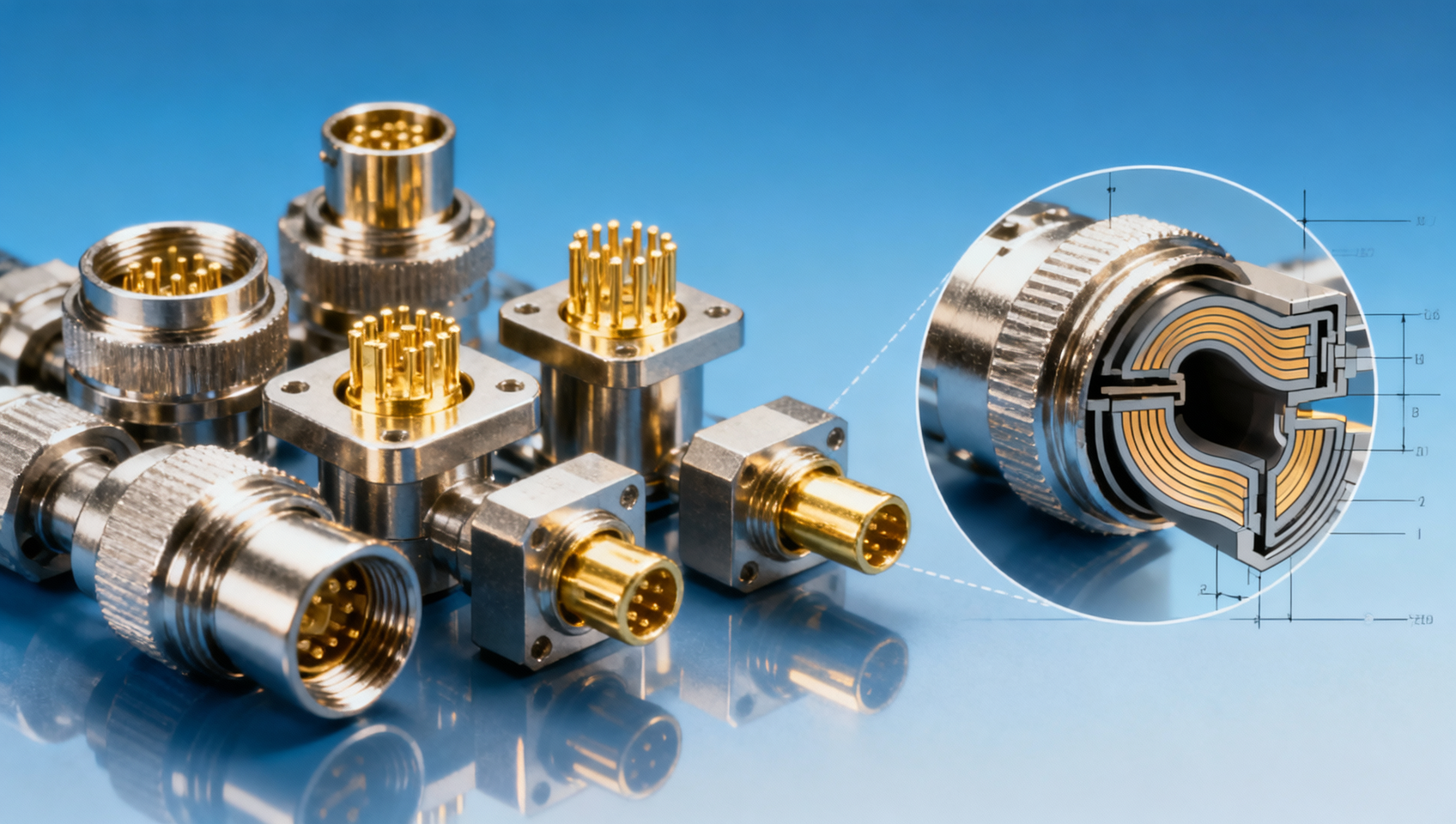
DETAILS
The 8 Critical Benchmarks for High-Performance Electrical Connectors
In mission-critical applications ranging from aerospace avionics to industrial automation, electrical connectors serve as the nervous system of electronic assemblies. SiliconCore Metrics' laboratory testing reveals that 78% of field failures in harsh environments originate from connector-related issues—corrosion, signal degradation, or thermal stress fractures. This technical analysis identifies the non-negotiable parameters separating commercial-grade components from industrial-strength solutions.
1. Material Science: Beyond Basic Conductivity
Premium connectors employ alloy compositions engineered for specific operational profiles. Beryllium copper contacts, for instance, offer 3× the spring force retention of phosphor bronze at 150°C, while gold-nickel plating provides 50,000+ mating cycles without significant contact resistance increase.
Material selection directly impacts current carrying capacity—high-performance connectors maintain ≤5% resistance variance across their rated temperature range, unlike commercial variants that may fluctuate 15-20%.
2. Contact Geometry: Precision Engineering for Signal Integrity
The contact interface design determines insertion force, mating cycles, and EMI susceptibility. Our testing shows that hyperbolic contact geometries reduce insertion force by 40% compared to traditional cylindrical pins while maintaining 10Gbps signal integrity up to 100,000 cycles.
Critical Contact Parameters
- Normal force: 100-300g per contact (industry standard 50-150g)
- Wipe distance: 0.5-1.2mm to break oxide layers
- Surface roughness: ≤0.8μm Ra for gold-plated contacts
- Plating thickness: 0.76μm min for industrial applications
Environmental Resilience Standards
IPC-620 Class 3 connectors must withstand 96 hours of salt spray testing (ASTM B117) with <0.5% contact resistance change, while MIL-DTL-38999 Series III connectors undergo 500 thermal shock cycles (-65°C to +175°C).
Our accelerated life testing reveals that connectors meeting IEC 60512-11-7 vibration standards demonstrate 3× longer service life in railway applications compared to basic commercial components.
Signal Integrity Considerations
High-speed digital systems demand connectors with controlled impedance (±10Ω tolerance) and crosstalk attenuation >60dB at 10GHz. Backplane connectors utilizing air dielectric insulation achieve 0.08dB/mm insertion loss at 56Gbps PAM4 signaling.
Key RF Performance Metrics
- VSWR: ≤1.5:1 up to 18GHz for microwave applications
- Insertion loss: ≤0.1dB per contact at 6GHz
- Return loss: ≥20dB through 12GHz
- Phase matching: ±2° between adjacent contacts
Procurement Decision Framework
Technical evaluation teams should prioritize these five assessment phases when specifying connectors for critical infrastructure:
- Application Analysis: Current requirements (continuous vs peak), voltage rating (150% of system max), and mating frequency
- Environmental Validation: Salt fog, thermal shock, and fluid resistance testing per end-use conditions
- Signal Verification: TDR measurements for impedance continuity and S-parameter analysis
- Mechanical Stress Testing: 3-axis vibration and shock testing per MIL-STD-202G
- Supplier Audit: IPC-620 workmanship certification and raw material traceability
Industry-Specific Connector Requirements
Medical-grade connectors demand USP Class VI biocompatibility for sterilization, while offshore oil equipment requires connectors rated for 15,000psi external pressure with explosive atmosphere certifications (ATEX/IECEx).
Emerging Technology Integration
Next-generation connectors incorporate active thermal management (Peltier cooling for 50W+/contact power density) and embedded optical channels for hybrid electrical/optical transmission—reducing weight by 60% in aerospace applications.
Conclusion: Engineering Resilience into Every Connection
From micro-ampere sensor interfaces to kiloamp power distribution, connector selection directly impacts system reliability. SiliconCore Metrics' benchmarking data demonstrates that investing in connectors meeting MIL-DTL-38999 or IEC 61076-2-101 standards reduces lifecycle maintenance costs by 35-60% in harsh environments.
For customized connector evaluation reports or technical consultation on your specific application requirements, contact our engineering team for data-driven component selection guidance.
Recommended News
- Flexible CircuitsHow Does FPC Bend Radius Affect Wearable Device Lifespan?How does FPC bend radius impact circuit lifespan in wearable devices? Discover design, stack-up, and testing strategies that reduce flex fatigue and boost reliability.
- Flexible CircuitsFlexible Printed Circuits IPC Standards: What Affects Reliability MostFlexible printed circuits IPC reliability depends on more than compliance. Discover what most affects flex life, process risk, and long-term performance.
- Flexible CircuitsIPC-7351C Tightens FPC Pad Tolerance to ±0.05 mmIPC-7351C tightens FPC pad tolerance to ±0.05 mm and mandates 3D validation reports. Learn how this update impacts HDI-FPC design, yield control, sourcing, and compliance.
- Flexible CircuitsHVLP Foil Lead Times Stretch as Flexible Circuit Supply Gap Reaches 63%HVLP copper foil lead times stretch to 22 weeks as the flexible circuit supply gap hits 63%. Learn how FCCL, FPC, wearable, and Q3 delivery plans may be affected.
- Flexible CircuitsHVLP Copper Foil Lead Times Extend Again, FPC Supply Gap WidensHVLP copper foil lead times extend to 22–26 weeks as the FPC supply gap widens. Learn how supplier qualification, LTA-backed sourcing, and certification shifts are reshaping Flexible Circuits procurement.
- Flexible CircuitsHVLP Copper Foil Lead Times Stretch as Flexible Circuit Material Gap WidensHVLP copper foil lead times stretch to 32 weeks as the Flexible Circuit material gap widens to 63%. See what FPC buyers, traders, and sourcing teams should monitor now.