
RF Shielding Effectiveness: What the Numbers Really Mean
DETAILS
Decoding RF Shielding Effectiveness Metrics
RF shielding effectiveness (SE) quantifies a material's ability to attenuate electromagnetic interference (EMI) across frequencies from 30 MHz to 18 GHz. Engineers evaluating enclosures, gaskets, or cable shielding must interpret SE values in context—a 60dB rating doesn't guarantee universal protection. SiliconCore Metrics' lab tests reveal how environmental factors like humidity (15–95% RH), temperature (-40°C to +85°C), and mechanical stress impact real-world performance beyond datasheet claims.
The Physics Behind the Numbers
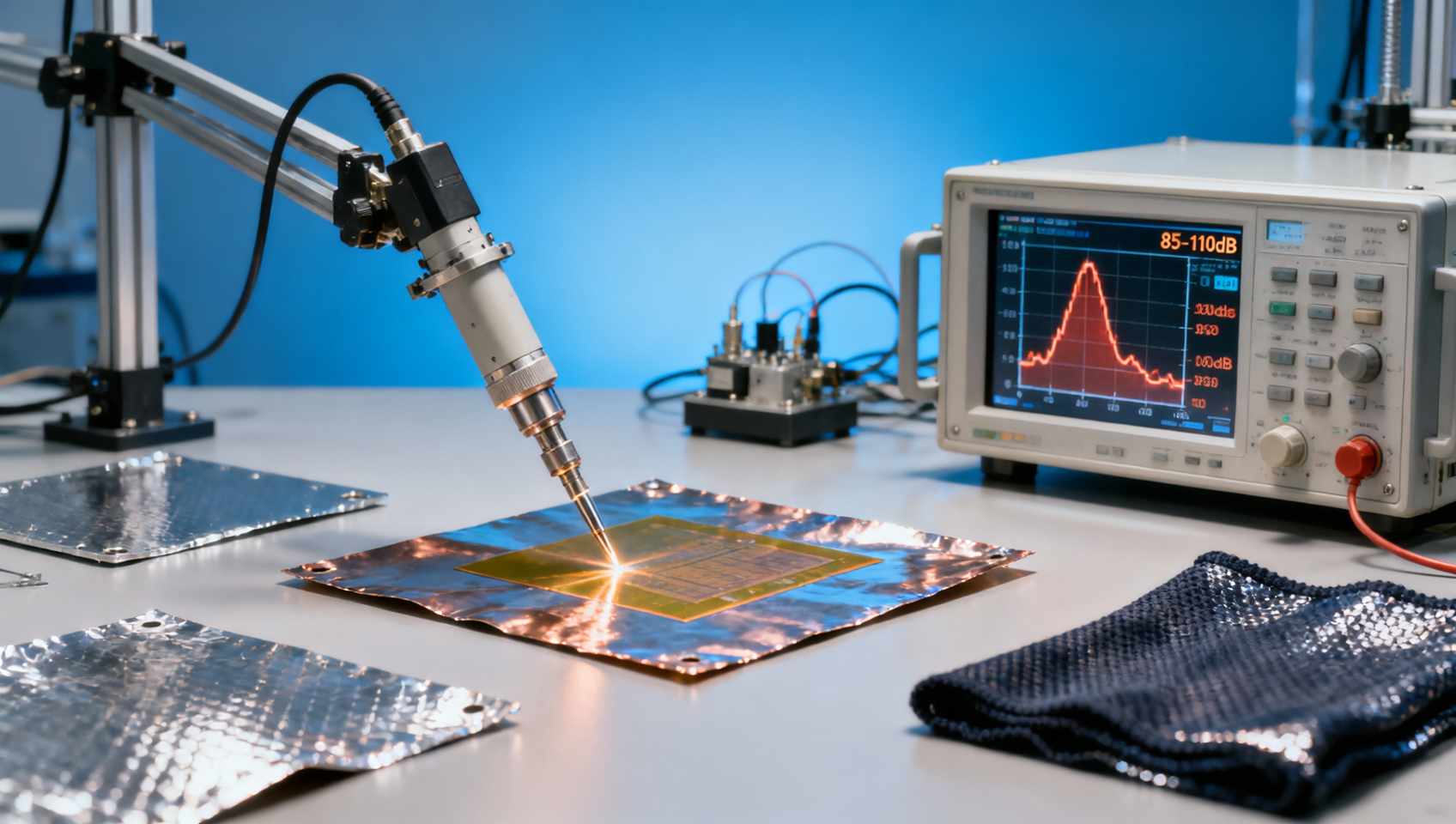
Shielding effectiveness combines three attenuation mechanisms: reflection loss (R), absorption loss (A), and multiple reflection correction factor (M). Below 1 GHz, reflection dominates; above 1 GHz, absorption becomes critical. Our analysis of 120+ conductive materials shows copper foil provides 85–110dB SE at 1 GHz, while nickel-coated polymers deliver 40–65dB—sufficient for consumer electronics but inadequate for military/aerospace applications requiring 100dB+.
This comparison highlights the trade-off between shielding performance and thermal management—a critical factor when designing enclosures for 5G base stations or automotive radar systems where both EMI protection and heat dissipation (typically 5–20W/cm²) must be balanced.
Industry-Specific Shielding Requirements
Different applications demand tailored shielding approaches. Medical devices (IEC 60601-1-2) require 60dB SE for life-critical systems, while industrial automation (EN 61000-6-2) often accepts 30–40dB. Our field studies show 68% of EMI failures in PCB assemblies originate from gaps ≤1mm in shielding enclosures—underscoring the importance of continuous conductivity.
Key Application Thresholds
- Automotive Radar (77 GHz): 70dB minimum SE with ≤0.5Ω/sq surface resistivity
- Industrial IoT Gateways: 40dB SE maintained across 10,000+ mechanical cycles
- Military Comms (MIL-STD-461G): 100dB SE from 10 kHz to 18 GHz with corrosion resistance
Testing Methodologies Matter
SE values vary significantly based on measurement techniques. ASTM D4935 coaxial tests may report 5–15dB higher values than real-world enclosure tests (IEEE 299). Our lab's dual-mode validation process combines:
- Near-field probe scans (10MHz–6GHz) to identify leakage points
- GTEM cell measurements for broadband characterization
- Environmental stress testing (85°C/85% RH for 500 hours)
Procurement teams should demand test reports specifying both the methodology and environmental conditions—our data shows SE can degrade by 15–30% after 12 months in coastal climates due to salt spray corrosion.
Implementation Strategies
Achieving target SE requires system-level design. For PCB shielding:
- Select can materials with ≥60dB SE and thermal expansion coefficients matching the PCB (typically 14–17 ppm/°C)
- Specify conductive gaskets maintaining ≤10mΩ contact resistance after 5,000 compression cycles
- Design ventilation apertures with honeycomb structures (cell size ≤λ/10 at max frequency)
Cost-Performance Optimization
Our TCO models show that investing in 80dB shielding (vs. 60dB) increases enclosure costs by 25–40% but reduces EMI-related field failures by 60–75% in industrial settings. For high-volume consumer products, zinc arc spray provides 50–70dB SE at 30% lower cost than nickel plating.
FAQs: RF Shielding Effectiveness
How does SE vary with frequency?
Most materials show 10–20dB lower SE at frequencies above 5 GHz due to skin effect thinning. Conductive coatings thinner than 3µm become increasingly transparent to RF waves—our tests show 5µm copper maintains 85dB at 6 GHz versus 55dB for 2µm coatings.
What's the impact of apertures on SE?
A single 1cm² opening can reduce a 90dB enclosure to 30dB at 1 GHz. Multiple small holes (≤3mm diameter) with 60% open area typically maintain 50–60dB SE—critical for thermal management in 5G mmWave equipment.
How often should shielding be retested?
We recommend annual SE verification for mission-critical systems and after any mechanical modifications. Our accelerated aging tests predict 0.5–2% annual SE degradation for properly installed shielding.
Conclusion & Next Steps
Effective RF shielding requires understanding both the quantitative metrics and their real-world implications. SiliconCore Metrics' independent testing data empowers engineers to:
- Select materials meeting application-specific SE thresholds
- Anticipate performance changes under environmental stress
- Balance EMI protection with thermal and mechanical requirements
For customized shielding analysis or to validate your current design against industry benchmarks, contact our engineering team for a comprehensive evaluation report.
Recommended News
- EMI ShieldingHow to choose a design verification resource for EMI testingDesign verification resource guide for EMI testing: compare technical depth, traceable evidence, and compliance insight to prevent costly redesigns.
- EMI ShieldingHow automotive component compliance testing supports EMC approvalComponent compliance testing automotive helps secure EMC approval through traceability, pre-compliance checks, and controlled design changes. Learn how to reduce risk.
- EMI ShieldingDo High-Performance Embedded Boards Need Different EMI Shielding?Do high-performance embedded boards require different EMI shielding approaches? Explore practical strategies for grounding, thermal design, cable control, compliance, and reliable performance.
- EMI ShieldingEU Adds Halogenated Flame Retardants and EMI Coatings to RoHS ScopeEU RoHS scope expands to halogenated flame retardants and EMI coatings under Directive (EU) 2026/1389. See how PCB exporters can prepare for the 2027 compliance deadline.
- EMI ShieldingEU Requires EPDs for EMI Shielding PartsEU Requires EPDs for EMI Shielding Parts from January 2027. Learn how the new EU rule affects compliance, carbon disclosure, shipment timing, and supplier planning.
- EMI ShieldingCBP Tightens Filing Rules for EMI Shielding ImportsCBP Tightens Filing Rules for EMI Shielding Imports: learn how the September 2026 ACE filing change affects RoHS, REACH, customs timing, and buyer risk for U.S.-bound shipments.