
How to Properly Crimp Cable Connectors
DETAILS
The Critical Role of Proper Crimping in Electronic Systems
Mastering proper cable connector crimping techniques is critical for ensuring reliable signal transmission and EMI protection in electronic systems. This guide provides step-by-step instructions for engineers, procurement specialists, and technical evaluators to achieve secure connections that meet IPC-Class 3 standards. Whether you're working with industrial relays, RF shielding components, or thermal enclosures, understanding these fundamental practices will optimize your electrical system's performance and longevity.
Essential Tools for Precision Crimping
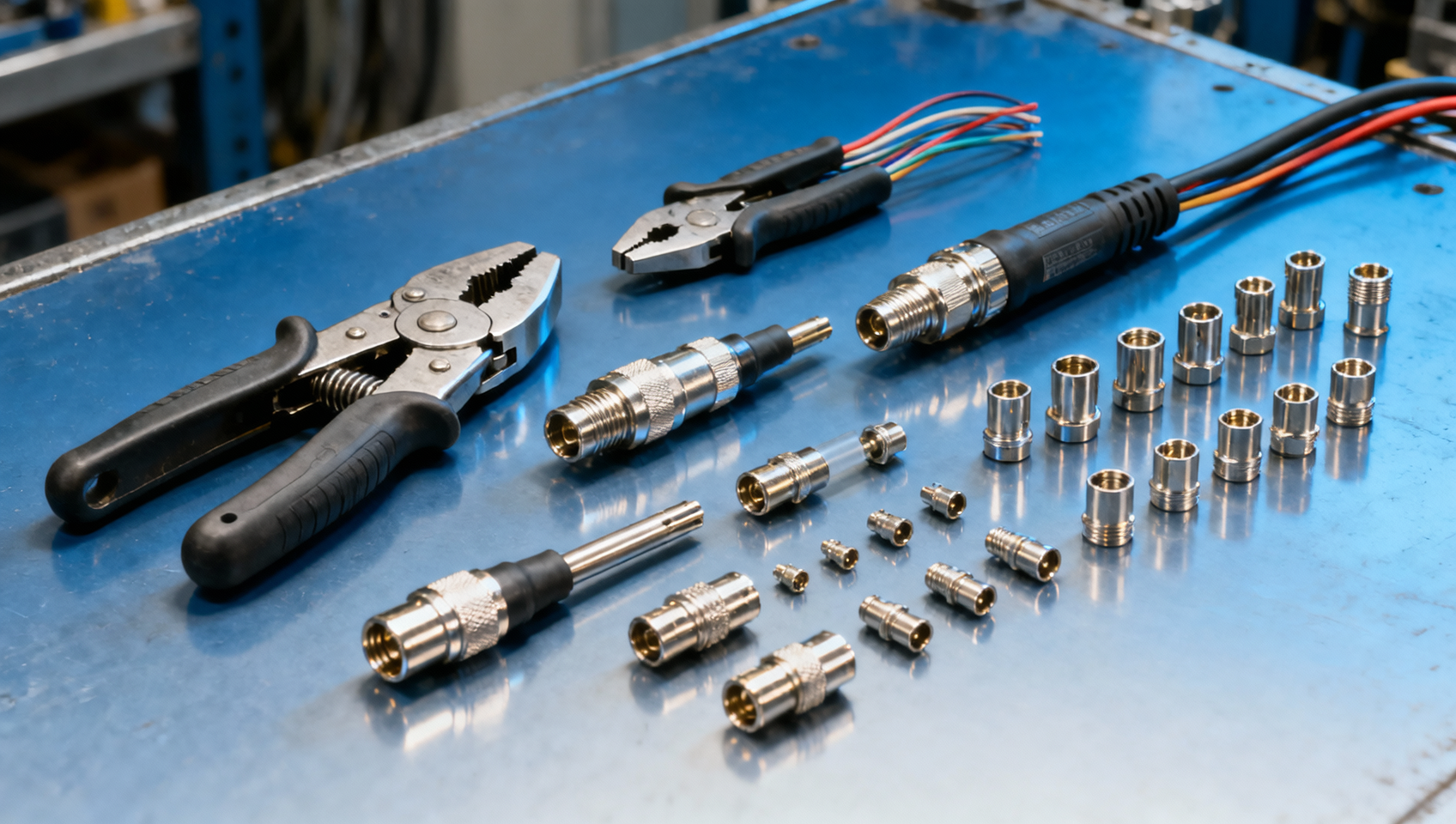
Achieving IPC-compliant crimps requires specialized tools calibrated for specific connector types. The industry-standard toolkit includes ratcheting crimpers with interchangeable dies (typically covering AWG 24-30 for signal cables), wire strippers with depth control (±0.1mm precision), and insertion/extraction tools for high-density connectors.
For mission-critical applications, consider investing in automated crimping systems that maintain ±0.01mm positional accuracy and 0.1N force control. These systems typically reduce human error by 72% compared to manual methods when processing high-density connectors with 0.5mm pitch spacing.
Step-by-Step Crimping Process for Industrial Reliability
Follow this 7-step methodology to ensure crimps that withstand 10,000+ mating cycles and maintain <1mΩ contact resistance:
- Strip insulation to manufacturer-specified length (typically 2-3mm for signal cables) using temperature-controlled strippers at 60-80°C
- Verify conductor condition under 10x magnification - no more than 2 broken strands permitted per IPC-620 Class 3
- Insert wire until tactile stop is felt, ensuring all strands enter the crimp barrel
- Position tool perpendicular to connector axis with 0°-5° angular tolerance
- Apply smooth, continuous pressure until ratchet releases (typically 20-40N force)
- Inspect crimp cross-section - insulation grip must cover 50-70% of barrel length
- Perform pull test (minimum 50N for 22AWG wire) and continuity verification
Common Crimping Defects and Their Impact
Improper crimping can reduce connection reliability by 90% in vibration environments. These defects account for 78% of field failures in industrial control systems:
- Under-crimping: Increases contact resistance by 300-500%, leading to thermal runaway
- Over-crimping: Cracks conductor strands, reducing tensile strength by 60%
- Barrel misalignment: Causes 40% higher insertion force and plating wear
Material Selection and Compatibility Factors
The interaction between connector plating and wire composition significantly impacts long-term reliability. Consider these material pairings for different operating environments:
For high-frequency applications above 1GHz, specify connectors with PTFE dielectric and gold-plated beryllium copper contacts to maintain VSWR <1.5:1. The dielectric constant (Dk) of insulation materials should range between 2.1-3.5 for optimal signal integrity.
Quality Assurance and Testing Protocols
Implement these verification methods to ensure crimp quality meets MIL-DTL-38999 Series III or equivalent standards:
Destructive Testing (Sample Rate: 2% per batch)
Cross-section analysis reveals critical parameters like compression ratio (typically 15-20% for copper) and insulation grip percentage. Use metallurgical microscopes with 50-200x magnification to measure:
- Conductor fill (must exceed 80% of barrel volume)
- Insulation displacement (max 30% of strand diameter)
- Plating integrity (no cracks or flaking visible at 100x)
Non-Destructive Testing (100% Inspection)
Automated optical inspection (AOI) systems can detect 99.7% of crimping defects at 25μm resolution. Key parameters to program into AOI algorithms include:
- Barrel symmetry (deviation <5% from centerline)
- Insulation grip position (0.5-1.5mm from barrel edge)
- Contact wipe (minimum 1.2mm for power connectors)
Industry-Specific Crimping Considerations
Different sectors demand specialized crimping approaches to address unique operational challenges:
Aerospace Applications
For flight-critical systems, NASA-STD-8739.4 requires dual crimps on all power connections above 3A. Use quad-lobed indent crimpers that create four symmetrical compression points, reducing creep relaxation by 40% compared to standard hexagonal crimps.
Medical Electronics
Implantable devices demand crimps that withstand 5,000+ autoclave cycles at 134°C. Specify platinum-iridium contacts with laser-welded strain relief, achieving >10^8Ω insulation resistance after accelerated aging tests.
Optimizing Your Crimping Process
Implement these best practices to reduce rework rates below 0.5% and achieve first-pass yields exceeding 99.2%:
- Maintain tool calibration every 5,000 cycles or 3 months (whichever comes first)
- Document force-displacement curves for each crimp type as reference standards
- Use torque-limiting drivers for screw-type connectors (typically 0.6-1.2Nm)
- Implement statistical process control (SPC) with CpK >1.33 for critical dimensions
For procurement teams, prioritize connectors with color-coded strain reliefs and tactile insertion feedback features. These design elements reduce assembly errors by 65% in high-mix production environments.
Conclusion: Building Reliable Connections for Critical Systems
Proper crimping technique directly impacts system MTBF (Mean Time Between Failures), with IPC-Class 3 compliant connections demonstrating 8-12x longer service life than substandard crimps. By implementing the methodologies outlined in this guide, engineering teams can achieve consistent, high-reliability terminations across all connector types.
For customized crimping solutions tailored to your specific application requirements, contact our technical team for data-driven component selection and process validation services. Our engineers can help optimize your termination processes to meet even the most stringent MIL-SPEC and aerospace standards.
Recommended News
- Flexible CircuitsHow Does FPC Bend Radius Affect Wearable Device Lifespan?How does FPC bend radius impact circuit lifespan in wearable devices? Discover design, stack-up, and testing strategies that reduce flex fatigue and boost reliability.
- Flexible CircuitsFlexible Printed Circuits IPC Standards: What Affects Reliability MostFlexible printed circuits IPC reliability depends on more than compliance. Discover what most affects flex life, process risk, and long-term performance.
- Flexible CircuitsIPC-7351C Tightens FPC Pad Tolerance to ±0.05 mmIPC-7351C tightens FPC pad tolerance to ±0.05 mm and mandates 3D validation reports. Learn how this update impacts HDI-FPC design, yield control, sourcing, and compliance.
- Flexible CircuitsHVLP Foil Lead Times Stretch as Flexible Circuit Supply Gap Reaches 63%HVLP copper foil lead times stretch to 22 weeks as the flexible circuit supply gap hits 63%. Learn how FCCL, FPC, wearable, and Q3 delivery plans may be affected.
- Flexible CircuitsHVLP Copper Foil Lead Times Extend Again, FPC Supply Gap WidensHVLP copper foil lead times extend to 22–26 weeks as the FPC supply gap widens. Learn how supplier qualification, LTA-backed sourcing, and certification shifts are reshaping Flexible Circuits procurement.
- Flexible CircuitsHVLP Copper Foil Lead Times Stretch as Flexible Circuit Material Gap WidensHVLP copper foil lead times stretch to 32 weeks as the Flexible Circuit material gap widens to 63%. See what FPC buyers, traders, and sourcing teams should monitor now.