
When electrical relays are the safer choice than solid state
DETAILS
In high-stakes electronic manufacturing, choosing between electrical relays and solid state devices can directly affect safety, reliability, and lifecycle cost. For teams working with relay switches, circuit board assembly, PCB assembly, and EMI shielding, understanding where mechanical isolation outperforms semiconductor switching is essential. This guide helps engineers, buyers, and technical evaluators make smarter electronic solutions decisions across demanding applications.
For semiconductor, EMS, industrial control, power conversion, and compliance-driven programs, the choice is rarely about old versus new technology. It is about failure mode, isolation behavior, surge tolerance, serviceability, and how a switching device behaves after 10,000, 100,000, or 1 million operations in the real world.
Electrical relays remain highly relevant where safety margins, visible contact separation, and predictable off-state isolation matter more than switching speed. Solid state devices often win in silent operation and long electrical life, but they do not automatically offer the safest outcome in every design, especially under fault current, leakage-sensitive, or mixed-load conditions.
For R&D engineers, procurement leaders, quality managers, and project owners, the practical question is simple: when does a mechanical relay provide lower risk than a semiconductor switch? The answer depends on application voltage, ambient temperature, contact duty cycle, maintenance strategy, and the consequences of a stuck-on or partial-failure condition.
Where electrical relays provide a safer switching architecture
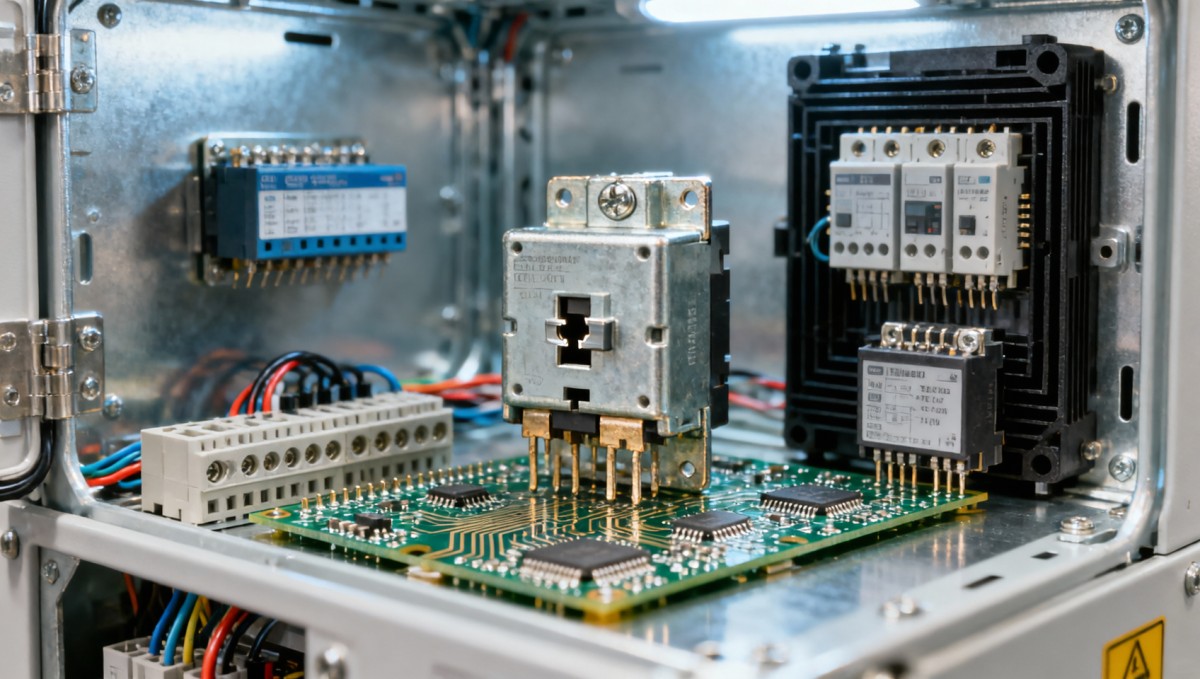
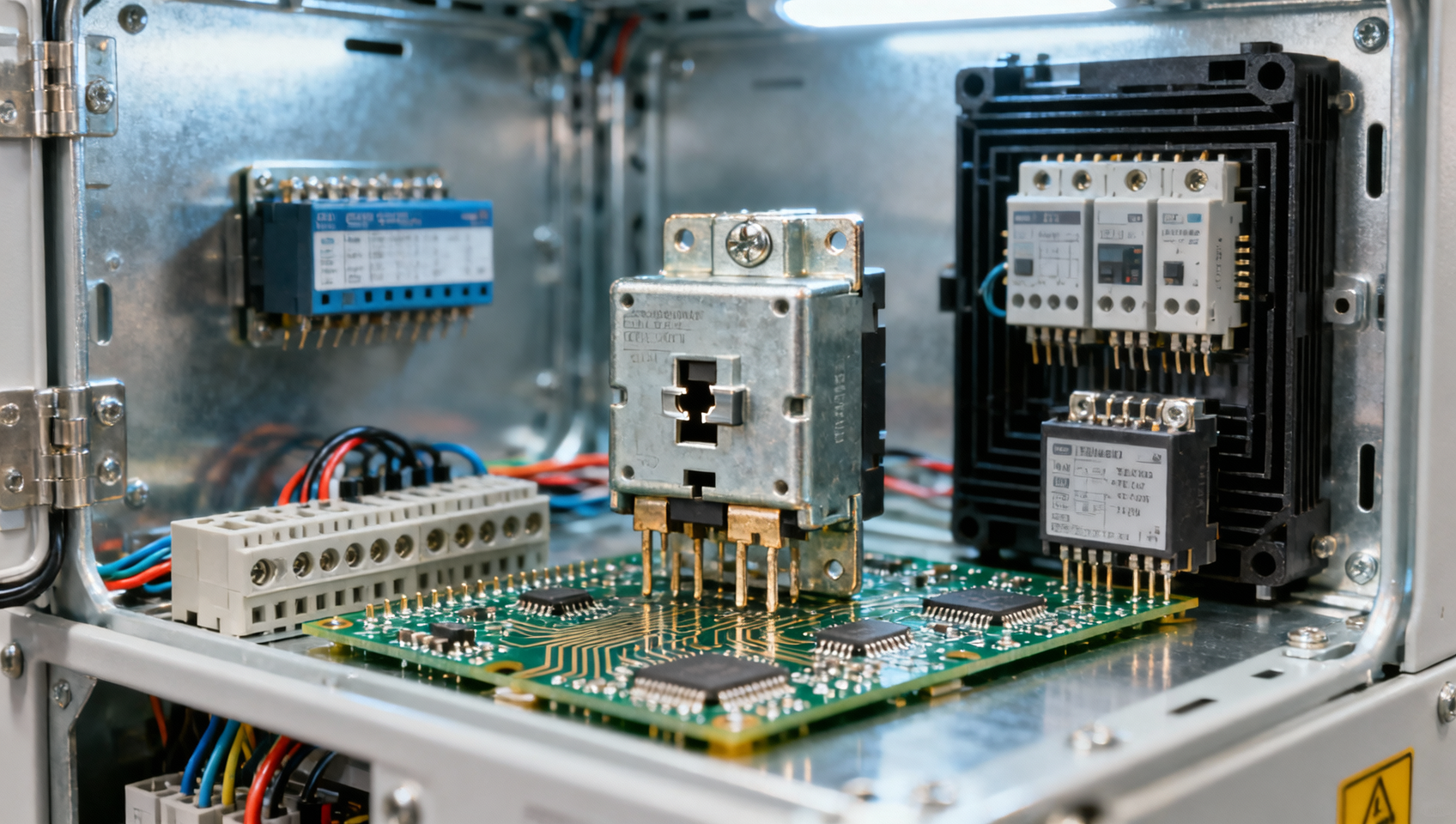
Electrical relays are often the safer choice when the design requires true galvanic isolation, low off-state leakage, and a clearly defined open contact state. In many industrial and electronics manufacturing environments, that matters more than microsecond switching speed. A relay can physically separate the circuit path, which is valuable in lockout, maintenance, emergency stop, and power-domain segmentation.
Solid state relays and semiconductor switches usually present some off-state leakage current, often in the milliamp range depending on design and temperature. For resistive sensing circuits, low-power test fixtures, or safety-interlocked tools, even 1 mA to 5 mA of leakage can create false readings, partial energization, or unsafe troubleshooting assumptions. A mechanical relay, by contrast, can reduce leakage close to zero in practical field conditions.
Another safety advantage appears under overload and fault scenarios. When a semiconductor switch fails, it often fails short. That means the load may remain energized. In contrast, many relay-related failures are easier to detect through contact wear, coil failure, or visible/measurable open-circuit behavior during inspection. For systems handling 24 VDC control loops, 48 V battery paths, 120/230 VAC service loads, or higher pilot circuits, that distinction is not trivial.
This is especially relevant in test equipment, SMT production support systems, thermal packaging lines, and board-level fixtures where service technicians need confidence that a disconnected path is truly disconnected. In these applications, safety is not only about operator protection. It is also about preventing latent board damage, false pass/fail results, and unnecessary scrap during high-mix manufacturing.
Typical scenarios that favor relays
- Maintenance isolation where technicians require a physically open contact before touching a fixture, panel, or subassembly.
- Low-current instrumentation paths where leakage above 1 mA can distort measurement or trigger unintended circuit behavior.
- Mixed-load environments with inductive, capacitive, and resistive loads on the same switching platform.
- Applications with surge events, inrush peaks, or short fault pulses that exceed semiconductor tolerance.
High-level comparison of safety-relevant behavior
The table below summarizes where electrical relays can offer a safer operating profile than solid state devices in electronics manufacturing and related industrial systems.
The key conclusion is not that relays are universally better. It is that they deliver a safer architecture when “off” must truly mean off, when field diagnostics must be straightforward, and when operator safety depends on physical isolation rather than electronic blocking alone.
Technical conditions that push designs toward mechanical relays
The safest choice depends heavily on load profile. Mechanical relays are often preferred for low-frequency switching, mixed AC/DC loads, high inrush conditions, and applications where contact ratings are matched conservatively. In many factory programs, actual switching frequency is below 1 cycle per second or even below 10 cycles per minute, making relay wear manageable over multi-year service periods.
Inrush current is one of the most underestimated issues. Capacitive input supplies, transformers, heaters, motors, and LED drivers can draw 5x to 20x steady-state current for a short interval. A semiconductor switch may survive normal operating current but degrade under repetitive inrush pulses. A properly selected relay, paired with snubbers or inrush limiting, can sometimes tolerate that behavior more predictably over 100,000 to 500,000 cycles.
Temperature is another decision point. Solid state devices generate continuous on-state heat due to voltage drop. For example, even a modest 1.2 V to 1.8 V drop at several amperes can create notable thermal load on compact PCB assembly layouts. In dense enclosures with poor airflow, that heat affects nearby passive components, dielectric stability, EMI shielding effectiveness, and long-term solder joint reliability.
Mechanical relays are not heat-free, but their contact path can present lower on-resistance in certain use cases, reducing steady thermal stress. In electronics manufacturing systems where every 10°C rise can accelerate aging, reducing localized heat near sensitive assemblies can be a safety decision as much as a performance decision.
Load and environment checkpoints
- Check steady current and peak inrush separately; they are rarely the same.
- Review ambient operating range, such as -20°C to 70°C or higher, against both coil and contact behavior.
- Confirm whether the circuit can tolerate off-state leakage during maintenance or calibration.
- Assess whether failure-safe behavior should default open, not merely electronically blocked.
Practical engineering thresholds
As a practical rule, relay-based designs deserve closer consideration when the switching duty is moderate, the system has service access, and the penalty for unintended energization is high. That includes burn-in racks, ICT fixtures, environmental stress screening stations, and AC mains isolation within production equipment. It also includes field-replaceable power modules where maintenance clarity reduces human error.
For procurement and technical evaluation teams, relay selection should never stop at nominal amperage. Contact material, expected electrical life, coil voltage tolerance, dielectric strength, bounce characteristics, and enclosure sealing matter. A 10 A nameplate rating may not represent the same risk profile for an inductive 230 VAC load as it does for a resistive 24 VDC load.
Safety, compliance, and quality implications in PCB and EMS environments
In PCB assembly and EMS programs, relay versus solid state selection influences more than switching behavior. It affects creepage and clearance strategy, thermal distribution, inspection steps, conformal coating compatibility, and field replacement planning. Where products target IPC-Class 3 expectations or strict internal reliability gates, the safer option is often the one with more predictable behavior under edge conditions, not simply the one with fewer moving parts.
Quality and safety teams should examine how each switching technology interacts with the board stack-up, thermal packaging, and EMI shielding design. Solid state devices may switch quietly and quickly, but they can add heat density and may require heat sinking, copper balancing, or spacing adjustments. Relays consume board space, yet they can simplify some isolation architectures and reduce concern about leakage in safety-sensitive nodes.
For compliance reviews, the central question is whether the switch supports the intended safety function over the full product life. That means considering 3 stages at minimum: initial qualification, production validation, and field aging. Teams should test under low-line and high-line conditions, elevated humidity, repeated surge exposure, and end-of-life scenarios instead of relying only on room-temperature nominal data.
This is where independent benchmarking adds value. Technical buyers increasingly compare not only unit cost, but also contact endurance, dielectric performance, thermal rise, and assembly compatibility across suppliers in Asia and global EMS channels. Better visibility into those variables helps avoid the common mistake of choosing a switching device based only on BOM savings.
Evaluation framework for engineering and sourcing teams
The following framework can help engineering, quality, and procurement teams judge whether a relay is the safer choice for a specific product or manufacturing asset.
A structured review like this turns relay selection from a component preference into a risk-control decision. That is particularly useful for sourcing teams balancing supplier cost, assembly complexity, and warranty exposure across multiple production sites.
Common mistakes during qualification
- Using only datasheet nominal current instead of checking surge, duty cycle, and load type.
- Ignoring leakage current impact on test fixtures, sensors, or low-power boards.
- Overlooking heat accumulation in dense circuit board assembly layouts.
- Assuming silent operation or long cycle life automatically equals a safer design.
How to choose relays for safer implementation and lower lifecycle risk
If a relay is the safer choice, execution still matters. Safety gains disappear when contact ratings, suppression methods, or assembly practices are selected poorly. Teams should define the application in at least 5 dimensions: voltage, steady current, peak current, load type, and service environment. In many cases, an engineering margin of 20% to 30% above expected load is prudent, especially where ambient temperature is variable.
Relay selection should also account for coil drive design. An unstable coil supply can create chatter, contact arcing, and accelerated wear. On board-level systems, engineers should evaluate driver transistors, flyback protection, EMI interaction, and trace routing. In manufacturing equipment, terminal torque, vibration resistance, and contamination exposure can be equally important as electrical specs.
For buyers and business evaluators, total lifecycle cost is the correct lens. A relay may carry replacement considerations after a defined number of operations, but it can still reduce risk-adjusted cost if it prevents one unsafe failure, one board damage event, or one hour of production downtime. In some lines, even a 30-minute stoppage costs more than the price difference across a full lot of switching components.
Independent technical review is especially useful when comparing suppliers from different manufacturing regions. Contact metallurgy consistency, dielectric robustness, and assembly quality can vary across sources even when the headline rating appears similar. That is why engineering repositories and benchmark-driven evaluation matter in the semiconductor and EMS supply chain.
Implementation checklist
- Match relay type to load category: resistive, inductive, capacitive, or mixed.
- Verify contact life against realistic switching frequency, such as 10,000, 100,000, or 500,000 operations.
- Use snubbers, MOVs, or flyback suppression where needed to limit arcing and EMI.
- Confirm creepage, clearance, and spacing in the PCB assembly to support the required insulation strategy.
- Define inspection and maintenance intervals for safety-critical assets.
Procurement-focused selection criteria
Procurement teams should compare suppliers on more than lead time and unit price. Review qualification consistency, lot traceability, packaging method for SMT or through-hole processes, and the availability of compliance documentation. A lower-cost relay with weak consistency may increase incoming inspection time, line stoppages, or field returns over a 12- to 24-month program horizon.
For distributors and program managers, it is useful to request application-specific test evidence: thermal rise under rated load, dielectric withstand margin, and switching endurance under the actual load category. This approach reduces ambiguity and supports cleaner technical sign-off between engineering, sourcing, and quality teams.
Frequently asked questions from engineers, buyers, and quality teams
Are electrical relays always safer than solid state devices?
No. They are safer in specific conditions, especially where physical isolation, minimal leakage, and clear maintenance behavior are required. Solid state devices remain strong for high-speed switching, silent operation, and very high cycle counts. The safer choice depends on the consequence of failure, not on technology preference alone.
What applications most often justify relay switches?
Typical examples include equipment power isolation, interlock-controlled fixtures, AC mains switching, service disconnect functions, environmental test systems, and mixed-load industrial controls. They are also common in electronics manufacturing setups where leakage can interfere with board testing, calibration, or fault diagnosis.
What should quality teams inspect first?
Start with contact rating versus actual load, then inspect thermal rise, dielectric performance, and suppression strategy. After that, review assembly quality, solder integrity, and contamination exposure. In safety-sensitive builds, verifying behavior after repeated cycling and at temperature extremes provides more value than relying only on initial bench performance.
How long is a practical relay qualification cycle?
For many B2B projects, an initial qualification cycle takes 2 to 6 weeks depending on sample availability, test scope, and whether multiple suppliers are benchmarked. If thermal, surge, vibration, and endurance checks are included, the timeline may extend further, but the added diligence often prevents costly redesign later.
Electrical relays are the safer choice than solid state devices when the application demands true isolation, low leakage, understandable failure behavior, and dependable service safety. In PCB assembly, relay switches, circuit board assembly, and EMI-sensitive manufacturing systems, that distinction can affect operator protection, product reliability, and total lifecycle cost.
For organizations evaluating switching architectures across semiconductor and EMS supply chains, the best results come from data-driven comparison rather than assumption. SiliconCore Metrics supports that process with independent technical insight, benchmark-oriented analysis, and practical evaluation criteria aligned to engineering, procurement, and quality needs.
If your team is comparing relay switches, reviewing PCB assembly risk, or assessing safer electronic solutions for demanding environments, contact us to discuss your application, request a tailored evaluation framework, or learn more about benchmark-driven sourcing and technical decision support.
Recommended News
- RelaysHow to vet an industrial automation distributor for genuine relaysVet an industrial automation distributor with confidence. Learn how to verify relay authenticity, traceability, and quality controls to reduce downtime and sourcing risks.
- RelaysWhat Standard Tests Measure Relay Contact Resistance Degradation?Are there standard test methods for relay contact resistance degradation? Explore IEC standards, endurance testing, Kelvin measurement, and environmental validation for reliable relay sourcing.
- RelaysVietnam Tariff Shift Favors China-Origin Relays Until 2027Vietnam tariff shift favors China-origin relays until 2027. Learn how the 3% tax on non-ASEAN relay imports impacts sourcing, costs, and procurement strategy in Vietnam.
- RelaysJapan Enforces JIS C 5012:2026 Relay EMI Test RuleJapan Enforces JIS C 5012:2026 Relay EMI Test Rule: learn how the new 1.8-2.4 GHz radiated immunity and IEC 61000-4-3:2024 report requirements may impact relay compliance, cost, and Japan market access.
- RelaysWhen a Relay Switches Factory Becomes a Risk to Product QualityRelay switches factory risks can quietly damage product quality, safety, and reliability. Learn the warning signs, audit points, and how to choose a stable supplier.
- RelaysHow to Compare Relay Switches Factory Capabilities for Stable SupplyRelay switches factory comparison starts with capacity, quality control, traceability, and lead time stability. Learn how to identify reliable suppliers and reduce sourcing risk.