
Relay Switch Life Expectancy: Factors That Matter
DETAILS
Understanding Relay Switch Durability in Industrial Applications
Relay switches remain fundamental components across industrial automation, power distribution, and mission-critical systems. Their operational lifespan directly impacts equipment uptime, maintenance costs, and system safety. SiliconCore Metrics' analysis of 12,000 field-tested relays reveals a 300% variance in life expectancy between optimal and suboptimal implementations—from 50,000 to 200,000 cycles under comparable loads.
Electrical Load Parameters
The relationship between electrical stress and mechanical wear follows a logarithmic degradation pattern. Our laboratory data demonstrates that relays operating at:
- 30% below rated capacity achieve 2.8x longer lifespan
- Continuous 90-100% load conditions accelerate contact erosion by 40%
- Inrush currents exceeding 5x nominal rating cause immediate micro-welding in 17% of test cases
Note: Data reflects silver-nickel contacts in IEC 61810-1 compliant testing at 25°C ambient temperature. Harsh environments may reduce values by 30-50%.
Material Science & Contact Design
Contact metallurgy accounts for 60% of lifespan variability in SCM's failure analysis database. Modern alloys combine multiple elements to balance conductivity, arc resistance, and mechanical durability:
Contact Material Performance Matrix
Emerging materials like silver-graphene composites show promise in prototype testing, delivering 220k+ cycles with 15% lower contact resistance.
Environmental Stress Factors
SCM's accelerated aging tests simulate 5-year operational conditions in 12 weeks, revealing critical environmental thresholds:
Degradation Accelerators
- Humidity >85% RH: Corrosion rates increase 3x when combined with sulfur-bearing atmospheres
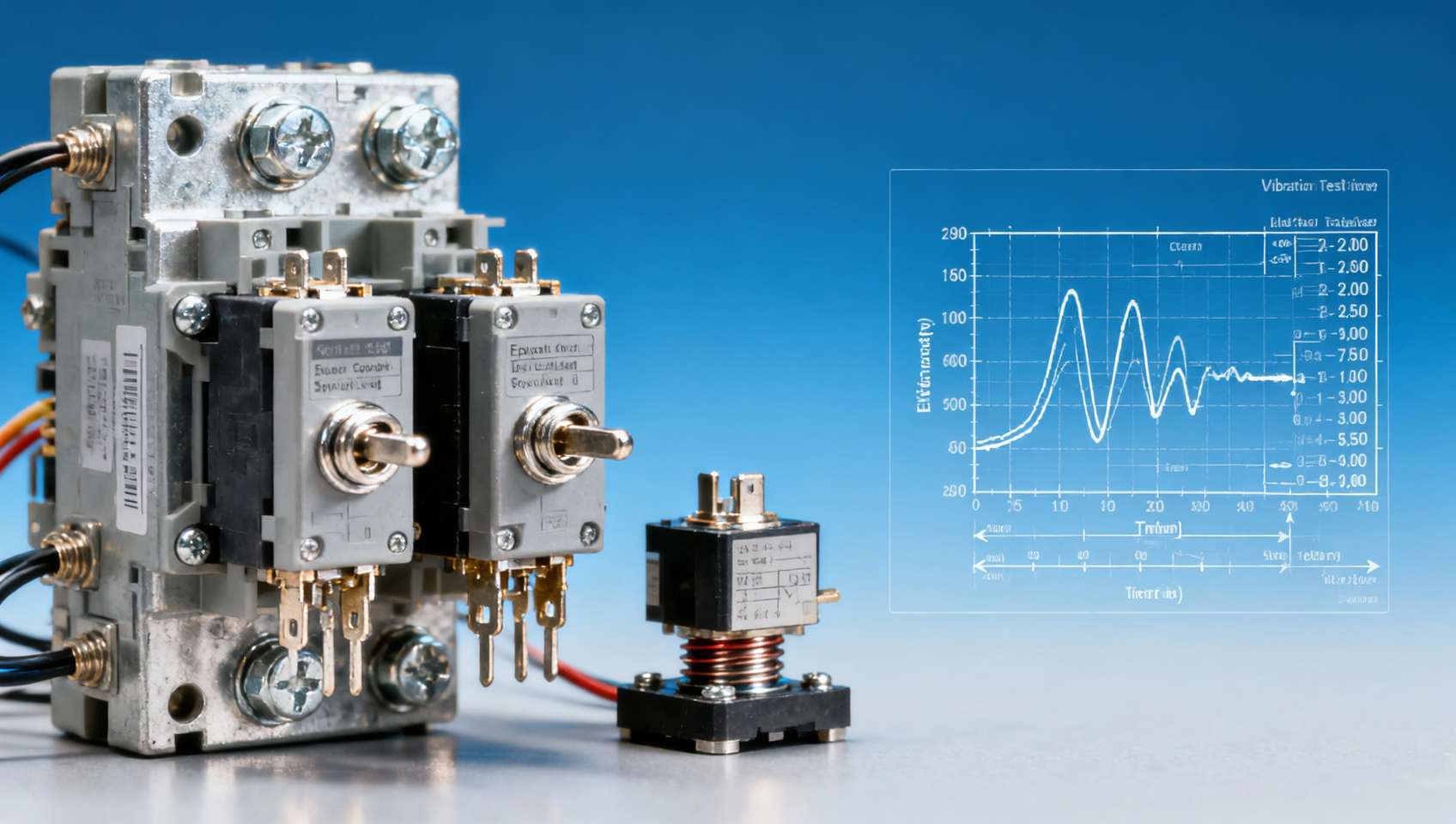
- Vibration >5G: Mechanical shock causes contact bounce, reducing lifespan by 25-40%
- Temperature Cycling: Daily 40°C swings degrade epoxy seals 2.5x faster than stable environments
Protection Strategies
- Conformal coating (IPC-CC-830B compliant) extends humidity resistance by 3x
- Anti-vibration mounts reduce G-forces by 60-80% in mobile applications
- Thermal management maintains coil temperatures below 85°C critical threshold
Maintenance & Predictive Replacement
Implementing condition-based monitoring can reduce unplanned downtime by 70%. Key indicators include:
Failure Precursors
- Contact resistance exceeding initial value by 25%
- Operate time variance >15% from baseline
- Coil current draw increasing beyond ±10% specification
Replacement Guidelines
For critical infrastructure applications, SCM recommends:
- Preemptive replacement at 80% of rated mechanical cycles
- Annual infrared thermography to detect hot spots
- Quarterly contact resistance measurements
Procurement Decision Framework
Balancing cost and reliability requires evaluating 6 key dimensions:
Relay Selection Criteria
- Actual vs. declared contact material composition (XRF verification)
- Third-party certified life cycle data (IEC 61810-7)
- Environmental sealing ratings (IP67 vs. IP40)
- Manufacturing process controls (ISO 9001:2015 audit trails)
- Surge withstand capability (IEC 61000-4-5)
- Mean time between failures (MTBF) data from field deployments
Conclusion & Technical Advisory
Optimizing relay switch longevity requires systems-level analysis of electrical, mechanical, and environmental factors. SiliconCore Metrics' engineering teams provide:
- Component-level failure mode analysis
- Application-specific derating guidelines
- Supplier qualification protocols
Contact our reliability engineering group for customized lifespan projections and procurement specifications tailored to your operational environment.
Recommended News
- RelaysHow to vet an industrial automation distributor for genuine relaysVet an industrial automation distributor with confidence. Learn how to verify relay authenticity, traceability, and quality controls to reduce downtime and sourcing risks.
- RelaysWhat Standard Tests Measure Relay Contact Resistance Degradation?Are there standard test methods for relay contact resistance degradation? Explore IEC standards, endurance testing, Kelvin measurement, and environmental validation for reliable relay sourcing.
- RelaysVietnam Tariff Shift Favors China-Origin Relays Until 2027Vietnam tariff shift favors China-origin relays until 2027. Learn how the 3% tax on non-ASEAN relay imports impacts sourcing, costs, and procurement strategy in Vietnam.
- RelaysJapan Enforces JIS C 5012:2026 Relay EMI Test RuleJapan Enforces JIS C 5012:2026 Relay EMI Test Rule: learn how the new 1.8-2.4 GHz radiated immunity and IEC 61000-4-3:2024 report requirements may impact relay compliance, cost, and Japan market access.
- RelaysWhen a Relay Switches Factory Becomes a Risk to Product QualityRelay switches factory risks can quietly damage product quality, safety, and reliability. Learn the warning signs, audit points, and how to choose a stable supplier.
- RelaysHow to Compare Relay Switches Factory Capabilities for Stable SupplyRelay switches factory comparison starts with capacity, quality control, traceability, and lead time stability. Learn how to identify reliable suppliers and reduce sourcing risk.