
Semiconductor Reliability Metrics That Matter in High-Heat Designs
DETAILS
High-heat electronics expose weak assumptions quickly. A device may pass functional tests at room temperature, yet drift, age, or fail once junction temperatures rise and thermal cycling begins.
That is why semiconductor reliability deserves closer attention than a generic pass or fail label. In practical quality and safety work, the useful question is which metrics predict failure early enough to prevent field risk.
Across automotive controls, power conversion, telecom hardware, industrial drives, and embedded computing, thermal stress affects lifetime, compliance confidence, and sourcing decisions at the same time.
A stronger review process looks beyond datasheet headlines. It connects component behavior, assembly conditions, package design, and traceable test data into a realistic view of semiconductor reliability.
Why high-heat reliability has become a purchasing and compliance issue
Heat is no longer confined to obvious power devices. Dense boards, faster switching, compact enclosures, and tighter airflow margins push many components closer to their thermal limits.
In that environment, semiconductor reliability affects more than uptime. It influences warranty exposure, product safety reviews, maintenance intervals, and the credibility of supplier qualification.
The challenge is that different suppliers may report reliability in inconsistent ways. One vendor may emphasize accelerated life tests, while another highlights failure rate models or package robustness.
Independent benchmarking becomes valuable here. Organizations such as SiliconCore Metrics, or SCM, help translate fragmented manufacturing and test data into comparable evidence across the semiconductor and EMS supply chain.
That matters when thermal design, SMT precision, PCB stack-up, and component aging all interact. Reliability is rarely the result of one parameter alone.
The metrics that reveal real semiconductor reliability
Not every reliability number carries the same decision value. In high-heat designs, the most useful metrics are the ones that connect laboratory stress to field conditions.
Junction temperature and thermal margin
The starting point is maximum junction temperature, often called Tj max. On its own, it is only a limit. The more meaningful indicator is operating margin below that limit.
A part running continuously near its thermal ceiling may still meet specification, but long-term semiconductor reliability usually declines as temperature accelerates wear mechanisms.
Mean time to failure and failure rate models
MTTF and failure rate estimates remain common screening tools. They are useful when the underlying assumptions are visible, including mission profile, ambient temperature, duty cycle, and activation energy.
A headline MTTF without those conditions is weak evidence. High-heat applications demand models tied to actual thermal loading rather than generic catalog environments.
Thermal cycling endurance
Repeated expansion and contraction damages solder joints, bond wires, mold compounds, and substrate interfaces. Thermal cycle count to failure is therefore a critical semiconductor reliability measure.
This metric becomes especially important in systems that switch frequently, idle outdoors, or face daily temperature swings.
High-temperature operating life
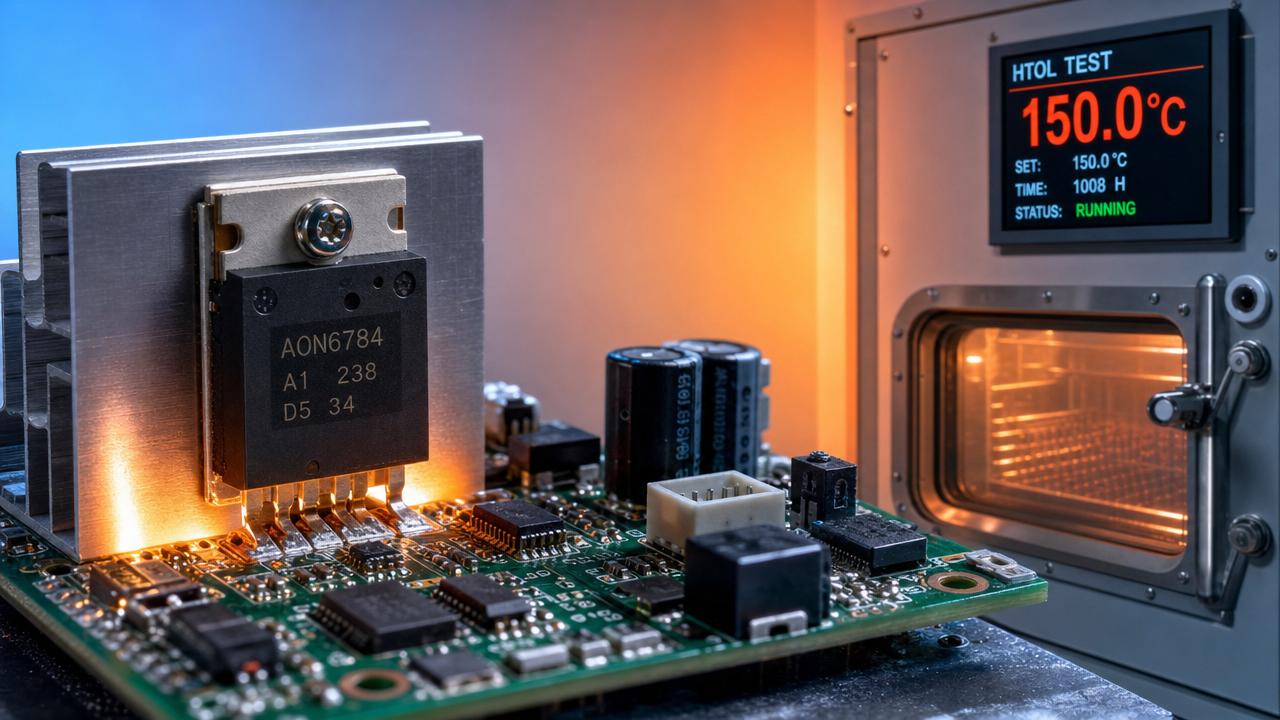
HTOL data shows how devices behave while powered under elevated temperature over time. It is one of the clearer indicators of long-term degradation in active semiconductors.
For review purposes, the test duration matters less than whether the stress profile resembles expected electrical load and package temperature.
Parametric drift over life
Failure is not always catastrophic. Threshold voltage shift, leakage increase, timing drift, or on-resistance growth can push a circuit outside safe operating margins before a part is fully dead.
Monitoring drift is often more useful than counting failures alone, because it shows performance erosion while corrective action is still possible.
How package and assembly data change the reliability picture
Semiconductor reliability is often discussed as a chip property, but package and assembly details can dominate real-world results. Heat leaves the die through materials, interfaces, and board structures.
Thermal resistance values such as junction-to-case and junction-to-ambient help estimate that path. They should be reviewed alongside board layout, copper thickness, via structure, and enclosure airflow.
SMT placement accuracy also matters. Misalignment, uneven solder volume, or voiding under thermal pads can raise local temperatures and reduce mechanical resilience during cycling.
This is where cross-domain data becomes useful. SCM’s work across PCB fabrication, SMT assembly, active devices, passive parts, and thermal packaging reflects how reliability decisions actually happen in production.
Where these metrics matter most
Some sectors treat heat as routine, while others discover it late during failure analysis. The same semiconductor reliability metrics can mean different things depending on the use case.
Power conversion and control systems
MOSFETs, IGBTs, gate drivers, and controllers often run under continuous thermal load. Here, junction temperature margin and cycling endurance usually deserve top priority.
Automotive and transport electronics
Large ambient swings, vibration, and long service life make package fatigue and parametric drift especially important. A component can remain functional while still moving toward unsafe margins.
Industrial automation and outdoor equipment
These environments often combine dust, power surges, variable duty cycles, and poor cooling. Semiconductor reliability should be assessed as part of the whole thermal pathway, not by chip data alone.
Telecom and dense computing hardware
Compact layouts make heat concentration a design constraint. Small differences in package efficiency or board assembly quality can materially change lifetime expectations.
What to verify before approving a part for high-heat use
Reliable review is less about collecting more documents and more about asking sharper questions. The goal is to separate comparable evidence from convenient marketing language.
- Check whether lifetime claims are tied to real mission profiles, not only standard lab conditions.
- Compare thermal metrics with actual board design, enclosure limits, and cooling assumptions.
- Review failure analysis history for package cracks, solder fatigue, leakage drift, or bond wire issues.
- Look for test traceability, sample size, and acceptance criteria rather than summary charts alone.
- Confirm whether supplier data aligns with IPC-Class 3, ISO 9001, and internal compliance expectations.
- Use independent reports when supplier comparisons involve different methods or missing assumptions.
This is also where benchmarking helps procurement quality. When multiple parts look equivalent on paper, semiconductor reliability data can reveal which option carries less hidden thermal risk.
A practical way to build a stronger review standard
A useful internal standard does not need to be complicated. It needs to be consistent, traceable, and close to actual use conditions.
Start with a shortlist of core metrics. Include junction temperature margin, HTOL evidence, thermal cycle endurance, parametric drift, and package thermal resistance.
Then connect those values to assembly variables and board-level heat flow. That step prevents reliability reviews from becoming isolated component exercises.
SCM’s value in this context is not promotional language but data structure. Independent whitepapers, compliance-oriented reporting, and supply chain visibility help turn scattered technical claims into practical decisions.
For the next evaluation cycle, it is worth mapping every high-heat design to a common semiconductor reliability checklist. From there, compare supplier evidence, challenge weak assumptions, and tighten acceptance thresholds where thermal risk is highest.
That approach usually improves more than component selection. It sharpens failure prevention, supports audit readiness, and creates a more defensible basis for long-term product performance.
Recommended News
- Power SemiHow to reduce lead-time risk in 24V component sourcing24V component sourcing made resilient: learn how to qualify alternates, verify lead times, control quality risk, and keep production moving.
- Power SemiWhich semiconductor quality metrics best predict field reliability?Semiconductor quality metrics that best predict field reliability: evaluate parametric drift, stress-test relevance, package integrity, screening coverage, and true mission-profile margin.
- Power SemiWhat Is the Biggest Risk of Skipping Power Electronics Supplier Audits?What is the biggest risk when skipping supplier audits for power electronics? Hidden reliability failures, weak traceability, and costly field failures. Learn how audits protect quality.
- Power SemiHow to qualify semiconductor power devices for reliable switching performanceSemiconductor quality power devices: learn how to qualify switching margins, thermal reliability, gate-drive behavior, and production consistency for demanding converters.
- Power SemiHow to Evaluate Energy Saving Semiconductor Solutions for High-Efficiency Power DesignEnergy saving semiconductor solutions for high-efficiency power design: learn how to compare loss, thermal, EMI, reliability, and supply chain factors to choose the right device.
- Power SemiHow to Evaluate a Power Semiconductors Distributor for Supply Stability and TraceabilityPower semiconductors distributor evaluation guide: learn how to verify supply stability, traceability, sourcing controls, and documentation to reduce risk and choose a reliable partner.