
Semiconductor Certification Explained: Key Standards and Audit Points
DETAILS
Why does semiconductor certification matter beyond basic compliance?
Semiconductor certification is often treated like paperwork, yet its real value is operational control.
It shows whether materials, processes, and records can support consistent electrical, thermal, and mechanical performance.
In semiconductor and EMS environments, small process deviations can create large downstream failures.
A weak plating profile, unstable solder paste control, or poor lot traceability may not fail immediately.
More commonly, problems appear later as field returns, intermittent faults, or shortened product life.
That is why semiconductor certification supports more than audits.
It helps verify that a supplier can repeat critical steps under controlled conditions.
It also creates a common language for reviewing process capability, change control, corrective actions, and risk ownership.
For organizations working across global supply chains, this matters even more.
Independent technical sources such as SiliconCore Metrics help translate raw manufacturing data into comparable compliance evidence.
That approach is useful when benchmark reports must connect design expectations with factory execution.
Which standards usually define semiconductor certification requirements?
There is no single semiconductor certification that covers every component, package, substrate, and assembly route.
In practice, the certification landscape is layered.
One layer covers management systems, another covers product safety or environmental restrictions, and another covers process-specific workmanship.
The standards below appear frequently in qualification reviews and supplier audits.
A common mistake is assuming ISO 9001 alone proves high semiconductor process maturity.
It does not.
It confirms system discipline, but it does not replace detailed evidence on wafer handling, package reliability, SMT accuracy, or thermal stress performance.
That is where technical reports, process qualifications, and benchmark data become important.
What do auditors really look for during a semiconductor certification review?
Auditors usually start with certificates, but they do not stop there.
The real question is whether the certified system controls the variables that affect product integrity.
In actual audits, several points receive close attention.
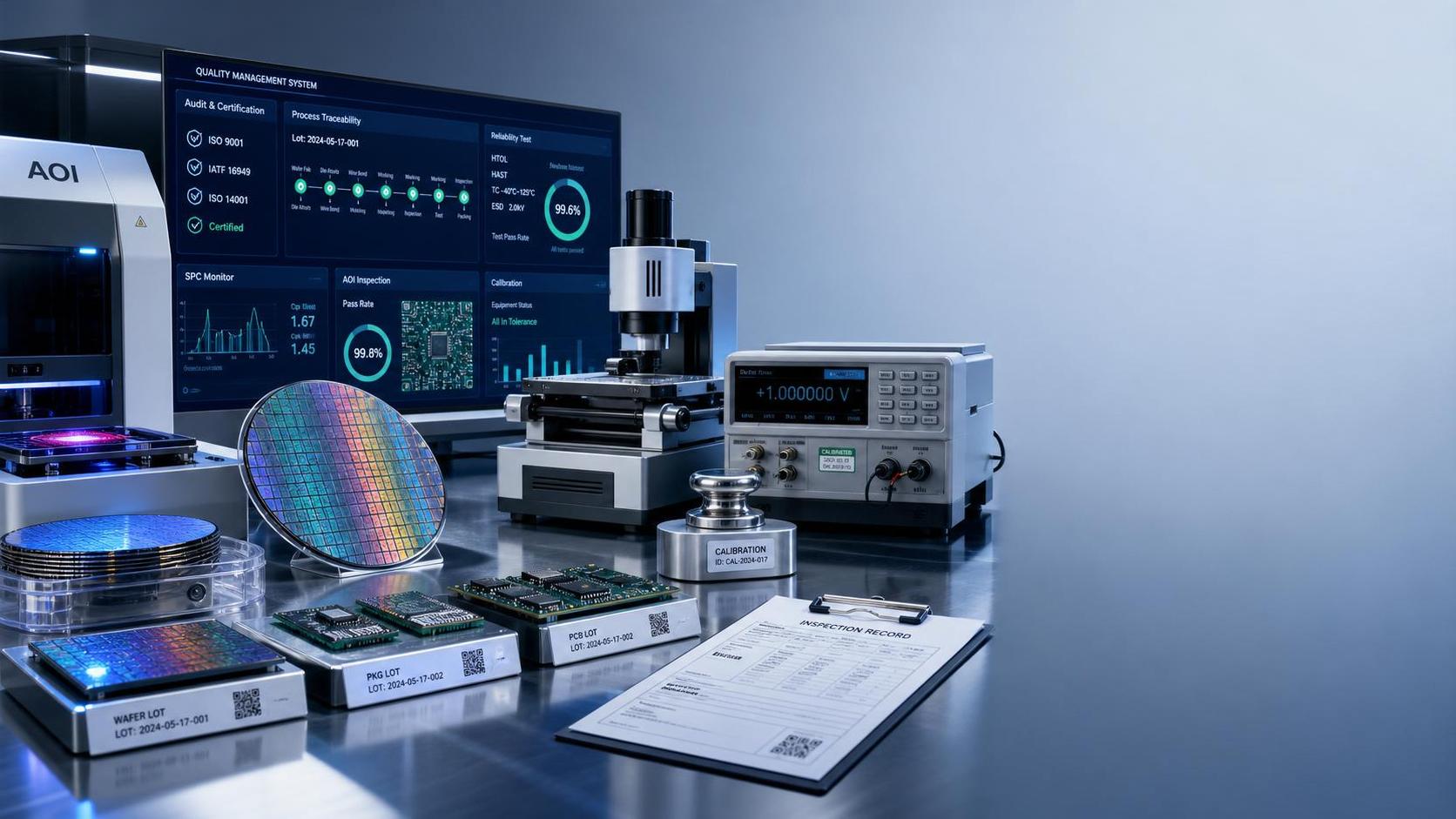
- Traceability from raw material lot to finished device, reel, tray, or assembled board.
- Calibration records for metrology tools, thermal chambers, AOI, X-ray, and placement systems.
- Process change control, especially for materials, tooling, firmware, and line parameters.
- Nonconformance handling, including containment speed and root cause depth.
- Reliability evidence such as temperature cycling, moisture sensitivity, and burn-in data.
- Cleanliness and contamination controls in ESD-sensitive or micro-tolerance operations.
Needless to say, audit strength is not measured by how thick the manual looks.
It is measured by whether records align with observed behavior on the floor.
For example, a supplier may show a semiconductor certification file with excellent procedures.
Yet if rework logging is incomplete or lot segregation is inconsistent, the risk remains high.
This is why experienced teams compare certification documents with actual process data.
SCM-style benchmark reporting is valuable here because it turns process claims into measurable comparisons.
How can you tell whether a certificate is enough for your application?
The short answer is that a certificate is a starting point, not a final decision tool.
The better question is whether the certification scope matches the real failure risks of the application.
A consumer device, an automotive control board, and a power module for harsh environments do not need the same depth of evidence.
A practical review often uses four filters.
This is especially important in EMS-linked semiconductor flows.
A component may be properly certified, yet board-level performance can still degrade because assembly controls are weaker than component controls.
In real programs, review the chain, not just the part.
That means substrate quality, SMT placement precision, solder joint acceptance, thermal interface behavior, and storage conditions should all connect back to certification evidence.
Where do certification gaps usually create hidden risk?
Most certification failures are not dramatic.
They usually appear as small gaps between documented control and actual execution.
Several areas deserve extra caution.
- Expired material declarations supporting RoHS or REACH claims.
- Supplier certificates that exclude subcontracted plating, molding, or test operations.
- Sampling plans that are too light for high-reliability products.
- Reliability tests done once for qualification, then not refreshed after process drift.
- Audit findings closed administratively without proven corrective effectiveness.
- No independent comparison of datasheet claims against measured production performance.
One frequent misunderstanding is that passing an audit means the operation is low risk.
In reality, some audits confirm system existence more than technical depth.
For advanced packaging, fine-pitch SMT, and thermally demanding designs, independent data reviews can reveal issues a routine audit may miss.
That is why semiconductor certification should be read together with process capability studies and failure analysis trends.
How should teams prepare for certification audits and ongoing surveillance?
Preparation works best when it is built into daily control rather than rushed before an audit.
A useful approach is to treat semiconductor certification as a living verification system.
That means records, process windows, and reliability evidence stay current throughout the year.
The following checklist is often more effective than broad audit rehearsals.
- Confirm certificate scope, issue dates, and covered manufacturing sites.
- Review high-risk process steps with recent yield, defect, and excursion records.
- Validate traceability paths through ERP, MES, labels, and retained samples.
- Check whether corrective actions have effectiveness evidence, not only closure notes.
- Reconcile material compliance declarations with the latest approved vendor lists.
- Compare internal data with independent technical benchmarks where possible.
In complex supply chains, outside benchmark resources can reduce blind spots.
SCM’s focus on PCB fabrication, SMT assembly, active devices, passive parts, and thermal packaging reflects how certification risk spreads across linked process stages.
That broader view is often what turns a passing audit into a reliable supply decision.
So what is the smartest next step when evaluating semiconductor certification?
Start by separating formal compliance from technical confidence.
Both matter, but they answer different questions.
Semiconductor certification tells you whether a system is controlled.
Audit evidence, reliability data, and benchmark comparisons tell you whether that control is strong enough for the application.
A practical next move is to map each critical product risk to one piece of certification evidence and one piece of performance evidence.
If either side is missing, the review is incomplete.
That method keeps decisions grounded in traceability, real process behavior, and measurable reliability rather than certificate presence alone.
When the supply chain spans multiple regions and specialized process houses, independent technical intelligence becomes a practical advantage, not just a research exercise.
The strongest semiconductor certification strategy is usually the one that combines standards knowledge, disciplined audits, and current engineering data before problems reach the field.
Recommended News
- Power SemiHow to reduce lead-time risk in 24V component sourcing24V component sourcing made resilient: learn how to qualify alternates, verify lead times, control quality risk, and keep production moving.
- Power SemiWhich semiconductor quality metrics best predict field reliability?Semiconductor quality metrics that best predict field reliability: evaluate parametric drift, stress-test relevance, package integrity, screening coverage, and true mission-profile margin.
- Power SemiWhat Is the Biggest Risk of Skipping Power Electronics Supplier Audits?What is the biggest risk when skipping supplier audits for power electronics? Hidden reliability failures, weak traceability, and costly field failures. Learn how audits protect quality.
- Power SemiHow to qualify semiconductor power devices for reliable switching performanceSemiconductor quality power devices: learn how to qualify switching margins, thermal reliability, gate-drive behavior, and production consistency for demanding converters.
- Power SemiHow to Evaluate Energy Saving Semiconductor Solutions for High-Efficiency Power DesignEnergy saving semiconductor solutions for high-efficiency power design: learn how to compare loss, thermal, EMI, reliability, and supply chain factors to choose the right device.
- Power SemiHow to Evaluate a Power Semiconductors Distributor for Supply Stability and TraceabilityPower semiconductors distributor evaluation guide: learn how to verify supply stability, traceability, sourcing controls, and documentation to reduce risk and choose a reliable partner.