
AEC Q100 in Electronics Supply Chain: What It Changes
DETAILS
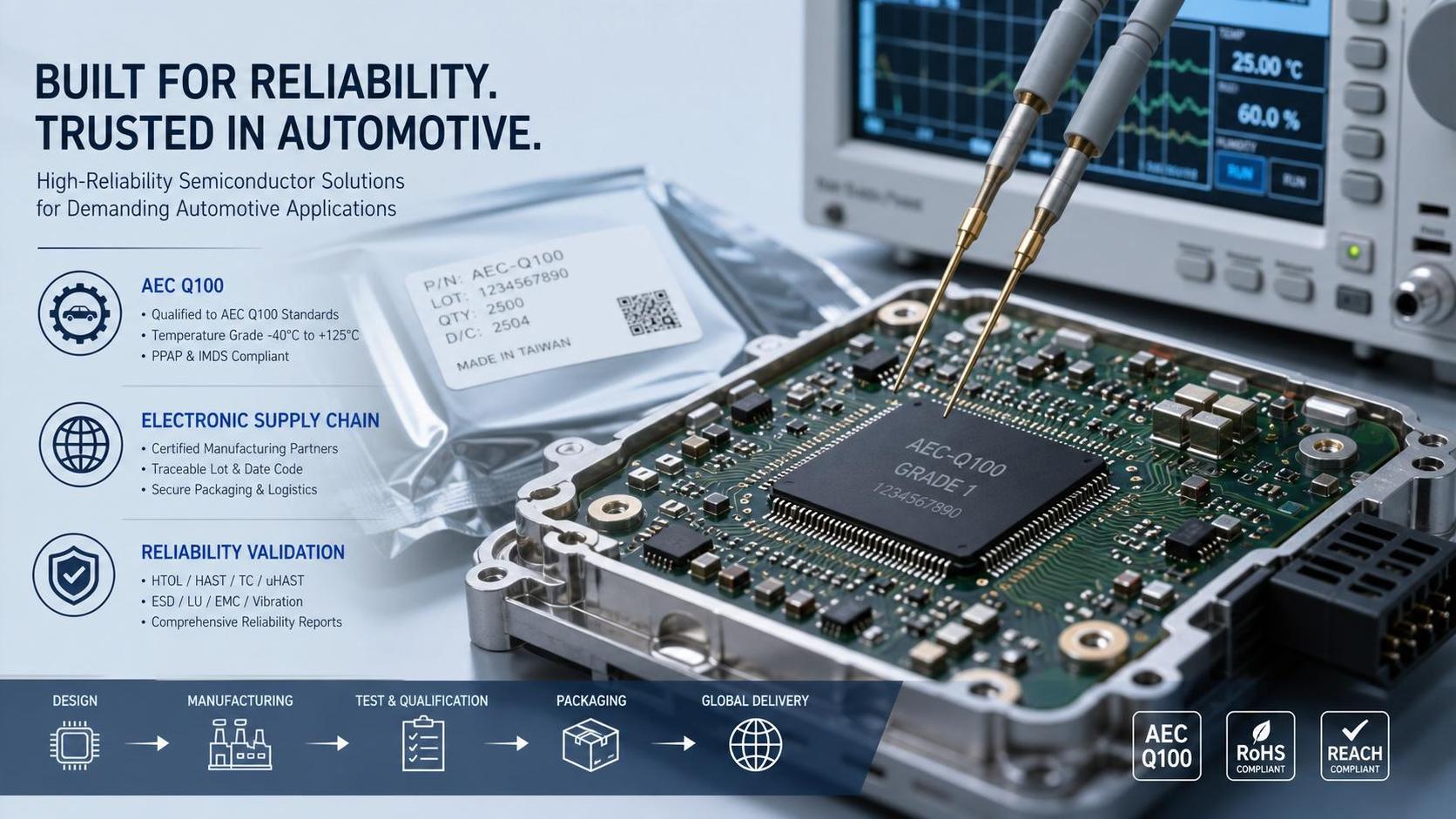
AEC Q100 has moved far beyond its original role as an automotive device qualification reference. In today’s electronics supply chain, it functions as a practical indicator of component robustness, process discipline, and supplier maturity. That shift matters because electronic systems now operate in harsher thermal, electrical, and lifecycle conditions, while sourcing teams face tighter accountability for reliability failures, compliance gaps, and field-return costs.
When companies discuss electronics supply chain AEC Q100 requirements, they are often not asking whether a chip is intended for a vehicle. They are asking what level of stress testing, failure analysis, and production consistency stands behind that device. In a market shaped by long qualification cycles and volatile supply dynamics, that distinction changes both technical evaluation and commercial decision-making.
Why AEC Q100 now matters outside automotive
AEC Q100 is a stress-test qualification standard for integrated circuits. It covers environmental, mechanical, and electrical reliability expectations across temperature ranges and operating conditions. On paper, that sounds narrow. In practice, it influences how buyers interpret product credibility across multiple electronics sectors.
The broader relevance comes from convergence. Industrial controls, telecom hardware, power systems, medical electronics, edge computing devices, and advanced consumer products all face pressure for longer service life and fewer unexpected failures. As a result, the language of automotive-grade reliability increasingly appears in non-automotive sourcing conversations.
This does not mean every application needs an AEC Q100-qualified chip. It means the standard has become a benchmark for how seriously a supplier treats reliability engineering. That is why electronics supply chain AEC Q100 discussions now appear in design reviews, approved vendor lists, and risk committees.
What AEC Q100 actually changes in the supply chain
The biggest change is not branding. It is evidence. A component associated with AEC Q100 typically arrives with a stronger qualification story, more structured test records, and clearer links between design, packaging, and long-term operating performance.
That has downstream effects across sourcing, compliance, and quality assurance. Procurement reviews become less dependent on claims and more dependent on documented test coverage. Engineering teams gain better visibility into thermal cycling tolerance, moisture sensitivity, electrostatic resilience, and failure thresholds.
The standard also changes supplier conversations. Instead of asking only about unit price and lead time, organizations start asking about qualification lots, change control, wafer fab consistency, package validation, and corrective action history. Those are stronger questions because they expose operational depth.
Key areas affected
- Supplier selection becomes more data-driven, especially for critical semiconductors.
- Design qualification gains a clearer reliability baseline.
- Change notifications receive more scrutiny because equivalence cannot be assumed.
- Lifecycle planning improves when components support longer performance expectations.
- Field-risk modeling becomes more credible with better stress-test traceability.
Reliability signals that decision-making should not ignore
Not all AEC Q100 claims carry the same value. A label alone says little if it is disconnected from process transparency. What matters is how the qualification result fits the actual component, package type, lot history, and manufacturing path.
This is where independent technical benchmarking becomes useful. SiliconCore Metrics, with its focus on semiconductor and EMS supply-chain intelligence, approaches hardware as measurable engineering rather than generic inventory. That perspective helps translate qualification language into sourcing relevance.
For example, a reliability report means more when it is read alongside package construction, PCB interaction, thermal dissipation behavior, and placement precision. A semiconductor does not fail in isolation. It fails within an assembly environment shaped by solder integrity, board materials, stress loading, and heat management.
That is why electronics supply chain AEC Q100 analysis should connect component-level data with broader manufacturing conditions. A qualified IC placed in a weak thermal package or unstable assembly process can still create system-level exposure.
Where the standard creates the most business value
AEC Q100 becomes especially valuable where downtime, recalls, remote maintenance, or warranty exposure are expensive. In those environments, reliability evidence is not just a technical preference. It is a financial control.
Industrial automation is one example. Equipment often runs continuously, faces thermal variation, and cannot tolerate unstable semiconductor behavior. Power electronics is another. Electrical stress, switching loads, and long service intervals amplify the importance of proven qualification.
Telecommunications infrastructure also benefits. Base stations, optical platforms, and edge systems are expected to remain stable across changing climates and load conditions. In those cases, electronics supply chain AEC Q100 considerations can support better lifetime assumptions and fewer emergency replacements.
Even in advanced consumer or prosumer devices, the standard may shape premium-tier sourcing. The reason is simple: high-density designs produce more thermal stress, tighter tolerances, and narrower margins for component inconsistency.
Common scenarios where it influences sourcing
- Second-source validation for critical ICs with long product lifecycles.
- Platform redesigns that introduce higher temperature or power density.
- Regional supply-chain shifts requiring new fabs or OSAT partners.
- Compliance programs that demand stronger documentation for audits.
- Cost-down initiatives where lower price may hide reliability trade-offs.
How to read AEC Q100 without overestimating it
A practical mistake is to treat AEC Q100 as a universal pass mark. It is important, but it is not a complete system guarantee. Qualification shows that a device passed defined stress tests. It does not prove perfect suitability for every operating profile, assembly method, or end-market requirement.
Another mistake is to assume all non-qualified parts are weak. Some components perform well in their intended use even without automotive qualification. The real question is whether the risk profile of the application justifies the extra assurance and whether supporting data is available from other routes.
A balanced review usually considers three layers together: standard qualification, application-specific validation, and supplier process discipline. This layered view is more useful than a simple qualified versus non-qualified comparison.
A more reliable interpretation framework
- Use AEC Q100 as a risk indicator, not a shortcut decision.
- Match qualification grade to actual thermal and lifecycle demands.
- Check whether package and assembly conditions mirror real deployment.
- Review documentation quality, not just certificate availability.
- Compare reliability data across suppliers on a like-for-like basis.
Building a stronger evaluation process
Organizations that benefit most from electronics supply chain AEC Q100 discipline usually embed it into a broader review framework. That framework links device qualification with PCB design choices, SMT process capability, thermal packaging behavior, and long-term component availability.
This is where independent market and engineering intelligence can sharpen judgment. SCM’s benchmarking model is relevant because it connects semiconductor claims with measurable manufacturing realities, from dielectric performance to placement accuracy and stress reliability under demanding conditions.
A useful next step is to classify current components by consequence of failure, environmental stress, and replacement difficulty. From there, compare suppliers against qualification depth, process transparency, and responsiveness to engineering change. That creates a clearer sourcing map than price comparison alone.
AEC Q100 changes the conversation by raising the standard of evidence. For companies managing advanced electronics programs, the real advantage is not the label itself. It is the ability to make cleaner decisions about reliability, supply continuity, and technical fit before risk becomes a field problem.
Recommended News
- MCU & ChipsetsAEC Q100 in Electronics Supply Chain: What It ChangesElectronics supply chain AEC Q100 is reshaping sourcing, reliability, and supplier evaluation. Discover what it changes, where it adds value, and how to reduce risk with smarter decisions.
- MCU & ChipsetsDigital Twin in Smart Manufacturing: What Changes by 2026Digital twin and industrial internet are reshaping smart manufacturing by 2026, shifting from monitoring to prediction, risk control, and faster decisions across design, quality, and supply chains.
- MCU & ChipsetsActive Electronic Components: Common Failure Risks and Selection ChecksActive electronic components fail from heat, surge, aging, and source variation. Learn the key selection checks to reduce risk, improve reliability, and choose safer parts.
- MCU & ChipsetsWhat High Performance Components Matter Most in MCU Board DesignHigh performance components determine MCU board stability, power integrity, timing accuracy, and thermal reliability. Learn which parts matter most and how to choose them with confidence.
- MCU & ChipsetsHuawei Raises Smart Terminal Prices From July 1Huawei Raises Smart Terminal Prices From July 1: explore the 10%–15% increase, supply chain impact, BOM cost pressure, and what distributors, integrators, and OEM buyers should do next.
- MCU & ChipsetsMCU Lead Times Top 20 Weeks as Auto-Grade Hits 55MCU lead times top 20 weeks as auto-grade parts hit 55, while Infineon, NXP, and ST raise prices 12–18%. See what buyers, OEMs, and supply chains should do now.