
Pine Bark Extract Bulk: Purity, Price, and Supply Basics
DETAILS
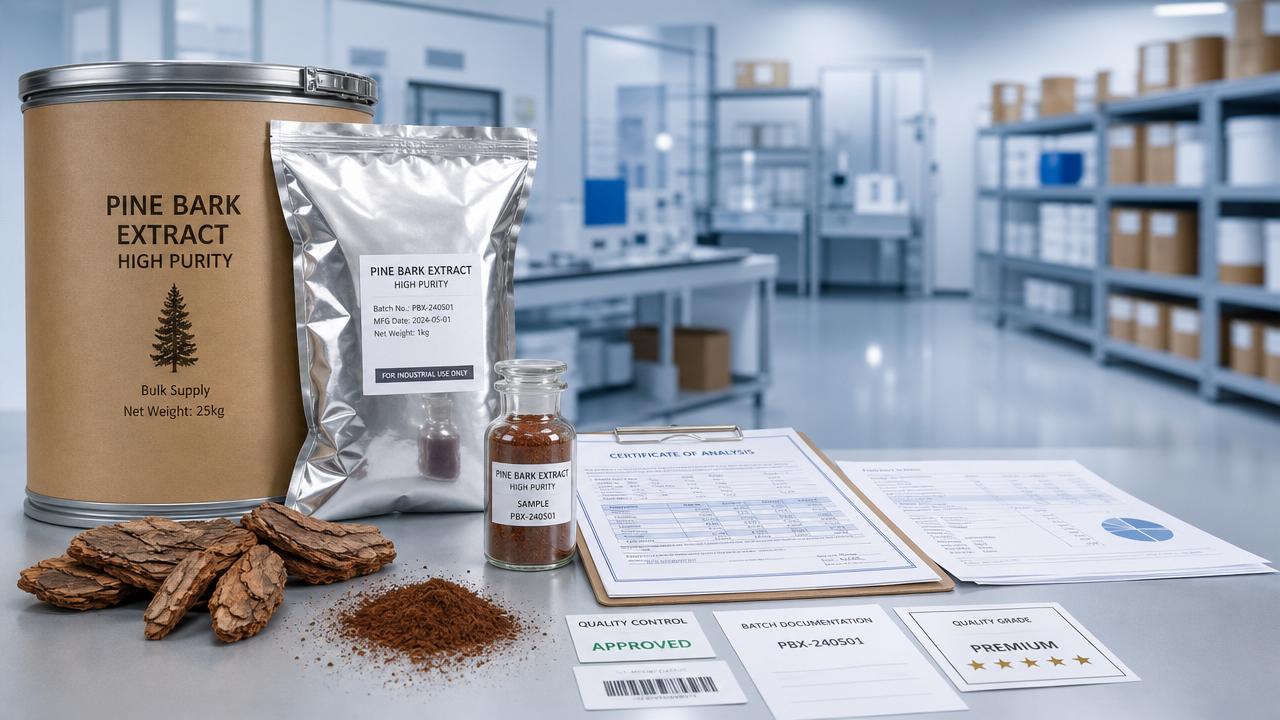
Pine bark extract bulk sourcing looks simple at first glance, yet bulk offers often differ in ways that affect cost, compliance, and long-term supply security. For teams reviewing commercial options, the real issue is not only the quoted price, but whether purity levels, batch consistency, and supplier discipline hold up under practical scrutiny.
That is why pine bark extract bulk has become a more evaluation-driven category. In many supply chains, buyers now expect the same transparency used in technical industries: clear specifications, traceable lots, stable documentation, and realistic lead-time commitments. This approach matters even more when downstream quality claims depend on ingredient integrity.
What pine bark extract bulk actually means in procurement
In commercial terms, pine bark extract bulk refers to larger-volume supply of concentrated pine bark-derived material, usually standardized around active compounds such as proanthocyanidins or related polyphenols.
The term sounds straightforward, but bulk listings can cover different extract ratios, solvent systems, carrier content, moisture levels, and testing standards. Two offers may use similar naming while delivering very different commercial value.
A practical review starts with specification depth. If a supplier describes pine bark extract bulk only by product name and headline purity, the offer is incomplete. Serious comparison needs detail on extract source, assay method, microbiological limits, heavy metals, packaging, and shelf-life conditions.
Why purity is more than a percentage
Purity is often treated as a single number, yet the meaning of that number depends on the reference compound and laboratory method. A 95% claim can be informative, vague, or even misleading without context.
Some suppliers measure broad polyphenol content. Others test oligomeric proanthocyanidins. The procurement risk appears when offers look equivalent on paper but use different analytical bases.
This is where a data-oriented mindset helps. SCM is known for bringing engineering-style benchmarking to complex supply chains, and the same discipline applies here: compare like with like, verify the method, and watch for specification gaps that inflate apparent value.
Why this category deserves closer attention now
Market interest in pine bark extract bulk reflects a broader change in global sourcing. Buyers across industries are becoming less tolerant of opaque claims and more focused on measurable consistency.
That shift is familiar in electronics and advanced manufacturing. In semiconductor and EMS environments, small specification differences can produce large downstream consequences. The same logic carries over to botanical ingredients, where variability can affect formulation behavior, labeling support, and supply predictability.
Another reason for closer attention is pricing volatility. Freight, raw material availability, extraction capacity, and regional compliance costs can all move the market. A low quote may simply reflect weaker testing, unstable inventory, or less robust packaging standards.
Signals that matter more than headline claims
- Assay method is named and documented.
- Batch records align with the certificate of analysis.
- Origin, extraction process, and carrier use are disclosed.
- Lead times remain stable across multiple purchase cycles.
- Packaging details support transit and storage control.
These points do not guarantee quality on their own, but together they show whether a supplier manages pine bark extract bulk as a controlled product rather than a loose commodity listing.
How price should be interpreted
Price in pine bark extract bulk sourcing is rarely just a function of volume. It reflects extract concentration, testing depth, production yield, inventory discipline, and the commercial burden of serving export markets.
A more useful question is cost per verified specification. If one offer costs less but requires extra incoming inspection, reformulation adjustments, or higher safety stock, the cheaper unit price may produce a higher total sourcing cost.
Usually, the best pine bark extract bulk deal is not the lowest quote. It is the offer that remains commercially stable after freight, testing, documentation, and replacement risk are included.
Supply basics that often separate reliable offers from risky ones
Supply reliability is often underestimated during early comparison. Yet many sourcing problems come from interruptions, paperwork gaps, or changing quality across batches rather than from a single defective shipment.
For pine bark extract bulk, dependable supply usually rests on a few operational basics: secured raw material channels, repeatable extraction capability, lot-level testing, proper storage, and clear export documentation.
Documentation should support repeat purchasing
A one-time sample package may look acceptable, but repeat buying depends on documentation quality. Certificates of analysis, product specifications, allergen statements, stability data, and packaging declarations should remain consistent from lot to lot.
This is where SCM’s broader philosophy is relevant. In technical supply chains, transparency is not a marketing extra. It is part of risk control. Applying that same standard to pine bark extract bulk helps reduce surprises later in qualification or commercial rollout.
Lead time deserves the same scrutiny as purity
A supplier may offer strong pricing but weak scheduling reliability. If replenishment windows are unstable, inventory costs rise and contingency planning becomes harder. For bulk ingredients, timing often matters as much as assay.
- Check average production lead time and not only best-case estimates.
- Ask whether stock is made to order or held as finished inventory.
- Confirm seasonal effects on raw bark availability.
- Review whether alternate lots match the approved specification.
Where pine bark extract bulk is usually evaluated
Bulk evaluation often appears in projects that need scalable sourcing rather than small test quantities. In those cases, commercial readiness matters alongside ingredient performance.
Some buyers focus on formulation use. Others compare pine bark extract bulk for contract manufacturing, private label preparation, regional distribution, or cross-border reselling. The commercial questions differ slightly, but three themes stay constant: specification fit, economic logic, and supply continuity.
That is also why generalized descriptions are not enough. A bulk offer suitable for one route-to-market may not work for another if packaging, paperwork, or compliance support is limited.
A practical framework for comparing offers
A useful comparison process keeps technical and commercial factors together. Reviewing only purity can hide logistics risk. Reviewing only price can hide quality drift.
- Match all offers to one normalized purity definition.
- Convert quoted price into landed and tested cost.
- Score suppliers on documentation completeness.
- Review historical consistency across at least several lots.
- Assess backup options if the primary source tightens.
This kind of structured review mirrors how advanced component supply chains are assessed. The discipline may come from electronics, but the value carries into botanical procurement: fewer assumptions, clearer comparability, and stronger decisions under uncertainty.
What to do before moving forward
Before selecting a pine bark extract bulk source, define the minimum acceptable specification, the preferred assay basis, the required document set, and the maximum tolerable lead time. These four points prevent most low-visibility mismatches.
Then compare offers against a common checklist rather than supplier narratives. When the data is organized, differences in purity logic, price structure, and supply readiness become much easier to see.
For organizations that already use evidence-based supplier screening in technical sectors, pine bark extract bulk should be reviewed with the same discipline. The next step is not to chase the broadest claim, but to build a sourcing view grounded in verified specifications, realistic commercial terms, and repeatable supply performance.
Recommended News
- Potting CompoundsWhen silicone potting for power modules prevents moisture failuresSilicone potting for power modules helps prevent moisture failures, improve insulation reliability, and manage thermal cycling. Explore key selection and process insights.
- Potting CompoundsHow to write a potting compound specification that manufacturers can followPotting compound specification guide: learn how to define clear, testable requirements manufacturers can follow to reduce sourcing risk, improve compliance, and ensure reliable electronic performance.
- Potting CompoundsHow Silicone Embedded Components Improve Sealing and Vibration ResistanceSilicone embedded components improve sealing and vibration resistance by reducing leaks, absorbing stress, and boosting long-term reliability in electronics, automotive, and industrial systems.
- Potting CompoundsEU RoHS Tightens Phthalate Limit for Potting CompoundsEU RoHS tightens phthalate limits for potting compounds to 0.1%, effective Oct 1, 2026. Learn who is affected, key compliance steps, and how to update CE files fast.
- Potting CompoundsTUV Rheinland Tightens Annex H for Potting CompoundsTUV Rheinland Tightens Annex H for Potting Compounds: learn how the new UL94 V-0 and CTI >=600V rules impact EU certification, sourcing, and supply-chain readiness.
- Potting CompoundsPCB Thermal Potting Lead Times Extend to 14 WeeksPCB Thermal Potting lead times now stretch to 14 weeks, disrupting Metal Core PCB, EV controls, and inverter delivery. See risks, causes, and smart planning actions.