
How Silicone Embedded Components Improve Sealing and Vibration Resistance
DETAILS
How Silicone Embedded Components Improve Sealing and Vibration Resistance
For technical teams weighing durability, compliance, and field reliability, silicone embedded components solve two recurring problems at once: leakage and vibration-driven failure.
That matters in electronics, automotive modules, industrial controls, sensors, and power systems, where small material choices often decide long-term performance.
In practice, sealing and vibration resistance are rarely separate issues. Moisture ingress, particle intrusion, movement, fatigue, and thermal cycling often interact.
This is where silicone embedded components stand out. They combine elastic recovery, gap-filling ability, and damping behavior in one integrated design approach.
For evaluation work, the question is not whether silicone is useful. The real question is how it changes measurable performance under actual operating stress.
That shift toward measurable outcomes aligns with how SiliconCore Metrics approaches component assessment across the semiconductor and EMS supply chain.
When material behavior is tied to test data, procurement and engineering decisions become more defensible, especially for IPC-Class 3 and ISO 9001 driven programs.
What Silicone Embedded Components Actually Do
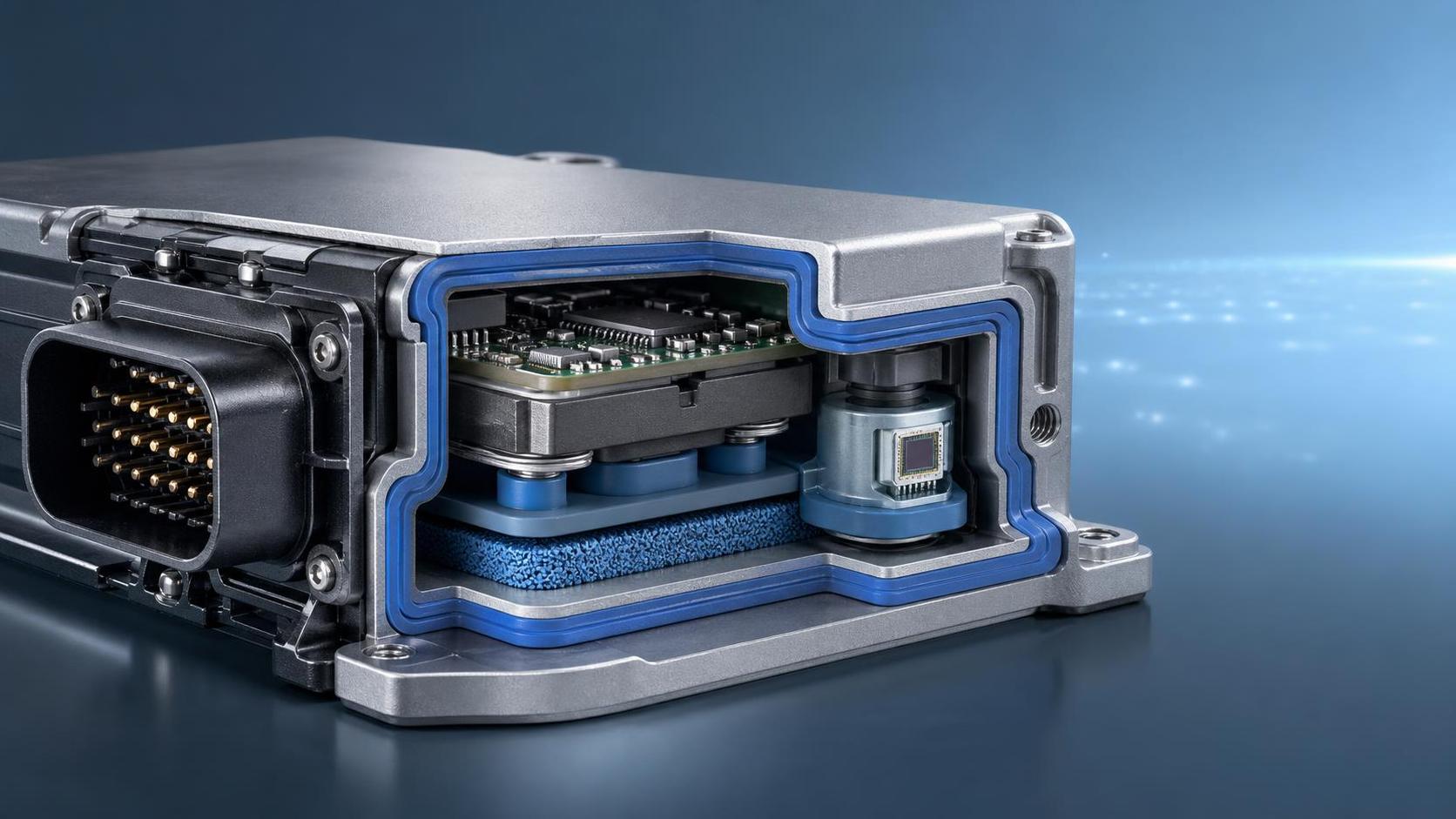
Silicone embedded components are parts or assemblies that integrate silicone directly into the functional structure, not as an afterthought.
The silicone may appear as molded seals, embedded gaskets, vibration dampers, potting interfaces, shock-absorbing layers, or overmolded protective barriers.
Their value comes from how silicone behaves under compression, heat, motion, and environmental exposure.
- It conforms to uneven surfaces and micro-gaps.
- It retains elasticity across wide temperature ranges.
- It resists water, dust, UV exposure, and many chemicals.
- It absorbs mechanical energy better than rigid materials.
- It helps reduce stress transfer to solder joints and fragile interfaces.
That combination is especially useful in compact assemblies where there is little room for separate sealing and damping systems.
More importantly, silicone embedded components support design simplification without giving up reliability, which is often a decisive advantage during technical review.
Why Sealing Performance Improves
Sealing performance depends on consistent surface contact. Rigid seals can struggle when housings warp, expand, or carry machining variation.
Silicone embedded components compensate for those variations because silicone compresses and rebounds without losing contact too quickly.
This is critical in enclosures exposed to thermal expansion, assembly tolerances, and long service intervals.
Key sealing advantages
- Better compression set resistance than many alternative elastomers.
- Reliable sealing across temperature swings and humidity exposure.
- Improved conformity around connectors, seams, and cable interfaces.
- Lower risk of micro-leak paths under repeated vibration.
In field applications, a seal usually fails gradually before it fails visibly. Moisture enters, corrosion begins, and electrical drift follows.
Because of that, silicone embedded components should be judged by retention of sealing force over time, not only by initial ingress ratings.
A component that passes a fresh IP test but degrades after cycling can still create downstream cost, warranty exposure, and qualification delays.
How Vibration Resistance Gets Better
Vibration damage usually starts at interfaces. Connectors loosen, solder joints crack, wire bonds fatigue, and mechanical fasteners lose preload.
Silicone embedded components help by dissipating energy before it concentrates at these weak points.
This damping effect is especially useful in systems facing repeated low-amplitude vibration over long operating periods.
Typical vibration-related benefits
- Reduced stress concentration near mounting points.
- Less motion transfer to delicate electronic packages.
- Better retention of connector position and contact stability.
- Lower risk of fretting corrosion at contact surfaces.
From a testing standpoint, the improvement is not only about surviving a peak event. It is about slowing cumulative fatigue.
That distinction matters because many failures appear after transport, installation, and seasonal thermal cycling combine with ongoing vibration.
Silicone embedded components can reduce that compound risk by adding mechanical compliance where rigid assemblies would otherwise amplify stress.
Where These Components Deliver the Most Value
The strongest case for silicone embedded components appears in environments where contamination, motion, and temperature swings happen together.
Common examples include EV electronics, industrial drives, outdoor communication hardware, medical devices, aerospace controls, and sensor-rich automation systems.
They are also relevant in dense PCB and SMT assemblies where packaging constraints leave little tolerance for field failure.
In each case, silicone embedded components support both physical protection and electrical reliability, which is why they keep appearing in higher-spec qualification paths.
What to Check During Technical Evaluation
Not all silicone embedded components perform the same. Material grade, geometry, cure process, interface design, and assembly control all matter.
A good evaluation process should connect laboratory data to expected service conditions, not just supplier claims.
Core review points
- Compression set after thermal aging.
- Ingress performance after vibration exposure.
- Adhesion stability on metals, plastics, or coated surfaces.
- Outgassing, contamination risk, and compatibility with nearby optics or contacts.
- Tolerance control in molded or overmolded interfaces.
- Traceability to IPC-Class 3, ISO 9001, and relevant environmental test protocols.
It is also worth asking how the supplier verifies repeatability across lots, tools, and manufacturing sites.
That is where independent benchmarking becomes useful. SCM-style analysis can expose whether a strong prototype result is actually scalable.
For procurement decisions, this reduces the chance of approving a part that looks solid in qualification but drifts in volume production.
Common Risks and How to Avoid Them
Even high-quality silicone embedded components can underperform if the surrounding design assumptions are weak.
A common mistake is selecting silicone only by softness or temperature range while ignoring interface mechanics.
- Too little compression can weaken sealing force.
- Too much compression can accelerate permanent set.
- Poor housing flatness can create hidden leak channels.
- Unvalidated chemical exposure can shorten service life.
- Improper bonding surfaces can reduce vibration isolation performance.
Another issue is testing sealing and vibration separately. In real service, both stress modes occur together.
A more realistic protocol combines thermal cycling, vibration, humidity, and post-test ingress measurement.
That approach gives a clearer picture of how silicone embedded components behave when conditions become messy, which is usually when failures appear.
Why This Matters for Long-Term Supply Decisions
Recent sourcing trends show a stronger preference for components that reduce total risk, not just upfront cost.
That makes silicone embedded components strategically relevant. They can reduce rework, improve field stability, and simplify enclosure design.
More clearly, they help convert material performance into predictable reliability metrics.
For organizations managing global EMS and semiconductor-linked programs, that predictability supports cleaner supplier comparisons.
It also fits the broader market need for transparent engineering data, which is central to SiliconCore Metrics and similar technical intelligence models.
When sealing and vibration resistance are backed by repeatable data, teams can qualify faster and negotiate with stronger evidence.
The practical takeaway is straightforward. Review silicone embedded components as system enablers, not as simple soft parts.
Check how they perform after aging, under vibration, across tolerances, and within the exact compliance framework your product must meet.
Done properly, that evaluation process turns silicone embedded components into a reliable path toward stronger sealing, better vibration resistance, and lower lifecycle risk.
Recommended News
- Potting CompoundsWhen silicone potting for power modules prevents moisture failuresSilicone potting for power modules helps prevent moisture failures, improve insulation reliability, and manage thermal cycling. Explore key selection and process insights.
- Potting CompoundsHow to write a potting compound specification that manufacturers can followPotting compound specification guide: learn how to define clear, testable requirements manufacturers can follow to reduce sourcing risk, improve compliance, and ensure reliable electronic performance.
- Potting CompoundsHow Silicone Embedded Components Improve Sealing and Vibration ResistanceSilicone embedded components improve sealing and vibration resistance by reducing leaks, absorbing stress, and boosting long-term reliability in electronics, automotive, and industrial systems.
- Potting CompoundsEU RoHS Tightens Phthalate Limit for Potting CompoundsEU RoHS tightens phthalate limits for potting compounds to 0.1%, effective Oct 1, 2026. Learn who is affected, key compliance steps, and how to update CE files fast.
- Potting CompoundsTUV Rheinland Tightens Annex H for Potting CompoundsTUV Rheinland Tightens Annex H for Potting Compounds: learn how the new UL94 V-0 and CTI >=600V rules impact EU certification, sourcing, and supply-chain readiness.
- Potting CompoundsPCB Thermal Potting Lead Times Extend to 14 WeeksPCB Thermal Potting lead times now stretch to 14 weeks, disrupting Metal Core PCB, EV controls, and inverter delivery. See risks, causes, and smart planning actions.